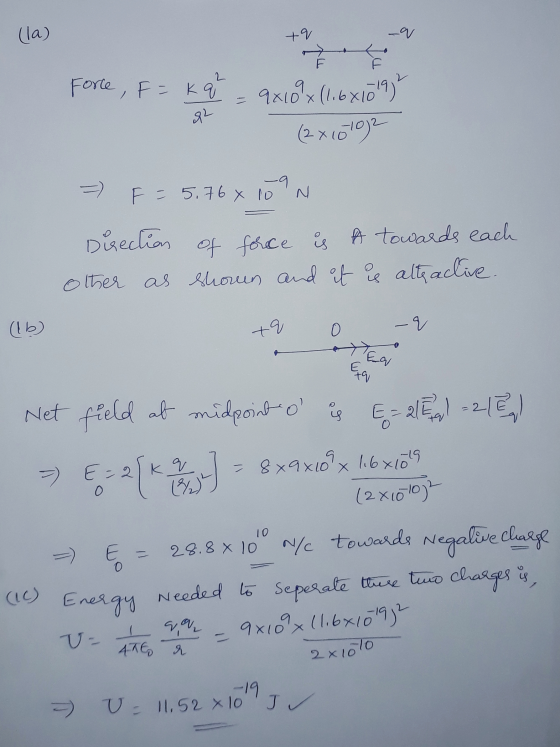
A particular electric dipole consists of a proton of charge of 1.6x10⁻¹⁹ Coulomb and an electron...
A particular electric dipole consists of a proton of charge of
1.6x10⁻¹⁹ Coulomb
and an electron of charge of -1.6x10⁻¹⁹ Coulomb, separated by
2x10⁻¹⁰[m] = 0.2[nm].
1a. What’s the electrostatic force between the charges (magnitude
and direction), and
why?
1b. What’s the electric field magnitude and direction at a point
halfway between the two
charges, and why?
1c. How much energy (in electron Volts OR in Joules) is needed
to separate these two
charges?
1d. If these two charges “fell into” that dipole state from
widely separate locations,
emitting the excess energy above in the form of a single photon,
what’s the frequency of
the emitted photon?
1e. Given the frequency of this photon, what’s its wavelength
and is it in the visible,
infrared, or ultraviolet?
Homework Answers
Add Answer to:
A particular electric dipole consists of a proton of charge of
1.6x10⁻¹⁹ Coulomb
and an electron...
1. An electron (q = -1.6x10⁻¹⁹ C, m=9.11x10⁻³¹ kg) is placed in an electric field of...
1. An electron (q = -1.6x10⁻¹⁹ C, m=9.11x10⁻³¹ kg) is placed in an electric field of magnitude 3.52x10⁴N/C which points in the positive z direction. Calculate the magnitude and direction of the acceleration of the electron. 2. An electron is initially moving in the +z direction, with a speed v=2.54x10⁵ m/s at z=0. In the region between z=+1.50 cm and z=+2.50 cm, there is a uniform electric field of magnitude 4.10x10⁴ N/C in the +x direction. Outside that region (z...
A particular organic molecule forms an electric dipole by possessing an effective charge separation of 0.193...
 A particular organic molecule forms an electric dipole by possessing an effective charge separation of 0.193 nm for a pair of +1.60 x 10¹⁹-C charges. What is the magnitude of the molecule's electric dipole moment? Number C m Find the magnitude of the torque that acts on the molecule when it is immersed in a uniform electric field of 3.77 x10⁵ N/C with its electric dipole vector at an angle of 58.5° from the direction of the field. Number N....
charges move in an electric field due to the Coulomb force. Some unknowns charge moves in...
 charges move in an electric field due to the Coulomb force.
Some unknowns charge moves in a direction perpendicular to the
direction of the electric field
TakeTutorialA Home Student: amaile7 Esam 1 PRACTICE Begin Date: 3/19/2019 1201.00 AM-Due Date: 3/20/2019 11 59.00 PM End Date: 3/20/2019 11 59.00 PM a3%) Problem 2: Charges move in an electric field due to the Coulomb force. moves in a direction perpendicular to the direction of the electric field lines. We can conctade that...
charges move in an electric field due to the Coulomb force.
Some unknowns charge moves in a direction perpendicular to the
direction of the electric field
TakeTutorialA Home Student: amaile7 Esam 1 PRACTICE Begin Date: 3/19/2019 1201.00 AM-Due Date: 3/20/2019 11 59.00 PM End Date: 3/20/2019 11 59.00 PM a3%) Problem 2: Charges move in an electric field due to the Coulomb force. moves in a direction perpendicular to the direction of the electric field lines. We can conctade that...
1. Suppose that two point charges, each with a charge of +1 Coulomb are separated by...
1. Suppose that two point charges, each with a charge of +1 Coulomb are separated by a distance of 1 meter. (a) Will they attract or repel? _______________(b) Determine the magnitude of the electrical force between them. 2. Two balloons are charged with an identical quantity and type of charge: -0.0025 C. They are held apart at a separation distance of 8 m. Determine the magnitude of the electrical force of repulsion between them. 3. Two charged boxes are 4...
An electron (mass 9.11×10^-31 kg, charge -1.602×10^ -19 C)is placed in a uniform electric field, E=5000N/C....
An electron (mass 9.11×10^-31 kg, charge -1.602×10^ -19 C)is placed in a uniform electric field, E=5000N/C. A) what is the change in electric potential if the election moves 1cm in the direction of the electric field? B)What is the change in electric potential energy if the electron moves 1 cm in the direction of the electric field?C) What is the change in electric potential if the election is 1 cm perpendicular to the electric field?D) What is the change in...
An electron (mass 9.11×10^-31 kg, charge -1.602×10^ -19 C)is placed in a uniform electric field, E=5000N/C....
An electron (mass 9.11×10^-31 kg, charge -1.602×10^ -19 C)is placed in a uniform electric field, E=5000N/C. A) what is the change in electric potential if the election moves 1cm in the direction of the electric field? B)What is the change in electric potential energy if the electron moves 1 cm in the direction of the electric field?C) What is the change in electric potential if the election is 1 cm perpendicular to the electric field?D) What is the change in...
oblem 2 A vacuum-tube diode consists of two concentric cylindrical electrodes of opposite charge. The electric...
 oblem 2 A vacuum-tube diode consists of two concentric cylindrical electrodes of opposite charge. The electric potential between the electrodes is given by V(x)Cxa where x is in meters and C is a constant. Let the distance between the electrodes equal 13.0 mm and their potential difference equal 240 V. (a) Calculate the value for C. 7.85x10 V/m3 (b) Derive and expression for the electric field between the electrodes as a function of x. [Answer not given.) (c) Determine the...
Problem 2 A vacuum-tube diode consists of two concentric cylindrical electrodes of opposite charge. The electric...
 Problem 2 A vacuum-tube diode consists of two concentric cylindrical electrodes of opposite charge. The electric potential between the electrodes is given by V(x)C/ where x is in meters and C'is a constant. Let the distance between the electrode equal 13.0 mm and their potential difference equal 240 V (a) Calculate the value for C. 7.85x10 V/m b) Derive and expression for the electric field between the electrodes as a function of x. [Answer not given. (c) Determine the magnitude...
Need all answers please A proton has a positive electric charge e = 1.609 times 10^-19...
 Need all answers please
A proton has a positive electric charge e = 1.609 times 10^-19 C. What is the electric potential energy of an electron (charge -e) at a point 5.29 times 10^-11 m from the proton? For simplicity, use k = 9.00 times 10^9 Nm^2/C^2. Three charges are spaced along the positive x axis at 1.0 cm intervals, beginning at the origin. Starting with the charge at the origin, the charges have values -4.2 mu C, + 1.3...
Need all answers please
A proton has a positive electric charge e = 1.609 times 10^-19 C. What is the electric potential energy of an electron (charge -e) at a point 5.29 times 10^-11 m from the proton? For simplicity, use k = 9.00 times 10^9 Nm^2/C^2. Three charges are spaced along the positive x axis at 1.0 cm intervals, beginning at the origin. Starting with the charge at the origin, the charges have values -4.2 mu C, + 1.3...
2. Electric field a) (5 pts) Which direction will a proton (charge = 1.6 x 10⁻¹⁹...
 2. Electric field a) (5 pts) Which direction will a proton (charge = 1.6 x 10⁻¹⁹ C) move if it is released from points C, D, and E shown in the figure below? Draw an arrow at each of the points. At which of these points the electron will have maximum acceleration (magnitude)? с 6 cm 450 45° - 10 με 12 cm + 10 uc 6 cm 6 cm E B D A Page 1 of 3
 A particular organic molecule forms an electric dipole by possessing an effective charge separation of 0.193 nm for a pair of +1.60 x 10¹⁹-C charges. What is the magnitude of the molecule's electric dipole moment? Number C m Find the magnitude of the torque that acts on the molecule when it is immersed in a uniform electric field of 3.77 x10⁵ N/C with its electric dipole vector at an angle of 58.5° from the direction of the field. Number N....
 charges move in an electric field due to the Coulomb force.
Some unknowns charge moves in a direction perpendicular to the
direction of the electric field
TakeTutorialA Home Student: amaile7 Esam 1 PRACTICE Begin Date: 3/19/2019 1201.00 AM-Due Date: 3/20/2019 11 59.00 PM End Date: 3/20/2019 11 59.00 PM a3%) Problem 2: Charges move in an electric field due to the Coulomb force. moves in a direction perpendicular to the direction of the electric field lines. We can conctade that...
charges move in an electric field due to the Coulomb force.
Some unknowns charge moves in a direction perpendicular to the
direction of the electric field
TakeTutorialA Home Student: amaile7 Esam 1 PRACTICE Begin Date: 3/19/2019 1201.00 AM-Due Date: 3/20/2019 11 59.00 PM End Date: 3/20/2019 11 59.00 PM a3%) Problem 2: Charges move in an electric field due to the Coulomb force. moves in a direction perpendicular to the direction of the electric field lines. We can conctade that...
 oblem 2 A vacuum-tube diode consists of two concentric cylindrical electrodes of opposite charge. The electric potential between the electrodes is given by V(x)Cxa where x is in meters and C is a constant. Let the distance between the electrodes equal 13.0 mm and their potential difference equal 240 V. (a) Calculate the value for C. 7.85x10 V/m3 (b) Derive and expression for the electric field between the electrodes as a function of x. [Answer not given.) (c) Determine the...
 Problem 2 A vacuum-tube diode consists of two concentric cylindrical electrodes of opposite charge. The electric potential between the electrodes is given by V(x)C/ where x is in meters and C'is a constant. Let the distance between the electrode equal 13.0 mm and their potential difference equal 240 V (a) Calculate the value for C. 7.85x10 V/m b) Derive and expression for the electric field between the electrodes as a function of x. [Answer not given. (c) Determine the magnitude...
 Need all answers please
A proton has a positive electric charge e = 1.609 times 10^-19 C. What is the electric potential energy of an electron (charge -e) at a point 5.29 times 10^-11 m from the proton? For simplicity, use k = 9.00 times 10^9 Nm^2/C^2. Three charges are spaced along the positive x axis at 1.0 cm intervals, beginning at the origin. Starting with the charge at the origin, the charges have values -4.2 mu C, + 1.3...
Need all answers please
A proton has a positive electric charge e = 1.609 times 10^-19 C. What is the electric potential energy of an electron (charge -e) at a point 5.29 times 10^-11 m from the proton? For simplicity, use k = 9.00 times 10^9 Nm^2/C^2. Three charges are spaced along the positive x axis at 1.0 cm intervals, beginning at the origin. Starting with the charge at the origin, the charges have values -4.2 mu C, + 1.3...
 2. Electric field a) (5 pts) Which direction will a proton (charge = 1.6 x 10⁻¹⁹ C) move if it is released from points C, D, and E shown in the figure below? Draw an arrow at each of the points. At which of these points the electron will have maximum acceleration (magnitude)? с 6 cm 450 45° - 10 με 12 cm + 10 uc 6 cm 6 cm E B D A Page 1 of 3
Most questions answered within 3 hours.
-
Where is the error in this code sequence?
String s1 = "Hello";
String s2 = "ello";...
asked 11 months ago -
Financial data for Joel de Paris, Inc., for last year
follow:
Joel de Paris, Inc.
Balance...
asked 11 months ago -
Consider this reaction:
Al2(SO4)3 (aq)+ BaCl3
(aq) Al2Cl6 (aq)- +
3BaSO4(s) . What is the...
asked 11 months ago -
Suppose that Savneet is considering increasing her
recent random sample from 20 car rentals to 40...
asked 11 months ago -
Trucks arrive at an unloading terminal at an average rate of 120
per hour.
Trucks arrive...
asked 11 months ago -
Why are methanol and ethanol completely soluble in water while
octanol is not very little soluble....
asked 11 months ago -
A facilities manager at a university reads in a research report
that the mean amount of...
asked 11 months ago -
When the CuSO4 is rehydrated by adding water to the anhydrous
compound, is this an endothermic...
asked 11 months ago -
A ray of sunlight is passing from diamond into crown glass; the
angle of incidence is...
asked 11 months ago -
A block of mass 0.249 kg is placed on top of a light, vertical
spring of...
asked 11 months ago -
how do the kidneys compensate in the presences of acidosis
a) trigger hyperventilate
b) reserve acid...
asked 11 months ago -
Question 501 pts
The rental rate of capital to the firm increases. Which of the
following...
asked 11 months ago