![(1) Suppose that f is continuous on la, b) except for at yi and y2. Prove that if eb for all continuous functions g : [a,b] →](http://img.homeworklib.com/questions/0766f740-3c44-11ec-a90e-6f3cd1ce1e8e.png?x-oss-process=image/resize,w_560)
Homework Answers
Let ![x_0\in [a,b]\setminus \{y_1,y_2\}](http://img.homeworklib.com/questions/4f4ad1b0-3c44-11ec-8d57-f9e415434e50.png?x-oss-process=image/resize,w_560) . We claim that
. We claim that  .
.
Suppose this is not the case, and let  . Because
, continuity at this point implies there is some
. Because
, continuity at this point implies there is some  such
that
such
that ![(x_0-\delta,x_0+\delta)\subseteq [a,b]\setminus \{y_1,y_2\}](http://img.homeworklib.com/questions/51682880-3c44-11ec-bd13-9b68396ed3db.png?x-oss-process=image/resize,w_560) or
or ![(x_0-\delta,x_0]\subseteq [a,b]\setminus \{y_1,y_2\}](http://img.homeworklib.com/questions/51ca5910-3c44-11ec-a1ab-1bb241a5d8b6.png?x-oss-process=image/resize,w_560) or
or  , and calling this neighborhood as
  , we see that for all
 , we have

Let ![g:[a,b]\rightarrow\mathbb R](http://img.homeworklib.com/questions/5398b5f0-3c44-11ec-8f01-61cb2e5362a6.png?x-oss-process=image/resize,w_560) be defined as follows:
be defined as follows:
![ує [a, b] \ {yi,Y2} f(y) for](http://img.homeworklib.com/questions/53f8d930-3c44-11ec-8b53-03478576082e.png?x-oss-process=image/resize,w_560)
where one or both the limits has to be considered one-sided
limit if the points happen to be  . Note that the
limits exist by continuity of
. Note that the
limits exist by continuity of  .
.
Now, this function
is continuous by definition and continuity of in ![[a,b]\setminus \{y_1,y_2\}](http://img.homeworklib.com/questions/55c64200-3c44-11ec-9ff9-d57fdec451d3.png?x-oss-process=image/resize,w_560) ; we also have
; we also have
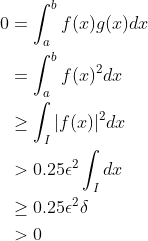
which is absurd. Thus, our assumption that  must
be false. This proves the claim.
must
be false. This proves the claim.
Now, we have shown that  for all
. Since is not continuous at
for all
. Since is not continuous at
 and
continuous everywhere else in
and
continuous everywhere else in ![[a,b]](http://img.homeworklib.com/questions/588037c0-3c44-11ec-866b-cd6cc1d25549.png?x-oss-process=image/resize,w_560) , we must
have
, we must
have

Add Answer to:
(1) Suppose that f is continuous on la, b) except for at yi and y2. Prove...
S f(r)da= g(x)dz. Prove a,bsuch that (8) Suppose f and g are continuous functions on that...
 S f(r)da= g(x)dz. Prove a,bsuch that (8) Suppose f and g are continuous functions on that there is ro e (a, b) such that f(ro) = g(xo). (9) Prove that if the function f is continuous on a, b, then there is c E [a, b such that f(x)dax a Ja f(e)
S f(r)da= g(x)dz. Prove a,bsuch that (8) Suppose f and g are continuous functions on that there is ro e (a, b) such that f(ro) = g(xo). (9)...
S f(r)da= g(x)dz. Prove a,bsuch that (8) Suppose f and g are continuous functions on that there is ro e (a, b) such that f(ro) = g(xo). (9) Prove that if the function f is continuous on a, b, then there is c E [a, b such that f(x)dax a Ja f(e)
S f(r)da= g(x)dz. Prove a,bsuch that (8) Suppose f and g are continuous functions on that there is ro e (a, b) such that f(ro) = g(xo). (9)...
8. Suppose f : la,b] → R is monotone increasing. Prove that f is integrable. Of course you may no...
 8. Suppose f : la,b] → R is monotone increasing. Prove that f is integrable. Of course you may not use the theorem that monotone functions are integrable!
8. Suppose f : la,b] → R is monotone increasing. Prove that f is integrable. Of course you may not use the theorem that monotone functions are integrable!
8. Suppose f : la,b] → R is monotone increasing. Prove that f is integrable. Of course you may not use the theorem that monotone functions are integrable!
9. Suppose that f is bounded on [a, b], and f is continuous at each point...
 9. Suppose that f is bounded on [a, b], and f is continuous at each point of la, b] except for .in (a,b). Prove that f is integrable on [a, b).
3. Let f, g : a, bl → R be functions such that f is integrable, g is continuous. and g(x) >0 for ...
 3. Let f, g : a, bl → R be functions such that f is integrable, g is continuous. and g(x) >0 for al x E [a, b]. Since both f,g are bounded, let K> 0 be such that f(x)| 〈 K and g(x)-K for all x E la,b] (a) Let η 〉 0 be given. Prove that there is a partition P of a,b] such that for all i (b) Let P be a partition as in (a). Prove...
Integral: If you know all about it you should be easy to prove..... Let f:[a,b]→R and...
Integral: If you know all about it you should be easy to prove..... Let f:[a,b]→R and g:[a,b]→R be two bounded functions. Suppose f≤g on [a,b]. Use the information to prove thatL(f)≤L(g)andU(f)≤U(g). Information: g : [0, 1] —> R be defined by if x=0, g(x)=1; if x=m/n (m and n are positive integer with no common factor), g(x)=1/n; if x doesn't belong to rational number, g(x)=0 g is discontinuous at every rational number in[0,1]. g is Riemann integrable on [0,1] based...
1) Suppose f (a, b) R is continuous. The Carathéodory Theorem says that f(x) is differentiable at -cE (a, b) if 3 (a, b)-R which is continuous, and so that, (a) Show, for any constant a and conti...
 1) Suppose f (a, b) R is continuous. The Carathéodory Theorem says that f(x) is differentiable at -cE (a, b) if 3 (a, b)-R which is continuous, and so that, (a) Show, for any constant a and continuous function (x), that af(x) is continuous at z-c by finding a Carathéodory function Paf(x). (b) Show, for any constants a, B, that if g : (a, b) -R is differentiable at c, with Carathéodory function pg(z), then the linear combination of functions,...
1. Suppose m,b,c E R. Prove: f(1) = mx + b is continuous at c. 2....
 1. Suppose m,b,c E R. Prove: f(1) = mx + b is continuous at c. 2. Prove: f(x) = x3 is continuous at 5.
3. Continuous dynamical systems - Dimension 2 (a) Suppose the ODE system describes a continuous dynamical...
 3. Continuous dynamical systems - Dimension 2 (a) Suppose the ODE system describes a continuous dynamical system in two dimensions (here f: R2 + R and g: R² R are two functions with smooth partial derivatives). Draw the corresponding vector field in the case that f(x,y) = x2 - y2 8(x, y) = x+y+1 and argue that (x,y) = R2 such that f(x,y) = g(x,y) = 0 are fixed points of the dynamical system above.
Suppose f is a continuous on R and f(x + y) = f(x) + f(y) for...
 Suppose f is a continuous on R and f(x + y) = f(x) + f(y) for
all
x, y ∈ R. Prove that for some constant a ∈ R, f(x) = ax.
Suppose f is a continuous on R and f(x + y) = f(x) + f(y) for all X, Y E R. Prove that for some constant a ER, f(x) = ax.
Suppose f is a continuous on R and f(x + y) = f(x) + f(y) for
all
x, y ∈ R. Prove that for some constant a ∈ R, f(x) = ax.
Suppose f is a continuous on R and f(x + y) = f(x) + f(y) for all X, Y E R. Prove that for some constant a ER, f(x) = ax.
3. Let f, g : a, b] → R be functions such that f is integrable, g is continuous. and g(x) 〉 0 fo...
 3. Let f, g : a, b] → R be functions such that f is integrable, g is continuous. and g(x) 〉 0 for all x є a,b]. Since both f, g are bounded, let K 〉 0 be such that |f(x) K and g(x) < K for all x E [a,b (a) Let n > 0 be given. Prove that there is a partition P of [a, b such that for all i 2. (b) Let P be a...
 S f(r)da= g(x)dz. Prove a,bsuch that (8) Suppose f and g are continuous functions on that there is ro e (a, b) such that f(ro) = g(xo). (9) Prove that if the function f is continuous on a, b, then there is c E [a, b such that f(x)dax a Ja f(e)
S f(r)da= g(x)dz. Prove a,bsuch that (8) Suppose f and g are continuous functions on that there is ro e (a, b) such that f(ro) = g(xo). (9)...
S f(r)da= g(x)dz. Prove a,bsuch that (8) Suppose f and g are continuous functions on that there is ro e (a, b) such that f(ro) = g(xo). (9) Prove that if the function f is continuous on a, b, then there is c E [a, b such that f(x)dax a Ja f(e)
S f(r)da= g(x)dz. Prove a,bsuch that (8) Suppose f and g are continuous functions on that there is ro e (a, b) such that f(ro) = g(xo). (9)...
 8. Suppose f : la,b] → R is monotone increasing. Prove that f is integrable. Of course you may not use the theorem that monotone functions are integrable!
8. Suppose f : la,b] → R is monotone increasing. Prove that f is integrable. Of course you may not use the theorem that monotone functions are integrable!
8. Suppose f : la,b] → R is monotone increasing. Prove that f is integrable. Of course you may not use the theorem that monotone functions are integrable!
 9. Suppose that f is bounded on [a, b], and f is continuous at each point of la, b] except for .in (a,b). Prove that f is integrable on [a, b).
 3. Let f, g : a, bl → R be functions such that f is integrable, g is continuous. and g(x) >0 for al x E [a, b]. Since both f,g are bounded, let K> 0 be such that f(x)| 〈 K and g(x)-K for all x E la,b] (a) Let η 〉 0 be given. Prove that there is a partition P of a,b] such that for all i (b) Let P be a partition as in (a). Prove...
 1) Suppose f (a, b) R is continuous. The Carathéodory Theorem says that f(x) is differentiable at -cE (a, b) if 3 (a, b)-R which is continuous, and so that, (a) Show, for any constant a and continuous function (x), that af(x) is continuous at z-c by finding a Carathéodory function Paf(x). (b) Show, for any constants a, B, that if g : (a, b) -R is differentiable at c, with Carathéodory function pg(z), then the linear combination of functions,...
 1. Suppose m,b,c E R. Prove: f(1) = mx + b is continuous at c. 2. Prove: f(x) = x3 is continuous at 5.
 3. Continuous dynamical systems - Dimension 2 (a) Suppose the ODE system describes a continuous dynamical system in two dimensions (here f: R2 + R and g: R² R are two functions with smooth partial derivatives). Draw the corresponding vector field in the case that f(x,y) = x2 - y2 8(x, y) = x+y+1 and argue that (x,y) = R2 such that f(x,y) = g(x,y) = 0 are fixed points of the dynamical system above.
 Suppose f is a continuous on R and f(x + y) = f(x) + f(y) for
all
x, y ∈ R. Prove that for some constant a ∈ R, f(x) = ax.
Suppose f is a continuous on R and f(x + y) = f(x) + f(y) for all X, Y E R. Prove that for some constant a ER, f(x) = ax.
Suppose f is a continuous on R and f(x + y) = f(x) + f(y) for
all
x, y ∈ R. Prove that for some constant a ∈ R, f(x) = ax.
Suppose f is a continuous on R and f(x + y) = f(x) + f(y) for all X, Y E R. Prove that for some constant a ER, f(x) = ax.
 3. Let f, g : a, b] → R be functions such that f is integrable, g is continuous. and g(x) 〉 0 for all x є a,b]. Since both f, g are bounded, let K 〉 0 be such that |f(x) K and g(x) < K for all x E [a,b (a) Let n > 0 be given. Prove that there is a partition P of [a, b such that for all i 2. (b) Let P be a...
Most questions answered within 3 hours.
-
Where is the error in this code sequence?
String s1 = "Hello";
String s2 = "ello";...
asked 10 months ago -
Financial data for Joel de Paris, Inc., for last year
follow:
Joel de Paris, Inc.
Balance...
asked 10 months ago -
Consider this reaction:
Al2(SO4)3 (aq)+ BaCl3
(aq) Al2Cl6 (aq)- +
3BaSO4(s) . What is the...
asked 10 months ago -
Suppose that Savneet is considering increasing her
recent random sample from 20 car rentals to 40...
asked 10 months ago -
Trucks arrive at an unloading terminal at an average rate of 120
per hour.
Trucks arrive...
asked 10 months ago -
Why are methanol and ethanol completely soluble in water while
octanol is not very little soluble....
asked 10 months ago -
A facilities manager at a university reads in a research report
that the mean amount of...
asked 10 months ago -
When the CuSO4 is rehydrated by adding water to the anhydrous
compound, is this an endothermic...
asked 10 months ago -
A ray of sunlight is passing from diamond into crown glass; the
angle of incidence is...
asked 10 months ago -
A block of mass 0.249 kg is placed on top of a light, vertical
spring of...
asked 10 months ago -
how do the kidneys compensate in the presences of acidosis
a) trigger hyperventilate
b) reserve acid...
asked 10 months ago -
Question 501 pts
The rental rate of capital to the firm increases. Which of the
following...
asked 10 months ago