Math
Convert the boundary value problem y y 0, y y (0) 1, (1) 0, into an integral equation.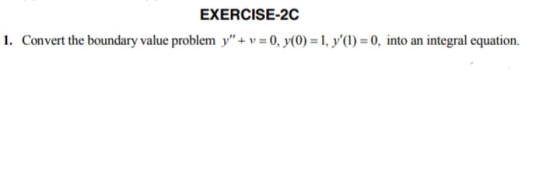
Homework Answers
Request Answer!
We need at least 1 more requests to produce the answer.
9 / 10 have requested this problem solution
The more requests, the faster the answer.
Question 24 1 pts Using the shooting method for the following second-order differential equation governing the...
 Question 24 1 pts Using the shooting method for the following second-order differential equation governing the boundary value problem G.E: + EA (x) +u = L (x) € (0,L] B.C's: u () = 0 and EA (2) de Iz-L=F, the trapezoidal method is used to converts the problem into coupled integral equations solved at the quadrature points. None of the above. finite differences are used to convert the governing equation and boundary conditions of the problem into an analog set...
I really need help with this math problem I really need help with this math problem!! can someone...
 I really need help with this math problem
!! can
someone help me
termine whether n; n 1,2,3,...are the positive eigenvalues of y" 2y 0 where y(O) (1) 0. Do this by finding the nonzero solutions (eigenfunctions) the equation would have is these were eigenvalues. Otherwise state "these are not eigenvalues of the equation". Hint: start with the general solution of the equation, y = A cosmrx + B sin nte Are there...
I really need help with this math problem
I really need help with this math problem!! can
someone help me
termine whether n; n 1,2,3,...are the positive eigenvalues of y" 2y 0 where y(O) (1) 0. Do this by finding the nonzero solutions (eigenfunctions) the equation would have is these were eigenvalues. Otherwise state "these are not eigenvalues of the equation". Hint: start with the general solution of the equation, y = A cosmrx + B sin nte Are there...
(1 point) a. Consider the differential equation: d2y 0.16y-0 dt2 with initial conditions dt (0)-3 y(0)--1 and Find the...
 (1 point) a. Consider the differential equation: d2y 0.16y-0 dt2 with initial conditions dt (0)-3 y(0)--1 and Find the solution to this initial value problem b. Assume the same second order differential equation as Part a. However, consider it is subject to the following boundary conditions: y(0)-2 and y(3)-7 Find the solution to this boundary value problem. If there is no solution, then write NO SOLUTION. If there are infinitely many solutions, then use C as your arbitrary constant (e.g....
Consider the 1D wave equation Ye = a?yrz (1) with boundary conditions y(x 0,t) 0; y(x...
 Consider the 1D wave equation Ye = a?yrz (1) with boundary conditions y(x 0,t) 0; y(x = L, t) = 0; y(r, t = 0) - f(x); y(r,t 0) 0. (2) Use separation of variables to convert the PDE into 2 ODEs. Clearly state the boundary conditions for the 2 ODEs
Consider the 1D wave equation Ye = a?yrz (1) with boundary conditions y(x 0,t) 0; y(x = L, t) = 0; y(r, t = 0) - f(x); y(r,t 0)...
Consider the 1D wave equation Ye = a?yrz (1) with boundary conditions y(x 0,t) 0; y(x = L, t) = 0; y(r, t = 0) - f(x); y(r,t 0) 0. (2) Use separation of variables to convert the PDE into 2 ODEs. Clearly state the boundary conditions for the 2 ODEs
Consider the 1D wave equation Ye = a?yrz (1) with boundary conditions y(x 0,t) 0; y(x = L, t) = 0; y(r, t = 0) - f(x); y(r,t 0)...
3. This question is about non-homogeneous boundary conditions (a) Consider Laplace's equation on a rectangle, with...
 3. This question is about non-homogeneous boundary conditions (a) Consider Laplace's equation on a rectangle, with fully inhomogeneous boundary conditions =0 0 a, 0< y <b u(x, 0) fi() u(, b) f2(a) u(0, y)g (x) ua, y) = 92(r) 0 ra Homogenise the boundary conditions to convert the problem to one of the form 2 F(x, y) 0 xa,0 y < b + (x, 0)= fi() b(x, b) f2(x) b(0, y)0 (a, y) = 0 0y b 0 y sb...
Project. Solve the boundary-value problem: y(1)0 10 Verify that your solution y(x) satisfies the ...
 Project. Solve the boundary-value problem: y(1)0 10 Verify that your solution y(x) satisfies the differential equation at every point in (-1,1). Is y twice differentiable at all points in (-1,1)1?
Project. Solve the boundary-value problem: y(1)0 10 Verify that your solution y(x) satisfies the differential equation at every point in (-1,1). Is y twice differentiable at all points in (-1,1)1?
Project. Solve the boundary-value problem: y(1)0 10 Verify that your solution y(x) satisfies the differential equation at every point in (-1,1). Is y twice differentiable at all points in (-1,1)1?
3. Green's function for a stretched string. Integrate twice to find the solution of the two-point...
 3. Green's function for a stretched string. Integrate twice to find the solution of the two-point boundary value problem d2y dr.2=f(x), 0<エ<1, y(0) = y(1)=0 in the form 0 Verify that if you differentiate twice under the integral sign and use the jump conditions at ξ you recover the original problem.
3. Green's function for a stretched string. Integrate twice to find the solution of the two-point boundary value problem d2y dr.2=f(x), 0
3. Green's function for a stretched string. Integrate twice to find the solution of the two-point boundary value problem d2y dr.2=f(x), 0<エ<1, y(0) = y(1)=0 in the form 0 Verify that if you differentiate twice under the integral sign and use the jump conditions at ξ you recover the original problem.
3. Green's function for a stretched string. Integrate twice to find the solution of the two-point boundary value problem d2y dr.2=f(x), 0
answer in matlab code Employ the bvp4c command to find the approximate solution of the boundary value problem governed by the second-order nonhomogeneous differential equation, 9. with the bound...
 answer in matlab code
Employ the bvp4c command to find the approximate solution of the boundary value problem governed by the second-order nonhomogeneous differential equation, 9. with the boundary conditions of y(0) 5 and y(1)-2. Plot to compare the approximate solution with the exact solution obtained by using the dsolve command.
Employ the bvp4c command to find the approximate solution of the boundary value problem governed by the second-order nonhomogeneous differential equation, 9. with the boundary conditions of y(0) 5...
answer in matlab code
Employ the bvp4c command to find the approximate solution of the boundary value problem governed by the second-order nonhomogeneous differential equation, 9. with the boundary conditions of y(0) 5 and y(1)-2. Plot to compare the approximate solution with the exact solution obtained by using the dsolve command.
Employ the bvp4c command to find the approximate solution of the boundary value problem governed by the second-order nonhomogeneous differential equation, 9. with the boundary conditions of y(0) 5...
2. For a boundary layer flow with U suction velocity Vo (0 is introduced at the...
 2. For a boundary layer flow with U suction velocity Vo (0 is introduced at the wall to delay flow separation. (a) By integrating the boundary layer equations from porous wall across the boundary layer, show that the integral momentum equation is given by -constant over a porous plate as shown in Figure 1, a Ou where τνν-μ w- 1 оу y-o and (b) obtain the integral energy equation. (c) Perform the dimensionless analysis on the integral equations and discuss...
III condition tl (0,2)-Sill utO, (2e) (6) Write down the solutions to the following initial-bound...
 #6-#8
III condition tl (0,2)-Sill utO, (2e) (6) Write down the solutions to the following initial-boundary value problem for the wave equation in the form of a Fourier series: utt = uzz, u(t, 0) = u(t,r) = 0, u(0,x) = sni, ut (0,z) = 0. (7) Solve the following boundary value problem for Laplace's equation on the square u(z,0) = 0, u(z,r) = sin3 x, u(0,y) = 0, u(my) = 0. (8) Solve the following boundary value problem ,u=
III...
#6-#8
III condition tl (0,2)-Sill utO, (2e) (6) Write down the solutions to the following initial-boundary value problem for the wave equation in the form of a Fourier series: utt = uzz, u(t, 0) = u(t,r) = 0, u(0,x) = sni, ut (0,z) = 0. (7) Solve the following boundary value problem for Laplace's equation on the square u(z,0) = 0, u(z,r) = sin3 x, u(0,y) = 0, u(my) = 0. (8) Solve the following boundary value problem ,u=
III...
 Question 24 1 pts Using the shooting method for the following second-order differential equation governing the boundary value problem G.E: + EA (x) +u = L (x) € (0,L] B.C's: u () = 0 and EA (2) de Iz-L=F, the trapezoidal method is used to converts the problem into coupled integral equations solved at the quadrature points. None of the above. finite differences are used to convert the governing equation and boundary conditions of the problem into an analog set...
 I really need help with this math problem
!! can
someone help me
termine whether n; n 1,2,3,...are the positive eigenvalues of y" 2y 0 where y(O) (1) 0. Do this by finding the nonzero solutions (eigenfunctions) the equation would have is these were eigenvalues. Otherwise state "these are not eigenvalues of the equation". Hint: start with the general solution of the equation, y = A cosmrx + B sin nte Are there...
I really need help with this math problem
I really need help with this math problem!! can
someone help me
termine whether n; n 1,2,3,...are the positive eigenvalues of y" 2y 0 where y(O) (1) 0. Do this by finding the nonzero solutions (eigenfunctions) the equation would have is these were eigenvalues. Otherwise state "these are not eigenvalues of the equation". Hint: start with the general solution of the equation, y = A cosmrx + B sin nte Are there...
 (1 point) a. Consider the differential equation: d2y 0.16y-0 dt2 with initial conditions dt (0)-3 y(0)--1 and Find the solution to this initial value problem b. Assume the same second order differential equation as Part a. However, consider it is subject to the following boundary conditions: y(0)-2 and y(3)-7 Find the solution to this boundary value problem. If there is no solution, then write NO SOLUTION. If there are infinitely many solutions, then use C as your arbitrary constant (e.g....
 Consider the 1D wave equation Ye = a?yrz (1) with boundary conditions y(x 0,t) 0; y(x = L, t) = 0; y(r, t = 0) - f(x); y(r,t 0) 0. (2) Use separation of variables to convert the PDE into 2 ODEs. Clearly state the boundary conditions for the 2 ODEs
Consider the 1D wave equation Ye = a?yrz (1) with boundary conditions y(x 0,t) 0; y(x = L, t) = 0; y(r, t = 0) - f(x); y(r,t 0)...
Consider the 1D wave equation Ye = a?yrz (1) with boundary conditions y(x 0,t) 0; y(x = L, t) = 0; y(r, t = 0) - f(x); y(r,t 0) 0. (2) Use separation of variables to convert the PDE into 2 ODEs. Clearly state the boundary conditions for the 2 ODEs
Consider the 1D wave equation Ye = a?yrz (1) with boundary conditions y(x 0,t) 0; y(x = L, t) = 0; y(r, t = 0) - f(x); y(r,t 0)...
 3. This question is about non-homogeneous boundary conditions (a) Consider Laplace's equation on a rectangle, with fully inhomogeneous boundary conditions =0 0 a, 0< y <b u(x, 0) fi() u(, b) f2(a) u(0, y)g (x) ua, y) = 92(r) 0 ra Homogenise the boundary conditions to convert the problem to one of the form 2 F(x, y) 0 xa,0 y < b + (x, 0)= fi() b(x, b) f2(x) b(0, y)0 (a, y) = 0 0y b 0 y sb...
 Project. Solve the boundary-value problem: y(1)0 10 Verify that your solution y(x) satisfies the differential equation at every point in (-1,1). Is y twice differentiable at all points in (-1,1)1?
Project. Solve the boundary-value problem: y(1)0 10 Verify that your solution y(x) satisfies the differential equation at every point in (-1,1). Is y twice differentiable at all points in (-1,1)1?
Project. Solve the boundary-value problem: y(1)0 10 Verify that your solution y(x) satisfies the differential equation at every point in (-1,1). Is y twice differentiable at all points in (-1,1)1?
 3. Green's function for a stretched string. Integrate twice to find the solution of the two-point boundary value problem d2y dr.2=f(x), 0<エ<1, y(0) = y(1)=0 in the form 0 Verify that if you differentiate twice under the integral sign and use the jump conditions at ξ you recover the original problem.
3. Green's function for a stretched string. Integrate twice to find the solution of the two-point boundary value problem d2y dr.2=f(x), 0
3. Green's function for a stretched string. Integrate twice to find the solution of the two-point boundary value problem d2y dr.2=f(x), 0<エ<1, y(0) = y(1)=0 in the form 0 Verify that if you differentiate twice under the integral sign and use the jump conditions at ξ you recover the original problem.
3. Green's function for a stretched string. Integrate twice to find the solution of the two-point boundary value problem d2y dr.2=f(x), 0
 answer in matlab code
Employ the bvp4c command to find the approximate solution of the boundary value problem governed by the second-order nonhomogeneous differential equation, 9. with the boundary conditions of y(0) 5 and y(1)-2. Plot to compare the approximate solution with the exact solution obtained by using the dsolve command.
Employ the bvp4c command to find the approximate solution of the boundary value problem governed by the second-order nonhomogeneous differential equation, 9. with the boundary conditions of y(0) 5...
answer in matlab code
Employ the bvp4c command to find the approximate solution of the boundary value problem governed by the second-order nonhomogeneous differential equation, 9. with the boundary conditions of y(0) 5 and y(1)-2. Plot to compare the approximate solution with the exact solution obtained by using the dsolve command.
Employ the bvp4c command to find the approximate solution of the boundary value problem governed by the second-order nonhomogeneous differential equation, 9. with the boundary conditions of y(0) 5...
 2. For a boundary layer flow with U suction velocity Vo (0 is introduced at the wall to delay flow separation. (a) By integrating the boundary layer equations from porous wall across the boundary layer, show that the integral momentum equation is given by -constant over a porous plate as shown in Figure 1, a Ou where τνν-μ w- 1 оу y-o and (b) obtain the integral energy equation. (c) Perform the dimensionless analysis on the integral equations and discuss...
 #6-#8
III condition tl (0,2)-Sill utO, (2e) (6) Write down the solutions to the following initial-boundary value problem for the wave equation in the form of a Fourier series: utt = uzz, u(t, 0) = u(t,r) = 0, u(0,x) = sni, ut (0,z) = 0. (7) Solve the following boundary value problem for Laplace's equation on the square u(z,0) = 0, u(z,r) = sin3 x, u(0,y) = 0, u(my) = 0. (8) Solve the following boundary value problem ,u=
III...
#6-#8
III condition tl (0,2)-Sill utO, (2e) (6) Write down the solutions to the following initial-boundary value problem for the wave equation in the form of a Fourier series: utt = uzz, u(t, 0) = u(t,r) = 0, u(0,x) = sni, ut (0,z) = 0. (7) Solve the following boundary value problem for Laplace's equation on the square u(z,0) = 0, u(z,r) = sin3 x, u(0,y) = 0, u(my) = 0. (8) Solve the following boundary value problem ,u=
III...
Most questions answered within 3 hours.
-
Where is the error in this code sequence?
String s1 = "Hello";
String s2 = "ello";...
asked 10 months ago -
Financial data for Joel de Paris, Inc., for last year
follow:
Joel de Paris, Inc.
Balance...
asked 10 months ago -
Consider this reaction:
Al2(SO4)3 (aq)+ BaCl3
(aq) Al2Cl6 (aq)- +
3BaSO4(s) . What is the...
asked 10 months ago -
Suppose that Savneet is considering increasing her
recent random sample from 20 car rentals to 40...
asked 10 months ago -
Trucks arrive at an unloading terminal at an average rate of 120
per hour.
Trucks arrive...
asked 10 months ago -
Why are methanol and ethanol completely soluble in water while
octanol is not very little soluble....
asked 10 months ago -
A facilities manager at a university reads in a research report
that the mean amount of...
asked 10 months ago -
When the CuSO4 is rehydrated by adding water to the anhydrous
compound, is this an endothermic...
asked 10 months ago -
A ray of sunlight is passing from diamond into crown glass; the
angle of incidence is...
asked 10 months ago -
A block of mass 0.249 kg is placed on top of a light, vertical
spring of...
asked 10 months ago -
how do the kidneys compensate in the presences of acidosis
a) trigger hyperventilate
b) reserve acid...
asked 10 months ago -
Question 501 pts
The rental rate of capital to the firm increases. Which of the
following...
asked 10 months ago