
Homework Answers
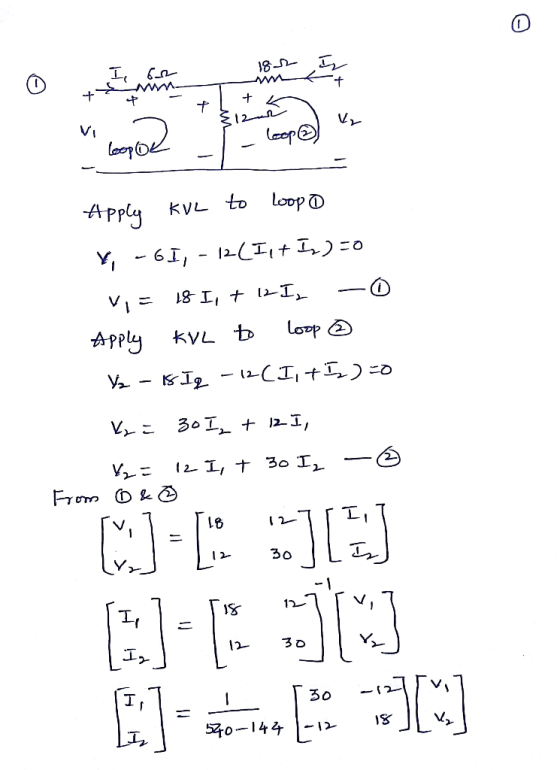
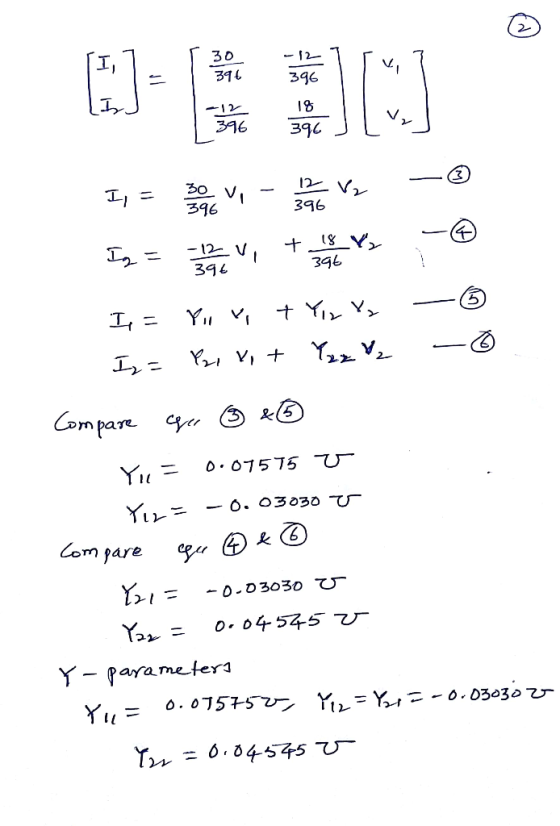
By using KVL and Y parameters equations we get the solution for first problem.
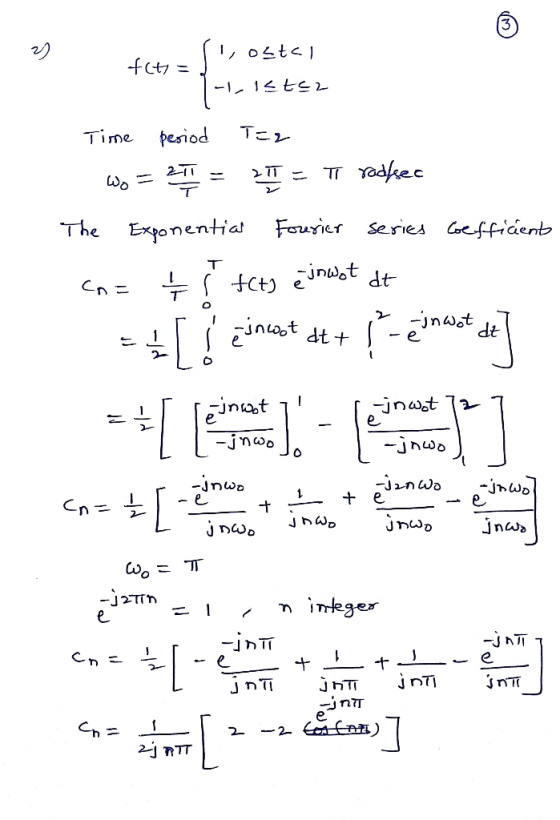
By using the Exponential Fourier Series analysis equation we get the solution for second problem.
![so= unite [ -einn] ® cos [l-ent], nto - 20 = + {fcu dt = [[[idt + [orde] = [ [+Jó – [+],]={[1-) =o - The Rekation between E](http://img.homeworklib.com/questions/d0c7d8a0-3d11-11ec-9d59-8d36b6f8b5f8.png?x-oss-process=image/resize,w_560)
Add Answer to:
Question 3) Obtain the Y parameters for the following T-circuit in Fig. 3. 62 182 €122...
Question 3 Fig. 3 In the circuit shown in Fig. 3, let R, = 122, R...
 Question 3 Fig. 3 In the circuit shown in Fig. 3, let R, = 122, R = 2 ks2, R, = 4 Rs = 4k92, and V=4V. Determine V. 2, R, = 2 k2,
Page 3 of 3 (5) The periodic square-wave voltage seen in Fig. 5a is applied to...
 Page 3 of 3 (5) The periodic square-wave voltage seen in Fig. 5a is applied to the circuit shown in Fig. 5b. (a) Determine the Fourier series of the periodic square-wave in Fig.5a. (b) Derive the steady-state voltage voC) as a response to the first two nonzero terms in the Fourier series that represents the v,) (20 points) v(t) 10% H 102 0 123 t (sec) -2 1 Fig. 5a Fig. 5b
Q3. Solve for vo(t) in the circuit of Fig. 3 using the Superposition 62 2H 12...
 Q3. Solve for vo(t) in the circuit of Fig. 3 using the Superposition 62 2H 12 cos 31 V + 4 sin 21 A 10 V Solution:
solve 2.40 a,b,c, e using Fourier series. 2.40 part a,b,c,e 2.40 Consider the continuous-time signals depicted in Fig. P2.40. Evaluate the following convolution integrals: (a) m(t) x(t) y(t) (...
 solve 2.40 a,b,c, e using Fourier series.
2.40 part a,b,c,e 2.40 Consider the continuous-time signals depicted in Fig. P2.40. Evaluate the following convolution integrals: (a) m(t) x(t) y(t) (b) m(t)x(t)z(t) (c) m(t) x(t) ft) (d) m(t) x(t) a(t) (e) m(t)y(t) z(t) (f) m(t) -y(t) w(t) (g) m(t) y(t)g(t) (h) m(t)y(t) c(t) (i) m(t) z(t) f(t) (j) m(t) z(t) g(t) (k) m(t) z(t)b(t) (1) m(t) w(t) g(t) (m) m(t) w(t) a(t) (n) m(t) f(t) g(t (o) m(t) fo) . do) (p)...
solve 2.40 a,b,c, e using Fourier series.
2.40 part a,b,c,e 2.40 Consider the continuous-time signals depicted in Fig. P2.40. Evaluate the following convolution integrals: (a) m(t) x(t) y(t) (b) m(t)x(t)z(t) (c) m(t) x(t) ft) (d) m(t) x(t) a(t) (e) m(t)y(t) z(t) (f) m(t) -y(t) w(t) (g) m(t) y(t)g(t) (h) m(t)y(t) c(t) (i) m(t) z(t) f(t) (j) m(t) z(t) g(t) (k) m(t) z(t)b(t) (1) m(t) w(t) g(t) (m) m(t) w(t) a(t) (n) m(t) f(t) g(t (o) m(t) fo) . do) (p)...
Given the waveform find the spectrum of w(t)-AX П () sin agt by using the multiplication theorem as discussed in Example 2-10 Question 9 135 marks] Question 10 Given w(t) 5+12 coswot, where fo 10...
 Given the waveform find the spectrum of w(t)-AX П () sin agt by using the multiplication theorem as discussed in Example 2-10 Question 9 135 marks] Question 10 Given w(t) 5+12 coswot, where fo 10 Hz, find [18 marks] a) Rw(r). [17 marks] Question 11 Find expressions for the complex Fourier series coefficients that represent the waveform shown in figure below x(t) 20 135 marks)
Given the waveform find the spectrum of w(t)-AX П () sin agt by using the...
Given the waveform find the spectrum of w(t)-AX П () sin agt by using the multiplication theorem as discussed in Example 2-10 Question 9 135 marks] Question 10 Given w(t) 5+12 coswot, where fo 10 Hz, find [18 marks] a) Rw(r). [17 marks] Question 11 Find expressions for the complex Fourier series coefficients that represent the waveform shown in figure below x(t) 20 135 marks)
Given the waveform find the spectrum of w(t)-AX П () sin agt by using the...
For each of the periodic signals in Fig. P3.4-3, find the exponential Fourier series and sketch the corresponding spectra. 3.5-1 4 Fig. P3.4-3 /2 1 x(t) 1/ 2 0l -2π -π 2π Fig. P3.4-4 II x(t) -2π 0l...
 For each of the periodic signals in Fig. P3.4-3, find the exponential Fourier series and sketch the corresponding spectra. 3.5-1 4 Fig. P3.4-3 /2 1 x(t) 1/ 2 0l -2π -π 2π Fig. P3.4-4 II x(t) -2π 0l t/2
For each of the periodic signals in Fig. P3.4-3, find the exponential Fourier series and sketch the corresponding spectra. 3.5-1
4 Fig. P3.4-3 /2 1 x(t) 1/ 2 0l -2π -π 2π Fig. P3.4-4 II x(t) -2π 0l t/2
For each of the periodic signals in Fig. P3.4-3, find the exponential Fourier series and sketch the corresponding spectra. 3.5-1 4 Fig. P3.4-3 /2 1 x(t) 1/ 2 0l -2π -π 2π Fig. P3.4-4 II x(t) -2π 0l t/2
For each of the periodic signals in Fig. P3.4-3, find the exponential Fourier series and sketch the corresponding spectra. 3.5-1
4 Fig. P3.4-3 /2 1 x(t) 1/ 2 0l -2π -π 2π Fig. P3.4-4 II x(t) -2π 0l t/2
a = any constant x(t) 2a a 0 0 4 5 -a Fig. 3 A periodical...
 a = any constant
x(t) 2a a 0 0 4 5 -a Fig. 3 A periodical signal 1) (20 pts.] Find the Fourier series representation of the signal shown in Fig. 3. 2) [10 pts.] Find the Fourier transform of x(t) = e-jat [u(t + a) = u(t - a)] Using the integral definition. 3) [10 pts.] Find the Fourier transform of x(t) = cos(at)[u(t+a) – u(t - a)] Using only the Fourier the transform table and properties
a = any constant
x(t) 2a a 0 0 4 5 -a Fig. 3 A periodical signal 1) (20 pts.] Find the Fourier series representation of the signal shown in Fig. 3. 2) [10 pts.] Find the Fourier transform of x(t) = e-jat [u(t + a) = u(t - a)] Using the integral definition. 3) [10 pts.] Find the Fourier transform of x(t) = cos(at)[u(t+a) – u(t - a)] Using only the Fourier the transform table and properties
For the circuit in Fig. 3.51, obtain u, and v2. 3.2 3.4 Given the circuit in...
 For the circuit in Fig. 3.51, obtain u, and v2. 3.2 3.4 Given the circuit in Fig. 3.53, calculate the currents 4 through i 20 ww ovpit 6A 14 10Ω . 4 0 50 3 A 100 40 2 20 Q 40 Q 2 A 6A Figure 3.53 Figure 3.51 For Prob. 3.2 For Prob. 3.4. ww ww-
Question 3 Please: Problem 1 is referenced below 3. Repeat problem 1 if the output y(t)...
 Question 3 Please: Problem 1 is referenced below
3. Repeat problem 1 if the output y(t) is the voltage across the resistor instead of across the capacitor and the input is as shown in Figure 3 (you can use MATLAB to find the inverse Fourier Transform). [7 points] x(1) 0.5 Figure 3 1. For the circuit shown in Figure 1, find y(t) if the input is x(t) = 5 + 7 cos(10 t) + 7sin(1000t) co y()= vc) X(t)= v(...
Question 3 Please: Problem 1 is referenced below
3. Repeat problem 1 if the output y(t) is the voltage across the resistor instead of across the capacitor and the input is as shown in Figure 3 (you can use MATLAB to find the inverse Fourier Transform). [7 points] x(1) 0.5 Figure 3 1. For the circuit shown in Figure 1, find y(t) if the input is x(t) = 5 + 7 cos(10 t) + 7sin(1000t) co y()= vc) X(t)= v(...
1) find the power of w(t) 2) find the complex fourier series of coefficient of w(t)...
 1) find the power of w(t)
2) find the complex fourier series of coefficient of
w(t)
2. (10 points) Consider the waveform shown below: w(t) 2 w t -4 -2 0 2
1) find the power of w(t)
2) find the complex fourier series of coefficient of
w(t)
2. (10 points) Consider the waveform shown below: w(t) 2 w t -4 -2 0 2
 Question 3 Fig. 3 In the circuit shown in Fig. 3, let R, = 122, R = 2 ks2, R, = 4 Rs = 4k92, and V=4V. Determine V. 2, R, = 2 k2,
 Page 3 of 3 (5) The periodic square-wave voltage seen in Fig. 5a is applied to the circuit shown in Fig. 5b. (a) Determine the Fourier series of the periodic square-wave in Fig.5a. (b) Derive the steady-state voltage voC) as a response to the first two nonzero terms in the Fourier series that represents the v,) (20 points) v(t) 10% H 102 0 123 t (sec) -2 1 Fig. 5a Fig. 5b
 Q3. Solve for vo(t) in the circuit of Fig. 3 using the Superposition 62 2H 12 cos 31 V + 4 sin 21 A 10 V Solution:
 solve 2.40 a,b,c, e using Fourier series.
2.40 part a,b,c,e 2.40 Consider the continuous-time signals depicted in Fig. P2.40. Evaluate the following convolution integrals: (a) m(t) x(t) y(t) (b) m(t)x(t)z(t) (c) m(t) x(t) ft) (d) m(t) x(t) a(t) (e) m(t)y(t) z(t) (f) m(t) -y(t) w(t) (g) m(t) y(t)g(t) (h) m(t)y(t) c(t) (i) m(t) z(t) f(t) (j) m(t) z(t) g(t) (k) m(t) z(t)b(t) (1) m(t) w(t) g(t) (m) m(t) w(t) a(t) (n) m(t) f(t) g(t (o) m(t) fo) . do) (p)...
solve 2.40 a,b,c, e using Fourier series.
2.40 part a,b,c,e 2.40 Consider the continuous-time signals depicted in Fig. P2.40. Evaluate the following convolution integrals: (a) m(t) x(t) y(t) (b) m(t)x(t)z(t) (c) m(t) x(t) ft) (d) m(t) x(t) a(t) (e) m(t)y(t) z(t) (f) m(t) -y(t) w(t) (g) m(t) y(t)g(t) (h) m(t)y(t) c(t) (i) m(t) z(t) f(t) (j) m(t) z(t) g(t) (k) m(t) z(t)b(t) (1) m(t) w(t) g(t) (m) m(t) w(t) a(t) (n) m(t) f(t) g(t (o) m(t) fo) . do) (p)...
 Given the waveform find the spectrum of w(t)-AX П () sin agt by using the multiplication theorem as discussed in Example 2-10 Question 9 135 marks] Question 10 Given w(t) 5+12 coswot, where fo 10 Hz, find [18 marks] a) Rw(r). [17 marks] Question 11 Find expressions for the complex Fourier series coefficients that represent the waveform shown in figure below x(t) 20 135 marks)
Given the waveform find the spectrum of w(t)-AX П () sin agt by using the...
Given the waveform find the spectrum of w(t)-AX П () sin agt by using the multiplication theorem as discussed in Example 2-10 Question 9 135 marks] Question 10 Given w(t) 5+12 coswot, where fo 10 Hz, find [18 marks] a) Rw(r). [17 marks] Question 11 Find expressions for the complex Fourier series coefficients that represent the waveform shown in figure below x(t) 20 135 marks)
Given the waveform find the spectrum of w(t)-AX П () sin agt by using the...
 For each of the periodic signals in Fig. P3.4-3, find the exponential Fourier series and sketch the corresponding spectra. 3.5-1 4 Fig. P3.4-3 /2 1 x(t) 1/ 2 0l -2π -π 2π Fig. P3.4-4 II x(t) -2π 0l t/2
For each of the periodic signals in Fig. P3.4-3, find the exponential Fourier series and sketch the corresponding spectra. 3.5-1
4 Fig. P3.4-3 /2 1 x(t) 1/ 2 0l -2π -π 2π Fig. P3.4-4 II x(t) -2π 0l t/2
For each of the periodic signals in Fig. P3.4-3, find the exponential Fourier series and sketch the corresponding spectra. 3.5-1 4 Fig. P3.4-3 /2 1 x(t) 1/ 2 0l -2π -π 2π Fig. P3.4-4 II x(t) -2π 0l t/2
For each of the periodic signals in Fig. P3.4-3, find the exponential Fourier series and sketch the corresponding spectra. 3.5-1
4 Fig. P3.4-3 /2 1 x(t) 1/ 2 0l -2π -π 2π Fig. P3.4-4 II x(t) -2π 0l t/2
 a = any constant
x(t) 2a a 0 0 4 5 -a Fig. 3 A periodical signal 1) (20 pts.] Find the Fourier series representation of the signal shown in Fig. 3. 2) [10 pts.] Find the Fourier transform of x(t) = e-jat [u(t + a) = u(t - a)] Using the integral definition. 3) [10 pts.] Find the Fourier transform of x(t) = cos(at)[u(t+a) – u(t - a)] Using only the Fourier the transform table and properties
a = any constant
x(t) 2a a 0 0 4 5 -a Fig. 3 A periodical signal 1) (20 pts.] Find the Fourier series representation of the signal shown in Fig. 3. 2) [10 pts.] Find the Fourier transform of x(t) = e-jat [u(t + a) = u(t - a)] Using the integral definition. 3) [10 pts.] Find the Fourier transform of x(t) = cos(at)[u(t+a) – u(t - a)] Using only the Fourier the transform table and properties
 For the circuit in Fig. 3.51, obtain u, and v2. 3.2 3.4 Given the circuit in Fig. 3.53, calculate the currents 4 through i 20 ww ovpit 6A 14 10Ω . 4 0 50 3 A 100 40 2 20 Q 40 Q 2 A 6A Figure 3.53 Figure 3.51 For Prob. 3.2 For Prob. 3.4. ww ww-
 Question 3 Please: Problem 1 is referenced below
3. Repeat problem 1 if the output y(t) is the voltage across the resistor instead of across the capacitor and the input is as shown in Figure 3 (you can use MATLAB to find the inverse Fourier Transform). [7 points] x(1) 0.5 Figure 3 1. For the circuit shown in Figure 1, find y(t) if the input is x(t) = 5 + 7 cos(10 t) + 7sin(1000t) co y()= vc) X(t)= v(...
Question 3 Please: Problem 1 is referenced below
3. Repeat problem 1 if the output y(t) is the voltage across the resistor instead of across the capacitor and the input is as shown in Figure 3 (you can use MATLAB to find the inverse Fourier Transform). [7 points] x(1) 0.5 Figure 3 1. For the circuit shown in Figure 1, find y(t) if the input is x(t) = 5 + 7 cos(10 t) + 7sin(1000t) co y()= vc) X(t)= v(...
 1) find the power of w(t)
2) find the complex fourier series of coefficient of
w(t)
2. (10 points) Consider the waveform shown below: w(t) 2 w t -4 -2 0 2
1) find the power of w(t)
2) find the complex fourier series of coefficient of
w(t)
2. (10 points) Consider the waveform shown below: w(t) 2 w t -4 -2 0 2
Most questions answered within 3 hours.
-
Where is the error in this code sequence?
String s1 = "Hello";
String s2 = "ello";...
asked 10 months ago -
Financial data for Joel de Paris, Inc., for last year
follow:
Joel de Paris, Inc.
Balance...
asked 10 months ago -
Consider this reaction:
Al2(SO4)3 (aq)+ BaCl3
(aq) Al2Cl6 (aq)- +
3BaSO4(s) . What is the...
asked 10 months ago -
Suppose that Savneet is considering increasing her
recent random sample from 20 car rentals to 40...
asked 10 months ago -
Trucks arrive at an unloading terminal at an average rate of 120
per hour.
Trucks arrive...
asked 10 months ago -
Why are methanol and ethanol completely soluble in water while
octanol is not very little soluble....
asked 10 months ago -
A facilities manager at a university reads in a research report
that the mean amount of...
asked 10 months ago -
When the CuSO4 is rehydrated by adding water to the anhydrous
compound, is this an endothermic...
asked 10 months ago -
A ray of sunlight is passing from diamond into crown glass; the
angle of incidence is...
asked 10 months ago -
A block of mass 0.249 kg is placed on top of a light, vertical
spring of...
asked 10 months ago -
how do the kidneys compensate in the presences of acidosis
a) trigger hyperventilate
b) reserve acid...
asked 10 months ago -
Question 501 pts
The rental rate of capital to the firm increases. Which of the
following...
asked 10 months ago