
Homework Answers


6. (12pts) A spring with a mass of 1 kg has damping constant 10 kg/s and...
 6. (12pts) A spring with a mass of 1 kg has damping constant 10 kg/s and a spring constant 41 kg/s2. If the spring begins at equilibrium position and is given a velocity of 2 m/s, find the position of the mass at any time t. Is this overdamping, critical damping or underdamping?
In nuclear reactors an example reaction would be Np-239 (nuclear mass defect = 49.3110MeV/c^2) to Pu-239...
In nuclear reactors an example reaction would be Np-239 (nuclear mass defect = 49.3110MeV/c^2) to Pu-239 (nuclear mass defect = 48.5882MeV/c^2) + other products. Calculate the magnitude of the difference in total nuclear binding energy before and after. (Answer in MeV with three sig figs)
QUESTION 3 One cup of coffee with a mass of 239 g of coffee contains 81...
 QUESTION 3 One cup of coffee with a mass of 239 g of coffee contains 81 mg of caffeine. What is the concentration of caffeine in %(m/m)? State your answer rounded to 3 decimal places.
The binding energy of a plutonium-239 nucleus is 7.560 MeV/nucleon. What is the mass of a...
The binding energy of a plutonium-239 nucleus is 7.560 MeV/nucleon. What is the mass of a single neutral atom of Pu-239? You must express your answer in atomic mass units (u) with six significant digits.
Calculate the mass defect for the formation of a plutonium-239 nucleus in grams/atom. The mass of...
Calculate the mass defect for the formation of a plutonium-239 nucleus in grams/atom. The mass of an 239Pu atom is 239.0521634 u, the mass of a proton is 1.00728 u, the mass of a neutron is 1.00867 u, and the mass of an electron is 5.486×10?4 u. A. Fine mass defect in gram/atoms B. Find mass defect C. Find ?E , in MeV/nucleon
Mass m = 0,1 kg moves to the right with speed v = 0.39 m/s and...
 Mass m = 0,1 kg moves to the right with speed v = 0.39 m/s and collides with an equal mass initially at rest. After this inelastic collision the system retains a fraction = 0.63 of its original kinetic energy. What is the speed VR (in m/s) of the mass which was originally at rest before the collision?
The position of a robot of mass m that moves on the axis and is given...
The position of a robot of mass m that moves on the axis and is given by the equation y = 2.5t ^ -2 + 3.4t 3. Where and is measured in cm. Calculate the total force in Newtons acting on the robot.
> m 3 M d 0 A projectile of mass m moves to the right with...
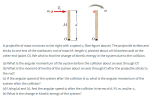 > m 3 M d 0 A projectile of mass m moves to the right with a speed v; (See figure above). The projectile strikes and sticks to one end of the stationary rod of mass M, length d, pivoted about a frictionless axle at the other end (point O). We wish to find the change of kinetic energy in the system due to the collision. (a) What is the angular momentum of the system before the collision about an...
What is the energy released in this β−β−nuclear reaction 239 93Np→239 94Pu+0−1e932 39Np→942 39Pu+−10e? (The atomic mass of 239Np239Np is 239.052939 u and that of 239Pu239Pu is 239.052163 u) 6. What i...
 What is the energy released in this β−β−nuclear reaction 239
93Np→239 94Pu+0−1e932 39Np→942 39Pu+−10e? (The atomic mass of
239Np239Np is 239.052939 u and that of 239Pu239Pu is 239.052163
u)
6. What is the energy released in this β 239.052163 u) nuclear reaction 9Np → 9 Pu + ,e? (The atomic mass of 239 Np is 239.052939 u and that of 239Pu is MeV
6. What is the energy released in this β 239.052163 u) nuclear reaction 9Np → 9 Pu...
What is the energy released in this β−β−nuclear reaction 239
93Np→239 94Pu+0−1e932 39Np→942 39Pu+−10e? (The atomic mass of
239Np239Np is 239.052939 u and that of 239Pu239Pu is 239.052163
u)
6. What is the energy released in this β 239.052163 u) nuclear reaction 9Np → 9 Pu + ,e? (The atomic mass of 239 Np is 239.052939 u and that of 239Pu is MeV
6. What is the energy released in this β 239.052163 u) nuclear reaction 9Np → 9 Pu...
Mass m = 0.1 kg moves to the right with speed v = 0.57 m/s and...
Mass m = 0.1 kg moves to the right with speed v = 0.57 m/s and collides with an equal mass initially at rest. After this inelastic collision the system retains a fraction = 0.75 of its original kinetic energy. How much impulse (in units of N sec) does the mass originally at rest receive during the collision?
 6. (12pts) A spring with a mass of 1 kg has damping constant 10 kg/s and a spring constant 41 kg/s2. If the spring begins at equilibrium position and is given a velocity of 2 m/s, find the position of the mass at any time t. Is this overdamping, critical damping or underdamping?
 QUESTION 3 One cup of coffee with a mass of 239 g of coffee contains 81 mg of caffeine. What is the concentration of caffeine in %(m/m)? State your answer rounded to 3 decimal places.
 Mass m = 0,1 kg moves to the right with speed v = 0.39 m/s and collides with an equal mass initially at rest. After this inelastic collision the system retains a fraction = 0.63 of its original kinetic energy. What is the speed VR (in m/s) of the mass which was originally at rest before the collision?
 > m 3 M d 0 A projectile of mass m moves to the right with a speed v; (See figure above). The projectile strikes and sticks to one end of the stationary rod of mass M, length d, pivoted about a frictionless axle at the other end (point O). We wish to find the change of kinetic energy in the system due to the collision. (a) What is the angular momentum of the system before the collision about an...
 What is the energy released in this β−β−nuclear reaction 239
93Np→239 94Pu+0−1e932 39Np→942 39Pu+−10e? (The atomic mass of
239Np239Np is 239.052939 u and that of 239Pu239Pu is 239.052163
u)
6. What is the energy released in this β 239.052163 u) nuclear reaction 9Np → 9 Pu + ,e? (The atomic mass of 239 Np is 239.052939 u and that of 239Pu is MeV
6. What is the energy released in this β 239.052163 u) nuclear reaction 9Np → 9 Pu...
What is the energy released in this β−β−nuclear reaction 239
93Np→239 94Pu+0−1e932 39Np→942 39Pu+−10e? (The atomic mass of
239Np239Np is 239.052939 u and that of 239Pu239Pu is 239.052163
u)
6. What is the energy released in this β 239.052163 u) nuclear reaction 9Np → 9 Pu + ,e? (The atomic mass of 239 Np is 239.052939 u and that of 239Pu is MeV
6. What is the energy released in this β 239.052163 u) nuclear reaction 9Np → 9 Pu...
Most questions answered within 3 hours.
-
Where is the error in this code sequence?
String s1 = "Hello";
String s2 = "ello";...
asked 11 months ago -
Financial data for Joel de Paris, Inc., for last year
follow:
Joel de Paris, Inc.
Balance...
asked 11 months ago -
Consider this reaction:
Al2(SO4)3 (aq)+ BaCl3
(aq) Al2Cl6 (aq)- +
3BaSO4(s) . What is the...
asked 11 months ago -
Suppose that Savneet is considering increasing her
recent random sample from 20 car rentals to 40...
asked 11 months ago -
Trucks arrive at an unloading terminal at an average rate of 120
per hour.
Trucks arrive...
asked 11 months ago -
Why are methanol and ethanol completely soluble in water while
octanol is not very little soluble....
asked 11 months ago -
A facilities manager at a university reads in a research report
that the mean amount of...
asked 11 months ago -
When the CuSO4 is rehydrated by adding water to the anhydrous
compound, is this an endothermic...
asked 11 months ago -
A ray of sunlight is passing from diamond into crown glass; the
angle of incidence is...
asked 11 months ago -
A block of mass 0.249 kg is placed on top of a light, vertical
spring of...
asked 11 months ago -
how do the kidneys compensate in the presences of acidosis
a) trigger hyperventilate
b) reserve acid...
asked 11 months ago -
Question 501 pts
The rental rate of capital to the firm increases. Which of the
following...
asked 11 months ago