physics
Consider a single pore, with a radius of 6 nm and length 50 nm in the basement membrane in a kidney. Assume that the pressure difference across the membrane is 1.4 kPa and the viscosity coefficient of the fluid passing through the pore is 1.5 × 10⁻³ N s/m2: (i)From this show that the volume flow rate through a single pore is 9.5 × 10⁻²¹ m2/s. (ii)Given that 190 L of fluid is filtered by the kidneys each day, how many pores are in the kidneys?
Homework Answers
Request Answer!
We need at least 10 more requests to produce the answer.
0 / 10 have requested this problem solution
The more requests, the faster the answer.
3. Consider a growth factor (e.g. VEGF) that is released in the extravascular space such that...
 3. Consider a growth factor (e.g. VEGF) that is released in the extravascular space such that its concentration Co in the extracellular space is constant and equal to 1 μM. The goal is to deliver the VEGF to the endothelium of a blood vessel passing through this space. The outer radius of the vessel (RO) is 200 μm and the inner radius Ri is 150 μm. The thickness of the endothelial layer is 1 μm. The diffusion coefficient of the...
A small artery has a length of 1.05 times 10^-3 m and a radius of 2.7...
 A small artery has a length of 1.05 times 10^-3 m and a radius of 2.7 times 10^-5 m. A If the pressure drop across the artery is 1.4 kPa, what is the flow rate through the artery in mm^3/s? (Assume that the temperature is 37 degree C, and the viscosity of blood at that temperature is 2.084 times 10^-3 N-s/m^2).
Consider a biological membrane 10.0 nm thick. The diffusion coefficient for potassium ions crossing this biological...
Consider a biological membrane 10.0 nm thick. The diffusion coefficient for potassium ions crossing this biological membrane is 1.00 X 10 -16 m2/s. a) Draw a representation of the membrane and the diffusion of potassium ions. b) Calculate the flow rate of potassium ions moving across an area 250 nm by 250 nm, if the concentration difference across the membrane is 0.500 mol/m3.
A hot fluid passes through a thin-walled tube of 10-mm diameter at 18 kg/h at a...
 A hot fluid passes through a thin-walled tube of 10-mm diameter at 18 kg/h at a temperature of 85 C. On the outside, coolant flows across the tube at a velocity of 3 m/s at a temperature of 25 C. Neglecting the thermal resistance of the metal wall, calculate 1. (a) The two heat transfer coefficients, (b) Overall heat transfer coefficient, and (c) Cooling rate (in W/m) achieved in the given configuration Assume hot fluid properties are constant at the...
Question 2 (a) An incompressible fluid of density ρ and viscosity μ flows through a curved...
 Question 2 (a) An incompressible fluid of density ρ and viscosity μ flows through a curved duct that turns the flow through angle θ. (ii) (iii) (i) Write an expression for the horizontal force F of the fluid on the walls of the duct in 4 marks) terms of the given variables (ignore the gravity); Calculate the force Fx, when: θ = 135°, ρ = 9982 kg/m , μ=1.003x10⁻³ kg/m.s., Al = 0.025 m2, A2-0.05 m, Vi-6 m/s, Plaage-78.47 kPa,...
The radius of the aorta is about 1.1 cm , and the blood passing through it...
The radius of the aorta is about 1.1 cm , and the blood passing through it has a speed of about 48 cm/s . Coefficient of viscosity for the whole blood (37∘) is η = 4×10⁻³Pa⋅s.Calculate the pressure drop per cm along the aorta.
A pump moving hexane is illustrated in Figure P2.42. The flow rate is 0.02 m3 /s;...
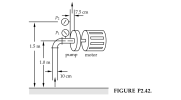 A pump moving hexane is illustrated in Figure P2.42. The flow
rate is 0.02 m3 /s; inlet and outlet gage pressure readings are–4
kPa and 190 kPa, respectively. Determine the required power input
to the fluid as it flows through the pump.
7.5 cm P2 P1 1.5 m motor pump 1.0 m 10 cm FIGURE P2.42
A pump moving hexane is illustrated in Figure P2.42. The flow
rate is 0.02 m3 /s; inlet and outlet gage pressure readings are–4
kPa and 190 kPa, respectively. Determine the required power input
to the fluid as it flows through the pump.
7.5 cm P2 P1 1.5 m motor pump 1.0 m 10 cm FIGURE P2.42
The diffusion coefficient for horse hemoglobin in water is 1.26 × 10⁻¹⁰ m2 s–1 at 40...
The diffusion coefficient for horse hemoglobin in water is 1.26 × 10⁻¹⁰ m2 s–1 at 40 °C. The viscosity of water at 40 °C is 0.653 × 10⁻³ kg m–1 s–1. Estimate the radius of hemoglobin assuming the molecule to be spherical and obey Stokes’s law. Comment on the size of Hemoglobin to a corona virus unit which has a diameter of 120 nm.
The radius of the aorta is about 1.2 cm , and the blood passing through it...
The radius of the aorta is about 1.2 cm , and the blood passing through it has a speed of about 36 cm/s . Coefficient of viscosity for the whole blood (37∘) is η = 4×10⁻³Pa⋅s. Calculate the pressure drop per cm along the aorta. Express your answer using two significant figures.
The radius of the aorta is about 1.3 cm , and the blood passing through it...
The radius of the aorta is about 1.3 cm , and the blood passing through it has a speed of about 50 cm/s . Coefficient of viscosity for the whole blood (37∘) is η = 4×10⁻³Pa⋅s. Calculate the pressure drop per cm along the aorta. Express your answer using two significant figures.
 3. Consider a growth factor (e.g. VEGF) that is released in the extravascular space such that its concentration Co in the extracellular space is constant and equal to 1 μM. The goal is to deliver the VEGF to the endothelium of a blood vessel passing through this space. The outer radius of the vessel (RO) is 200 μm and the inner radius Ri is 150 μm. The thickness of the endothelial layer is 1 μm. The diffusion coefficient of the...
 A small artery has a length of 1.05 times 10^-3 m and a radius of 2.7 times 10^-5 m. A If the pressure drop across the artery is 1.4 kPa, what is the flow rate through the artery in mm^3/s? (Assume that the temperature is 37 degree C, and the viscosity of blood at that temperature is 2.084 times 10^-3 N-s/m^2).
 A hot fluid passes through a thin-walled tube of 10-mm diameter at 18 kg/h at a temperature of 85 C. On the outside, coolant flows across the tube at a velocity of 3 m/s at a temperature of 25 C. Neglecting the thermal resistance of the metal wall, calculate 1. (a) The two heat transfer coefficients, (b) Overall heat transfer coefficient, and (c) Cooling rate (in W/m) achieved in the given configuration Assume hot fluid properties are constant at the...
 Question 2 (a) An incompressible fluid of density ρ and viscosity μ flows through a curved duct that turns the flow through angle θ. (ii) (iii) (i) Write an expression for the horizontal force F of the fluid on the walls of the duct in 4 marks) terms of the given variables (ignore the gravity); Calculate the force Fx, when: θ = 135°, ρ = 9982 kg/m , μ=1.003x10⁻³ kg/m.s., Al = 0.025 m2, A2-0.05 m, Vi-6 m/s, Plaage-78.47 kPa,...
 A pump moving hexane is illustrated in Figure P2.42. The flow
rate is 0.02 m3 /s; inlet and outlet gage pressure readings are–4
kPa and 190 kPa, respectively. Determine the required power input
to the fluid as it flows through the pump.
7.5 cm P2 P1 1.5 m motor pump 1.0 m 10 cm FIGURE P2.42
A pump moving hexane is illustrated in Figure P2.42. The flow
rate is 0.02 m3 /s; inlet and outlet gage pressure readings are–4
kPa and 190 kPa, respectively. Determine the required power input
to the fluid as it flows through the pump.
7.5 cm P2 P1 1.5 m motor pump 1.0 m 10 cm FIGURE P2.42
Most questions answered within 3 hours.
-
Where is the error in this code sequence?
String s1 = "Hello";
String s2 = "ello";...
asked 11 months ago -
Financial data for Joel de Paris, Inc., for last year
follow:
Joel de Paris, Inc.
Balance...
asked 11 months ago -
Consider this reaction:
Al2(SO4)3 (aq)+ BaCl3
(aq) Al2Cl6 (aq)- +
3BaSO4(s) . What is the...
asked 11 months ago -
Suppose that Savneet is considering increasing her
recent random sample from 20 car rentals to 40...
asked 11 months ago -
Trucks arrive at an unloading terminal at an average rate of 120
per hour.
Trucks arrive...
asked 11 months ago -
Why are methanol and ethanol completely soluble in water while
octanol is not very little soluble....
asked 11 months ago -
A facilities manager at a university reads in a research report
that the mean amount of...
asked 11 months ago -
When the CuSO4 is rehydrated by adding water to the anhydrous
compound, is this an endothermic...
asked 11 months ago -
A ray of sunlight is passing from diamond into crown glass; the
angle of incidence is...
asked 11 months ago -
A block of mass 0.249 kg is placed on top of a light, vertical
spring of...
asked 11 months ago -
how do the kidneys compensate in the presences of acidosis
a) trigger hyperventilate
b) reserve acid...
asked 11 months ago -
Question 501 pts
The rental rate of capital to the firm increases. Which of the
following...
asked 11 months ago