
Homework Answers
mass is
 kg
kg
.
spring stretches 9.8 cm or 0.098 meter
so x=0.098
from Hooke's law,




 N/m
N/m
.
.
there is no damping so damping constant is c=0
.
force is 
.
DE is given by




.
.
initially, spring is in steady-state so 
and there is no initial velocity so 
.
for homogeneous system

find roots


for 2 complex roots, the complementary solution is

.
.
here we have
here 
which is already a root of given DE so we need to multiply "t" in particular solution
so assume that particular solution is

take first derivative

take second derivative

.
.
put all values in given DE
.

.

.

compare coefficient both sides.
 .
.

put both constant in a particular solution

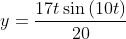
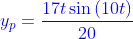
..
general solution is

 ....................(1)
.
here y(0)=0



 ....................put
it back in equation 1
....................put
it back in equation 1
.

 .........................(2)
take derivative

here y'(0)=0


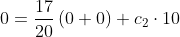

 ...................put
it back in equation 2
...................put
it back in equation 2
.

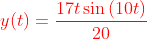
.
.
.
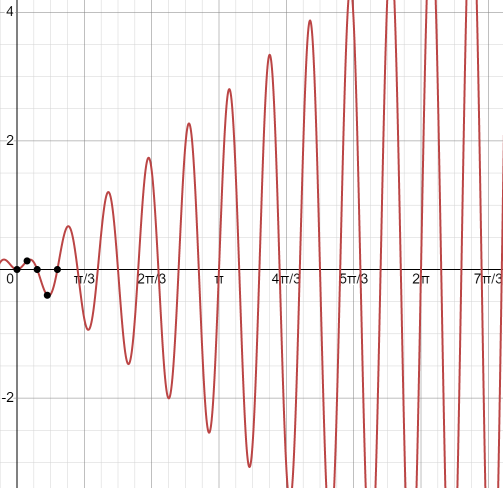
from the graph, there is no maximum excursion
so type NONE
.
Add Answer to:
(10 pts) A 10 kilogram object suspended from the end of a vertically hanging spring stretches...
(1 point) A 10 kilogram object suspended from the end of a vertically hanging spring stretches th...
 (1 point) A 10 kilogram object suspended from the end of a vertically hanging spring stretches the spring 9.8 centimeters. At time 0, the resulting mass- spring system is disturbed from its rest state by the force F(t) 70 cos(8t). The force F(t) is expressed in Newtons and is positive in the downward direction, and time is measured in seconds. a. Determine the spring constant k Newtons/meter b. Formulate the initial value problem for y(), where y(t) is the displacement...
A 10 10 kilogram object suspended from the end of a vertically hanging spring stretches the...
A 10 10 kilogram object suspended from the end of a vertically hanging spring stretches the spring 9.8 9.8 centimeters. At time ?=0 t = 0 , the resulting mass-spring system is disturbed from its rest state by the force ?(?)=150cos(10?) F ( t ) = 150 cos ( 10 t ) . The force ?(?) F ( t ) is expressed in Newtons and is positive in the downward direction, and time is measured in seconds. Solve the initial...
A 5 kilogram mass suspended from the end of a vertical spring stretches it by 1.225 metres. The system is placed in a medium offering a resistance (in Newtons) equal to 45 times the instantaneous vel...
 A 5 kilogram mass suspended from the end of a vertical spring stretches it by 1.225 metres. The system is placed in a medium offering a resistance (in Newtons) equal to 45 times the instantaneous velocity (in m/s). The mass is started in motion from the equilibrium position with an initial velocity of 1 m/s in the upward direction and with an applied external force F(t) 365 cos(3t) Newtons downwards. The displacement of the mass below the equilibrium position at...
A 10 kg object is suspended from a spring causes the spring to lengthen by 5...
A 10 kg object is suspended from a spring causes the spring to lengthen by 5 cm down. The object is subjected to a force of 2cos (t / 4) N (newtons), and it moves in an environment where the viscosity force is 1N when the speed is 6 cm / s. If the object is set in motion from its position of equilibrium with an initial speed of 2 cm / s, formulate the initial value problem that describes...
A 10 kg object is suspended from a spring causes the spring to lengthen by 5...
A 10 kg object is suspended from a spring causes the spring to lengthen by 5 cm down. The object is subjected to a force of 2cos (t / 4) N (newtons), and it moves in a medium where the viscosity force is 1N when the speed is 6 cm / s. If the object is set in motion from its position of equilibrium with an initial speed of 2 cm / s, formulate the initial value problem that describes...
A 189-kg mass, when attached to the end of a spring hanging vertically, stretches the spring...
 A 189-kg mass, when attached to the end of a spring hanging vertically, stretches the spring 9 m. The mass is in a medium that exerts a viscous resistance of 3024 N when the mass has a velocity of 4 m/sec. Assume the mass is given an initial velocity of 14 m/s from the equilibrium position. a) Determine the spring constant k. Use g = 10 m/sec. k b) Determine the damping coeffient 7. 7 c) If the initial value...
A 16-lb weight is attached to the lower end of a coil spring suspended from the...
 A 16-lb weight is attached to the lower end of a coil spring suspended from the ceiling and having a spring constant of 5 lb/ft. The resistance in the spring-mass system is numerically equal to the instantaneous velocity. At t=0 the weight is set in motion from a position 1 ft below its equilibrium position by giving it an upward velocity of 1 ft/sec. Write an initial value problem that models the given situation. Write the differential equation for the...
A 288-kg mass, when attached to the end of a spring hanging vertically, stretches the spring...
 A 288-kg mass, when attached to the end of a spring hanging vertically, stretches the spring 8 m. The mass is in a medium that exerts a viscous resistance of 576 N when the mass has a velocity of 4 m/sec. Assume the mass is given an initial velocity of 18 m/s from the equilibrium position. a) Determine the spring constant k. Use g = 10 m/sec. k b) Determine the damping coeffient 7. 7= c) If the initial value...
An object stretches a spring 6 inches in equilibrium. Find its displacement y for t> 0...
 An object stretches a spring 6 inches in equilibrium. Find its displacement y for t> 0 (where y is the displacement of the object from its equilibrium position, measured positive upward), if it's initially displaced 3 inches above equilibrium and given a downward velocity of 6 inches/s. Find the frequency, period, amplitude and phase angle of the motion.
An object is suspended from the ceiling by a spring aligned along a vertical x axis,...
An object is suspended from the ceiling by a spring aligned along a vertical x axis, with upward defined as the positive x direction. When the spring is at its relaxed length, the object is at the origin of the axis. The object is pulled down to position −x1, held at rest, and released. Consider its motion from the instant of release until the instant it returns to −x1. Ignore friction, air drag, and the inertia of the spring. part...
 (1 point) A 10 kilogram object suspended from the end of a vertically hanging spring stretches the spring 9.8 centimeters. At time 0, the resulting mass- spring system is disturbed from its rest state by the force F(t) 70 cos(8t). The force F(t) is expressed in Newtons and is positive in the downward direction, and time is measured in seconds. a. Determine the spring constant k Newtons/meter b. Formulate the initial value problem for y(), where y(t) is the displacement...
 A 5 kilogram mass suspended from the end of a vertical spring stretches it by 1.225 metres. The system is placed in a medium offering a resistance (in Newtons) equal to 45 times the instantaneous velocity (in m/s). The mass is started in motion from the equilibrium position with an initial velocity of 1 m/s in the upward direction and with an applied external force F(t) 365 cos(3t) Newtons downwards. The displacement of the mass below the equilibrium position at...
 A 189-kg mass, when attached to the end of a spring hanging vertically, stretches the spring 9 m. The mass is in a medium that exerts a viscous resistance of 3024 N when the mass has a velocity of 4 m/sec. Assume the mass is given an initial velocity of 14 m/s from the equilibrium position. a) Determine the spring constant k. Use g = 10 m/sec. k b) Determine the damping coeffient 7. 7 c) If the initial value...
 A 16-lb weight is attached to the lower end of a coil spring suspended from the ceiling and having a spring constant of 5 lb/ft. The resistance in the spring-mass system is numerically equal to the instantaneous velocity. At t=0 the weight is set in motion from a position 1 ft below its equilibrium position by giving it an upward velocity of 1 ft/sec. Write an initial value problem that models the given situation. Write the differential equation for the...
 A 288-kg mass, when attached to the end of a spring hanging vertically, stretches the spring 8 m. The mass is in a medium that exerts a viscous resistance of 576 N when the mass has a velocity of 4 m/sec. Assume the mass is given an initial velocity of 18 m/s from the equilibrium position. a) Determine the spring constant k. Use g = 10 m/sec. k b) Determine the damping coeffient 7. 7= c) If the initial value...
 An object stretches a spring 6 inches in equilibrium. Find its displacement y for t> 0 (where y is the displacement of the object from its equilibrium position, measured positive upward), if it's initially displaced 3 inches above equilibrium and given a downward velocity of 6 inches/s. Find the frequency, period, amplitude and phase angle of the motion.
Most questions answered within 3 hours.
-
Where is the error in this code sequence?
String s1 = "Hello";
String s2 = "ello";...
asked 10 months ago -
Financial data for Joel de Paris, Inc., for last year
follow:
Joel de Paris, Inc.
Balance...
asked 10 months ago -
Consider this reaction:
Al2(SO4)3 (aq)+ BaCl3
(aq) Al2Cl6 (aq)- +
3BaSO4(s) . What is the...
asked 10 months ago -
Suppose that Savneet is considering increasing her
recent random sample from 20 car rentals to 40...
asked 10 months ago -
Trucks arrive at an unloading terminal at an average rate of 120
per hour.
Trucks arrive...
asked 10 months ago -
Why are methanol and ethanol completely soluble in water while
octanol is not very little soluble....
asked 10 months ago -
A facilities manager at a university reads in a research report
that the mean amount of...
asked 10 months ago -
When the CuSO4 is rehydrated by adding water to the anhydrous
compound, is this an endothermic...
asked 10 months ago -
A ray of sunlight is passing from diamond into crown glass; the
angle of incidence is...
asked 10 months ago -
A block of mass 0.249 kg is placed on top of a light, vertical
spring of...
asked 10 months ago -
how do the kidneys compensate in the presences of acidosis
a) trigger hyperventilate
b) reserve acid...
asked 10 months ago -
Question 501 pts
The rental rate of capital to the firm increases. Which of the
following...
asked 10 months ago