

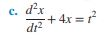
5. Use the following initial conditions for each part as follows:


Assume that the forcing functions are zero prior to t=0
Homework Answers
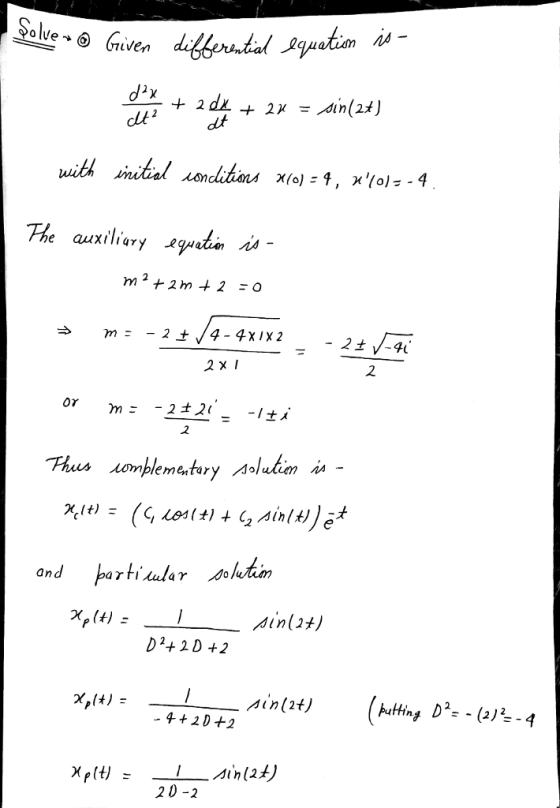

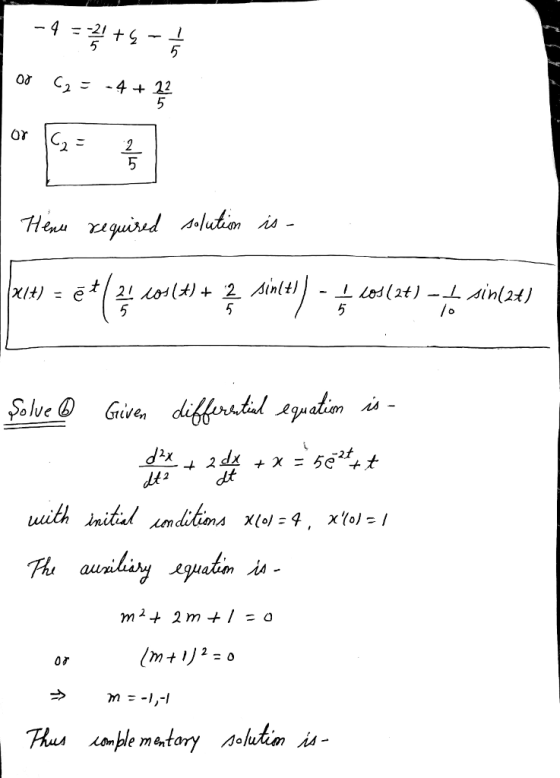
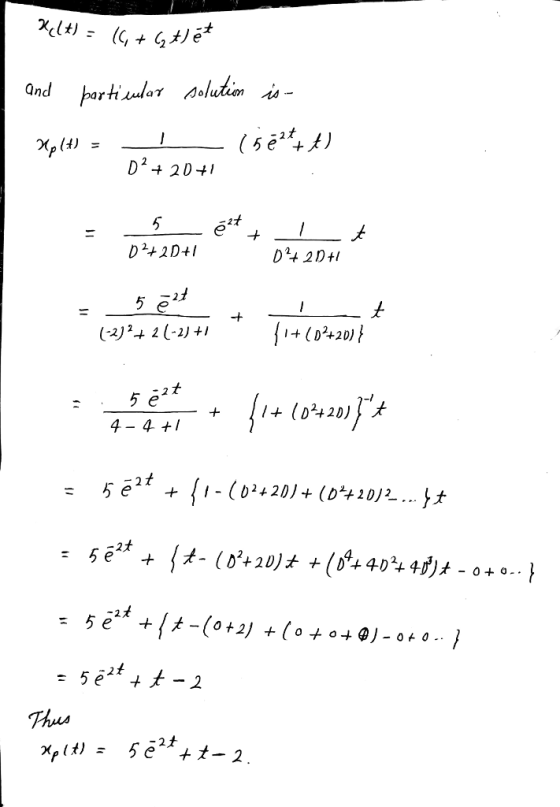
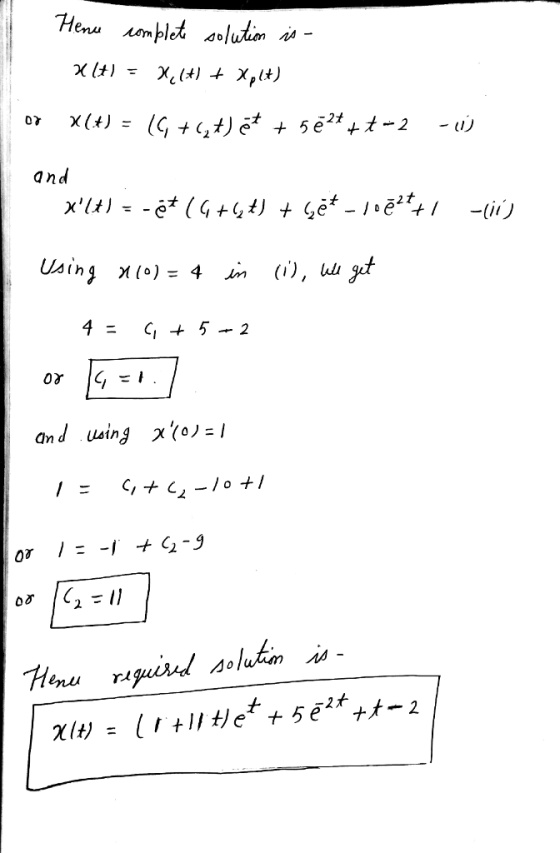
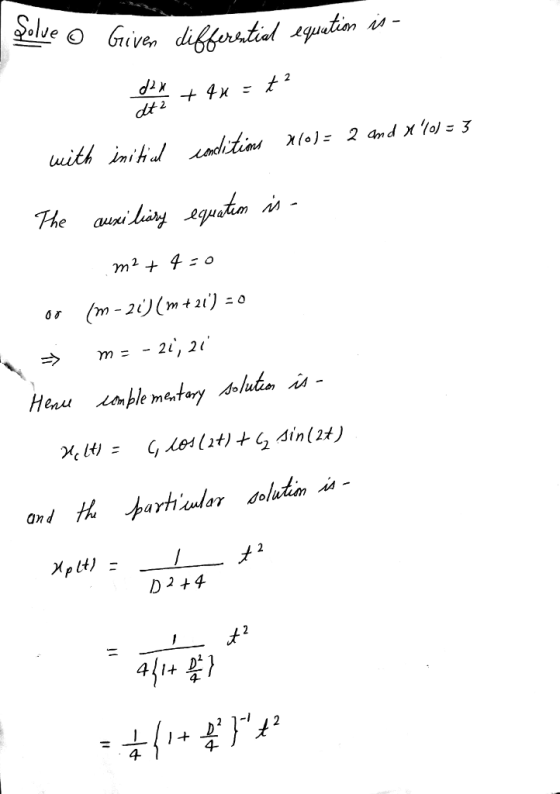
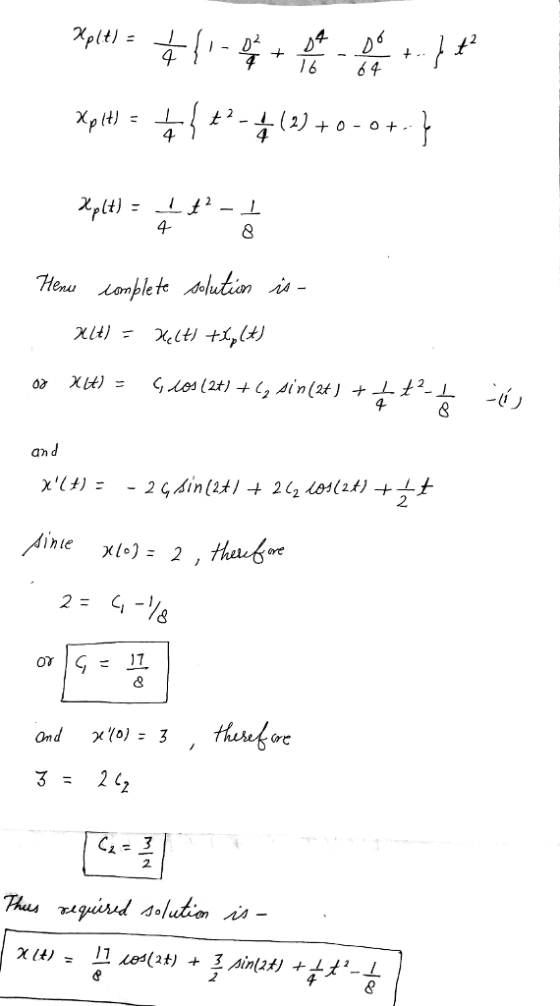
Add Answer to:
5. Use the following initial conditions for each part as
follows:
Assume that the forcing functions...
This is the exact problem that was given to study for an upcoming exam, Give the...
 This is the exact problem that was given to study for an
upcoming exam,
Give the general form of the solution:
du/dt
= 3 (d2u/dr2 + 1/r du/dr +1/r2
d2u/d2)
inside the circle 0 r 3, - subject to the
periodicity conditions on
and initial condition u(r, , 0) = (r,)
We were unable to transcribe this imageWe were unable to transcribe this imageWe were unable to transcribe this imageWe were unable to transcribe this imageWe were unable to transcribe...
This is the exact problem that was given to study for an
upcoming exam,
Give the general form of the solution:
du/dt
= 3 (d2u/dr2 + 1/r du/dr +1/r2
d2u/d2)
inside the circle 0 r 3, - subject to the
periodicity conditions on
and initial condition u(r, , 0) = (r,)
We were unable to transcribe this imageWe were unable to transcribe this imageWe were unable to transcribe this imageWe were unable to transcribe this imageWe were unable to transcribe...
a) By direct substitution determine which of the following functions satisfy the wave equation. 1. g(x,...
a) By direct substitution determine which of the following functions satisfy the wave equation. 1. g(x, t) = Acos(kx − t) where A, k, are positive constants. 2. h(x, t) = Ae where A, k, are positive constants. 3. p(x, t) = Asinh(kx − t) where A, k, are positive constants. 4. q(x, t) = Ae where A, a, are positive constants. 5. An arbitrary function: f(x, t) = f(kx−t) where k and are positive constants. (Hint: Be careful with...
Assume that a procedure yields a binomial distribution with a trial repeated n=5n=5 times. Use some...
 Assume that a procedure yields a binomial distribution with a
trial repeated n=5n=5 times. Use some form of technology to find
the cumulative probability distribution given the
probability p=0.155p=0.155 of success on a single trial.
(Report answers accurate to 4 decimal places.)
k
P(X < k)
0
1
2
3
4
5
We were unable to transcribe this imageWe were unable to transcribe this imageWe were unable to transcribe this imageWe were unable to transcribe this imageWe were unable to...
Assume that a procedure yields a binomial distribution with a
trial repeated n=5n=5 times. Use some form of technology to find
the cumulative probability distribution given the
probability p=0.155p=0.155 of success on a single trial.
(Report answers accurate to 4 decimal places.)
k
P(X < k)
0
1
2
3
4
5
We were unable to transcribe this imageWe were unable to transcribe this imageWe were unable to transcribe this imageWe were unable to transcribe this imageWe were unable to...
consider the variation of constants formula where P(t)= a) show that solves the initial value problem x'+p(t)=(t) x()= when p and q are continuous functions of t on an interval I and tg p(s)d...
consider the variation of constants formula where P(t)= a) show that solves the initial value problem x'+p(t)=(t) x()= when p and q are continuous functions of t on an interval I and tg p(s)ds We were unable to transcribe this imageWe were unable to transcribe this imageWe were unable to transcribe this imageWe were unable to transcribe this imageWe were unable to transcribe this image tg p(s)ds
Let R and S be PIDs, and assume that R is a subring of S. Assume the following about R and S: If,...
Let R and S be PIDs, and assume that R is a subring of S. Assume the following about R and S: If, for an element , there exists a non-zero with , then . Show: If is a greatest common divisor in S for two elements a and b in R (not both 0), then d is a greatest common divisor for a and b in R. sES TER We were unable to transcribe this imageWe were unable to...
Use the Debye approximation to find the following themodynamic functions of a solid as a function...
Use the Debye approximation to find the following themodynamic functions of a solid as a function of the absolute temperature T a) the fee energy F b) the mean energy c) the entropy S Express your answers in terms of the Debye function D(y) = and the Debye temperature D = hwmax/k e) Evaluate the function D(y) in the limit when y >> land y<<1. Use these results to express the thermodynamic functions F, and S in the llimiting cases...
Consider the initial value problem below has a series solution centered at zero of y =...
 Consider the initial value problem below has a series solution
centered at zero of y =
(x). Determine
'(0),
''(0) and
4(0).
y''+ x2y'+ cos(x)y = 0, y(0) = 2, y'(0) = 3.
We were unable to transcribe this imageWe were unable to transcribe this imageWe were unable to transcribe this imageWe were unable to transcribe this image
Consider the initial value problem below has a series solution
centered at zero of y =
(x). Determine
'(0),
''(0) and
4(0).
y''+ x2y'+ cos(x)y = 0, y(0) = 2, y'(0) = 3.
We were unable to transcribe this imageWe were unable to transcribe this imageWe were unable to transcribe this imageWe were unable to transcribe this image
Solve the harmonic oscillator motion for initial conditions x(0) = 0, V(0) = V0 in the...
 Solve the harmonic oscillator motion for initial conditions x(0)
= 0, V(0) = V0 in the case of (a) underdamped
(b) overdamped
We were unable to transcribe this imageWe were unable to transcribe this imageWe were unable to transcribe this image
Solve the harmonic oscillator motion for initial conditions x(0)
= 0, V(0) = V0 in the case of (a) underdamped
(b) overdamped
We were unable to transcribe this imageWe were unable to transcribe this imageWe were unable to transcribe this image
how do I take the laplace transform of this? I'm trying to find X(s). . I...
 how do I take the laplace transform of this? I'm trying to find
X(s).
. I already found a solution but I want to verify if it's
correct.
The unit inside f0 is 1(t). they're step functions. I forgot to
add though
The initial conditions are x(0)=0 and
.
We were unable to transcribe this imageWe were unable to transcribe this imageWe were unable to transcribe this image
how do I take the laplace transform of this? I'm trying to find
X(s).
. I already found a solution but I want to verify if it's
correct.
The unit inside f0 is 1(t). they're step functions. I forgot to
add though
The initial conditions are x(0)=0 and
.
We were unable to transcribe this imageWe were unable to transcribe this imageWe were unable to transcribe this image
a) Two instantaneous sources, each of strength M are symmetrically placed about the origin (x=0) at...
 a) Two instantaneous sources, each of strength M are
symmetrically placed about the origin (x=0) at locations respectively and
released at time t=0. Obtain the solution to the 1d diffusion
equation describing the concentration c(x,t) at a time > 0 for
. Plot the
concentration field, c(x,t)/M, as a function of x for -4 What does
the plot looks like for Dt > 5. b) Find the peak concentration
at x=0 and the time to at which it develops. Plot...
a) Two instantaneous sources, each of strength M are
symmetrically placed about the origin (x=0) at locations respectively and
released at time t=0. Obtain the solution to the 1d diffusion
equation describing the concentration c(x,t) at a time > 0 for
. Plot the
concentration field, c(x,t)/M, as a function of x for -4 What does
the plot looks like for Dt > 5. b) Find the peak concentration
at x=0 and the time to at which it develops. Plot...
 This is the exact problem that was given to study for an
upcoming exam,
Give the general form of the solution:
du/dt
= 3 (d2u/dr2 + 1/r du/dr +1/r2
d2u/d2)
inside the circle 0 r 3, - subject to the
periodicity conditions on
and initial condition u(r, , 0) = (r,)
We were unable to transcribe this imageWe were unable to transcribe this imageWe were unable to transcribe this imageWe were unable to transcribe this imageWe were unable to transcribe...
This is the exact problem that was given to study for an
upcoming exam,
Give the general form of the solution:
du/dt
= 3 (d2u/dr2 + 1/r du/dr +1/r2
d2u/d2)
inside the circle 0 r 3, - subject to the
periodicity conditions on
and initial condition u(r, , 0) = (r,)
We were unable to transcribe this imageWe were unable to transcribe this imageWe were unable to transcribe this imageWe were unable to transcribe this imageWe were unable to transcribe...
 Assume that a procedure yields a binomial distribution with a
trial repeated n=5n=5 times. Use some form of technology to find
the cumulative probability distribution given the
probability p=0.155p=0.155 of success on a single trial.
(Report answers accurate to 4 decimal places.)
k
P(X < k)
0
1
2
3
4
5
We were unable to transcribe this imageWe were unable to transcribe this imageWe were unable to transcribe this imageWe were unable to transcribe this imageWe were unable to...
Assume that a procedure yields a binomial distribution with a
trial repeated n=5n=5 times. Use some form of technology to find
the cumulative probability distribution given the
probability p=0.155p=0.155 of success on a single trial.
(Report answers accurate to 4 decimal places.)
k
P(X < k)
0
1
2
3
4
5
We were unable to transcribe this imageWe were unable to transcribe this imageWe were unable to transcribe this imageWe were unable to transcribe this imageWe were unable to...
 Consider the initial value problem below has a series solution
centered at zero of y =
(x). Determine
'(0),
''(0) and
4(0).
y''+ x2y'+ cos(x)y = 0, y(0) = 2, y'(0) = 3.
We were unable to transcribe this imageWe were unable to transcribe this imageWe were unable to transcribe this imageWe were unable to transcribe this image
Consider the initial value problem below has a series solution
centered at zero of y =
(x). Determine
'(0),
''(0) and
4(0).
y''+ x2y'+ cos(x)y = 0, y(0) = 2, y'(0) = 3.
We were unable to transcribe this imageWe were unable to transcribe this imageWe were unable to transcribe this imageWe were unable to transcribe this image
 Solve the harmonic oscillator motion for initial conditions x(0)
= 0, V(0) = V0 in the case of (a) underdamped
(b) overdamped
We were unable to transcribe this imageWe were unable to transcribe this imageWe were unable to transcribe this image
Solve the harmonic oscillator motion for initial conditions x(0)
= 0, V(0) = V0 in the case of (a) underdamped
(b) overdamped
We were unable to transcribe this imageWe were unable to transcribe this imageWe were unable to transcribe this image
 how do I take the laplace transform of this? I'm trying to find
X(s).
. I already found a solution but I want to verify if it's
correct.
The unit inside f0 is 1(t). they're step functions. I forgot to
add though
The initial conditions are x(0)=0 and
.
We were unable to transcribe this imageWe were unable to transcribe this imageWe were unable to transcribe this image
how do I take the laplace transform of this? I'm trying to find
X(s).
. I already found a solution but I want to verify if it's
correct.
The unit inside f0 is 1(t). they're step functions. I forgot to
add though
The initial conditions are x(0)=0 and
.
We were unable to transcribe this imageWe were unable to transcribe this imageWe were unable to transcribe this image
 a) Two instantaneous sources, each of strength M are
symmetrically placed about the origin (x=0) at locations respectively and
released at time t=0. Obtain the solution to the 1d diffusion
equation describing the concentration c(x,t) at a time > 0 for
. Plot the
concentration field, c(x,t)/M, as a function of x for -4 What does
the plot looks like for Dt > 5. b) Find the peak concentration
at x=0 and the time to at which it develops. Plot...
a) Two instantaneous sources, each of strength M are
symmetrically placed about the origin (x=0) at locations respectively and
released at time t=0. Obtain the solution to the 1d diffusion
equation describing the concentration c(x,t) at a time > 0 for
. Plot the
concentration field, c(x,t)/M, as a function of x for -4 What does
the plot looks like for Dt > 5. b) Find the peak concentration
at x=0 and the time to at which it develops. Plot...
Most questions answered within 3 hours.
-
Where is the error in this code sequence?
String s1 = "Hello";
String s2 = "ello";...
asked 10 months ago -
Financial data for Joel de Paris, Inc., for last year
follow:
Joel de Paris, Inc.
Balance...
asked 10 months ago -
Consider this reaction:
Al2(SO4)3 (aq)+ BaCl3
(aq) Al2Cl6 (aq)- +
3BaSO4(s) . What is the...
asked 10 months ago -
Suppose that Savneet is considering increasing her
recent random sample from 20 car rentals to 40...
asked 10 months ago -
Trucks arrive at an unloading terminal at an average rate of 120
per hour.
Trucks arrive...
asked 10 months ago -
Why are methanol and ethanol completely soluble in water while
octanol is not very little soluble....
asked 10 months ago -
A facilities manager at a university reads in a research report
that the mean amount of...
asked 10 months ago -
When the CuSO4 is rehydrated by adding water to the anhydrous
compound, is this an endothermic...
asked 10 months ago -
A ray of sunlight is passing from diamond into crown glass; the
angle of incidence is...
asked 10 months ago -
A block of mass 0.249 kg is placed on top of a light, vertical
spring of...
asked 10 months ago -
how do the kidneys compensate in the presences of acidosis
a) trigger hyperventilate
b) reserve acid...
asked 10 months ago -
Question 501 pts
The rental rate of capital to the firm increases. Which of the
following...
asked 10 months ago