Graphing demand for labor and computing the optimal quantity
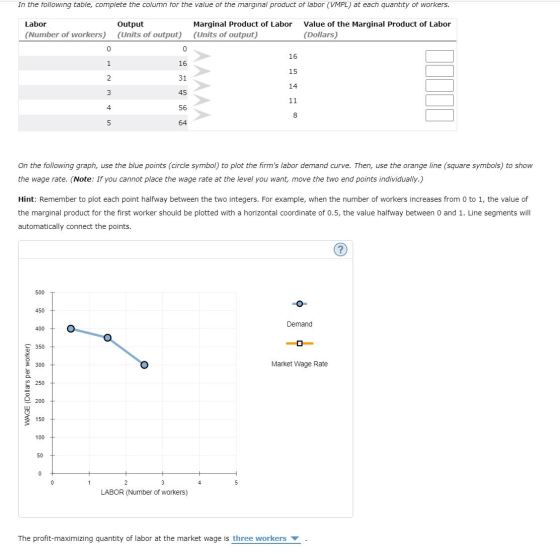
A company operates in a competitive market, selling each unit of output for a price of $30 and paying the market wage of $375 per day for each worker it hires.
Homework Answers
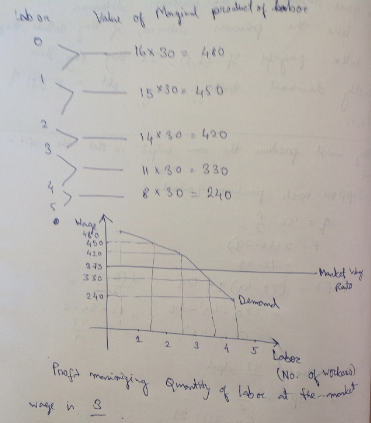
2. Graphing demand for labor and computing the optimal quantity of labor demanded
 2. Graphing demand for labor and computing the optimal quantity of labor demanded A company operates in a competitive market, selling each unit of output for a price of $20 and paying the market wage of $330 per day for each worker it hires. In the following table, complete the column for the value of the marginal product of labor (VMPL) each quantity of workers On the following graph, use the blue points (circle symbol) to plot the firm's labor demand curve. Then,...
A company operates in a competitive market, selling each unit of output for a price of...
 A company operates in a competitive market, selling each unit of output for a price of $30 and paying the market wage of $405 per day for each worker it hires. In the following table, complete the column for the value of the marginal product of labor (VMPL) at each quantity of workers. Hint: Remember to plot each point halfway between the two integers. For example, when the number of workers increases from 0 to 1, the value of the marginal product...
please help me with the graph and how many workers. thank youu 1. Graphing demand for...
 please help me with the graph and how many workers. thank youu
1. Graphing demand for labour and computing the optimal quantity A company operates in a perfectly competitive market, selling each unit of output for a price of $20 and paying the market wage (marginal resource cost) of $270 per day for each worker it hires. In the following table, complete the column for the marginal revenue product of labour (MRP) at each quantity of workers. Labour (Number of...
please help me with the graph and how many workers. thank youu
1. Graphing demand for labour and computing the optimal quantity A company operates in a perfectly competitive market, selling each unit of output for a price of $20 and paying the market wage (marginal resource cost) of $270 per day for each worker it hires. In the following table, complete the column for the marginal revenue product of labour (MRP) at each quantity of workers. Labour (Number of...
4. Marginal resource cost A company operates in a perfectly competitive market, selling each unit of...
 4. Marginal resource cost
A company operates in a perfectly competitive market, selling
each unit of output for a price of $20 and paying the market wage
of $330 per day for each worker it hires.
In the following table, complete the column for the value of the
marginal product of labor (VMPL) at each quantity of workers.
Labor
Output
Marginal Product of Labor
Value of the Marginal Product of Labor
(Number of workers)
(Units of output)
(Units of output)...
4. Marginal resource cost
A company operates in a perfectly competitive market, selling
each unit of output for a price of $20 and paying the market wage
of $330 per day for each worker it hires.
In the following table, complete the column for the value of the
marginal product of labor (VMPL) at each quantity of workers.
Labor
Output
Marginal Product of Labor
Value of the Marginal Product of Labor
(Number of workers)
(Units of output)
(Units of output)...
A firm hires labor in a perfectly competitive labor market. Its current profit-maximizing hourly output is...
A firm hires labor in a perfectly competitive labor market. Its current profit-maximizing hourly output is 100 units, which the firm sells at a price of $5 per unit. The Marginal Physical product (MPP) of the last unit of labor employed is 5 units per hour. The firm pays each worker an hourly wage of $15. a)What Marginal Revenue (MR) does the firm earn from sale of the output produced by the last worker employed? Explain your asnwer b)Does this...
4. Marginal resource cost A company operates in a perfectly competitive market, selling each unit of...
 4. Marginal resource cost A company operates in a perfectly competitive market, selling each unit of output for a price of $20 and paying the market wage of $270 per day for each worker it hires. In the following table, complete the column for the value of the marginal product of labor (VMPL) at each quantity of workers. Labor (Number of workers) 0 Output Marginal Product of Labor (Units of output) (Units of output) Value of the Marginal Product of...
Quantity of labor Total product of labor 0 0 1 3 2 10 3 16 4...
 Quantity of labor Total product of labor 0 0 1 3 2 10 3 16 4 21 5 25 6 28 Debbie owns a bakery and can hire workers to produce cakes selling in a competitive output market at $8 each. The table shows the relationship between the number of workers and the number of cakes produced. Debbie must pay each worker a competitive market wage of $45 per day. How many workers will she hire to maximize profit? O...
38. An increase in the supply of labor с.increases the value of ~ginal Product of er...
 38. An increase in the supply of labor с.increases the value of ~ginal Product of er and enes D. decreases the value of the marginal product of labor and increases the wage the wage. 39. A decrease in the demand for fish A. decreases the value of the marginal product of fishemen reduces their wage, and reduces employment in the fishing industry employment in the fishing industry employment in the fishing industry employment in the fishing industry B. increases the...
Please, I need workings, I was confused about it, tries may time l did not get...
Please, I need workings, I was confused about it, tries may time l did not get the answers. thanks for your help Amy's Hair Dressing hires hairdressers in a competitive market. The cost for a haircut, other than the labour cost, is €4. The daily number of haircuts varies with the number of workers hired, as shown in the table below: No of workers haircut per day 0 0 1 16 2 36 3 54 4 70 5 84 6...
A dry-cleaning business operates in a monopolistically competitive market with the following demand and marginal revenue...
A dry-cleaning business operates in a monopolistically competitive market with the following demand and marginal revenue curves: P = 100–5Q TR = 100Q–5Q2 MR = 100–10Q The business’s total and marginal cost curves are: TC = 4Q + Q2 + 5 MC = 4+2Q where P is in dollars per unit, output rate Q is in units per time period, and total cost C is in dollars. a) Determine the price and output rate that will allow the firm...
 please help me with the graph and how many workers. thank youu
1. Graphing demand for labour and computing the optimal quantity A company operates in a perfectly competitive market, selling each unit of output for a price of $20 and paying the market wage (marginal resource cost) of $270 per day for each worker it hires. In the following table, complete the column for the marginal revenue product of labour (MRP) at each quantity of workers. Labour (Number of...
please help me with the graph and how many workers. thank youu
1. Graphing demand for labour and computing the optimal quantity A company operates in a perfectly competitive market, selling each unit of output for a price of $20 and paying the market wage (marginal resource cost) of $270 per day for each worker it hires. In the following table, complete the column for the marginal revenue product of labour (MRP) at each quantity of workers. Labour (Number of...
 4. Marginal resource cost
A company operates in a perfectly competitive market, selling
each unit of output for a price of $20 and paying the market wage
of $330 per day for each worker it hires.
In the following table, complete the column for the value of the
marginal product of labor (VMPL) at each quantity of workers.
Labor
Output
Marginal Product of Labor
Value of the Marginal Product of Labor
(Number of workers)
(Units of output)
(Units of output)...
4. Marginal resource cost
A company operates in a perfectly competitive market, selling
each unit of output for a price of $20 and paying the market wage
of $330 per day for each worker it hires.
In the following table, complete the column for the value of the
marginal product of labor (VMPL) at each quantity of workers.
Labor
Output
Marginal Product of Labor
Value of the Marginal Product of Labor
(Number of workers)
(Units of output)
(Units of output)...
 4. Marginal resource cost A company operates in a perfectly competitive market, selling each unit of output for a price of $20 and paying the market wage of $270 per day for each worker it hires. In the following table, complete the column for the value of the marginal product of labor (VMPL) at each quantity of workers. Labor (Number of workers) 0 Output Marginal Product of Labor (Units of output) (Units of output) Value of the Marginal Product of...
 Quantity of labor Total product of labor 0 0 1 3 2 10 3 16 4 21 5 25 6 28 Debbie owns a bakery and can hire workers to produce cakes selling in a competitive output market at $8 each. The table shows the relationship between the number of workers and the number of cakes produced. Debbie must pay each worker a competitive market wage of $45 per day. How many workers will she hire to maximize profit? O...
 38. An increase in the supply of labor с.increases the value of ~ginal Product of er and enes D. decreases the value of the marginal product of labor and increases the wage the wage. 39. A decrease in the demand for fish A. decreases the value of the marginal product of fishemen reduces their wage, and reduces employment in the fishing industry employment in the fishing industry employment in the fishing industry employment in the fishing industry B. increases the...
Most questions answered within 3 hours.
-
Where is the error in this code sequence?
String s1 = "Hello";
String s2 = "ello";...
asked 11 months ago -
Financial data for Joel de Paris, Inc., for last year
follow:
Joel de Paris, Inc.
Balance...
asked 11 months ago -
Consider this reaction:
Al2(SO4)3 (aq)+ BaCl3
(aq) Al2Cl6 (aq)- +
3BaSO4(s) . What is the...
asked 11 months ago -
Suppose that Savneet is considering increasing her
recent random sample from 20 car rentals to 40...
asked 11 months ago -
Trucks arrive at an unloading terminal at an average rate of 120
per hour.
Trucks arrive...
asked 11 months ago -
Why are methanol and ethanol completely soluble in water while
octanol is not very little soluble....
asked 11 months ago -
A facilities manager at a university reads in a research report
that the mean amount of...
asked 11 months ago -
When the CuSO4 is rehydrated by adding water to the anhydrous
compound, is this an endothermic...
asked 11 months ago -
A ray of sunlight is passing from diamond into crown glass; the
angle of incidence is...
asked 11 months ago -
A block of mass 0.249 kg is placed on top of a light, vertical
spring of...
asked 11 months ago -
how do the kidneys compensate in the presences of acidosis
a) trigger hyperventilate
b) reserve acid...
asked 11 months ago -
Question 501 pts
The rental rate of capital to the firm increases. Which of the
following...
asked 11 months ago