1,3–Dimethoxybenzene (below) is very reactive toward electrophilic aromatic substitution. Draw a complete mechanism for the following...
1,3–Dimethoxybenzene (below) is very reactive toward
electrophilic aromatic substitution. Draw a complete mechanism for
the following nitration reaction making sure you include details of
formation of the required electrophile and all possible delocalized
structures for the intermediate cation. Provide a brief explanation
for why only the pictured product is formed: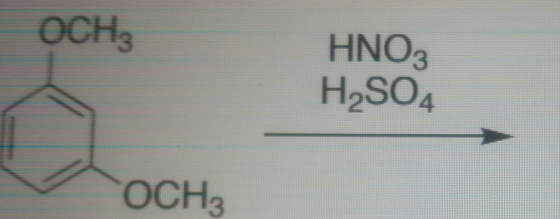
Homework Answers
In electrophilic aromatic substitution reaction, as OMe are the
donating groups, therefore incoming NO2 electrophile will go on the
ortho and para to the methoxy group. Another forming products are
not that much stable. Bcoz three group are at the adjacent
positions. Therefore this product is not forming. 
Add Answer to:
1,3–Dimethoxybenzene (below) is very reactive toward
electrophilic aromatic substitution. Draw a complete mechanism for
the following...
Nitration of an aromatic ring involves an electrophilic substitution reaction. Draw the structure of the electrophile...
 Nitration of an aromatic ring involves an electrophilic
substitution reaction. Draw the structure of the electrophile that
is attacked by the aromatic ring and the intermediate formed after
attachment of the electrophile to the ring. Be sure to show formal
charges.
Nitration of an aromatic ring involves an electrophilic
substitution reaction. Draw the structure of the electrophile that
is attacked by the aromatic ring and the intermediate formed after
attachment of the electrophile to the ring. Be sure to show formal
charges.
For the following electrophilic aromatic substitution: a.) draw complete arrow pushing mechanism for the movement of...
 For the following electrophilic aromatic substitution: a.) draw complete arrow pushing mechanism for the movement of electrons to form product b.) draw arrow pushing for the formation of the electrophile c.) draw the major monoalkylated product Br. AlBr3
Electrophiles for the electrophilic aromatic substitution reactions have to be very strong to react with the...
 Electrophiles for the electrophilic aromatic substitution
reactions have to be very strong to react with the stable aromatic
rings. A nitronium ion is needed for nitration of aromatic rings.
Complete the mechanism of the formation of the nitronium ion from
concentrated nitric acid in concentrated sulfuric acid.
Electrophiles for the electrophilic aromatic substitution
reactions have to be very strong to react with the stable aromatic
rings. A nitronium ion is needed for nitration of aromatic rings.
Complete the mechanism of the formation of the nitronium ion from
concentrated nitric acid in concentrated sulfuric acid.
Pyrrole undergoes nitration by electrophilic aromatic substitution. Complete the mechanism by drawing curved arrows, the structure...
 Pyrrole undergoes nitration by electrophilic aromatic substitution.
Complete the mechanism by drawing curved arrows, the structure of
the charged intermediate, and the structure of the major uncharged
product. Omit electron lone pairs and bases.
Trole undergoes nitration by electrophilic aromatic substitution. Complete the mechanism by drawing curved arrows, the structure of the charged intermediate, and the structure of the major uncharged product. Omit electron lone pairs and bases.
Pyrrole undergoes nitration by electrophilic aromatic substitution.
Complete the mechanism by drawing curved arrows, the structure of
the charged intermediate, and the structure of the major uncharged
product. Omit electron lone pairs and bases.
Trole undergoes nitration by electrophilic aromatic substitution. Complete the mechanism by drawing curved arrows, the structure of the charged intermediate, and the structure of the major uncharged product. Omit electron lone pairs and bases.
For question 2) Electrophiles for the electrophilic aromatic substitution reactions have to be very strong to...
 For question 2) Electrophiles for the electrophilic aromatic
substitution reactions have to be very strong to react with the
stable aromatic rings. A nitronium ion is needed for nitration of
aromatic rings. Complete the mechanism of the formation of the
nitronium ion from concentrated nitric acid in concentrated
sulfuric acid.
Question 2 of 45 Add curved arrows. Hint Map Complete the structure and add curved arrows to show the formation of the nitronium. Draw the products. Previous Check Answer 0...
For question 2) Electrophiles for the electrophilic aromatic
substitution reactions have to be very strong to react with the
stable aromatic rings. A nitronium ion is needed for nitration of
aromatic rings. Complete the mechanism of the formation of the
nitronium ion from concentrated nitric acid in concentrated
sulfuric acid.
Question 2 of 45 Add curved arrows. Hint Map Complete the structure and add curved arrows to show the formation of the nitronium. Draw the products. Previous Check Answer 0...
Which of the following compounds is the most reactive toward electrophilic aromatic substitution? IV H III...
 Which of the following compounds is the most reactive toward electrophilic aromatic substitution? IV H III IT IN
250 ChemActivity 29 Electrophilic Aromatic Substitution no ChemActivity 29 Part A: Electrophilic Aromatic Substitution (What products...
 250 ChemActivity 29 Electrophilic Aromatic Substitution no ChemActivity 29 Part A: Electrophilic Aromatic Substitution (What products are formed when a strong electrophile is added to benzene?) Model 1: (review) Electrophilic Addition of HCI Rani o g cyclohexene carbocation intermediate Run 2 U X benzene This product carbocation intermediate DOES NOT Critical Thinking Questions 1 For Rxn I (above) draw curved arrows showing the mechanism of electrophilic addition of HCl. Include an appropriate carbocation intermediate in the box above. Figure 1:...
Please help... Need a detail Mechanism of this reaction. Thanks... Electrophilic aromatic substitution describes the reaction...
 Please help... Need a detail Mechanism of this reaction.
Thanks...
Electrophilic aromatic substitution describes the reaction where a hydrogen from a benzene ring is replaced by an electrophile. Halogenation, nitration, sulfonation, alkylation and acylation are all possible using this type of reaction. The electrophile attacks the pi electrons of the aromatic ring, yielding a benzenonium ion. The substituted aromatic product is obtained when a proton is lost, restoring the aromatic system. If there is a substituent on the aromatic ring...
Please help... Need a detail Mechanism of this reaction.
Thanks...
Electrophilic aromatic substitution describes the reaction where a hydrogen from a benzene ring is replaced by an electrophile. Halogenation, nitration, sulfonation, alkylation and acylation are all possible using this type of reaction. The electrophile attacks the pi electrons of the aromatic ring, yielding a benzenonium ion. The substituted aromatic product is obtained when a proton is lost, restoring the aromatic system. If there is a substituent on the aromatic ring...
a) Complete the generic mechanism for an electrophilic aromatic substitution (EAS) reaction using El as the...
 a) Complete the generic mechanism for an electrophilic aromatic
substitution (EAS) reaction using El as the electrophile and show
how the sigma complex is resonance stabilized. Use curved arrows to
show the mechanism and the conversion between resonance structures.
Make sure to add any missing charges. Note the use of a generic
base in the last step. b) Label the reaction coordinate diagram for
a typical EAS reaction shown below by correctly placing the letter
for each structure on the...
a) Complete the generic mechanism for an electrophilic aromatic
substitution (EAS) reaction using El as the electrophile and show
how the sigma complex is resonance stabilized. Use curved arrows to
show the mechanism and the conversion between resonance structures.
Make sure to add any missing charges. Note the use of a generic
base in the last step. b) Label the reaction coordinate diagram for
a typical EAS reaction shown below by correctly placing the letter
for each structure on the...
Provide the reaction for chlorination of benzene using electrophilic aromatic substitution, it's complete mechanism including formation...
 Provide the reaction for chlorination of benzene using electrophilic aromatic substitution, it's complete mechanism including formation of "super" electrophile, and a completely labeled reaction coordinate energy diagram. 1.
 Nitration of an aromatic ring involves an electrophilic
substitution reaction. Draw the structure of the electrophile that
is attacked by the aromatic ring and the intermediate formed after
attachment of the electrophile to the ring. Be sure to show formal
charges.
Nitration of an aromatic ring involves an electrophilic
substitution reaction. Draw the structure of the electrophile that
is attacked by the aromatic ring and the intermediate formed after
attachment of the electrophile to the ring. Be sure to show formal
charges.
 For the following electrophilic aromatic substitution: a.) draw complete arrow pushing mechanism for the movement of electrons to form product b.) draw arrow pushing for the formation of the electrophile c.) draw the major monoalkylated product Br. AlBr3
 Electrophiles for the electrophilic aromatic substitution
reactions have to be very strong to react with the stable aromatic
rings. A nitronium ion is needed for nitration of aromatic rings.
Complete the mechanism of the formation of the nitronium ion from
concentrated nitric acid in concentrated sulfuric acid.
Electrophiles for the electrophilic aromatic substitution
reactions have to be very strong to react with the stable aromatic
rings. A nitronium ion is needed for nitration of aromatic rings.
Complete the mechanism of the formation of the nitronium ion from
concentrated nitric acid in concentrated sulfuric acid.
 Pyrrole undergoes nitration by electrophilic aromatic substitution.
Complete the mechanism by drawing curved arrows, the structure of
the charged intermediate, and the structure of the major uncharged
product. Omit electron lone pairs and bases.
Trole undergoes nitration by electrophilic aromatic substitution. Complete the mechanism by drawing curved arrows, the structure of the charged intermediate, and the structure of the major uncharged product. Omit electron lone pairs and bases.
Pyrrole undergoes nitration by electrophilic aromatic substitution.
Complete the mechanism by drawing curved arrows, the structure of
the charged intermediate, and the structure of the major uncharged
product. Omit electron lone pairs and bases.
Trole undergoes nitration by electrophilic aromatic substitution. Complete the mechanism by drawing curved arrows, the structure of the charged intermediate, and the structure of the major uncharged product. Omit electron lone pairs and bases.
 For question 2) Electrophiles for the electrophilic aromatic
substitution reactions have to be very strong to react with the
stable aromatic rings. A nitronium ion is needed for nitration of
aromatic rings. Complete the mechanism of the formation of the
nitronium ion from concentrated nitric acid in concentrated
sulfuric acid.
Question 2 of 45 Add curved arrows. Hint Map Complete the structure and add curved arrows to show the formation of the nitronium. Draw the products. Previous Check Answer 0...
For question 2) Electrophiles for the electrophilic aromatic
substitution reactions have to be very strong to react with the
stable aromatic rings. A nitronium ion is needed for nitration of
aromatic rings. Complete the mechanism of the formation of the
nitronium ion from concentrated nitric acid in concentrated
sulfuric acid.
Question 2 of 45 Add curved arrows. Hint Map Complete the structure and add curved arrows to show the formation of the nitronium. Draw the products. Previous Check Answer 0...
 Which of the following compounds is the most reactive toward electrophilic aromatic substitution? IV H III IT IN
 250 ChemActivity 29 Electrophilic Aromatic Substitution no ChemActivity 29 Part A: Electrophilic Aromatic Substitution (What products are formed when a strong electrophile is added to benzene?) Model 1: (review) Electrophilic Addition of HCI Rani o g cyclohexene carbocation intermediate Run 2 U X benzene This product carbocation intermediate DOES NOT Critical Thinking Questions 1 For Rxn I (above) draw curved arrows showing the mechanism of electrophilic addition of HCl. Include an appropriate carbocation intermediate in the box above. Figure 1:...
 Please help... Need a detail Mechanism of this reaction.
Thanks...
Electrophilic aromatic substitution describes the reaction where a hydrogen from a benzene ring is replaced by an electrophile. Halogenation, nitration, sulfonation, alkylation and acylation are all possible using this type of reaction. The electrophile attacks the pi electrons of the aromatic ring, yielding a benzenonium ion. The substituted aromatic product is obtained when a proton is lost, restoring the aromatic system. If there is a substituent on the aromatic ring...
Please help... Need a detail Mechanism of this reaction.
Thanks...
Electrophilic aromatic substitution describes the reaction where a hydrogen from a benzene ring is replaced by an electrophile. Halogenation, nitration, sulfonation, alkylation and acylation are all possible using this type of reaction. The electrophile attacks the pi electrons of the aromatic ring, yielding a benzenonium ion. The substituted aromatic product is obtained when a proton is lost, restoring the aromatic system. If there is a substituent on the aromatic ring...
 a) Complete the generic mechanism for an electrophilic aromatic
substitution (EAS) reaction using El as the electrophile and show
how the sigma complex is resonance stabilized. Use curved arrows to
show the mechanism and the conversion between resonance structures.
Make sure to add any missing charges. Note the use of a generic
base in the last step. b) Label the reaction coordinate diagram for
a typical EAS reaction shown below by correctly placing the letter
for each structure on the...
a) Complete the generic mechanism for an electrophilic aromatic
substitution (EAS) reaction using El as the electrophile and show
how the sigma complex is resonance stabilized. Use curved arrows to
show the mechanism and the conversion between resonance structures.
Make sure to add any missing charges. Note the use of a generic
base in the last step. b) Label the reaction coordinate diagram for
a typical EAS reaction shown below by correctly placing the letter
for each structure on the...
 Provide the reaction for chlorination of benzene using electrophilic aromatic substitution, it's complete mechanism including formation of "super" electrophile, and a completely labeled reaction coordinate energy diagram. 1.
Most questions answered within 3 hours.
-
Where is the error in this code sequence?
String s1 = "Hello";
String s2 = "ello";...
asked 10 months ago -
Financial data for Joel de Paris, Inc., for last year
follow:
Joel de Paris, Inc.
Balance...
asked 10 months ago -
Consider this reaction:
Al2(SO4)3 (aq)+ BaCl3
(aq) Al2Cl6 (aq)- +
3BaSO4(s) . What is the...
asked 10 months ago -
Suppose that Savneet is considering increasing her
recent random sample from 20 car rentals to 40...
asked 10 months ago -
Trucks arrive at an unloading terminal at an average rate of 120
per hour.
Trucks arrive...
asked 10 months ago -
Why are methanol and ethanol completely soluble in water while
octanol is not very little soluble....
asked 10 months ago -
A facilities manager at a university reads in a research report
that the mean amount of...
asked 10 months ago -
When the CuSO4 is rehydrated by adding water to the anhydrous
compound, is this an endothermic...
asked 10 months ago -
A ray of sunlight is passing from diamond into crown glass; the
angle of incidence is...
asked 10 months ago -
A block of mass 0.249 kg is placed on top of a light, vertical
spring of...
asked 10 months ago -
how do the kidneys compensate in the presences of acidosis
a) trigger hyperventilate
b) reserve acid...
asked 10 months ago -
Question 501 pts
The rental rate of capital to the firm increases. Which of the
following...
asked 10 months ago