![Use the recurrence relation (l1)P+1-(21 +1)xP IP-1 to compute 70r15a)] Also, directly compute P6() and P(). [P(x)63r to show their orthogonality P)P4(x) da](http://img.homeworklib.com/questions/df955ee0-419f-11ec-a0d9-97154dd872be.png?x-oss-process=image/resize,w_560)
Homework Answers


Add Answer to:
Use the recurrence relation (l1)P+1-(21 +1)xP IP-1 to compute 70r15a)] Also, directly compute P6() and P()....
Show that the recurrence relation 1/(x) = } ["n–1(x) – In+1 (x)] follows directly from differentiation...
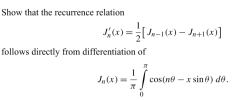 Show that the recurrence relation 1/(x) = } ["n–1(x) – In+1 (x)] follows directly from differentiation of cos (nᎾ - x sin Ꮎ ) dᎾ . ]
3. Use the recurrence relation to obtain ex ,P(x),P,(z),B(x), assuming that P)(z) = i. Pi (x)-z. ...
 3. Use the recurrence relation to obtain ex ,P(x),P,(z),B(x), assuming that P)(z) = i. Pi (x)-z. Then sketch the graphs of P,.(x) for n-0. Î,2.3.4.5 İn the interval-1-z-i in one Figure. You may use any software to produce the graphs. pressions for the Legendre polynomials P2(r)
3. Use the recurrence relation to obtain ex ,P(x),P,(z),B(x), assuming that P)(z) = i. Pi (x)-z. Then sketch the graphs of P,.(x) for n-0. Î,2.3.4.5 İn the interval-1-z-i in one Figure. You may use...
3. Use the recurrence relation to obtain ex ,P(x),P,(z),B(x), assuming that P)(z) = i. Pi (x)-z. Then sketch the graphs of P,.(x) for n-0. Î,2.3.4.5 İn the interval-1-z-i in one Figure. You may use any software to produce the graphs. pressions for the Legendre polynomials P2(r)
3. Use the recurrence relation to obtain ex ,P(x),P,(z),B(x), assuming that P)(z) = i. Pi (x)-z. Then sketch the graphs of P,.(x) for n-0. Î,2.3.4.5 İn the interval-1-z-i in one Figure. You may use...
1 Solve by using power series: 2)-y = ex. Find the recurrence relation and compute the...
 1 Solve by using power series: 2)-y = ex. Find the recurrence relation and compute the first 6 coefficients (a -as). Use the methods of chapter 3 to solve the differential equation and show your chapter 8 solution is equivalent to your chapter 3 solution.
Question 1. A linear homogeneous recurrence relation of degree 2 with constant coefficients is a recurrence...
 Question 1. A linear homogeneous recurrence relation of degree 2 with constant coefficients is a recurrence relation of the form an = Cian-1 + c2an-2, for real constants Ci and C2, and all n 2. Show that if an = r" for some constant r, then r must satisfy the characteristic equation, p2 - cir= c = 0. Question 2. Given a linear homogeneous recurrence relation of degree 2 with constant coefficients, the solutions of its characteristic equation are called...
1. Use the fact that Se-** dx = VTT to show that 21% = xp (x)...
 1. Use the fact that Se-** dx = VTT to show that 21% = xp (x) u-/.I O 41 = DE OS (G) 21} = xpx-ə x1 T (8) 41} = xp_x_@zx T O 11 = xp (2)
Consider the Catalan numbers P(n) described here (it is also described on page 372 of the...
Consider the Catalan numbers P(n) described here (it is also described on page 372 of the book). Show a recursion-dependence tree for P(5) according to the recurrence relation. Design a bottom-up dynamic programming algorithm to compute P(n) based on the recurrence relation (without using the formula P(n) = (2n−2)!/(n!(n−1)!)). Analyze its asymptotic runtime efficiency. Design a top-down memoized algorithm to compute P(n) based on the recurrence relation (without using the formula P(n) = (2n−2)!/(n!(n−1)!)). Analyze its asymptotic runtime efficiency.
Need answers for 1-5 Consider the following recurrence relation: H(n) = {0 if n lessthanorequalto 0...
 Need answers for 1-5
Consider the following recurrence relation: H(n) = {0 if n lessthanorequalto 0 1 if n = 1 or n = 2 H(n - 1) + H (n - 2)-H(n - 3) if n > 2. (a) Compute H(n) for n = 1, 2, ...., 10. (b) Using the pattern from part (a), guess what H(100) is. 2. Consider the recurrence relation defined in Example 3.3 (FROM TEXT BOOK, also discussed in class and shown in slides)...
Need answers for 1-5
Consider the following recurrence relation: H(n) = {0 if n lessthanorequalto 0 1 if n = 1 or n = 2 H(n - 1) + H (n - 2)-H(n - 3) if n > 2. (a) Compute H(n) for n = 1, 2, ...., 10. (b) Using the pattern from part (a), guess what H(100) is. 2. Consider the recurrence relation defined in Example 3.3 (FROM TEXT BOOK, also discussed in class and shown in slides)...
5. Let F(n, m) denote the number of paths from top-left cell to bottom-right cell in a (n x m) grid (that only permits moving right or moving down). It satisfies the recurrence relation F(n, m) F(n-1...
 5. Let F(n, m) denote the number of paths from top-left cell to bottom-right cell in a (n x m) grid (that only permits moving right or moving down). It satisfies the recurrence relation F(n, m) F(n-1, m) + F(n, m-1) What should be the initial condition for this recurrence relation? (Hint: What would be the number of paths if there was only a single row or a single column in the grid?)[5] Convince yourself that F(n, m) gives correct...
could u help me for this question?thanku!! 21. Let T be a linear transformation from P2 into P3 over R defined by T(p(x)) xp(x). (a) Find [T]B.A the matrix of T relative to the bases A = {1-x, l-x...
 could u help me for this question?thanku!!
21. Let T be a linear transformation from P2 into P3 over R defined by T(p(x)) xp(x). (a) Find [T]B.A the matrix of T relative to the bases A = {1-x, l-x2,x) and B={1,1+x, 1 +x+12, 1-x3}. (b) Use [TlB. A to find a basis for the range of T. (c) Use TB.A to find a basis for the kernel of T. (d) State the rank and nullity of T.
21. Let T...
could u help me for this question?thanku!!
21. Let T be a linear transformation from P2 into P3 over R defined by T(p(x)) xp(x). (a) Find [T]B.A the matrix of T relative to the bases A = {1-x, l-x2,x) and B={1,1+x, 1 +x+12, 1-x3}. (b) Use [TlB. A to find a basis for the range of T. (c) Use TB.A to find a basis for the kernel of T. (d) State the rank and nullity of T.
21. Let T...
5. Suppose XExp(A). (a) [5 pts) Show that E(X) 1/A. Hint: You can directly use the...
 5. Suppose XExp(A). (a) [5 pts) Show that E(X) 1/A. Hint: You can directly use the definition and properties of a gamma function.] (b) [5 pts] Prove that P(X > t +s | X > s) = P(X > t) for s, t > 0, [Hint: You can directly use the tail probablity P(X >) e for 0.]
 Show that the recurrence relation 1/(x) = } ["n–1(x) – In+1 (x)] follows directly from differentiation of cos (nᎾ - x sin Ꮎ ) dᎾ . ]
 3. Use the recurrence relation to obtain ex ,P(x),P,(z),B(x), assuming that P)(z) = i. Pi (x)-z. Then sketch the graphs of P,.(x) for n-0. Î,2.3.4.5 İn the interval-1-z-i in one Figure. You may use any software to produce the graphs. pressions for the Legendre polynomials P2(r)
3. Use the recurrence relation to obtain ex ,P(x),P,(z),B(x), assuming that P)(z) = i. Pi (x)-z. Then sketch the graphs of P,.(x) for n-0. Î,2.3.4.5 İn the interval-1-z-i in one Figure. You may use...
3. Use the recurrence relation to obtain ex ,P(x),P,(z),B(x), assuming that P)(z) = i. Pi (x)-z. Then sketch the graphs of P,.(x) for n-0. Î,2.3.4.5 İn the interval-1-z-i in one Figure. You may use any software to produce the graphs. pressions for the Legendre polynomials P2(r)
3. Use the recurrence relation to obtain ex ,P(x),P,(z),B(x), assuming that P)(z) = i. Pi (x)-z. Then sketch the graphs of P,.(x) for n-0. Î,2.3.4.5 İn the interval-1-z-i in one Figure. You may use...
 1 Solve by using power series: 2)-y = ex. Find the recurrence relation and compute the first 6 coefficients (a -as). Use the methods of chapter 3 to solve the differential equation and show your chapter 8 solution is equivalent to your chapter 3 solution.
 Question 1. A linear homogeneous recurrence relation of degree 2 with constant coefficients is a recurrence relation of the form an = Cian-1 + c2an-2, for real constants Ci and C2, and all n 2. Show that if an = r" for some constant r, then r must satisfy the characteristic equation, p2 - cir= c = 0. Question 2. Given a linear homogeneous recurrence relation of degree 2 with constant coefficients, the solutions of its characteristic equation are called...
 1. Use the fact that Se-** dx = VTT to show that 21% = xp (x) u-/.I O 41 = DE OS (G) 21} = xpx-ə x1 T (8) 41} = xp_x_@zx T O 11 = xp (2)
 Need answers for 1-5
Consider the following recurrence relation: H(n) = {0 if n lessthanorequalto 0 1 if n = 1 or n = 2 H(n - 1) + H (n - 2)-H(n - 3) if n > 2. (a) Compute H(n) for n = 1, 2, ...., 10. (b) Using the pattern from part (a), guess what H(100) is. 2. Consider the recurrence relation defined in Example 3.3 (FROM TEXT BOOK, also discussed in class and shown in slides)...
Need answers for 1-5
Consider the following recurrence relation: H(n) = {0 if n lessthanorequalto 0 1 if n = 1 or n = 2 H(n - 1) + H (n - 2)-H(n - 3) if n > 2. (a) Compute H(n) for n = 1, 2, ...., 10. (b) Using the pattern from part (a), guess what H(100) is. 2. Consider the recurrence relation defined in Example 3.3 (FROM TEXT BOOK, also discussed in class and shown in slides)...
 5. Let F(n, m) denote the number of paths from top-left cell to bottom-right cell in a (n x m) grid (that only permits moving right or moving down). It satisfies the recurrence relation F(n, m) F(n-1, m) + F(n, m-1) What should be the initial condition for this recurrence relation? (Hint: What would be the number of paths if there was only a single row or a single column in the grid?)[5] Convince yourself that F(n, m) gives correct...
 could u help me for this question?thanku!!
21. Let T be a linear transformation from P2 into P3 over R defined by T(p(x)) xp(x). (a) Find [T]B.A the matrix of T relative to the bases A = {1-x, l-x2,x) and B={1,1+x, 1 +x+12, 1-x3}. (b) Use [TlB. A to find a basis for the range of T. (c) Use TB.A to find a basis for the kernel of T. (d) State the rank and nullity of T.
21. Let T...
could u help me for this question?thanku!!
21. Let T be a linear transformation from P2 into P3 over R defined by T(p(x)) xp(x). (a) Find [T]B.A the matrix of T relative to the bases A = {1-x, l-x2,x) and B={1,1+x, 1 +x+12, 1-x3}. (b) Use [TlB. A to find a basis for the range of T. (c) Use TB.A to find a basis for the kernel of T. (d) State the rank and nullity of T.
21. Let T...
 5. Suppose XExp(A). (a) [5 pts) Show that E(X) 1/A. Hint: You can directly use the definition and properties of a gamma function.] (b) [5 pts] Prove that P(X > t +s | X > s) = P(X > t) for s, t > 0, [Hint: You can directly use the tail probablity P(X >) e for 0.]
Most questions answered within 3 hours.
-
Where is the error in this code sequence?
String s1 = "Hello";
String s2 = "ello";...
asked 10 months ago -
Financial data for Joel de Paris, Inc., for last year
follow:
Joel de Paris, Inc.
Balance...
asked 10 months ago -
Consider this reaction:
Al2(SO4)3 (aq)+ BaCl3
(aq) Al2Cl6 (aq)- +
3BaSO4(s) . What is the...
asked 10 months ago -
Suppose that Savneet is considering increasing her
recent random sample from 20 car rentals to 40...
asked 10 months ago -
Trucks arrive at an unloading terminal at an average rate of 120
per hour.
Trucks arrive...
asked 10 months ago -
Why are methanol and ethanol completely soluble in water while
octanol is not very little soluble....
asked 10 months ago -
A facilities manager at a university reads in a research report
that the mean amount of...
asked 10 months ago -
When the CuSO4 is rehydrated by adding water to the anhydrous
compound, is this an endothermic...
asked 10 months ago -
A ray of sunlight is passing from diamond into crown glass; the
angle of incidence is...
asked 10 months ago -
A block of mass 0.249 kg is placed on top of a light, vertical
spring of...
asked 10 months ago -
how do the kidneys compensate in the presences of acidosis
a) trigger hyperventilate
b) reserve acid...
asked 10 months ago -
Question 501 pts
The rental rate of capital to the firm increases. Which of the
following...
asked 10 months ago