Draw a labelled diagram showing the atomic orbitals for N and O on each side and...
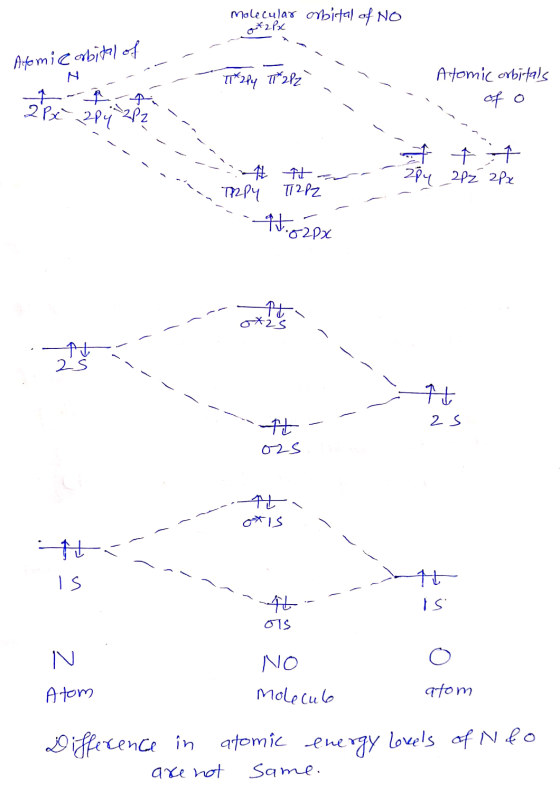
Draw a labelled diagram showing the atomic orbitals for N and O on each side and the molecular orbitals for NO, in the middle. The diagram should clearly show: which atomic orbitals combine to form each molecular orbital, the relative position (increasing energy going up the page) of the molecular orbitals and the locations of electrons in the atomic orbitals and in the molecular orbitals. Use your diagram to determine the following:
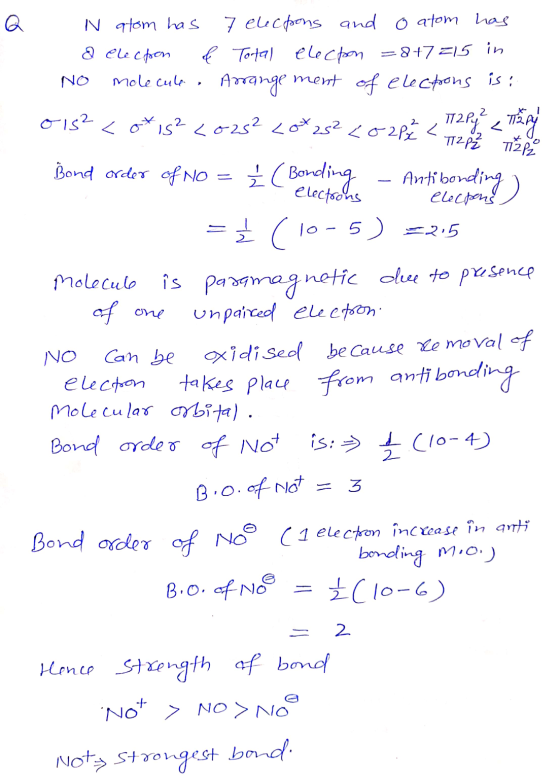
What is the bond order?
Explain how you obtained this number from your MO diagram. Is the molecule diamagnetic or paramagnetic?
Explain how you deduced this from your MO diagram. NO can be either oxidised or reduced by one electron, to form the cation NO+ and the anion NO–, respectively. Which of these three compounds has the strongest bond? Explain with reference to your MO diagram.
Homework Answers
Add Answer to:
Draw a labelled diagram showing the atomic orbitals for N and O
on each side and...
5. Draw the molecular orbital diagram for N2. Label all of the atomic orbitals and molecular...
 5. Draw the molecular orbital diagram for N2. Label all of the atomic orbitals and molecular orbitals and put the correct number of electrons in. You do not need to draw the shapes of any of the orbitals. a) MO diagram b) Based on your MO diagram, is N2 diamagnetic or paramagnetic? c) Calculate the bond order for N2.
For each of the following examples, (a) Draw a molecular orbital diagram. Include both the atomic...
For each of the following examples, (a) Draw a molecular orbital diagram. Include both the atomic orbitals that combine and the molecular orbitals that are formed. Clearly show the relative energies of all orbitals. Label all orbitals and show the appropriate number of electrons in the molecular orbitals. Give both labeling conventions (e.g. sigma2s and 1sigmag) for each of the molecular orbitals. You do not have to sketch the actual orbitals. (b) Give the bond order. (c) Indicate the effect...
13. (14 pts) MO Theory Draw the complete (core and valence) molecular orbital energy level diagram...
 13. (14 pts) MO Theory Draw the complete (core and valence) molecular orbital energy level diagram for the homonuclear diatomic molecule Be2. Use standard MO symbols to label the energy levels (That is: o, o, , or n*, as needed, with subscripts indicating which atomic orbitals formed them.) a. Sketch the molecular orbital formed when two 2p orbitals, one each on each Be atom, overlap to form a o antibonding MO b. Using your MO energy level diagram in (a),...
(a) Draw a molecular orbital energy diagram for Cl2 and show which orbitals are occupied with...
 (a) Draw a molecular orbital energy diagram for Cl2 and show which orbitals are occupied with electrons. (b) How many bands are expected in the photoelectron spectrum of the valence electrons for Cl2? Why? (c) Draw the shape of the r* orbital in Cl2. (d) What is the bond order for Cl2? (e) Is Cl2 diamagnetic or paramagnetic?
5. Molecular orbitals are formed by the overlap of atomic orbitals. Thus, n atomic orbitals can combine (overlap) t...
 5. Molecular orbitals are formed by the overlap of atomic orbitals. Thus, n atomic orbitals can combine (overlap) to form n molecular orbitals. In 1,3-butadiene there are four atomic p orbitals which can combine to form four 7 molecular orbitals. In ethene there are two atomic p orbitals which can combine to form two y molecular orbitals. The drawings below show the different ways in which the p orbitals of ethene and 1,3- butadiene can be combined to form the...
(a) Draw a molecular orbital energy diagram for Cl2 and show which orbitals are occupied with electrons. (b) How many ba...
(a) Draw a molecular orbital energy diagram for Cl2 and show which orbitals are occupied with electrons. (b) How many bands are expected in the photoelectron spectrum of the valence electrons for Cl2? Why? (c) Draw the shape of the pi* orbital in Cl2. (d) What is the bond order for Cl2? (e) Is Cl2 diamagnetic or paramagnetic?
7. Without using hybridization, construct a reasonable molecular orbital diagram showing the interaction between the oxygen...
 7. Without using hybridization, construct a reasonable molecular orbital diagram showing the interaction between the oxygen and the fluorines for OFs (oxygen is the central atom). Your diagram must account for the following: OFs is diamagnetic. OF, is paramagnetic. relative to OFs, the bond order for OF3 decreases. . relative to OF,, the bond order for OF, does not change. relative to OF, , the bond order for OF, does not change. For full credit, you must: . label the...
Consider two 2p orbitals, one on each of two different atoms, oriented side-to-side, as in the...
 Consider two 2p orbitals, one on each of two different atoms, oriented side-to-side, as in the figure. Imagine bringing these nuclei together so that overlap occurs as shown in the figure. This overlap results in a system of molecular orbitals. (Scroll down to answer part "c)".) a) Below, construct an orbital interaction diagram for molecular orbital formation by dragging the images triat represent various orbital types (e.g., atomic, bonding, antibonding) into the relevant boxes. b) Identify the number of nodes in each...
Illustrate with a picture how a H 1s atomic orbital and a F2p a form bonding...
 Illustrate with a picture how a H 1s atomic orbital and a F2p a form bonding and antibonding molecular orbitals in the HF m 3. mustrate 4. What is the bond order for HFT 5. Is the HF molecule predicted to be paramagnetic or diamagnetic? Use the MO diagram to predict where the electron density in the HF bond lies, closer to the H atom or closer to the F atom? Explain. 6. 7. Now draw the Lewis structure for...
4. On the basis of molecular orbitals and molecular orbital diagrams, predict which molecule in each...
 4. On the basis of molecular orbitals and molecular orbital diagrams, predict which molecule in each series will have the longest bond. Be sure to provide a brief explanation a. B2, B2 b. 02*, 0,- c. HHe", Hz 5. Consider the hydroxide ion, OH and do the following: a. Prepare a molecular orbital diagram and fill with electrons given the following atomic orbital potential energies: O(2s) = -32.3 eV, O(2p) = -15.8 eV, H(s) -13.6 eV. Be sure to label...
 5. Draw the molecular orbital diagram for N2. Label all of the atomic orbitals and molecular orbitals and put the correct number of electrons in. You do not need to draw the shapes of any of the orbitals. a) MO diagram b) Based on your MO diagram, is N2 diamagnetic or paramagnetic? c) Calculate the bond order for N2.
 13. (14 pts) MO Theory Draw the complete (core and valence) molecular orbital energy level diagram for the homonuclear diatomic molecule Be2. Use standard MO symbols to label the energy levels (That is: o, o, , or n*, as needed, with subscripts indicating which atomic orbitals formed them.) a. Sketch the molecular orbital formed when two 2p orbitals, one each on each Be atom, overlap to form a o antibonding MO b. Using your MO energy level diagram in (a),...
 (a) Draw a molecular orbital energy diagram for Cl2 and show which orbitals are occupied with electrons. (b) How many bands are expected in the photoelectron spectrum of the valence electrons for Cl2? Why? (c) Draw the shape of the r* orbital in Cl2. (d) What is the bond order for Cl2? (e) Is Cl2 diamagnetic or paramagnetic?
 5. Molecular orbitals are formed by the overlap of atomic orbitals. Thus, n atomic orbitals can combine (overlap) to form n molecular orbitals. In 1,3-butadiene there are four atomic p orbitals which can combine to form four 7 molecular orbitals. In ethene there are two atomic p orbitals which can combine to form two y molecular orbitals. The drawings below show the different ways in which the p orbitals of ethene and 1,3- butadiene can be combined to form the...
 7. Without using hybridization, construct a reasonable molecular orbital diagram showing the interaction between the oxygen and the fluorines for OFs (oxygen is the central atom). Your diagram must account for the following: OFs is diamagnetic. OF, is paramagnetic. relative to OFs, the bond order for OF3 decreases. . relative to OF,, the bond order for OF, does not change. relative to OF, , the bond order for OF, does not change. For full credit, you must: . label the...
 Illustrate with a picture how a H 1s atomic orbital and a F2p a form bonding and antibonding molecular orbitals in the HF m 3. mustrate 4. What is the bond order for HFT 5. Is the HF molecule predicted to be paramagnetic or diamagnetic? Use the MO diagram to predict where the electron density in the HF bond lies, closer to the H atom or closer to the F atom? Explain. 6. 7. Now draw the Lewis structure for...
 4. On the basis of molecular orbitals and molecular orbital diagrams, predict which molecule in each series will have the longest bond. Be sure to provide a brief explanation a. B2, B2 b. 02*, 0,- c. HHe", Hz 5. Consider the hydroxide ion, OH and do the following: a. Prepare a molecular orbital diagram and fill with electrons given the following atomic orbital potential energies: O(2s) = -32.3 eV, O(2p) = -15.8 eV, H(s) -13.6 eV. Be sure to label...
Most questions answered within 3 hours.
-
Where is the error in this code sequence?
String s1 = "Hello";
String s2 = "ello";...
asked 10 months ago -
Financial data for Joel de Paris, Inc., for last year
follow:
Joel de Paris, Inc.
Balance...
asked 10 months ago -
Consider this reaction:
Al2(SO4)3 (aq)+ BaCl3
(aq) Al2Cl6 (aq)- +
3BaSO4(s) . What is the...
asked 10 months ago -
Suppose that Savneet is considering increasing her
recent random sample from 20 car rentals to 40...
asked 10 months ago -
Trucks arrive at an unloading terminal at an average rate of 120
per hour.
Trucks arrive...
asked 10 months ago -
Why are methanol and ethanol completely soluble in water while
octanol is not very little soluble....
asked 10 months ago -
A facilities manager at a university reads in a research report
that the mean amount of...
asked 10 months ago -
When the CuSO4 is rehydrated by adding water to the anhydrous
compound, is this an endothermic...
asked 10 months ago -
A ray of sunlight is passing from diamond into crown glass; the
angle of incidence is...
asked 10 months ago -
A block of mass 0.249 kg is placed on top of a light, vertical
spring of...
asked 10 months ago -
how do the kidneys compensate in the presences of acidosis
a) trigger hyperventilate
b) reserve acid...
asked 10 months ago -
Question 501 pts
The rental rate of capital to the firm increases. Which of the
following...
asked 10 months ago