
Homework Answers
Hello dear if you have any doubt please comment happy HomeworkLibing keep smiling.:))
Add Answer to:
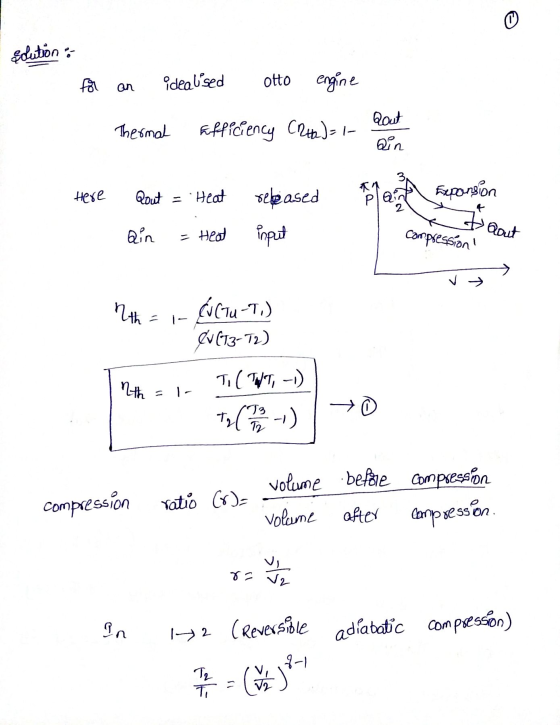
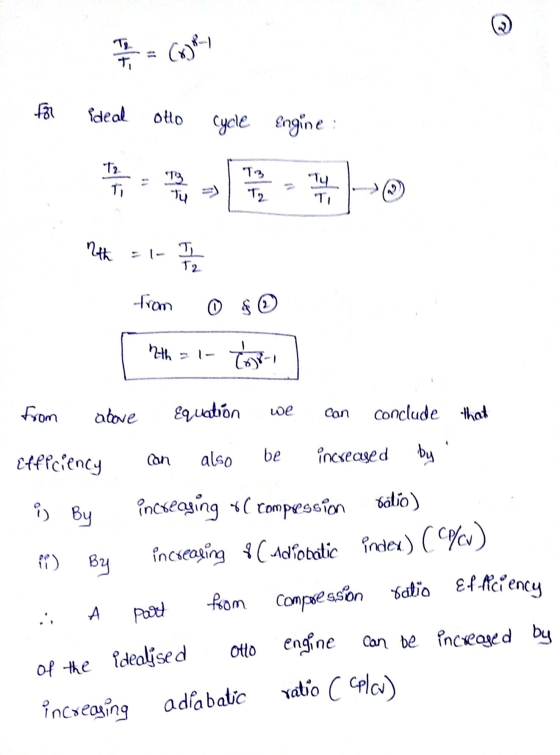
Q7. Apart from raising the compression ratio of an idealised Otto engine, how else can the...
Q1 Otto Cycle Bookwork Question An air standard Otto cycle:- 1. Draws air from the environment...
 Q1 Otto Cycle Bookwork Question An air standard Otto cycle:- 1. Draws air from the environment at 100 kPa and 5°C. 2. The cycle has a compression ratio of 9.2: 1. 3. Heat (880 kJ/kg) is added to the compressed gases at constant volume. 4. The working fluid is air, a perfect gas with ratio of specific heats y = 1.4 and gas constant R = 287 J/kgk. Follow the instructions below: a) Describe each of the four processes from...
4. A4.6 L spark ignition engine operates on the ideal Otto cycle with a compression ratio of 10. At the beginning of the compression process the air is at 107 kPa and 21 C. The maximum cycle temp...
 4. A4.6 L spark ignition engine operates on the ideal Otto cycle with a compression ratio of 10. At the beginning of the compression process the air is at 107 kPa and 21 C. The maximum cycle temperature is 1116°C. Accounting for variable specific heats, determine: (a) the heat addition per cycle in kJ. Ans: 3.368 kJ (b) the net work per cycle in kJ. Ans: 1.907 kJ (c) the mean effective pressure in kPa. Ans: 460.6 kPa (d) the...
An Otto engine is operating with natural gas which can be approximated as an ideal gas....
An Otto engine is operating with natural gas which can be approximated as an ideal gas. Assuming the engine is at standard condition (25°C, 1 atm) before the compression process. Also, temperature of the Otto cycle after the combustion process is 1500 K. (a) Assuming compression ratio of the Otto engine as 8, 9 and 10, determine the corresponding temperatures of the natural gas-air mixture (natural gas with 100% excess air) after the compression. (b) Determine the thermal energy release...
A spark ignition engine works with an Otto cycle that has the following characteristics: Q =...
A spark ignition engine works with an Otto cycle that has the following characteristics: Q = 42000 kJ / kg, P1=90kPa, T1 = 30 ° C, and rc=8. It is desired to increase the power of the motor by increasing the work indicated using a fuel with a higher calorific value or by varying the compression ratio. a) What is the indicated work increase if the compression ratio is increased from 8 to 10? b) How much should the heat...
assuming : T1 = 298°k p1= 101Kpa compression ratio 8.8 air fuel ratio = 15 displcement...
 assuming :
T1 = 298°k
p1= 101Kpa
compression ratio 8.8
air fuel ratio = 15
displcement 242 cu in.
6cylinder
Step 5: Otto/Diesel Cycle Approximation, Conduct a thermodynamic analysis (temp and pressure at each state) using the appropriate idealized cycle (Otto or Diesel) and cold air standard assumptions. State 1 should be approximately ambient (unless turbo/supercharged) and state 2 can be found using your compression ratio and isentropic relationships. State 3 carn be found using the heat input from Step...
assuming :
T1 = 298°k
p1= 101Kpa
compression ratio 8.8
air fuel ratio = 15
displcement 242 cu in.
6cylinder
Step 5: Otto/Diesel Cycle Approximation, Conduct a thermodynamic analysis (temp and pressure at each state) using the appropriate idealized cycle (Otto or Diesel) and cold air standard assumptions. State 1 should be approximately ambient (unless turbo/supercharged) and state 2 can be found using your compression ratio and isentropic relationships. State 3 carn be found using the heat input from Step...
Q6. (a) Using appropriate diagrams to support your answer: (i) Briefly describe the Otto cycle [3...
 Q6. (a) Using appropriate diagrams to support your answer: (i) Briefly describe the Otto cycle [3 marks] (ii) Briefly describe the actual spark ignition engine cycle [3 marks] (iii) Discuss the differences between i and ii above. [4 marks] (b) 1 kg of air is taken through constant volume cycle. At the commencement of the adiabatic compression, the pressure and temperature are 90 kN/m² and 20°C, respectively. The adiabatic compression has a volume ratio of 7.5:1. The maximum pressure of...
Problem #3 (Total marks-14) Given: An engine has the following operating conditions per air-standard Otto cycle:...
 Problem #3 (Total marks-14) Given: An engine has the following operating conditions per air-standard Otto cycle: Gasolina (SI) TYCO engine Pressure at beginning of compression process (Pal state 1 Temperature at beginning of compression process state 1) Volumetric compression ratio , Specific heat added during combustion process ( k g) (process 273) 300 1400 Data used for constant Specific Heat (standard cold-air assumption) Method: Ic ... 1.005 kJ/kg. K(C) = 0.718 kJ/kg.K. k=1.400, R -0.287 kJkgK Required: Draw a clear...
A friend passionate about cars mentions that Toyota has developed an engine with a thermal efficiency...
A friend passionate about cars mentions that Toyota has developed an engine with a thermal efficiency of 40% which is an extraordinary accomplishment! 1) Supposing this engine is ideal and based on the Carnot cycle, and also assuming that the cold reservoir temperature is 300 K, what is the hot reservoir temperature to meet the stated efficiency? You mention your result to this friend who points out correctly that the temperature of the hot reservoir would essentially be the temperature...
A four-cylinder four-stroke engine is modelled using the air standard Otto cycle (two engine revolutions per...
 A four-cylinder four-stroke engine is modelled using the air
standard Otto cycle (two engine revolutions per cycle). Given the
conditions at state 1, total volume (V1) of each cylinder,
compression ratio (r), rate of heat addition (Q), and engine speed
in RPM, determine the efficiency and other values listed below. The
gas constant for air is R=0.287 kJ/kg-K.
--Given Values--
T1 (K) = 335
P1 (kPa) = 175
V1 (cm^3) = 600
r = 11
Q (kW) = 57
Speed...
A four-cylinder four-stroke engine is modelled using the air
standard Otto cycle (two engine revolutions per cycle). Given the
conditions at state 1, total volume (V1) of each cylinder,
compression ratio (r), rate of heat addition (Q), and engine speed
in RPM, determine the efficiency and other values listed below. The
gas constant for air is R=0.287 kJ/kg-K.
--Given Values--
T1 (K) = 335
P1 (kPa) = 175
V1 (cm^3) = 600
r = 11
Q (kW) = 57
Speed...
A Student cycle engine is analyzed using the cold air-standard method. Given the definition of each...
A Student cycle engine is analyzed using the cold air-standard method. Given the definition of each process in the cycle, determine the thermal efficiency of the engine for each set of defined ratios listed below. All ratios are given as the larger value over the smaller one. --Given Values-- Process 1-2 = Isentropic compression & volume ratio=rv12 Process 2-3 = Isobaric compression & volume ratio=rv23 Process 3-4 = Isometric heat addition & temperature ratio=rT34 Process 4-5 = Isobaric heat addition...
 Q1 Otto Cycle Bookwork Question An air standard Otto cycle:- 1. Draws air from the environment at 100 kPa and 5°C. 2. The cycle has a compression ratio of 9.2: 1. 3. Heat (880 kJ/kg) is added to the compressed gases at constant volume. 4. The working fluid is air, a perfect gas with ratio of specific heats y = 1.4 and gas constant R = 287 J/kgk. Follow the instructions below: a) Describe each of the four processes from...
 4. A4.6 L spark ignition engine operates on the ideal Otto cycle with a compression ratio of 10. At the beginning of the compression process the air is at 107 kPa and 21 C. The maximum cycle temperature is 1116°C. Accounting for variable specific heats, determine: (a) the heat addition per cycle in kJ. Ans: 3.368 kJ (b) the net work per cycle in kJ. Ans: 1.907 kJ (c) the mean effective pressure in kPa. Ans: 460.6 kPa (d) the...
 assuming :
T1 = 298°k
p1= 101Kpa
compression ratio 8.8
air fuel ratio = 15
displcement 242 cu in.
6cylinder
Step 5: Otto/Diesel Cycle Approximation, Conduct a thermodynamic analysis (temp and pressure at each state) using the appropriate idealized cycle (Otto or Diesel) and cold air standard assumptions. State 1 should be approximately ambient (unless turbo/supercharged) and state 2 can be found using your compression ratio and isentropic relationships. State 3 carn be found using the heat input from Step...
assuming :
T1 = 298°k
p1= 101Kpa
compression ratio 8.8
air fuel ratio = 15
displcement 242 cu in.
6cylinder
Step 5: Otto/Diesel Cycle Approximation, Conduct a thermodynamic analysis (temp and pressure at each state) using the appropriate idealized cycle (Otto or Diesel) and cold air standard assumptions. State 1 should be approximately ambient (unless turbo/supercharged) and state 2 can be found using your compression ratio and isentropic relationships. State 3 carn be found using the heat input from Step...
 Q6. (a) Using appropriate diagrams to support your answer: (i) Briefly describe the Otto cycle [3 marks] (ii) Briefly describe the actual spark ignition engine cycle [3 marks] (iii) Discuss the differences between i and ii above. [4 marks] (b) 1 kg of air is taken through constant volume cycle. At the commencement of the adiabatic compression, the pressure and temperature are 90 kN/m² and 20°C, respectively. The adiabatic compression has a volume ratio of 7.5:1. The maximum pressure of...
 Problem #3 (Total marks-14) Given: An engine has the following operating conditions per air-standard Otto cycle: Gasolina (SI) TYCO engine Pressure at beginning of compression process (Pal state 1 Temperature at beginning of compression process state 1) Volumetric compression ratio , Specific heat added during combustion process ( k g) (process 273) 300 1400 Data used for constant Specific Heat (standard cold-air assumption) Method: Ic ... 1.005 kJ/kg. K(C) = 0.718 kJ/kg.K. k=1.400, R -0.287 kJkgK Required: Draw a clear...
 A four-cylinder four-stroke engine is modelled using the air
standard Otto cycle (two engine revolutions per cycle). Given the
conditions at state 1, total volume (V1) of each cylinder,
compression ratio (r), rate of heat addition (Q), and engine speed
in RPM, determine the efficiency and other values listed below. The
gas constant for air is R=0.287 kJ/kg-K.
--Given Values--
T1 (K) = 335
P1 (kPa) = 175
V1 (cm^3) = 600
r = 11
Q (kW) = 57
Speed...
A four-cylinder four-stroke engine is modelled using the air
standard Otto cycle (two engine revolutions per cycle). Given the
conditions at state 1, total volume (V1) of each cylinder,
compression ratio (r), rate of heat addition (Q), and engine speed
in RPM, determine the efficiency and other values listed below. The
gas constant for air is R=0.287 kJ/kg-K.
--Given Values--
T1 (K) = 335
P1 (kPa) = 175
V1 (cm^3) = 600
r = 11
Q (kW) = 57
Speed...
Most questions answered within 3 hours.
-
Where is the error in this code sequence?
String s1 = "Hello";
String s2 = "ello";...
asked 11 months ago -
Financial data for Joel de Paris, Inc., for last year
follow:
Joel de Paris, Inc.
Balance...
asked 11 months ago -
Consider this reaction:
Al2(SO4)3 (aq)+ BaCl3
(aq) Al2Cl6 (aq)- +
3BaSO4(s) . What is the...
asked 11 months ago -
Suppose that Savneet is considering increasing her
recent random sample from 20 car rentals to 40...
asked 11 months ago -
Trucks arrive at an unloading terminal at an average rate of 120
per hour.
Trucks arrive...
asked 11 months ago -
Why are methanol and ethanol completely soluble in water while
octanol is not very little soluble....
asked 11 months ago -
A facilities manager at a university reads in a research report
that the mean amount of...
asked 11 months ago -
When the CuSO4 is rehydrated by adding water to the anhydrous
compound, is this an endothermic...
asked 11 months ago -
A ray of sunlight is passing from diamond into crown glass; the
angle of incidence is...
asked 11 months ago -
A block of mass 0.249 kg is placed on top of a light, vertical
spring of...
asked 11 months ago -
how do the kidneys compensate in the presences of acidosis
a) trigger hyperventilate
b) reserve acid...
asked 11 months ago -
Question 501 pts
The rental rate of capital to the firm increases. Which of the
following...
asked 11 months ago