
Homework Answers
Add Answer to:
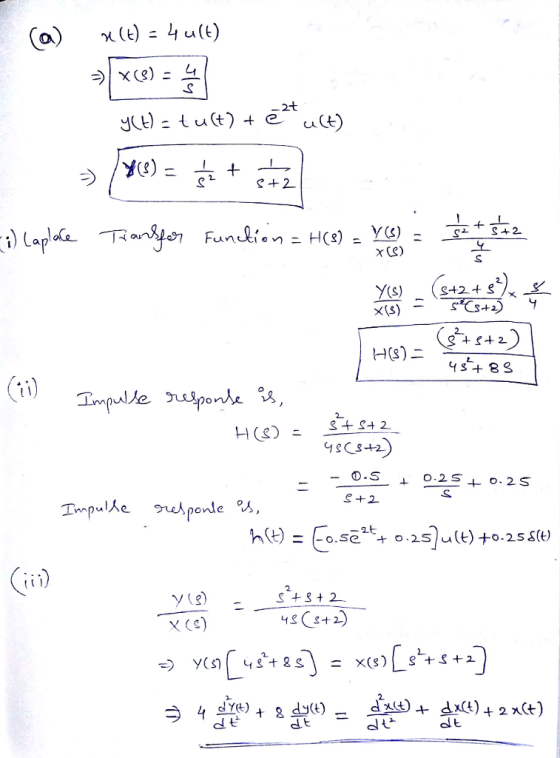
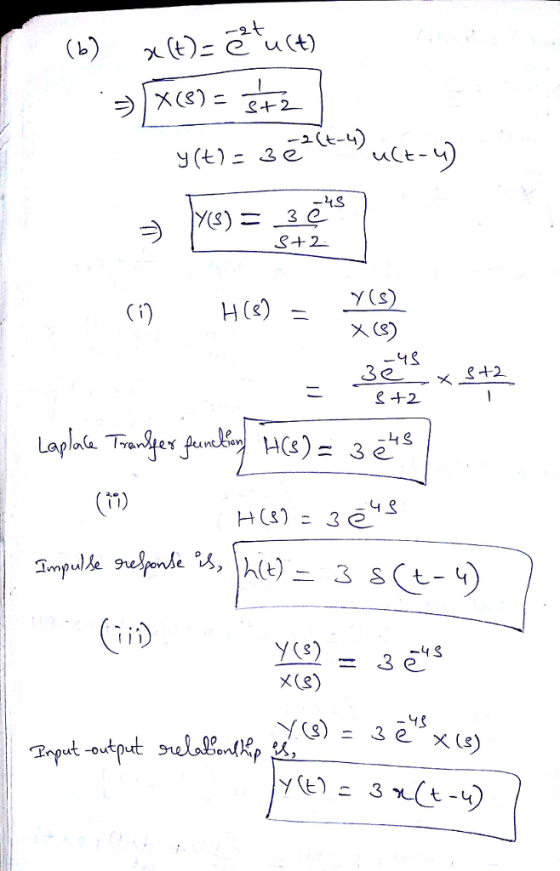
4. (2 marks) Determine (i) the Laplace transfer function, (ii) the impulse response function, and (ii)...
(e) Consider an LTI system with impulse response h(t) = π8ǐnc(2(t-1). i. (5 pts) Find the frequency response H(jw). Hint: Use the FT properties and pairs tables. ii. (5 pts) Find the output y(t) when...
 (e) Consider an LTI system with impulse response h(t) = π8ǐnc(2(t-1). i. (5 pts) Find the frequency response H(jw). Hint: Use the FT properties and pairs tables. ii. (5 pts) Find the output y(t) when the input is (tsin(t) by using the Fourier Transform method. 3. Fourier Transforms: LTI Systems Described by LCCDE (35 pts) (a) Consider a causal (meaning zero initial conditions) LTI system represented by its input-output relationship in the form of a differential equation:-p +3讐+ 2y(t)--r(t). i....
Consider the LTI system with input ??(??) = ?? ?????(??) and the impulse response ?(??) =...
 Consider the LTI system with input ??(??) = ?? ?????(??) and the
impulse response ?(??) = ?? ?2????(??). A. (3 points) Determine
??(??) and ??(??) and the ROCs B. (3 points) Using the
convolutional property of the Laplace transform, determine ??(??),
the Laplace transform of the output, ??(??) C. (3 points) From the
answer of part B, find ??(??)
9 points) Consider the LTI system with input x(t)eu(t) and the impulse response h(t)-e-2u(t) A. 3 points) Determine X(s) and H(s)...
Consider the LTI system with input ??(??) = ?? ?????(??) and the
impulse response ?(??) = ?? ?2????(??). A. (3 points) Determine
??(??) and ??(??) and the ROCs B. (3 points) Using the
convolutional property of the Laplace transform, determine ??(??),
the Laplace transform of the output, ??(??) C. (3 points) From the
answer of part B, find ??(??)
9 points) Consider the LTI system with input x(t)eu(t) and the impulse response h(t)-e-2u(t) A. 3 points) Determine X(s) and H(s)...
Let x(t) = tu(t) be the input to a LTI with impulse response h(t) = t...
Let x(t) = tu(t) be the input to a LTI with impulse response h(t) = t 2u(t). Find the output y(t) using convolution
Term brua 2019 Instructor: Ahnet A 1. Determine the Laplace transform and the associated region of...
 Term brua 2019 Instructor: Ahnet A 1. Determine the Laplace transform and the associated region of convergence and pole-zero plot for each of the following functions of time (b) r(t)te-24 elsewhere (d) a(t) (t)+u(t) 2. Determine the function of time, a(t), for each of the following Laplace transforms and their associated regions of convergenice: )부부, Rds) > 1 d)승부 R1(s) >-1 3. Consider an LTI systern with input r(t)-ε-lu(t) and impulse response h(t)-e-2u(t). (a) Determine the Laplace transforms of ar(t)...
A continuous-time LTI system has unit impulse response h(t). The Laplace transform of h(t), also called...
 A continuous-time LTI system has unit impulse response h(t). The
Laplace transform of h(t), also called the “transfer function” of
the LTI system, is
.
For each of the following cases, determine the region of
convergence (ROC) for H(s) and the corresponding h(t), and
determine whether the Fourier transform of h(t) exists.
(a) The LTI system is causal but not stable.
(b) The LTI system is stable but not causal.
(c) The LTI system is neither stable nor causal
8...
A continuous-time LTI system has unit impulse response h(t). The
Laplace transform of h(t), also called the “transfer function” of
the LTI system, is
.
For each of the following cases, determine the region of
convergence (ROC) for H(s) and the corresponding h(t), and
determine whether the Fourier transform of h(t) exists.
(a) The LTI system is causal but not stable.
(b) The LTI system is stable but not causal.
(c) The LTI system is neither stable nor causal
8...
Signal and Systems Problem 2 (3 points) Given the unilateral Laplace transform of the impulse response...
 Signal and Systems
Problem 2 (3 points) Given the unilateral Laplace transform of the impulse response for a causal system H(s) Determine h(t) the impulse response? Hint synthetic division! (s+10) 40 t-10 Problem 3 a) (2 points) What is the initial value of time function f(t) corresponding to the one sided Laplace Transform F(s) = (i.e. f(t) is causal) s(s+10)(2+4) lim f(t) = 0 40 lim f(t) = 1. t-0 10 x 4 lim f(t) = 0 t-0 lim f(t)...
Signal and Systems
Problem 2 (3 points) Given the unilateral Laplace transform of the impulse response for a causal system H(s) Determine h(t) the impulse response? Hint synthetic division! (s+10) 40 t-10 Problem 3 a) (2 points) What is the initial value of time function f(t) corresponding to the one sided Laplace Transform F(s) = (i.e. f(t) is causal) s(s+10)(2+4) lim f(t) = 0 40 lim f(t) = 1. t-0 10 x 4 lim f(t) = 0 t-0 lim f(t)...
Problem 3.6 i) Compute the causal impulse response, h, and the anti-causal impulse response, h, for...
 Problem 3.6 i) Compute the causal impulse response, h, and the anti-causal impulse response, h, for the system described by the input-output differential equation (D? + 9)y = (2D + 1)u. ii) Show that the anti-causal impulse response has a significant physical meaning: It is the autonomous output of a system that can be stopped (i.e. made equal to zero) by applying a Dirac-impulse 8(t) at the input. iii) How would an arbitrary solution in Sol (D2 +9), the set...
(c) If the impulse response function of a linear time invariant (LTI) system is h0)-Se u(),...
 (c) If the impulse response function of a linear time invariant (LTI) system is h0)-Se u(), compute the output of this system due to an input ) which is a 4 second pulse of height 3, as shown in Fig.1 below. x(t) t(sec) 0 Fig.1 Input signal 10 marks/
signal and system 8) By using Laplace transform determine the transfer function and the impulse response of the system with equation below. y) is the output and u) is the input to the system + 6 d...
 signal and system
8) By using Laplace transform determine the transfer function and the impulse response of the system with equation below. y) is the output and u) is the input to the system + 6 dt2
8) By using Laplace transform determine the transfer function and the impulse response of the system with equation below. y) is the output and u) is the input to the system + 6 dt2
signal and system
8) By using Laplace transform determine the transfer function and the impulse response of the system with equation below. y) is the output and u) is the input to the system + 6 dt2
8) By using Laplace transform determine the transfer function and the impulse response of the system with equation below. y) is the output and u) is the input to the system + 6 dt2
Problem 3. The input and the output of a stable and causal LTI system are related...
 Problem 3. The input and the output of a stable and causal LTI system are related by the differential equation dy ) + 64x2 + 8y(t) = 2x(t) dt2 dt i) Find the frequency response of the system H(jw) [2 marks] ii) Using your result in (i) find the impulse response of the system h(t). [3 marks] iii) Find the transfer function of the system H(s), i.e. the Laplace transform of the impulse response [2 marks] iv) Sketch the pole-zero...
 (e) Consider an LTI system with impulse response h(t) = π8ǐnc(2(t-1). i. (5 pts) Find the frequency response H(jw). Hint: Use the FT properties and pairs tables. ii. (5 pts) Find the output y(t) when the input is (tsin(t) by using the Fourier Transform method. 3. Fourier Transforms: LTI Systems Described by LCCDE (35 pts) (a) Consider a causal (meaning zero initial conditions) LTI system represented by its input-output relationship in the form of a differential equation:-p +3讐+ 2y(t)--r(t). i....
 Consider the LTI system with input ??(??) = ?? ?????(??) and the
impulse response ?(??) = ?? ?2????(??). A. (3 points) Determine
??(??) and ??(??) and the ROCs B. (3 points) Using the
convolutional property of the Laplace transform, determine ??(??),
the Laplace transform of the output, ??(??) C. (3 points) From the
answer of part B, find ??(??)
9 points) Consider the LTI system with input x(t)eu(t) and the impulse response h(t)-e-2u(t) A. 3 points) Determine X(s) and H(s)...
Consider the LTI system with input ??(??) = ?? ?????(??) and the
impulse response ?(??) = ?? ?2????(??). A. (3 points) Determine
??(??) and ??(??) and the ROCs B. (3 points) Using the
convolutional property of the Laplace transform, determine ??(??),
the Laplace transform of the output, ??(??) C. (3 points) From the
answer of part B, find ??(??)
9 points) Consider the LTI system with input x(t)eu(t) and the impulse response h(t)-e-2u(t) A. 3 points) Determine X(s) and H(s)...
 Term brua 2019 Instructor: Ahnet A 1. Determine the Laplace transform and the associated region of convergence and pole-zero plot for each of the following functions of time (b) r(t)te-24 elsewhere (d) a(t) (t)+u(t) 2. Determine the function of time, a(t), for each of the following Laplace transforms and their associated regions of convergenice: )부부, Rds) > 1 d)승부 R1(s) >-1 3. Consider an LTI systern with input r(t)-ε-lu(t) and impulse response h(t)-e-2u(t). (a) Determine the Laplace transforms of ar(t)...
 A continuous-time LTI system has unit impulse response h(t). The
Laplace transform of h(t), also called the “transfer function” of
the LTI system, is
.
For each of the following cases, determine the region of
convergence (ROC) for H(s) and the corresponding h(t), and
determine whether the Fourier transform of h(t) exists.
(a) The LTI system is causal but not stable.
(b) The LTI system is stable but not causal.
(c) The LTI system is neither stable nor causal
8...
A continuous-time LTI system has unit impulse response h(t). The
Laplace transform of h(t), also called the “transfer function” of
the LTI system, is
.
For each of the following cases, determine the region of
convergence (ROC) for H(s) and the corresponding h(t), and
determine whether the Fourier transform of h(t) exists.
(a) The LTI system is causal but not stable.
(b) The LTI system is stable but not causal.
(c) The LTI system is neither stable nor causal
8...
 Signal and Systems
Problem 2 (3 points) Given the unilateral Laplace transform of the impulse response for a causal system H(s) Determine h(t) the impulse response? Hint synthetic division! (s+10) 40 t-10 Problem 3 a) (2 points) What is the initial value of time function f(t) corresponding to the one sided Laplace Transform F(s) = (i.e. f(t) is causal) s(s+10)(2+4) lim f(t) = 0 40 lim f(t) = 1. t-0 10 x 4 lim f(t) = 0 t-0 lim f(t)...
Signal and Systems
Problem 2 (3 points) Given the unilateral Laplace transform of the impulse response for a causal system H(s) Determine h(t) the impulse response? Hint synthetic division! (s+10) 40 t-10 Problem 3 a) (2 points) What is the initial value of time function f(t) corresponding to the one sided Laplace Transform F(s) = (i.e. f(t) is causal) s(s+10)(2+4) lim f(t) = 0 40 lim f(t) = 1. t-0 10 x 4 lim f(t) = 0 t-0 lim f(t)...
 Problem 3.6 i) Compute the causal impulse response, h, and the anti-causal impulse response, h, for the system described by the input-output differential equation (D? + 9)y = (2D + 1)u. ii) Show that the anti-causal impulse response has a significant physical meaning: It is the autonomous output of a system that can be stopped (i.e. made equal to zero) by applying a Dirac-impulse 8(t) at the input. iii) How would an arbitrary solution in Sol (D2 +9), the set...
 (c) If the impulse response function of a linear time invariant (LTI) system is h0)-Se u(), compute the output of this system due to an input ) which is a 4 second pulse of height 3, as shown in Fig.1 below. x(t) t(sec) 0 Fig.1 Input signal 10 marks/
 signal and system
8) By using Laplace transform determine the transfer function and the impulse response of the system with equation below. y) is the output and u) is the input to the system + 6 dt2
8) By using Laplace transform determine the transfer function and the impulse response of the system with equation below. y) is the output and u) is the input to the system + 6 dt2
signal and system
8) By using Laplace transform determine the transfer function and the impulse response of the system with equation below. y) is the output and u) is the input to the system + 6 dt2
8) By using Laplace transform determine the transfer function and the impulse response of the system with equation below. y) is the output and u) is the input to the system + 6 dt2
 Problem 3. The input and the output of a stable and causal LTI system are related by the differential equation dy ) + 64x2 + 8y(t) = 2x(t) dt2 dt i) Find the frequency response of the system H(jw) [2 marks] ii) Using your result in (i) find the impulse response of the system h(t). [3 marks] iii) Find the transfer function of the system H(s), i.e. the Laplace transform of the impulse response [2 marks] iv) Sketch the pole-zero...
Most questions answered within 3 hours.
-
Where is the error in this code sequence?
String s1 = "Hello";
String s2 = "ello";...
asked 10 months ago -
Financial data for Joel de Paris, Inc., for last year
follow:
Joel de Paris, Inc.
Balance...
asked 10 months ago -
Consider this reaction:
Al2(SO4)3 (aq)+ BaCl3
(aq) Al2Cl6 (aq)- +
3BaSO4(s) . What is the...
asked 10 months ago -
Suppose that Savneet is considering increasing her
recent random sample from 20 car rentals to 40...
asked 10 months ago -
Trucks arrive at an unloading terminal at an average rate of 120
per hour.
Trucks arrive...
asked 10 months ago -
Why are methanol and ethanol completely soluble in water while
octanol is not very little soluble....
asked 10 months ago -
A facilities manager at a university reads in a research report
that the mean amount of...
asked 10 months ago -
When the CuSO4 is rehydrated by adding water to the anhydrous
compound, is this an endothermic...
asked 10 months ago -
A ray of sunlight is passing from diamond into crown glass; the
angle of incidence is...
asked 10 months ago -
A block of mass 0.249 kg is placed on top of a light, vertical
spring of...
asked 10 months ago -
how do the kidneys compensate in the presences of acidosis
a) trigger hyperventilate
b) reserve acid...
asked 10 months ago -
Question 501 pts
The rental rate of capital to the firm increases. Which of the
following...
asked 10 months ago