Reaction mechanisms of acid catalyzed esterification of vanillin react with acetic anhydrides
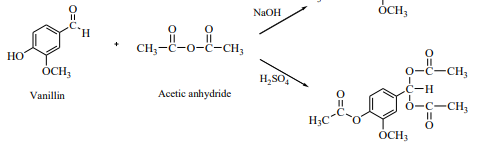
Does anyone know the full mechanism of acid-catalyzed esterification of vanillin when it react with acetic anhydride under acidic condition yielding the product below?
Homework Answers
Request Answer!
We need at least 9 more requests to produce the answer.
1 / 10 have requested this problem solution
The more requests, the faster the answer.
Add Answer to:
Reaction mechanisms of acid catalyzed esterification of vanillin react with acetic anhydrides
Please interpret and record spectral data for base and acid catalyzed products of vanillin esterfication. Base...
 Please interpret and record spectral data for base and acid
catalyzed products of vanillin esterfication.
Base product name: Vanillyl acetate
Acid product name: 4-acetyloxy-3-methoxyphenyl methanediyl
diacetate
HNMR acid
CNMR acid
HNMR base
CNMR base
CHOM 237 Esterification of Vanilla Acid Catalyzed Product 7.6 7.5 7.4 CHM 237 Esterification of Vanillin Acid Catalyzed Product 190 180 170 160 150 140 130 120 110 100 90 80 70 60 50 40 30 20 10 Oppm CM 237 Esterification of Vanillin Base Catalysed...
Please interpret and record spectral data for base and acid
catalyzed products of vanillin esterfication.
Base product name: Vanillyl acetate
Acid product name: 4-acetyloxy-3-methoxyphenyl methanediyl
diacetate
HNMR acid
CNMR acid
HNMR base
CNMR base
CHOM 237 Esterification of Vanilla Acid Catalyzed Product 7.6 7.5 7.4 CHM 237 Esterification of Vanillin Acid Catalyzed Product 190 180 170 160 150 140 130 120 110 100 90 80 70 60 50 40 30 20 10 Oppm CM 237 Esterification of Vanillin Base Catalysed...
a) Draw the mechanism (including electron-movement arrows) of the acid-catalyzed esterification + H2O Sulfuric Acetic acid...
 a) Draw the mechanism (including electron-movement arrows) of the acid-catalyzed esterification + H2O Sulfuric Acetic acid Isoamyl alcohol acid isoamyl acetatewater (concn.) (glacial)
what is the mechanism of the reaction of vanillin and acetic anhydride under basic condation NaOH...
what is the mechanism of the reaction of vanillin and acetic anhydride under basic condation NaOH and under acedic codnation H2SO$4 and what is the name of the product
Draw the product AND mechanism for the esterification reaction of acetic anhydride and 1-octanol (assuming there...
Draw the product AND mechanism for the esterification reaction of acetic anhydride and 1-octanol (assuming there is acid catalyst present).
Show the mechanism of the acid catalyzed reaction of an alcohol with acetic anhydride, indicating the...
 Show the mechanism of the acid catalyzed reaction of an alcohol
with acetic anhydride, indicating the involvement of the strong
acid catalyst in the reaction.
H2SO4 (cat.) R'OH ROR ROH ROD +
Show the mechanism of the acid catalyzed reaction of an alcohol
with acetic anhydride, indicating the involvement of the strong
acid catalyst in the reaction.
H2SO4 (cat.) R'OH ROR ROH ROD +
Full mechanisms for: Fischer esterification of propanoic acid and methanol. Ester hydrolysis of ethyl benzoate, catalyzed...
Full mechanisms for: Fischer esterification of propanoic acid and methanol. Ester hydrolysis of ethyl benzoate, catalyzed by sulfuric acid
Please answer all questions and show all work 1. Write a mechanism for the acid-catalyzed esterification...
Please answer all questions and show all work 1. Write a mechanism for the acid-catalyzed esterification that uses cyclopentanol and acetic acid. 2. Tertiary alcohols do not work well in the procedure outlined for this experiment; they give a different product from what you might expect. Explain this and draw the expected product from t-butyl alcohol (2-methyl-2-propanol).
H3PO4 OH + OH OH salicylic acid acetic anhydride acetic acid acetylsalicylic acid (aspirin) 1. Why...
 H3PO4 OH + OH OH salicylic acid acetic anhydride acetic acid acetylsalicylic acid (aspirin) 1. Why is it better to perform acetylation with acetic anhydride rather than using a Fischer esterification with acetic acid? 2. Draw a complete arrow-pushing mechanism for the reaction. 3. When an old sample of aspirin is left in moist conditions, it will begin to smell like vinegar. Draw a reaction scheme and briefly explain what happened.
In the mechanism for formation of acetylsalicylic acid via reaction of salicylic acid with acetic anhydride,...
 In the mechanism for formation of acetylsalicylic acid via reaction of salicylic acid with acetic anhydride, phosphoric acid acts as a catalyst by O cleaving an acetyl group from acetic anhydride via protonation of the bridging oxygen O neutralizing the hydroxide ion side product protonating the carbonyl oxygen in the acetic anhydride protonating the phenolic oxygen of salicylic acid Question 10 (3 points) What would be the predicted major product from the thermodynamically controlled dehydration of the following material OH
NMR for [4-(acetyloxy)-3-methoxyphenyl]methanediyl diacetate. Is this correct? 17.40 7.26 7.17 7.04 -3.87 2.35 2.14 Acid-catalyzed vanillin...
 NMR for [4-(acetyloxy)-3-methoxyphenyl]methanediyl diacetate. Is
this correct?
17.40 7.26 7.17 7.04 -3.87 2.35 2.14 Acid-catalyzed vanillin esterification possible product 2 (esterification of alcohol and aldehyde substituent) Simulated High Resolution Spectrum –7.40 –7.26 212- A OOCH3 G F E CEⓇ Hec. AHHH 7.4 7.0 CH 7.3 7.2 7.1 Chemical Shift A,B 13.041 6.101 11.5 10.5 9.5 8.5 7.5 6.5 5.5 4.5 Chemical Shift 3.5 2.5 1.5 0.5 -0.5 -1.5
NMR for [4-(acetyloxy)-3-methoxyphenyl]methanediyl diacetate. Is
this correct?
17.40 7.26 7.17 7.04 -3.87 2.35 2.14 Acid-catalyzed vanillin esterification possible product 2 (esterification of alcohol and aldehyde substituent) Simulated High Resolution Spectrum –7.40 –7.26 212- A OOCH3 G F E CEⓇ Hec. AHHH 7.4 7.0 CH 7.3 7.2 7.1 Chemical Shift A,B 13.041 6.101 11.5 10.5 9.5 8.5 7.5 6.5 5.5 4.5 Chemical Shift 3.5 2.5 1.5 0.5 -0.5 -1.5
 Please interpret and record spectral data for base and acid
catalyzed products of vanillin esterfication.
Base product name: Vanillyl acetate
Acid product name: 4-acetyloxy-3-methoxyphenyl methanediyl
diacetate
HNMR acid
CNMR acid
HNMR base
CNMR base
CHOM 237 Esterification of Vanilla Acid Catalyzed Product 7.6 7.5 7.4 CHM 237 Esterification of Vanillin Acid Catalyzed Product 190 180 170 160 150 140 130 120 110 100 90 80 70 60 50 40 30 20 10 Oppm CM 237 Esterification of Vanillin Base Catalysed...
Please interpret and record spectral data for base and acid
catalyzed products of vanillin esterfication.
Base product name: Vanillyl acetate
Acid product name: 4-acetyloxy-3-methoxyphenyl methanediyl
diacetate
HNMR acid
CNMR acid
HNMR base
CNMR base
CHOM 237 Esterification of Vanilla Acid Catalyzed Product 7.6 7.5 7.4 CHM 237 Esterification of Vanillin Acid Catalyzed Product 190 180 170 160 150 140 130 120 110 100 90 80 70 60 50 40 30 20 10 Oppm CM 237 Esterification of Vanillin Base Catalysed...
 a) Draw the mechanism (including electron-movement arrows) of the acid-catalyzed esterification + H2O Sulfuric Acetic acid Isoamyl alcohol acid isoamyl acetatewater (concn.) (glacial)
 Show the mechanism of the acid catalyzed reaction of an alcohol
with acetic anhydride, indicating the involvement of the strong
acid catalyst in the reaction.
H2SO4 (cat.) R'OH ROR ROH ROD +
Show the mechanism of the acid catalyzed reaction of an alcohol
with acetic anhydride, indicating the involvement of the strong
acid catalyst in the reaction.
H2SO4 (cat.) R'OH ROR ROH ROD +
 H3PO4 OH + OH OH salicylic acid acetic anhydride acetic acid acetylsalicylic acid (aspirin) 1. Why is it better to perform acetylation with acetic anhydride rather than using a Fischer esterification with acetic acid? 2. Draw a complete arrow-pushing mechanism for the reaction. 3. When an old sample of aspirin is left in moist conditions, it will begin to smell like vinegar. Draw a reaction scheme and briefly explain what happened.
 In the mechanism for formation of acetylsalicylic acid via reaction of salicylic acid with acetic anhydride, phosphoric acid acts as a catalyst by O cleaving an acetyl group from acetic anhydride via protonation of the bridging oxygen O neutralizing the hydroxide ion side product protonating the carbonyl oxygen in the acetic anhydride protonating the phenolic oxygen of salicylic acid Question 10 (3 points) What would be the predicted major product from the thermodynamically controlled dehydration of the following material OH
 NMR for [4-(acetyloxy)-3-methoxyphenyl]methanediyl diacetate. Is
this correct?
17.40 7.26 7.17 7.04 -3.87 2.35 2.14 Acid-catalyzed vanillin esterification possible product 2 (esterification of alcohol and aldehyde substituent) Simulated High Resolution Spectrum –7.40 –7.26 212- A OOCH3 G F E CEⓇ Hec. AHHH 7.4 7.0 CH 7.3 7.2 7.1 Chemical Shift A,B 13.041 6.101 11.5 10.5 9.5 8.5 7.5 6.5 5.5 4.5 Chemical Shift 3.5 2.5 1.5 0.5 -0.5 -1.5
NMR for [4-(acetyloxy)-3-methoxyphenyl]methanediyl diacetate. Is
this correct?
17.40 7.26 7.17 7.04 -3.87 2.35 2.14 Acid-catalyzed vanillin esterification possible product 2 (esterification of alcohol and aldehyde substituent) Simulated High Resolution Spectrum –7.40 –7.26 212- A OOCH3 G F E CEⓇ Hec. AHHH 7.4 7.0 CH 7.3 7.2 7.1 Chemical Shift A,B 13.041 6.101 11.5 10.5 9.5 8.5 7.5 6.5 5.5 4.5 Chemical Shift 3.5 2.5 1.5 0.5 -0.5 -1.5
Most questions answered within 3 hours.
-
Where is the error in this code sequence?
String s1 = "Hello";
String s2 = "ello";...
asked 11 months ago -
Financial data for Joel de Paris, Inc., for last year
follow:
Joel de Paris, Inc.
Balance...
asked 11 months ago -
Consider this reaction:
Al2(SO4)3 (aq)+ BaCl3
(aq) Al2Cl6 (aq)- +
3BaSO4(s) . What is the...
asked 11 months ago -
Suppose that Savneet is considering increasing her
recent random sample from 20 car rentals to 40...
asked 11 months ago -
Trucks arrive at an unloading terminal at an average rate of 120
per hour.
Trucks arrive...
asked 11 months ago -
Why are methanol and ethanol completely soluble in water while
octanol is not very little soluble....
asked 11 months ago -
A facilities manager at a university reads in a research report
that the mean amount of...
asked 11 months ago -
When the CuSO4 is rehydrated by adding water to the anhydrous
compound, is this an endothermic...
asked 11 months ago -
A ray of sunlight is passing from diamond into crown glass; the
angle of incidence is...
asked 11 months ago -
A block of mass 0.249 kg is placed on top of a light, vertical
spring of...
asked 11 months ago -
how do the kidneys compensate in the presences of acidosis
a) trigger hyperventilate
b) reserve acid...
asked 11 months ago -
Question 501 pts
The rental rate of capital to the firm increases. Which of the
following...
asked 11 months ago