
Homework Answers
Add Answer to:
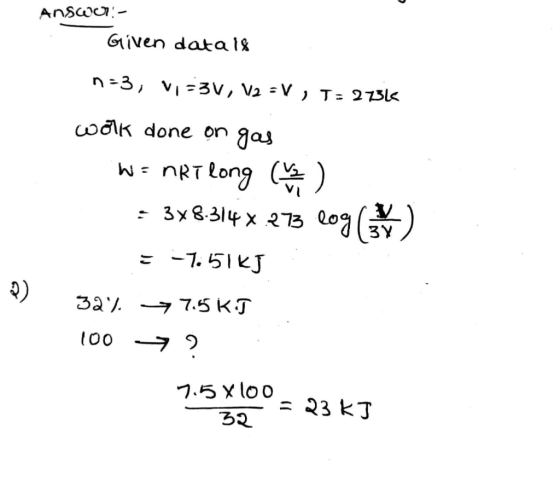
Problem 1: An ideal gas fills a container. A membrane is broken which allows the gas...
Problem 8: Consider the reversible Carnot's cycle of an ideal monatomic gas in the cold cylinder...
 Problem 8: Consider the reversible Carnot's cycle of an ideal monatomic gas in the cold cylinder of 290 K corresponding to the isothermal compression step. Then the volume of the gas is further compressed by a factor of 7.5 in the adiabatic compression step. a) Find the temperature at the final step of the adiabatic compression. b) What is Thot for the isothermal expansion step? c) What is the maximum thermodynamic efficiency for this engine? d) How much would the...
A monatomic ideal gas initially fills a container of volume V = 0.15 m3 at an...
A monatomic ideal gas initially fills a container of volume V = 0.15 m3 at an initial pressure of P = 360 kPa and temperature T = 275 K. The gas undergoes an isobaric expansion to V2 = 0.55 m3 and then an isovolumetric heating to P2 = 680 kPa. a) Calculate the number of moles, n, contained in this ideal gas. b) Calculate the temperature of the gas, in kelvins, after it undergoes the isobaric expansion. c) Calculate the...
(8%) Problem 12: A monatomic ideal gas initially fills a container of volume V = 0.15...
 (8%) Problem 12: A monatomic ideal gas initially fills a container of volume V = 0.15 m at an initial pressure of P= 380 kPa and temperature T = 375 K. The gas undergoes an isobaric expansion to V2 = 0.65 m and then an isovolumetric heating to P2 = 520 kPa. ► 25% Part (a) Calculate the number of moles, n, contained in this ideal gas. n = 0.00861 Grade Summary Deductions 6% Potential 94% HOME d E sin...
1. Name three characteristics of the atoms in a gas that are essential for the gas...
1. Name three characteristics of the atoms in a gas that are essential for the gas to be ideal. Explain why these three qualities of the atoms or molecules make the gas ideal. 2. Considering the Boltzmann distribution of atomic/molecular speeds for an ideal gas at temperature T (in K) , order the following speeds from smallest to largest: average speed, most probable speed, and root mean squared speed. Why are they different speeds? 3. What is the most important...
Part A:Refer to diagram 2. A flask contains 85.2 moles of a monatomic ideal gas at...
 Part A:Refer to diagram 2. A flask contains 85.2 moles of a
monatomic ideal gas at pressure 6.9 atm and volume 13.4 liters
(point A on the graph. Now, the gas undergoes a cycle of three
steps: - First there is an isothermal expansion to pressure 3.65
atm (point B on the graph). - Next, there is an isochoric process
in which the pressure is raised to P1 (point C on the graph). -
Finally, there is an isobaric compression...
Part A:Refer to diagram 2. A flask contains 85.2 moles of a
monatomic ideal gas at pressure 6.9 atm and volume 13.4 liters
(point A on the graph. Now, the gas undergoes a cycle of three
steps: - First there is an isothermal expansion to pressure 3.65
atm (point B on the graph). - Next, there is an isochoric process
in which the pressure is raised to P1 (point C on the graph). -
Finally, there is an isobaric compression...
(17%) Problem 4: A monatomic ideal gas is in a state with volume of Vo at...
 (17%) Problem 4: A monatomic ideal gas is in a state with volume of Vo at pressure Po and temperature T . The following questions refer to the work done on the gas, W- -PA 17% Part (a) The gas undergoes an isochoric cooling from its initial state (I-Po-T0). For this process, choose what happens to the energy heat, and work from the following Grade Summary Deductions Potential 100% 0% Submissions OAU > 0, Δυ-o-w. Q < 0, and w...
1. Which of the following are the sites within the human body where carbon dioxide and...
1. Which of the following are the sites within the human body where carbon dioxide and oxygen are exchanged? A. Alveoli B. Arteries C. Synapses D. Venules 2. Which of the following describes the most important reason for repeating an experimental investigation? A. To verify the validity of the original findings B. To expand upon the original investigation C. To manipulate the independent variable D. To attempt to disprove the hypothesis 3. Lithium has an atomic number of 3 and...
 Problem 8: Consider the reversible Carnot's cycle of an ideal monatomic gas in the cold cylinder of 290 K corresponding to the isothermal compression step. Then the volume of the gas is further compressed by a factor of 7.5 in the adiabatic compression step. a) Find the temperature at the final step of the adiabatic compression. b) What is Thot for the isothermal expansion step? c) What is the maximum thermodynamic efficiency for this engine? d) How much would the...
 (8%) Problem 12: A monatomic ideal gas initially fills a container of volume V = 0.15 m at an initial pressure of P= 380 kPa and temperature T = 375 K. The gas undergoes an isobaric expansion to V2 = 0.65 m and then an isovolumetric heating to P2 = 520 kPa. ► 25% Part (a) Calculate the number of moles, n, contained in this ideal gas. n = 0.00861 Grade Summary Deductions 6% Potential 94% HOME d E sin...
 Part A:Refer to diagram 2. A flask contains 85.2 moles of a
monatomic ideal gas at pressure 6.9 atm and volume 13.4 liters
(point A on the graph. Now, the gas undergoes a cycle of three
steps: - First there is an isothermal expansion to pressure 3.65
atm (point B on the graph). - Next, there is an isochoric process
in which the pressure is raised to P1 (point C on the graph). -
Finally, there is an isobaric compression...
Part A:Refer to diagram 2. A flask contains 85.2 moles of a
monatomic ideal gas at pressure 6.9 atm and volume 13.4 liters
(point A on the graph. Now, the gas undergoes a cycle of three
steps: - First there is an isothermal expansion to pressure 3.65
atm (point B on the graph). - Next, there is an isochoric process
in which the pressure is raised to P1 (point C on the graph). -
Finally, there is an isobaric compression...
 (17%) Problem 4: A monatomic ideal gas is in a state with volume of Vo at pressure Po and temperature T . The following questions refer to the work done on the gas, W- -PA 17% Part (a) The gas undergoes an isochoric cooling from its initial state (I-Po-T0). For this process, choose what happens to the energy heat, and work from the following Grade Summary Deductions Potential 100% 0% Submissions OAU > 0, Δυ-o-w. Q < 0, and w...
Most questions answered within 3 hours.
-
Where is the error in this code sequence?
String s1 = "Hello";
String s2 = "ello";...
asked 10 months ago -
Financial data for Joel de Paris, Inc., for last year
follow:
Joel de Paris, Inc.
Balance...
asked 10 months ago -
Consider this reaction:
Al2(SO4)3 (aq)+ BaCl3
(aq) Al2Cl6 (aq)- +
3BaSO4(s) . What is the...
asked 10 months ago -
Suppose that Savneet is considering increasing her
recent random sample from 20 car rentals to 40...
asked 10 months ago -
Trucks arrive at an unloading terminal at an average rate of 120
per hour.
Trucks arrive...
asked 10 months ago -
Why are methanol and ethanol completely soluble in water while
octanol is not very little soluble....
asked 10 months ago -
A facilities manager at a university reads in a research report
that the mean amount of...
asked 10 months ago -
When the CuSO4 is rehydrated by adding water to the anhydrous
compound, is this an endothermic...
asked 10 months ago -
A ray of sunlight is passing from diamond into crown glass; the
angle of incidence is...
asked 10 months ago -
A block of mass 0.249 kg is placed on top of a light, vertical
spring of...
asked 10 months ago -
how do the kidneys compensate in the presences of acidosis
a) trigger hyperventilate
b) reserve acid...
asked 10 months ago -
Question 501 pts
The rental rate of capital to the firm increases. Which of the
following...
asked 10 months ago