
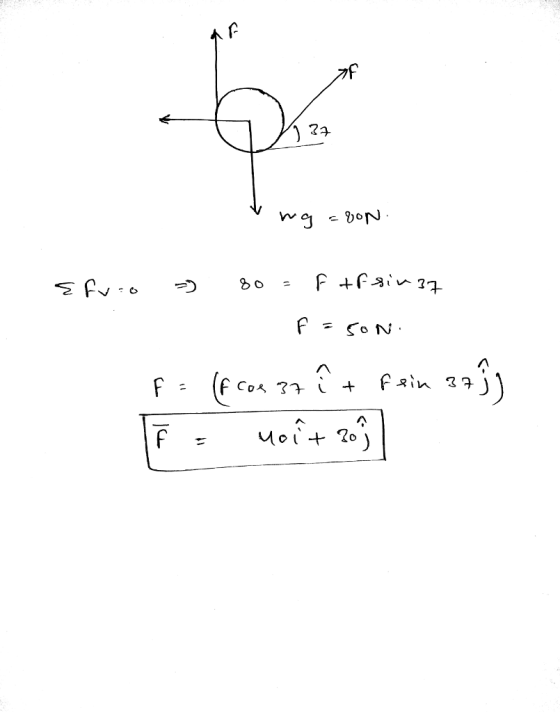
An object whose weight is  is balanced in the force of
 as seen on the diagram. Note
that the pulley is frictionless. What is the magnitude of ?
as seen on the diagram. Note
that the pulley is frictionless. What is the magnitude of ?
 ;
; 
Homework Answers
Add Answer to:
An object whose weight is is balanced in the force of
as seen on the diagram....
Newton's Laws of Motion 12. The diagram below shows a horizontal 8.0-newton force applied to a...
 Newton's Laws of Motion 12. The diagram below shows a horizontal 8.0-newton force applied to a 4.0-kilogram block on a frictionless table. 4.0 kg F8.0 N Frictionless Table What is the magnitude of the block's acceleration? 13. Two forces are applied to a 2.0-kilogram block on a frictionless horizontal surface, as shown in the diagram below. F, -2.0 N F2-8.0 N 2.0 kg Frictionless Surface What is the acceleration of the block? What additional force, when applied to the object...
Two masses are connected by a massless rope. The mass of object 1 is 5.5 kg,...
Two masses are connected by a massless rope. The mass of object 1 is 5.5 kg, and it rests on a surface with a 1.7 coefficient for static friction (us) and a .90 coefficient for kinetic friction (uk). Object 2 has a mass of 8.3 kg and hangs over the edge of the surface by a frictionless, massless pulley. The two objects begin at rest when object 2 is released to hang freely. A.) Draw a free body diagram for...
1.There is a falling object, whose mass is A [kg] and experiences a force (its own weight) equal ...
1.There is a falling object, whose mass is A [kg] and experiences a force (its own weight) equal numerically to A times 9.81. The object starts from rest and the air causes a retarding force numerically equal to B times its velocity. a)Find general expression for velocity as a function of time, and draw its graph. b)Evaluate velocity for t = C (s) Depending on your value of R choose R A B C 0 6 0.180 4 1 7 ...
Two masses of weight 11.0 N are suspended at opposite ends of a rope that passes...
Two masses of weight 11.0 N are suspended at opposite ends of a rope that passes over a light, frictionless pulley. The pulley is attached to a chain that goes to the ceiling. What is the tension in the rope? What is the tension in the chain?
What is the magnitude of force F that is required to keep the following system in...
 What is the magnitude of force F that is required to keep the
following system in equilibrium. assume the rope has negligible
mass and that the pulleys are frictionless. each pulley in the
system has a mass of 20kg with a 300 kg crate
300 Kg
What is the magnitude of force F that is required to keep the
following system in equilibrium. assume the rope has negligible
mass and that the pulleys are frictionless. each pulley in the
system has a mass of 20kg with a 300 kg crate
300 Kg
A mass mi falls under its own weight while connected by a string to a frictionless...
 A mass mi falls under its own weight while connected by a string to a frictionless pulley of mass m2 and radius R, whose center is fixed. Use two generalized coordinated, y (the length of the hanging string) and 6 (the angle through (a) Assuming that the string does not slip relative to the pulley, find the constraint governing 1. y and θ, and express this in the form of a constraint equation gy.9,-0. (You can assume (b) Write the...
1] As a projectile is flying (following the standard projectile motion seen in class), it lodes...
 1] As a projectile is flying (following the standard projectile motion seen in class), it lodes for an unknown reason not due to external intervention. Which one of suddenly exp the following statements is correct? Only one of them is. A Both kinetic energy and linear momentum are conserved B Kinetic energy is conserved, but linear momentum may not be conserved. C Neither linear momentum nor kinetic energy are conserved. D Linear momentum is conserved, but kinetic energy may not...
In the figure a worker lifts a weight by pulling down on a rope with a...
 In the figure a worker lifts a weight
by pulling down on a rope with a force . The upper pulley is attached to the ceiling by a
chain,and the lower pulley is attached to the weight by another
chain.The weight is lifted at constant speed. Assume that the
rope,pulleys, and chains all have negligible weights.
A) In terms of ,find the tension in the lower chain.
B) In terms of ,find the tension in upper chain.
C) In terms...
In the figure a worker lifts a weight
by pulling down on a rope with a force . The upper pulley is attached to the ceiling by a
chain,and the lower pulley is attached to the weight by another
chain.The weight is lifted at constant speed. Assume that the
rope,pulleys, and chains all have negligible weights.
A) In terms of ,find the tension in the lower chain.
B) In terms of ,find the tension in upper chain.
C) In terms...
The fiqure shows a man sitting in a bosun's chair that dangles from a massless rope, which runs over a massless, fr...
 The fiqure shows a man sitting in a bosun's chair that dangles from a massless rope, which runs over a massless, frictionless pulley and back down to the man's hand. The combined mass of man and chair is 78.4 kg. With what force magnitude must the man pull on the rope if he is to rise (a) with a constant velocity and (b) with an upward acceleration of 1.42 m/s2? (Hint: A free-body diagram can really help.) Problem continues below...
The figure shows a man sitting in a bosun's chair that dangles from a massless rope,...
 The figure shows a man sitting in a bosun's chair that dangles
from a massless rope, which runs over a massless, frictionless
pulley and back down to the man's hand. The combined mass of man
and chair is 83.1 kg. With what force magnitude must the man pull
on the rope if he is to rise (a) with a constant
velocity and (b) with an upward acceleration of
1.27 m/s2? (Hint: A free-body diagram can really help.) Problem
continues below....
The figure shows a man sitting in a bosun's chair that dangles
from a massless rope, which runs over a massless, frictionless
pulley and back down to the man's hand. The combined mass of man
and chair is 83.1 kg. With what force magnitude must the man pull
on the rope if he is to rise (a) with a constant
velocity and (b) with an upward acceleration of
1.27 m/s2? (Hint: A free-body diagram can really help.) Problem
continues below....
 Newton's Laws of Motion 12. The diagram below shows a horizontal 8.0-newton force applied to a 4.0-kilogram block on a frictionless table. 4.0 kg F8.0 N Frictionless Table What is the magnitude of the block's acceleration? 13. Two forces are applied to a 2.0-kilogram block on a frictionless horizontal surface, as shown in the diagram below. F, -2.0 N F2-8.0 N 2.0 kg Frictionless Surface What is the acceleration of the block? What additional force, when applied to the object...
 What is the magnitude of force F that is required to keep the
following system in equilibrium. assume the rope has negligible
mass and that the pulleys are frictionless. each pulley in the
system has a mass of 20kg with a 300 kg crate
300 Kg
What is the magnitude of force F that is required to keep the
following system in equilibrium. assume the rope has negligible
mass and that the pulleys are frictionless. each pulley in the
system has a mass of 20kg with a 300 kg crate
300 Kg
 A mass mi falls under its own weight while connected by a string to a frictionless pulley of mass m2 and radius R, whose center is fixed. Use two generalized coordinated, y (the length of the hanging string) and 6 (the angle through (a) Assuming that the string does not slip relative to the pulley, find the constraint governing 1. y and θ, and express this in the form of a constraint equation gy.9,-0. (You can assume (b) Write the...
 1] As a projectile is flying (following the standard projectile motion seen in class), it lodes for an unknown reason not due to external intervention. Which one of suddenly exp the following statements is correct? Only one of them is. A Both kinetic energy and linear momentum are conserved B Kinetic energy is conserved, but linear momentum may not be conserved. C Neither linear momentum nor kinetic energy are conserved. D Linear momentum is conserved, but kinetic energy may not...
 In the figure a worker lifts a weight
by pulling down on a rope with a force . The upper pulley is attached to the ceiling by a
chain,and the lower pulley is attached to the weight by another
chain.The weight is lifted at constant speed. Assume that the
rope,pulleys, and chains all have negligible weights.
A) In terms of ,find the tension in the lower chain.
B) In terms of ,find the tension in upper chain.
C) In terms...
In the figure a worker lifts a weight
by pulling down on a rope with a force . The upper pulley is attached to the ceiling by a
chain,and the lower pulley is attached to the weight by another
chain.The weight is lifted at constant speed. Assume that the
rope,pulleys, and chains all have negligible weights.
A) In terms of ,find the tension in the lower chain.
B) In terms of ,find the tension in upper chain.
C) In terms...
 The fiqure shows a man sitting in a bosun's chair that dangles from a massless rope, which runs over a massless, frictionless pulley and back down to the man's hand. The combined mass of man and chair is 78.4 kg. With what force magnitude must the man pull on the rope if he is to rise (a) with a constant velocity and (b) with an upward acceleration of 1.42 m/s2? (Hint: A free-body diagram can really help.) Problem continues below...
 The figure shows a man sitting in a bosun's chair that dangles
from a massless rope, which runs over a massless, frictionless
pulley and back down to the man's hand. The combined mass of man
and chair is 83.1 kg. With what force magnitude must the man pull
on the rope if he is to rise (a) with a constant
velocity and (b) with an upward acceleration of
1.27 m/s2? (Hint: A free-body diagram can really help.) Problem
continues below....
The figure shows a man sitting in a bosun's chair that dangles
from a massless rope, which runs over a massless, frictionless
pulley and back down to the man's hand. The combined mass of man
and chair is 83.1 kg. With what force magnitude must the man pull
on the rope if he is to rise (a) with a constant
velocity and (b) with an upward acceleration of
1.27 m/s2? (Hint: A free-body diagram can really help.) Problem
continues below....
Most questions answered within 3 hours.
-
Where is the error in this code sequence?
String s1 = "Hello";
String s2 = "ello";...
asked 10 months ago -
Financial data for Joel de Paris, Inc., for last year
follow:
Joel de Paris, Inc.
Balance...
asked 10 months ago -
Consider this reaction:
Al2(SO4)3 (aq)+ BaCl3
(aq) Al2Cl6 (aq)- +
3BaSO4(s) . What is the...
asked 10 months ago -
Suppose that Savneet is considering increasing her
recent random sample from 20 car rentals to 40...
asked 10 months ago -
Trucks arrive at an unloading terminal at an average rate of 120
per hour.
Trucks arrive...
asked 10 months ago -
Why are methanol and ethanol completely soluble in water while
octanol is not very little soluble....
asked 10 months ago -
A facilities manager at a university reads in a research report
that the mean amount of...
asked 10 months ago -
When the CuSO4 is rehydrated by adding water to the anhydrous
compound, is this an endothermic...
asked 10 months ago -
A ray of sunlight is passing from diamond into crown glass; the
angle of incidence is...
asked 10 months ago -
A block of mass 0.249 kg is placed on top of a light, vertical
spring of...
asked 10 months ago -
how do the kidneys compensate in the presences of acidosis
a) trigger hyperventilate
b) reserve acid...
asked 10 months ago -
Question 501 pts
The rental rate of capital to the firm increases. Which of the
following...
asked 10 months ago