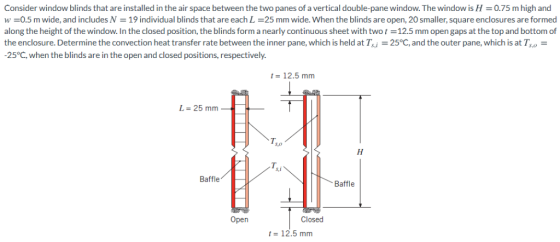
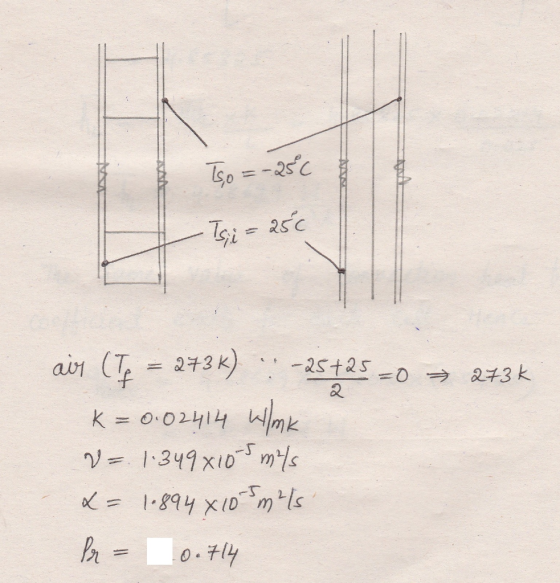
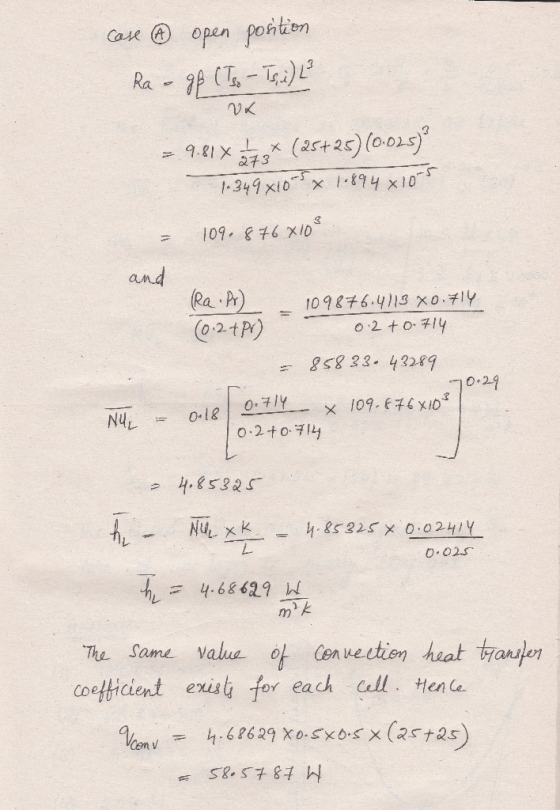
(1) When the blinds are open, what is the Rayleigh number?
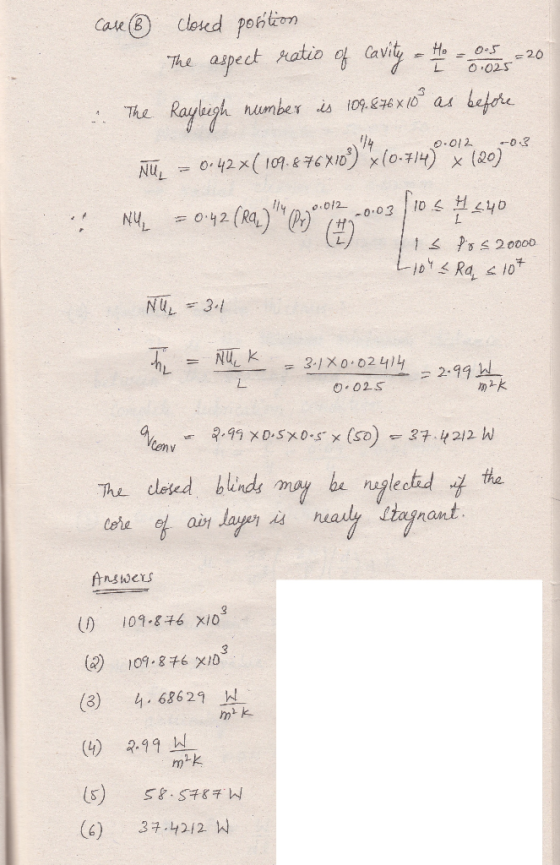
(2) When the blinds are closed, what is the Rayleigh number?
(3) What is the free convection heat transfer coefficient when the blinds are open, in W/m2·K?
(4) What is the free convection heat transfer coefficient when the blinds are closed, in W/m2·K?
(5) What is the heat transfer rate when the blinds are open, in W?
(6) What is the heat transfer rate when the blinds are closed, in W?
Homework Answers
Add Answer to:
(1) When the blinds are open, what is the Rayleigh number?
(2) When the blinds are...
1. Consider a 1.2-m-high and 2-m-wide double-pane window consisting of two 3-mm a W/m C) separated...
 1. Consider a 1.2-m-high and 2-m-wide double-pane window consisting of two 3-mm a W/m C) separated by a 12-mm-wide stagnant air space thick layers of glass ( 0.78 (0.026 W/m C). Determine the steady rate of heat transfer through this double- pane window and the temperature of its inner surface for a day during which the room is maintained at 24 C while the temperature of the outdoors is 5 C. Take the convection heat transfer coefficients on the inner...
3. (15 pts) A 0.5 m x 1 m double paned window is made of two...
 3. (15 pts) A 0.5 m x 1 m double paned window is made of two silica glass panes 1 cm thick, with air in between. Under steady conditions, linear (constant gradient) temperature profiles are found in both silica panes, as well as the air. a) If the room (and the inner surface of the inner glass pane) is at a temperature of 25°C, while outdoors it is -25°C with a convection coefficient of 18 W m2 k-4, what is...
Thermal Resistance Analysis: Consider a 1.2 m high and 1.4 m wide double-pane window consisting o...
 Thermal Resistance Analysis: Consider a 1.2 m high and 1.4 m wide double-pane window consisting of two 4 mm thick layers ofglass (k-0.85 W m-K) separated by a 8-min stagnant air space. (k= 0.025 W m-K) Determine the steady rate of heat transfer through this double-pane window and the temperature of its inner and outer surfaces on a day when the inside room temperature is maintained at 20 °C and the outside ambient temperature is 32 °C. Assume the convection...
Consider a 1.2-m-high and 2-m-wide double-pane window consisting of two 3-mm-thick layers of glass (k =...
 Consider a 1.2-m-high and 2-m-wide double-pane window consisting of two 3-mm-thick layers of glass (k = 0.78 W/m K) separated by a 12-mm-wide stagnant air space (k = 0.026 W/m K). Determine the steady rate of heat transfer through this double-pane window. R . and all the surface temperatures (inner and outer of each pane) within the circuit (which you will draw and correctly label) for a day during which the room is maintained at 24°C while the temperature of...
(25pts) Consider a 1.2-m-high and 2-m-wide glass window whose thickness is 6 mm and thermal conductivity...
 (25pts) Consider a 1.2-m-high and 2-m-wide glass window whose thickness is 6 mm and thermal conductivity is k 0.78 W/m °C. Determine the steady rate of heat transfer through this glass window and the temperature of its inner surface for a day during which the room is maintained at 24°C while the temperature of the outdoors is-5°C. Take the convection heat transfer coefficients on the inner and outer surfaces of the window to be h 10 W/m2 °C and h...
To reduce building heating costs, modern building codes in many parts of the country require the...
 To reduce building heating costs, modern building codes in many parts of the country require the use of double-pane windows (sometimes, called "double-glazed" or "thermopane" windows). Ivpically, a double-pane window consists of two panes of glass separated by a space that contains trapped stagnant air. In one design of a double-pane window, each glass layer is 0.7 cm thick, the stagnant air layer is 2 cm thick, and the area is 4 m2 In the living room of a large...
The one-dimensional plane wall, shown in the figure below, is of thickness L =75 mm and...
 The one-dimensional plane wall, shown in the figure below, is of thickness L =75 mm and thermal conductivity k = 15 W/ mK. The fluid temperatures are T, 200°C and T2 = 100°C, respectively. Using the minimum and maximum typical values of the convection heat! transfer coefficients listed in the table below, determine the minimum and maximum steady-state heat fluxes through the wall for free convection in gases and free convection in liquids. Typical values of the convection heat transfer...
Consider the manufacture of photovoltaic silicon where a thin sheet of silicon is pulled from the...
 Consider the manufacture of photovoltaic silicon where a thin sheet of silicon is pulled from the pool of molten material very slowly and is subjected to an ambient temperature of T 627°C within the growth chamber. The silicon sheet is Wsi =85 mm wide and tsi =150um thick. A convection coefficient of h 7.5 W/m2.K is associated with the exposed surfaces of the silicon sheet when it is inside the growth chamber. Calculate the maximum allowable velocity of the silicon...
MEGR 3116 Heat Transfer Summer 2019 NAME Please show all of your work. Open book and open notes. 1) A flat/planar w...
 MEGR 3116 Heat Transfer Summer 2019 NAME Please show all of your work. Open book and open notes. 1) A flat/planar window of thickness, L, having a thermal conductivity, k, is exposed on its inner face to a room at temperature, T。, and on its outer surface to outside air having temperature, T-(far from the window surface). Define an x-axis having origin at the window's inner surface and directed towards the outer surface, and assume that the inner surface temperature...
What is the rate of heat transfer due to conduction through a single-pane glass window that...
What is the rate of heat transfer due to conduction through a single-pane glass window that is 3.0 m2 and 3.175 mm thick, when the exterior temperature is 37°C and the interior temperature is 24°C?
 1. Consider a 1.2-m-high and 2-m-wide double-pane window consisting of two 3-mm a W/m C) separated by a 12-mm-wide stagnant air space thick layers of glass ( 0.78 (0.026 W/m C). Determine the steady rate of heat transfer through this double- pane window and the temperature of its inner surface for a day during which the room is maintained at 24 C while the temperature of the outdoors is 5 C. Take the convection heat transfer coefficients on the inner...
 3. (15 pts) A 0.5 m x 1 m double paned window is made of two silica glass panes 1 cm thick, with air in between. Under steady conditions, linear (constant gradient) temperature profiles are found in both silica panes, as well as the air. a) If the room (and the inner surface of the inner glass pane) is at a temperature of 25°C, while outdoors it is -25°C with a convection coefficient of 18 W m2 k-4, what is...
 Thermal Resistance Analysis: Consider a 1.2 m high and 1.4 m wide double-pane window consisting of two 4 mm thick layers ofglass (k-0.85 W m-K) separated by a 8-min stagnant air space. (k= 0.025 W m-K) Determine the steady rate of heat transfer through this double-pane window and the temperature of its inner and outer surfaces on a day when the inside room temperature is maintained at 20 °C and the outside ambient temperature is 32 °C. Assume the convection...
 Consider a 1.2-m-high and 2-m-wide double-pane window consisting of two 3-mm-thick layers of glass (k = 0.78 W/m K) separated by a 12-mm-wide stagnant air space (k = 0.026 W/m K). Determine the steady rate of heat transfer through this double-pane window. R . and all the surface temperatures (inner and outer of each pane) within the circuit (which you will draw and correctly label) for a day during which the room is maintained at 24°C while the temperature of...
 (25pts) Consider a 1.2-m-high and 2-m-wide glass window whose thickness is 6 mm and thermal conductivity is k 0.78 W/m °C. Determine the steady rate of heat transfer through this glass window and the temperature of its inner surface for a day during which the room is maintained at 24°C while the temperature of the outdoors is-5°C. Take the convection heat transfer coefficients on the inner and outer surfaces of the window to be h 10 W/m2 °C and h...
 To reduce building heating costs, modern building codes in many parts of the country require the use of double-pane windows (sometimes, called "double-glazed" or "thermopane" windows). Ivpically, a double-pane window consists of two panes of glass separated by a space that contains trapped stagnant air. In one design of a double-pane window, each glass layer is 0.7 cm thick, the stagnant air layer is 2 cm thick, and the area is 4 m2 In the living room of a large...
 The one-dimensional plane wall, shown in the figure below, is of thickness L =75 mm and thermal conductivity k = 15 W/ mK. The fluid temperatures are T, 200°C and T2 = 100°C, respectively. Using the minimum and maximum typical values of the convection heat! transfer coefficients listed in the table below, determine the minimum and maximum steady-state heat fluxes through the wall for free convection in gases and free convection in liquids. Typical values of the convection heat transfer...
 Consider the manufacture of photovoltaic silicon where a thin sheet of silicon is pulled from the pool of molten material very slowly and is subjected to an ambient temperature of T 627°C within the growth chamber. The silicon sheet is Wsi =85 mm wide and tsi =150um thick. A convection coefficient of h 7.5 W/m2.K is associated with the exposed surfaces of the silicon sheet when it is inside the growth chamber. Calculate the maximum allowable velocity of the silicon...
 MEGR 3116 Heat Transfer Summer 2019 NAME Please show all of your work. Open book and open notes. 1) A flat/planar window of thickness, L, having a thermal conductivity, k, is exposed on its inner face to a room at temperature, T。, and on its outer surface to outside air having temperature, T-(far from the window surface). Define an x-axis having origin at the window's inner surface and directed towards the outer surface, and assume that the inner surface temperature...
Most questions answered within 3 hours.
-
Where is the error in this code sequence?
String s1 = "Hello";
String s2 = "ello";...
asked 10 months ago -
Financial data for Joel de Paris, Inc., for last year
follow:
Joel de Paris, Inc.
Balance...
asked 10 months ago -
Consider this reaction:
Al2(SO4)3 (aq)+ BaCl3
(aq) Al2Cl6 (aq)- +
3BaSO4(s) . What is the...
asked 10 months ago -
Suppose that Savneet is considering increasing her
recent random sample from 20 car rentals to 40...
asked 10 months ago -
Trucks arrive at an unloading terminal at an average rate of 120
per hour.
Trucks arrive...
asked 10 months ago -
Why are methanol and ethanol completely soluble in water while
octanol is not very little soluble....
asked 10 months ago -
A facilities manager at a university reads in a research report
that the mean amount of...
asked 10 months ago -
When the CuSO4 is rehydrated by adding water to the anhydrous
compound, is this an endothermic...
asked 10 months ago -
A ray of sunlight is passing from diamond into crown glass; the
angle of incidence is...
asked 10 months ago -
A block of mass 0.249 kg is placed on top of a light, vertical
spring of...
asked 10 months ago -
how do the kidneys compensate in the presences of acidosis
a) trigger hyperventilate
b) reserve acid...
asked 10 months ago -
Question 501 pts
The rental rate of capital to the firm increases. Which of the
following...
asked 10 months ago