
Homework Answers
Add Answer to:
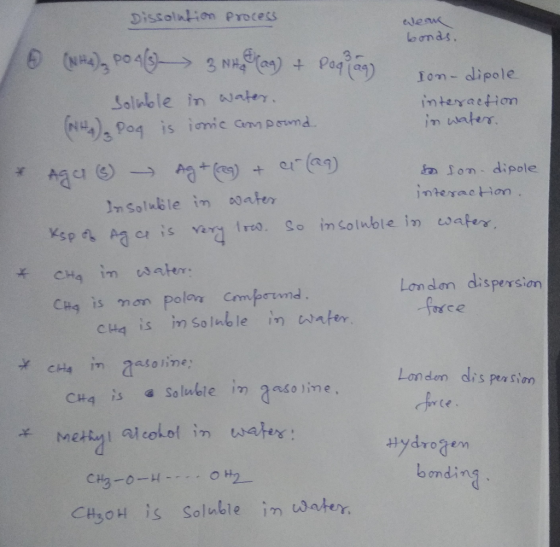
Show whether the following solutes are soluble in each solvent, and the process of dissolution of...
4.21 Using solubility guidelines, predict whether each of the following compounds is soluble or insoluble in...
 4.21 Using solubility guidelines, predict whether each of the
following compounds is soluble or insoluble in water: (a) MgBr 2 ,
(b s) Pbl 2 (c)(NH 4 ) 2 CO 3 ,(d)Sr(OH) 2 (e) ZnSO 4
4.21 Using solubility guidelines, predict whether each of the following compounds is soluble or insoluble in water: (a) MgBrz, (b) Pblz, (c) (NH4)2CO3, (d) Sr(OH)2, (e) ZnSO4.
4.21 Using solubility guidelines, predict whether each of the
following compounds is soluble or insoluble in water: (a) MgBr 2 ,
(b s) Pbl 2 (c)(NH 4 ) 2 CO 3 ,(d)Sr(OH) 2 (e) ZnSO 4
4.21 Using solubility guidelines, predict whether each of the following compounds is soluble or insoluble in water: (a) MgBrz, (b) Pblz, (c) (NH4)2CO3, (d) Sr(OH)2, (e) ZnSO4.
Indicate whether each of the indicated is more soluble in water (polar solvent) or in benzene...
Indicate whether each of the indicated is more soluble in water (polar solvent) or in benzene (nonpolar solvent) Question 4 options: C6H12 (nonpolar) NaBr (polar) KI (polar) I 2(nonpolar) 1. Water (polar) 2. Benzene (nonpolar)
11. Each of the following reactions results in one water-soluble product, and one solid precipitate. Complete...
 11. Each of the following reactions results in one water-soluble product, and one solid precipitate. Complete and balance each reaction, and show phases is or ag) to indicate whether the products are aqueous or solid KCI) Pb(NO hal KOH(aq) + FeCl, (aq) → Bacl, (aq) + K,PO. (aq) → 14. Predict the products (based on the type of chemical reaction) and balance each chemical reaction equation AgC,H,O, (aq) + NaCl(aq) → Na (s) + Cl, (g) → HCl(aq) + Ba(OH)2...
Pt.1 predict whether soluble or insoluble. Pt 2. Miscible or immiscible Pt 3 and beyond- answering...
 Pt.1 predict whether soluble or insoluble.
Pt 2. Miscible or immiscible
Pt 3 and beyond- answering questions
1. For each of the following pairs of solute and solvent, predict whether the solute would be soluble or insoluble. After making your predictions, you can check your answers by looking up the compounds in The Merck Index or the CRC Handbook of Chemistry and Physics. Generally, The Merck Index is the easier reference book to use. If the substance has a solubility...
Pt.1 predict whether soluble or insoluble.
Pt 2. Miscible or immiscible
Pt 3 and beyond- answering questions
1. For each of the following pairs of solute and solvent, predict whether the solute would be soluble or insoluble. After making your predictions, you can check your answers by looking up the compounds in The Merck Index or the CRC Handbook of Chemistry and Physics. Generally, The Merck Index is the easier reference book to use. If the substance has a solubility...
Name Structure 1) ethanol (ethyl alcohol) State (s), (0) H2O Notes CH-CH2-OH Sol., Insol CH4 Sol.,...
 Name Structure 1) ethanol (ethyl alcohol) State (s), (0) H2O Notes CH-CH2-OH Sol., Insol CH4 Sol., Insol. IS Is I No change 2) t-butyl alcohol (2-methyl-2- propanol) CH CH3-C-CH3 1 Is Is I No change OH 3) n-hexyl alcohol (1-hexanol) CH3CH,CH,CH,CHCH2-OH 4) dodecanol 5) 1,6-hexanediol CH CH CH CH CHCH OH ОН 6) decanoic acid Part A) save sample for part B OHS Insols decanoic acid Part B) changed to sodium decanoate after rxn with NaOH After adding the NaOH...
16. If water is a solvent, of the compounds shown below, how many are readily soluble...
 16. If water is a solvent, of the compounds shown below, how many are readily soluble in water НН НН НН [a] 1 [b1 2 c] 3 [d] 4 [e] 5 17. Select the compound expected to have the highest surface tension: F: H-N-H F: F: [b][c [d 8. Of the compounds shown below, how many have dipole-dipole interactions as at least one of their intermolecular forces: Se-C-Se [a]1 [b)2 [c]3 [d]4 [e]5 Which of these solutes would have the...
to e whether each of the follo the following 8-26 Using Table 8-2, indicate whether soluble...
 to e whether each of the follo the following 8-26 Using Table 8-2, indicate whether soluble in water. vease ter vo members of each of the ave like solubiszy (both mpounds is soluble or insoluble in a. FeSO4 b. FeCO3 c. Fe(NO3)2 d. FeCl2 827 Indicate whether or not the two membe following pairs of compounds have like soluble or both insoluble). a. NHC and NH Br b. KNO, and K c. Caco, and Ca3(PO4)2 d. Ni(OH)2 and 8-28 Indicate...
Solutions 1. Identify the solvent and solute(s) in each of the following solutions. Note that there...
 Solutions 1. Identify the solvent and solute(s) in each of the following solutions. Note that there may be more than one solute in a solution. A 20 g of calcium chloride CaCl2 dissolved in 100 g of water. Solvent Solute(s) B Air which contains 20.95% oxygen, 0.93% argon, 78.09% nitrogen and 0.04% carbon dioxide. Solvent Solute(s) C Rubbing alcohol which consists of 70% isopropyl alcohol and 30% water. Solvent Solute(s) D Alloy 7705 which consist of 6% zinc, 2.3% magnesium,...
1. Solubility in WATER Check solubility of four solutes in water (H2O). For each solute record...
1. Solubility in WATER Check solubility of four solutes in water (H2O). For each solute record how many teaspoons dissolved in 1/2 cup of water. NaCl: Start out with 4 small glasses (cups) and add 1/2 cup of water to each. Put 1/2 level teaspoon (tsp) of salt (NaCl) into the first cup and stir. If it dissolves within 1 minute; add another 1/2 tsp of salt and stir. Count the number of 1/2 tsps you are adding. Repeat until...
Decide whether each of the following is water-soluble. If soluble, tell what ions are produced when...
 Decide whether each of the following is water-soluble. If soluble, tell what ions are produced when the compound dissolves in water (a) NajCO (b) CuSO (c) NiS (d) BaBe. b. Predict the products of each precipitation reaction. Balance the equation, and then write the net ionic equation. (a) NiCl(aq) + (NHS(aq) th) Mn(NOlaq) + Na POalaq) Complete and balance the equations for the following acid-base reactions. Name the reactants and products. (a) CH,CO H(aq) + Mg(OH) (s)- (b) HCIOa(aq) +NH(aq)-...
 4.21 Using solubility guidelines, predict whether each of the
following compounds is soluble or insoluble in water: (a) MgBr 2 ,
(b s) Pbl 2 (c)(NH 4 ) 2 CO 3 ,(d)Sr(OH) 2 (e) ZnSO 4
4.21 Using solubility guidelines, predict whether each of the following compounds is soluble or insoluble in water: (a) MgBrz, (b) Pblz, (c) (NH4)2CO3, (d) Sr(OH)2, (e) ZnSO4.
4.21 Using solubility guidelines, predict whether each of the
following compounds is soluble or insoluble in water: (a) MgBr 2 ,
(b s) Pbl 2 (c)(NH 4 ) 2 CO 3 ,(d)Sr(OH) 2 (e) ZnSO 4
4.21 Using solubility guidelines, predict whether each of the following compounds is soluble or insoluble in water: (a) MgBrz, (b) Pblz, (c) (NH4)2CO3, (d) Sr(OH)2, (e) ZnSO4.
 11. Each of the following reactions results in one water-soluble product, and one solid precipitate. Complete and balance each reaction, and show phases is or ag) to indicate whether the products are aqueous or solid KCI) Pb(NO hal KOH(aq) + FeCl, (aq) → Bacl, (aq) + K,PO. (aq) → 14. Predict the products (based on the type of chemical reaction) and balance each chemical reaction equation AgC,H,O, (aq) + NaCl(aq) → Na (s) + Cl, (g) → HCl(aq) + Ba(OH)2...
 Pt.1 predict whether soluble or insoluble.
Pt 2. Miscible or immiscible
Pt 3 and beyond- answering questions
1. For each of the following pairs of solute and solvent, predict whether the solute would be soluble or insoluble. After making your predictions, you can check your answers by looking up the compounds in The Merck Index or the CRC Handbook of Chemistry and Physics. Generally, The Merck Index is the easier reference book to use. If the substance has a solubility...
Pt.1 predict whether soluble or insoluble.
Pt 2. Miscible or immiscible
Pt 3 and beyond- answering questions
1. For each of the following pairs of solute and solvent, predict whether the solute would be soluble or insoluble. After making your predictions, you can check your answers by looking up the compounds in The Merck Index or the CRC Handbook of Chemistry and Physics. Generally, The Merck Index is the easier reference book to use. If the substance has a solubility...
 Name Structure 1) ethanol (ethyl alcohol) State (s), (0) H2O Notes CH-CH2-OH Sol., Insol CH4 Sol., Insol. IS Is I No change 2) t-butyl alcohol (2-methyl-2- propanol) CH CH3-C-CH3 1 Is Is I No change OH 3) n-hexyl alcohol (1-hexanol) CH3CH,CH,CH,CHCH2-OH 4) dodecanol 5) 1,6-hexanediol CH CH CH CH CHCH OH ОН 6) decanoic acid Part A) save sample for part B OHS Insols decanoic acid Part B) changed to sodium decanoate after rxn with NaOH After adding the NaOH...
 16. If water is a solvent, of the compounds shown below, how many are readily soluble in water НН НН НН [a] 1 [b1 2 c] 3 [d] 4 [e] 5 17. Select the compound expected to have the highest surface tension: F: H-N-H F: F: [b][c [d 8. Of the compounds shown below, how many have dipole-dipole interactions as at least one of their intermolecular forces: Se-C-Se [a]1 [b)2 [c]3 [d]4 [e]5 Which of these solutes would have the...
 to e whether each of the follo the following 8-26 Using Table 8-2, indicate whether soluble in water. vease ter vo members of each of the ave like solubiszy (both mpounds is soluble or insoluble in a. FeSO4 b. FeCO3 c. Fe(NO3)2 d. FeCl2 827 Indicate whether or not the two membe following pairs of compounds have like soluble or both insoluble). a. NHC and NH Br b. KNO, and K c. Caco, and Ca3(PO4)2 d. Ni(OH)2 and 8-28 Indicate...
 Solutions 1. Identify the solvent and solute(s) in each of the following solutions. Note that there may be more than one solute in a solution. A 20 g of calcium chloride CaCl2 dissolved in 100 g of water. Solvent Solute(s) B Air which contains 20.95% oxygen, 0.93% argon, 78.09% nitrogen and 0.04% carbon dioxide. Solvent Solute(s) C Rubbing alcohol which consists of 70% isopropyl alcohol and 30% water. Solvent Solute(s) D Alloy 7705 which consist of 6% zinc, 2.3% magnesium,...
 Decide whether each of the following is water-soluble. If soluble, tell what ions are produced when the compound dissolves in water (a) NajCO (b) CuSO (c) NiS (d) BaBe. b. Predict the products of each precipitation reaction. Balance the equation, and then write the net ionic equation. (a) NiCl(aq) + (NHS(aq) th) Mn(NOlaq) + Na POalaq) Complete and balance the equations for the following acid-base reactions. Name the reactants and products. (a) CH,CO H(aq) + Mg(OH) (s)- (b) HCIOa(aq) +NH(aq)-...
Most questions answered within 3 hours.
-
Where is the error in this code sequence?
String s1 = "Hello";
String s2 = "ello";...
asked 10 months ago -
Financial data for Joel de Paris, Inc., for last year
follow:
Joel de Paris, Inc.
Balance...
asked 10 months ago -
Consider this reaction:
Al2(SO4)3 (aq)+ BaCl3
(aq) Al2Cl6 (aq)- +
3BaSO4(s) . What is the...
asked 10 months ago -
Suppose that Savneet is considering increasing her
recent random sample from 20 car rentals to 40...
asked 10 months ago -
Trucks arrive at an unloading terminal at an average rate of 120
per hour.
Trucks arrive...
asked 10 months ago -
Why are methanol and ethanol completely soluble in water while
octanol is not very little soluble....
asked 10 months ago -
A facilities manager at a university reads in a research report
that the mean amount of...
asked 10 months ago -
When the CuSO4 is rehydrated by adding water to the anhydrous
compound, is this an endothermic...
asked 10 months ago -
A ray of sunlight is passing from diamond into crown glass; the
angle of incidence is...
asked 10 months ago -
A block of mass 0.249 kg is placed on top of a light, vertical
spring of...
asked 10 months ago -
how do the kidneys compensate in the presences of acidosis
a) trigger hyperventilate
b) reserve acid...
asked 10 months ago -
Question 501 pts
The rental rate of capital to the firm increases. Which of the
following...
asked 10 months ago