
Homework Answers
Add Answer to:
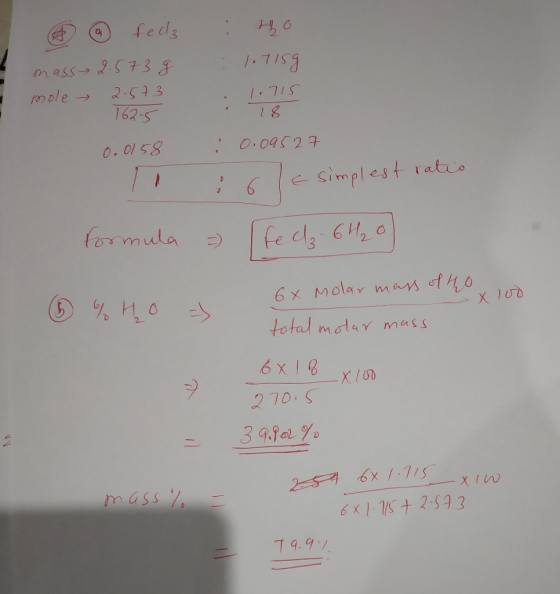
7. Upon gravimetric analysis of a hydrate, the sample was found to contain 2.573 g of...
H20 MASS of H20 2.09 8. A sample of 8.85 g of Na2CO3 hydrate is heated,...
 H20 MASS of H20 2.09 8. A sample of 8.85 g of Na2CO3 hydrate is heated, losing 1.28 g of water. Find the empirical formula 8. A sample of 8.85 g of Na2CO3 hydrate is heated, losing 1.28 g of water. Find the empirical formula.
An unknown hydrated salt was analyzed and found to contain 16.4% water. If the anhydrous salt...
 An
unknown hydrated salt was analyzed and found to contain 16.4%
water. If the anhydrous salt has a formula mass of 183.0 g, find
the empirical formula of the hydrate.
LOVE 3. An unknown hydrated salt was analyzed and found to contain 16.4 % water. If the anhydrous salt has a formula mass of 183.0 g, find the empirical formula of the hydrate. 4. Find the empirical formula of the hydrated salt, Caso, XH,O, if it contains 20.9 % water
An
unknown hydrated salt was analyzed and found to contain 16.4%
water. If the anhydrous salt has a formula mass of 183.0 g, find
the empirical formula of the hydrate.
LOVE 3. An unknown hydrated salt was analyzed and found to contain 16.4 % water. If the anhydrous salt has a formula mass of 183.0 g, find the empirical formula of the hydrate. 4. Find the empirical formula of the hydrated salt, Caso, XH,O, if it contains 20.9 % water
A student is given a sample of a manganese(II) chloride hydrate. She weighs the sample in...
 A student is given a sample of a manganese(II) chloride hydrate. She weighs the sample in a dry, covered crucible and obtains a mass of 24.747 g for the crucible, cover, and sample. Earlier she had found that the crucible and cover weighed 23.599 g. She then heats the crucible to drive off the water of hydration, keeping the crucible at red heat for about 10 minutes with the cover slightly ajar. She then lets the crucible cool, and finds...
GRAVIMETRIC ANALYSIS Gravimetric Analysis-A type of analysis in which a sample is subjected to some treatment...
 GRAVIMETRIC ANALYSIS Gravimetric Analysis-A type of analysis in which a sample is subjected to some treatment that causes a change in the physical state of the analyte that permits its separation from the other components of the sample. Mass measurements of the isolated analyte used along with the known stoichiometry of the compounds involved, permit calculation of the analyte concentration. Commonly, the analyte is separated by subjecting it to a precipitation reaction. -EXAMPLE a) A 0.4550-g solid mixture containing MgS0,...
if a hydrate was found to contain 12% water and original weight of the sample was...
if a hydrate was found to contain 12% water and original weight of the sample was 30g, what will be the final weight of the anhydrous sample
A 1.232 g sample of a magnesium sulfate hydrate is heated until its final mass is...
 A 1.232 g sample of a magnesium sulfate hydrate is heated until its final mass is 0.602 g. What is the formula of the hydrate? Note: the molar mass of MgSO4 is 120.4 g/mol and the molar mass of water is 18.0 g/mol. MgSO4.5H20 a. O b. MgSO4.7H20 O c. MgSO4:3H20 d. MgSO4:H20
Data Table 1. CuSO4 Data Mass of empty cup (grams) Mass of CuSO, hydrate (erams)S Cuso,...
 Data Table 1. CuSO4 Data Mass of empty cup (grams) Mass of CuSO, hydrate (erams)S Cuso, hydrate after 1st heating (grams) CuSO, hydrate after 2nd heating (grams) Mass of released H20 (grams) Number of moles of released H201 Mass of anhydrous Cuso (grams) Number of moles of anhydrous CuSO 02a mo Questions: A) Calculate the ratio of moles of H2O to moles of anhydrous Cuso4. Note: Report the ratio to the closest whole number. B) Write the empirical formula for...
Metal Sulfate Hydrate lab (12 points) 4) An unknown metal sulfate hydrate (MSO XHO) sample with...
 Metal Sulfate Hydrate lab (12 points) 4) An unknown metal sulfate hydrate (MSO XHO) sample with the recorded mass below is dissolved in water, and the sulfate ions from the sample precipitated with Ba2+ ions as BaSO4. A pre-massed filter paper is then used to collect the solid BaSO4. Experimental data was recorded below following same procedure in MSH lab. 0.6939 96.06 g/mol Molar mass of SO42- PARTA Mass of unknown metal sulfate hydrate (MSH) Mass of unknown sample sulfate...
. Gravimetric analysis. The gravimetric analysis that we will perform in lab occurs according to the...
. Gravimetric analysis. The gravimetric analysis that we will perform in lab occurs according to the following reactions: 1. Fe3+(aq) + 3 OH-(aq) + x H2O(l) --> Fe(OH)3 • xH2O(s) 2. 2Fe(OH)3 • xH2O(s) + yO2 (g) --> Fe2O3 (s) The second step, which occurs at approximately 900 degrees C, is necessary because the iron hydroxide can contain complexes with different states of hydration. A student performs three replicate gravimetric analyses. Here data is as follows: Fe2O3 (g) 0.2332 ±...
A student is given a sample of a calcium sulfate hydrate. He places the sample in...
A student is given a sample of a calcium sulfate hydrate. He places the sample in a dry, covered crucible and weighs it. The total mass (crucible, cover, and hydrate) is 19.39219.392 g. The crucible and cover together had previously weighed 17.98717.987 g. He then heats the crucible to redness for 10 minutes with the cover slightly ajar. After the crucible cools, he weighs the crucible and its contents; the mass is now 19.09819.098 g, due to the loss of...
 H20 MASS of H20 2.09 8. A sample of 8.85 g of Na2CO3 hydrate is heated, losing 1.28 g of water. Find the empirical formula 8. A sample of 8.85 g of Na2CO3 hydrate is heated, losing 1.28 g of water. Find the empirical formula.
 An
unknown hydrated salt was analyzed and found to contain 16.4%
water. If the anhydrous salt has a formula mass of 183.0 g, find
the empirical formula of the hydrate.
LOVE 3. An unknown hydrated salt was analyzed and found to contain 16.4 % water. If the anhydrous salt has a formula mass of 183.0 g, find the empirical formula of the hydrate. 4. Find the empirical formula of the hydrated salt, Caso, XH,O, if it contains 20.9 % water
An
unknown hydrated salt was analyzed and found to contain 16.4%
water. If the anhydrous salt has a formula mass of 183.0 g, find
the empirical formula of the hydrate.
LOVE 3. An unknown hydrated salt was analyzed and found to contain 16.4 % water. If the anhydrous salt has a formula mass of 183.0 g, find the empirical formula of the hydrate. 4. Find the empirical formula of the hydrated salt, Caso, XH,O, if it contains 20.9 % water
 A student is given a sample of a manganese(II) chloride hydrate. She weighs the sample in a dry, covered crucible and obtains a mass of 24.747 g for the crucible, cover, and sample. Earlier she had found that the crucible and cover weighed 23.599 g. She then heats the crucible to drive off the water of hydration, keeping the crucible at red heat for about 10 minutes with the cover slightly ajar. She then lets the crucible cool, and finds...
 GRAVIMETRIC ANALYSIS Gravimetric Analysis-A type of analysis in which a sample is subjected to some treatment that causes a change in the physical state of the analyte that permits its separation from the other components of the sample. Mass measurements of the isolated analyte used along with the known stoichiometry of the compounds involved, permit calculation of the analyte concentration. Commonly, the analyte is separated by subjecting it to a precipitation reaction. -EXAMPLE a) A 0.4550-g solid mixture containing MgS0,...
 A 1.232 g sample of a magnesium sulfate hydrate is heated until its final mass is 0.602 g. What is the formula of the hydrate? Note: the molar mass of MgSO4 is 120.4 g/mol and the molar mass of water is 18.0 g/mol. MgSO4.5H20 a. O b. MgSO4.7H20 O c. MgSO4:3H20 d. MgSO4:H20
 Data Table 1. CuSO4 Data Mass of empty cup (grams) Mass of CuSO, hydrate (erams)S Cuso, hydrate after 1st heating (grams) CuSO, hydrate after 2nd heating (grams) Mass of released H20 (grams) Number of moles of released H201 Mass of anhydrous Cuso (grams) Number of moles of anhydrous CuSO 02a mo Questions: A) Calculate the ratio of moles of H2O to moles of anhydrous Cuso4. Note: Report the ratio to the closest whole number. B) Write the empirical formula for...
 Metal Sulfate Hydrate lab (12 points) 4) An unknown metal sulfate hydrate (MSO XHO) sample with the recorded mass below is dissolved in water, and the sulfate ions from the sample precipitated with Ba2+ ions as BaSO4. A pre-massed filter paper is then used to collect the solid BaSO4. Experimental data was recorded below following same procedure in MSH lab. 0.6939 96.06 g/mol Molar mass of SO42- PARTA Mass of unknown metal sulfate hydrate (MSH) Mass of unknown sample sulfate...
Most questions answered within 3 hours.
-
Where is the error in this code sequence?
String s1 = "Hello";
String s2 = "ello";...
asked 11 months ago -
Financial data for Joel de Paris, Inc., for last year
follow:
Joel de Paris, Inc.
Balance...
asked 11 months ago -
Consider this reaction:
Al2(SO4)3 (aq)+ BaCl3
(aq) Al2Cl6 (aq)- +
3BaSO4(s) . What is the...
asked 11 months ago -
Suppose that Savneet is considering increasing her
recent random sample from 20 car rentals to 40...
asked 11 months ago -
Trucks arrive at an unloading terminal at an average rate of 120
per hour.
Trucks arrive...
asked 11 months ago -
Why are methanol and ethanol completely soluble in water while
octanol is not very little soluble....
asked 11 months ago -
A facilities manager at a university reads in a research report
that the mean amount of...
asked 11 months ago -
When the CuSO4 is rehydrated by adding water to the anhydrous
compound, is this an endothermic...
asked 11 months ago -
A ray of sunlight is passing from diamond into crown glass; the
angle of incidence is...
asked 11 months ago -
A block of mass 0.249 kg is placed on top of a light, vertical
spring of...
asked 11 months ago -
how do the kidneys compensate in the presences of acidosis
a) trigger hyperventilate
b) reserve acid...
asked 11 months ago -
Question 501 pts
The rental rate of capital to the firm increases. Which of the
following...
asked 11 months ago