![Question Two (10 Marks] Air is contained in vertical piston-cylinder assembly fitted with an electrical resistor. The atmosph](http://img.homeworklib.com/questions/6c629c70-4af5-11ec-b476-4f0903e22611.png?x-oss-process=image/resize,w_560)
Homework Answers
Add Answer to:
Question Two (10 Marks] Air is contained in vertical piston-cylinder assembly fitted with an electrical resistor....
Question 1 Air is contained in a vertical piston-cylinder assembly fitted with an electrical heater. The...
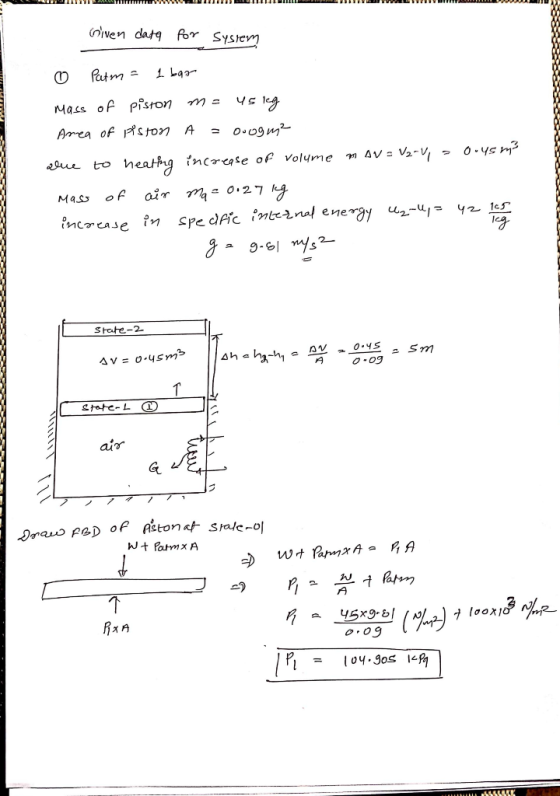
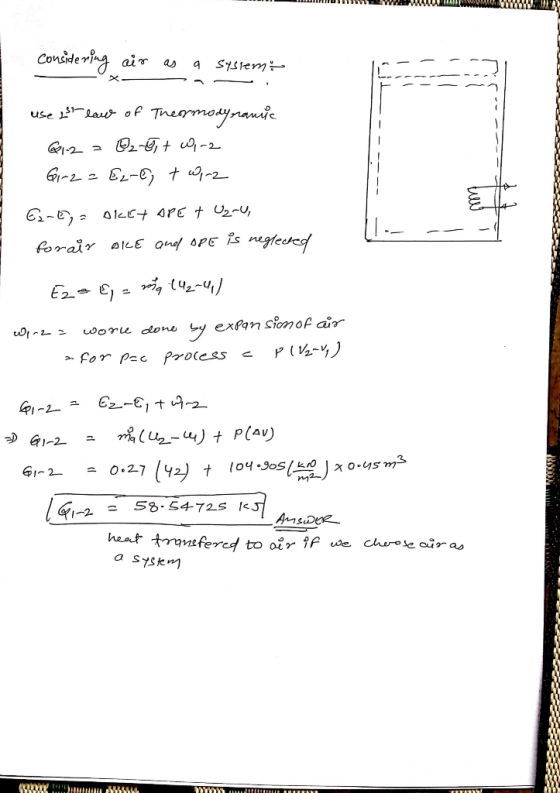
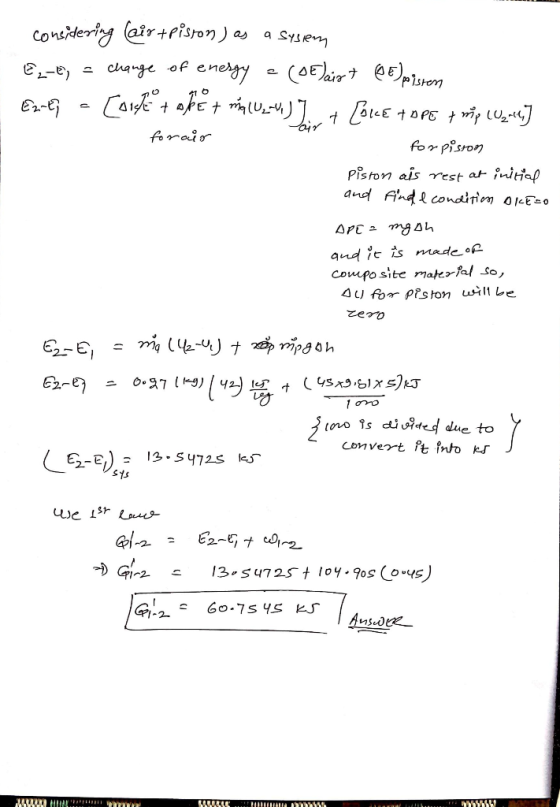
 Question 1 Air is contained in a vertical piston-cylinder assembly fitted with an electrical heater. The atmospheric pressure is 100 kPa and piston has a mass of 50 kg and a face area of 0.1 m . Electric current passes through the heater, and the volume of air slowly increases by 0.045 m. The mass of the air is 0.3 kg and its specific internal energy increases by 42.2 kJ/kg. Assume the assembly (including the piston) is insulated and neglect...
Air is contained in a piston cylinder device that has a resistance heater inside. The atmosphere...
 Air is contained in a piston cylinder device that has a
resistance heater inside. The atmosphere exerts a pressure of 100
kpa on the piston of which it has a mass of 45 kg and a transverse
area of 0.9 m². An electric current passes through the resistance
of the air volume slowly increases by 0.45 m³ while the pressure
remains constant. The mass of the air is 0.27 kg and its specific
internal energy increases 42 kJ / kg,...
Air is contained in a piston cylinder device that has a
resistance heater inside. The atmosphere exerts a pressure of 100
kpa on the piston of which it has a mass of 45 kg and a transverse
area of 0.9 m². An electric current passes through the resistance
of the air volume slowly increases by 0.45 m³ while the pressure
remains constant. The mass of the air is 0.27 kg and its specific
internal energy increases 42 kJ / kg,...
Air is contained in a vertical piston-cylinder assembly such that the piston is in static...
 Air is contained in a vertical piston-cylinder assembly such that the piston is in static equilibrium The atmosphere exerts a pressure of 101 kPa on top of the 0.8 meter-diameter piston. The gage pressure of the air inside the cylinder is 1.2 kPa. Subsequently, a weight is placed on top of the piston, as shown below, causing the piston to descend until reaching a new static equilibrium position. At this position, the gage pressure of the air inside the cylinder is...
1/2 Question 3 A piston-cylinder assembly fitted with a paddle wheel contains air, initially at 38°C,...
 1/2 Question 3 A piston-cylinder assembly fitted with a paddle wheel contains air, initially at 38°C, 125 kPa, and a volume of 0.02 mº. Energy in the amount of 1.8 kJ is transferred to the air by the paddle wheel. The volume of the air in the piston-cylinder increases to 0.05 mº at constant pressure. If the heat transfer between the air and its surroundings can be ignored, determine (a) the mass of the air in the piston-cylinder (b) the...
A gas is contained in a vertical piston–cylinder assembly by a piston with a face area...
A gas is contained in a vertical piston–cylinder assembly by a piston with a face area of 40 in.2 and weight of 100 lbf. The atmosphere exerts a pressure of 14.7 lbf/in.2on top of the piston. A paddle wheel transfers 3 Btu of energy to the gas during a process in which the elevation of the piston increases by 1 ft. The change in internal energy of the gas is 2.12 Btu. The piston and cylinder are poor thermal conductors,...
Air contained within a piston-cylinder assembly is slowly heated. As shown below, during this process the...
 Air contained within a piston-cylinder assembly is slowly
heated. As shown below, during this process the pressure first
varies linearly with volume and then remains constant. Determine
the total work, in kJ.
5. Air contained in a piston-cylinder assembly is slowly heat pressure first varies linearly and then is constant. Determ 150 100 LPa 50 003 0.045 007 V(m) 7. Carbon dioxide gas contained within a piston-cy
Air contained within a piston-cylinder assembly is slowly
heated. As shown below, during this process the pressure first
varies linearly with volume and then remains constant. Determine
the total work, in kJ.
5. Air contained in a piston-cylinder assembly is slowly heat pressure first varies linearly and then is constant. Determ 150 100 LPa 50 003 0.045 007 V(m) 7. Carbon dioxide gas contained within a piston-cy
A piston–cylinder assembly fitted with a slowly rotating paddle wheel contains 0.19 kg of air, initially...
 A piston–cylinder assembly fitted with a slowly rotating paddle
wheel contains 0.19 kg of air, initially at 300 K. The air
undergoes a constant-pressure process to a final temperature of 420
K. During the process, energy is gradually transferred to the air
by heat transfer in the amount 12 kJ.
Assuming the ideal gas model with k = 1.4 and negligible
changes in kinetic and potential energy for the air, determine the
work done by the paddle wheel on the...
A piston–cylinder assembly fitted with a slowly rotating paddle
wheel contains 0.19 kg of air, initially at 300 K. The air
undergoes a constant-pressure process to a final temperature of 420
K. During the process, energy is gradually transferred to the air
by heat transfer in the amount 12 kJ.
Assuming the ideal gas model with k = 1.4 and negligible
changes in kinetic and potential energy for the air, determine the
work done by the paddle wheel on the...
A piston-cylinder assembly fitted with a slowly rotating paddle wheel contains 0.19 kg of air, initially...
 A piston-cylinder assembly fitted with a slowly rotating paddle wheel contains 0.19 kg of air, initially at 300 K. The air undergoes a constant-pressure process to a final temperature of 440 K. During the process, energy is gradually transferred to the air by heat transfer in the amount 12 kJ. Assuming the ideal gas model with k = 1.4 and negligible changes in kinetic and potential energy for the air, determine the work done by the paddle wheel on the...
A piston cylinder assembly fitted with a slowly rotating paddle wheel contains 0.13 kg of air...
A piston cylinder assembly fitted with a slowly rotating paddle wheel contains 0.13 kg of air at 300K. The air undergoes a constant pressure process to a final temp of 400K. During the process heat is transfered to the air by Q=12kJ. Assuming the ideal gas model with k=1.4 and negligible changes in kinetic and potential energy for the air, determine the work done by the paddle on the air and the work done by the air to displace the...
A gas is contained in a vertical, frictionless piston-cylinder device. The piston has a mass of...
 A gas is contained in a vertical, frictionless piston-cylinder device. The piston has a mass of 3.2 kg and a cross-sectional area of 35 cm2. A compressed spring above the piston exerts a force of 110 N on the piston. If the atmospheric pressure is 95 kPa, determine the pressure inside the cylinder. The pressure inside the cylinder is _______ kPa.
 Question 1 Air is contained in a vertical piston-cylinder assembly fitted with an electrical heater. The atmospheric pressure is 100 kPa and piston has a mass of 50 kg and a face area of 0.1 m . Electric current passes through the heater, and the volume of air slowly increases by 0.045 m. The mass of the air is 0.3 kg and its specific internal energy increases by 42.2 kJ/kg. Assume the assembly (including the piston) is insulated and neglect...
 Air is contained in a piston cylinder device that has a
resistance heater inside. The atmosphere exerts a pressure of 100
kpa on the piston of which it has a mass of 45 kg and a transverse
area of 0.9 m². An electric current passes through the resistance
of the air volume slowly increases by 0.45 m³ while the pressure
remains constant. The mass of the air is 0.27 kg and its specific
internal energy increases 42 kJ / kg,...
Air is contained in a piston cylinder device that has a
resistance heater inside. The atmosphere exerts a pressure of 100
kpa on the piston of which it has a mass of 45 kg and a transverse
area of 0.9 m². An electric current passes through the resistance
of the air volume slowly increases by 0.45 m³ while the pressure
remains constant. The mass of the air is 0.27 kg and its specific
internal energy increases 42 kJ / kg,...
 1/2 Question 3 A piston-cylinder assembly fitted with a paddle wheel contains air, initially at 38°C, 125 kPa, and a volume of 0.02 mº. Energy in the amount of 1.8 kJ is transferred to the air by the paddle wheel. The volume of the air in the piston-cylinder increases to 0.05 mº at constant pressure. If the heat transfer between the air and its surroundings can be ignored, determine (a) the mass of the air in the piston-cylinder (b) the...
 Air contained within a piston-cylinder assembly is slowly
heated. As shown below, during this process the pressure first
varies linearly with volume and then remains constant. Determine
the total work, in kJ.
5. Air contained in a piston-cylinder assembly is slowly heat pressure first varies linearly and then is constant. Determ 150 100 LPa 50 003 0.045 007 V(m) 7. Carbon dioxide gas contained within a piston-cy
Air contained within a piston-cylinder assembly is slowly
heated. As shown below, during this process the pressure first
varies linearly with volume and then remains constant. Determine
the total work, in kJ.
5. Air contained in a piston-cylinder assembly is slowly heat pressure first varies linearly and then is constant. Determ 150 100 LPa 50 003 0.045 007 V(m) 7. Carbon dioxide gas contained within a piston-cy
 A piston–cylinder assembly fitted with a slowly rotating paddle
wheel contains 0.19 kg of air, initially at 300 K. The air
undergoes a constant-pressure process to a final temperature of 420
K. During the process, energy is gradually transferred to the air
by heat transfer in the amount 12 kJ.
Assuming the ideal gas model with k = 1.4 and negligible
changes in kinetic and potential energy for the air, determine the
work done by the paddle wheel on the...
A piston–cylinder assembly fitted with a slowly rotating paddle
wheel contains 0.19 kg of air, initially at 300 K. The air
undergoes a constant-pressure process to a final temperature of 420
K. During the process, energy is gradually transferred to the air
by heat transfer in the amount 12 kJ.
Assuming the ideal gas model with k = 1.4 and negligible
changes in kinetic and potential energy for the air, determine the
work done by the paddle wheel on the...
 A piston-cylinder assembly fitted with a slowly rotating paddle wheel contains 0.19 kg of air, initially at 300 K. The air undergoes a constant-pressure process to a final temperature of 440 K. During the process, energy is gradually transferred to the air by heat transfer in the amount 12 kJ. Assuming the ideal gas model with k = 1.4 and negligible changes in kinetic and potential energy for the air, determine the work done by the paddle wheel on the...
Most questions answered within 3 hours.
-
Where is the error in this code sequence?
String s1 = "Hello";
String s2 = "ello";...
asked 10 months ago -
Financial data for Joel de Paris, Inc., for last year
follow:
Joel de Paris, Inc.
Balance...
asked 10 months ago -
Consider this reaction:
Al2(SO4)3 (aq)+ BaCl3
(aq) Al2Cl6 (aq)- +
3BaSO4(s) . What is the...
asked 10 months ago -
Suppose that Savneet is considering increasing her
recent random sample from 20 car rentals to 40...
asked 10 months ago -
Trucks arrive at an unloading terminal at an average rate of 120
per hour.
Trucks arrive...
asked 10 months ago -
Why are methanol and ethanol completely soluble in water while
octanol is not very little soluble....
asked 10 months ago -
A facilities manager at a university reads in a research report
that the mean amount of...
asked 10 months ago -
When the CuSO4 is rehydrated by adding water to the anhydrous
compound, is this an endothermic...
asked 10 months ago -
A ray of sunlight is passing from diamond into crown glass; the
angle of incidence is...
asked 10 months ago -
A block of mass 0.249 kg is placed on top of a light, vertical
spring of...
asked 10 months ago -
how do the kidneys compensate in the presences of acidosis
a) trigger hyperventilate
b) reserve acid...
asked 10 months ago -
Question 501 pts
The rental rate of capital to the firm increases. Which of the
following...
asked 10 months ago