Electromagnetic Theory EMF
Calculate the emf when the flux is given by 3sin t + 5cos t
a) 3cos t – 5sin t
b) -3cos t + 5sin t
c) -3sin t – 5cos t
d) 3cos t + 5sin t
Homework Answers
Answer: b
Explanation: The electromotive force is given by Vemf = -dλ/dt. Thus Vemf = -dλ/dt = -(3cos t – 5sin t) = -3cos t + 5sin t.
Which of the following sets of parametric equations traces the semicircle shown below from (5,0) to (-5,0) in the clockwise direction for 0 S t S (-5,0(5,0) a Selected Answer: b.x 5sin(t), y 5cos(t)...
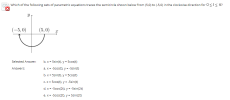 Which of the following sets of parametric equations traces the semicircle shown below from (5,0) to (-5,0) in the clockwise direction for 0 S t S (-5,0(5,0) a Selected Answer: b.x 5sin(t), y 5cos(t) Answers: a. x--5cos(t), y--5sin(t) b.x-5sin(t) y 5cos(t) c. x-5cos(t), y -5sin(t) e, x =-5cos(2t), y = 5sin(2t)
Which of the following sets of parametric equations traces the semicircle shown below from (5,0) to (-5,0) in the clockwise direction for 0 S t S (-5,0(5,0) a Selected...
Which of the following sets of parametric equations traces the semicircle shown below from (5,0) to (-5,0) in the clockwise direction for 0 S t S (-5,0(5,0) a Selected Answer: b.x 5sin(t), y 5cos(t) Answers: a. x--5cos(t), y--5sin(t) b.x-5sin(t) y 5cos(t) c. x-5cos(t), y -5sin(t) e, x =-5cos(2t), y = 5sin(2t)
Which of the following sets of parametric equations traces the semicircle shown below from (5,0) to (-5,0) in the clockwise direction for 0 S t S (-5,0(5,0) a Selected...
Consider the BVP for the function y given by 21T (a) Find ri, r2, roots of the characteristic pol...
 Consider the BVP for the function y given by 21T (a) Find ri, r2, roots of the characteristic polynomial of the equation above. (b) Find a set of real-valued fundamental solutions to the differential equation above. y (x)-| 3cos(5x) y2 (x)-| 3/5cos(5x)+ksin(5x) (c) Find all solutions y of the boundary value problem. y(r)3cos(5x)+3/5sin(5x) Note 1: If there are no solutions, type No Solution. Note 2: If there are infinitely many solutions, use k for the arbitrary constant.
Consider the BVP...
Consider the BVP for the function y given by 21T (a) Find ri, r2, roots of the characteristic polynomial of the equation above. (b) Find a set of real-valued fundamental solutions to the differential equation above. y (x)-| 3cos(5x) y2 (x)-| 3/5cos(5x)+ksin(5x) (c) Find all solutions y of the boundary value problem. y(r)3cos(5x)+3/5sin(5x) Note 1: If there are no solutions, type No Solution. Note 2: If there are infinitely many solutions, use k for the arbitrary constant.
Consider the BVP...
(2) Velocity Vectors Consider the curve given by the position vector: r(t) =< 3cos(t), 5sin(t), 4cos(t)...
 (2) Velocity Vectors Consider the curve given by the position vector: r(t) =< 3cos(t), 5sin(t), 4cos(t) > (2a) Find the velocity vector for this trajectory. (2b) Find the speed for a particle moving along this trajectory. (20) At what point (a,b,c) does the position vector pass through the xy-plane?
1. (i) In a circuit, the voltage is given by: Vs (t) 12 cos(50t10) V (a)...
 1. (i) In a circuit, the voltage is given by: Vs (t) 12 cos(50t10) V (a) What is the amplitude of the voltage? (b) What is the phase of the voltage? (c) What is the angular frequency (radians/sec.) of the voltage? (d) What is the frequency (in cycles/sec.) of the voltage? (e) Determine vs (t) at time t 2.5ms (ii) Given v1(t)cos(50t 50°) V and v2(t) 12 sin(50t 10°) V, determine the phase angle between the two sinusoids and determine...
Four wave functions are given below. III. IV. yx, t) = 5sin(4x - 20t+4) y(x, t)...
 Four wave functions are given below. III. IV. yx, t) = 5sin(4x - 20t+4) y(x, t) = 5sin(3x – 12t+5) y(x, t) = 5cos(4x + 24 + 6) y(x,0) = 14cos(2x - 8t+3) Use this exhibit to answer the following question(s). Refer to Exhibit 16-3. Rank the wave functions in order of the magnitude of the frequencies of the waves, from least to greatest. O a. III, IV, II, I b. IV = II, I, III C. IV. I, II,...
is 45-5 The inverse Laplace transform of F(s) = $?+9 Select the correct answer a. 4cos3t...
 is 45-5 The inverse Laplace transform of F(s) = $?+9 Select the correct answer a. 4cos3t - 5sin 31 b. 2cos(2t) - sin (36) c. 2cos4 - 3sin 5t 5 d. 4 cos 3-sin 31 e. 4cos(26) - 5sin (31)
Q5. Faraday's law says that a) an emf is induced in a closed loop if the...
 Q5. Faraday's law says that a) an emf is induced in a closed loop if the magnetic flux through the loop does not change (ε = lng) = 0) b) an emf is induced in a closed loop if the magnetic flux through the loop changes ΔΦ E = -1 At c) an emf is induced in a closed loop only if a constant current is made to flow through the loop first d) an emf is induced in a...
What is the relationship between the number of coils in a solenoid and the emf induced...
What is the relationship between the number of coils in a solenoid and the emf induced in it by a change in the magnetic flux through the solenoid? a. The induced emf is inversely proportional to the number of coils in a solenoid. b. The induced emf is directly proportional to the number of coils in a solenoid. c. The induced emf is inversely proportional to the square of the number of coils in a solenoid. d. The induced emf...
1) Induced emf in a coil depends on a) Relative motion of magnet b) Relative motion...
 1) Induced emf in a coil depends on a) Relative motion of magnet b) Relative motion of coil c) Both d) None 2) When is passed through coil is there magnet a a (changing/unchanging) magnetic flux through the coil that induces an electromotive force(emf) in the coil; the incoming flux is (equal /not equal)to the outgoing flux. 3) While a magnet is moved toward the end of a solenoid, a voltage difference is induced between the two ends of the...
The inductance of a closely wound coil is such that an emf of 4.71 mV is...
 The inductance of a closely wound coil is such that an emf of 4.71 mV is induced when the current changes at the rate of 3.1 A/s. A steady current of 3.87 A produces a magnetic flux of 43.9 mu Wb through each turn. (a) Calculate the inductance of the coil. (b) How many turns does the coil have? (a) Number Units (b) Number Units
 Which of the following sets of parametric equations traces the semicircle shown below from (5,0) to (-5,0) in the clockwise direction for 0 S t S (-5,0(5,0) a Selected Answer: b.x 5sin(t), y 5cos(t) Answers: a. x--5cos(t), y--5sin(t) b.x-5sin(t) y 5cos(t) c. x-5cos(t), y -5sin(t) e, x =-5cos(2t), y = 5sin(2t)
Which of the following sets of parametric equations traces the semicircle shown below from (5,0) to (-5,0) in the clockwise direction for 0 S t S (-5,0(5,0) a Selected...
Which of the following sets of parametric equations traces the semicircle shown below from (5,0) to (-5,0) in the clockwise direction for 0 S t S (-5,0(5,0) a Selected Answer: b.x 5sin(t), y 5cos(t) Answers: a. x--5cos(t), y--5sin(t) b.x-5sin(t) y 5cos(t) c. x-5cos(t), y -5sin(t) e, x =-5cos(2t), y = 5sin(2t)
Which of the following sets of parametric equations traces the semicircle shown below from (5,0) to (-5,0) in the clockwise direction for 0 S t S (-5,0(5,0) a Selected...
 Consider the BVP for the function y given by 21T (a) Find ri, r2, roots of the characteristic polynomial of the equation above. (b) Find a set of real-valued fundamental solutions to the differential equation above. y (x)-| 3cos(5x) y2 (x)-| 3/5cos(5x)+ksin(5x) (c) Find all solutions y of the boundary value problem. y(r)3cos(5x)+3/5sin(5x) Note 1: If there are no solutions, type No Solution. Note 2: If there are infinitely many solutions, use k for the arbitrary constant.
Consider the BVP...
Consider the BVP for the function y given by 21T (a) Find ri, r2, roots of the characteristic polynomial of the equation above. (b) Find a set of real-valued fundamental solutions to the differential equation above. y (x)-| 3cos(5x) y2 (x)-| 3/5cos(5x)+ksin(5x) (c) Find all solutions y of the boundary value problem. y(r)3cos(5x)+3/5sin(5x) Note 1: If there are no solutions, type No Solution. Note 2: If there are infinitely many solutions, use k for the arbitrary constant.
Consider the BVP...
 (2) Velocity Vectors Consider the curve given by the position vector: r(t) =< 3cos(t), 5sin(t), 4cos(t) > (2a) Find the velocity vector for this trajectory. (2b) Find the speed for a particle moving along this trajectory. (20) At what point (a,b,c) does the position vector pass through the xy-plane?
 1. (i) In a circuit, the voltage is given by: Vs (t) 12 cos(50t10) V (a) What is the amplitude of the voltage? (b) What is the phase of the voltage? (c) What is the angular frequency (radians/sec.) of the voltage? (d) What is the frequency (in cycles/sec.) of the voltage? (e) Determine vs (t) at time t 2.5ms (ii) Given v1(t)cos(50t 50°) V and v2(t) 12 sin(50t 10°) V, determine the phase angle between the two sinusoids and determine...
 Four wave functions are given below. III. IV. yx, t) = 5sin(4x - 20t+4) y(x, t) = 5sin(3x – 12t+5) y(x, t) = 5cos(4x + 24 + 6) y(x,0) = 14cos(2x - 8t+3) Use this exhibit to answer the following question(s). Refer to Exhibit 16-3. Rank the wave functions in order of the magnitude of the frequencies of the waves, from least to greatest. O a. III, IV, II, I b. IV = II, I, III C. IV. I, II,...
 is 45-5 The inverse Laplace transform of F(s) = $?+9 Select the correct answer a. 4cos3t - 5sin 31 b. 2cos(2t) - sin (36) c. 2cos4 - 3sin 5t 5 d. 4 cos 3-sin 31 e. 4cos(26) - 5sin (31)
 Q5. Faraday's law says that a) an emf is induced in a closed loop if the magnetic flux through the loop does not change (ε = lng) = 0) b) an emf is induced in a closed loop if the magnetic flux through the loop changes ΔΦ E = -1 At c) an emf is induced in a closed loop only if a constant current is made to flow through the loop first d) an emf is induced in a...
 1) Induced emf in a coil depends on a) Relative motion of magnet b) Relative motion of coil c) Both d) None 2) When is passed through coil is there magnet a a (changing/unchanging) magnetic flux through the coil that induces an electromotive force(emf) in the coil; the incoming flux is (equal /not equal)to the outgoing flux. 3) While a magnet is moved toward the end of a solenoid, a voltage difference is induced between the two ends of the...
 The inductance of a closely wound coil is such that an emf of 4.71 mV is induced when the current changes at the rate of 3.1 A/s. A steady current of 3.87 A produces a magnetic flux of 43.9 mu Wb through each turn. (a) Calculate the inductance of the coil. (b) How many turns does the coil have? (a) Number Units (b) Number Units
Most questions answered within 3 hours.
-
Where is the error in this code sequence?
String s1 = "Hello";
String s2 = "ello";...
asked 11 months ago -
Financial data for Joel de Paris, Inc., for last year
follow:
Joel de Paris, Inc.
Balance...
asked 11 months ago -
Consider this reaction:
Al2(SO4)3 (aq)+ BaCl3
(aq) Al2Cl6 (aq)- +
3BaSO4(s) . What is the...
asked 11 months ago -
Suppose that Savneet is considering increasing her
recent random sample from 20 car rentals to 40...
asked 11 months ago -
Trucks arrive at an unloading terminal at an average rate of 120
per hour.
Trucks arrive...
asked 11 months ago -
Why are methanol and ethanol completely soluble in water while
octanol is not very little soluble....
asked 11 months ago -
A facilities manager at a university reads in a research report
that the mean amount of...
asked 11 months ago -
When the CuSO4 is rehydrated by adding water to the anhydrous
compound, is this an endothermic...
asked 11 months ago -
A ray of sunlight is passing from diamond into crown glass; the
angle of incidence is...
asked 11 months ago -
A block of mass 0.249 kg is placed on top of a light, vertical
spring of...
asked 11 months ago -
how do the kidneys compensate in the presences of acidosis
a) trigger hyperventilate
b) reserve acid...
asked 11 months ago -
Question 501 pts
The rental rate of capital to the firm increases. Which of the
following...
asked 11 months ago