
Homework Answers
Add Answer to:
quantum physics.
no one is solvong it right
please solve it.
from a) to h)
step...
Please solve question 3 ,4,5,6 the state IL,tni is an eigenvestor of i and izg with...
 Please solve question 3 ,4,5,6
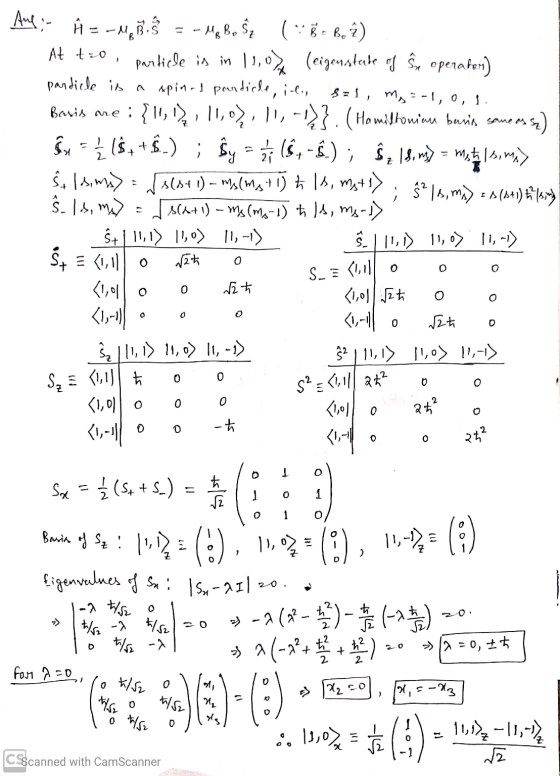
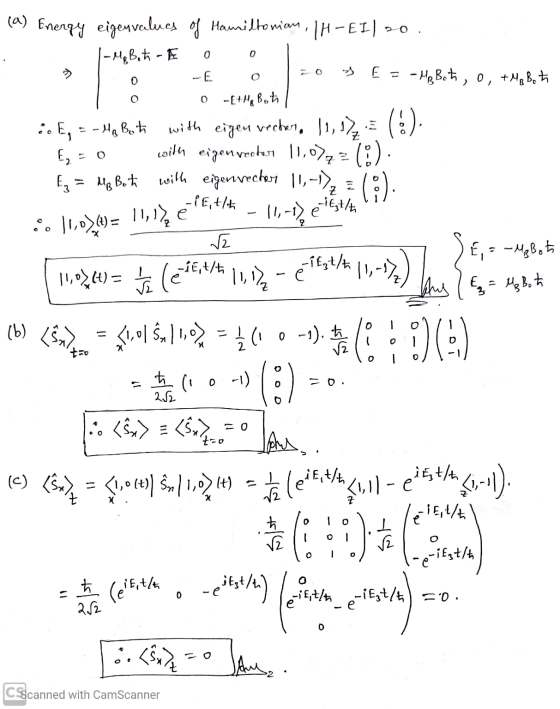
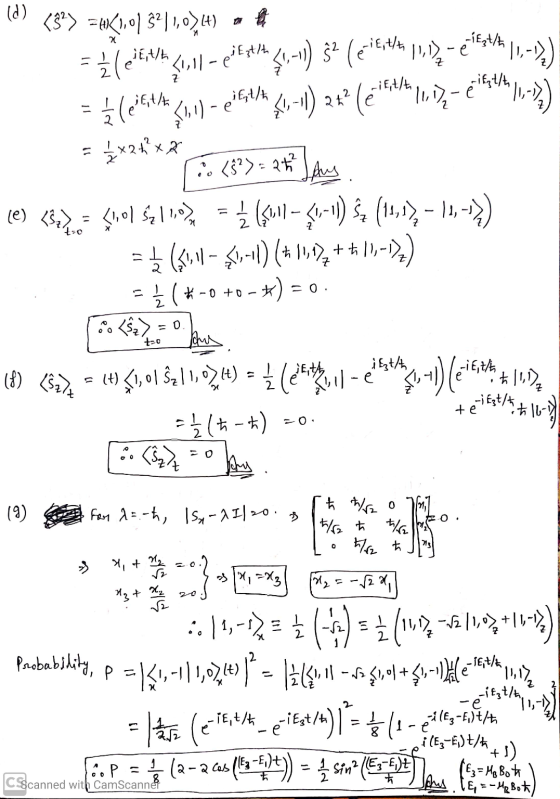
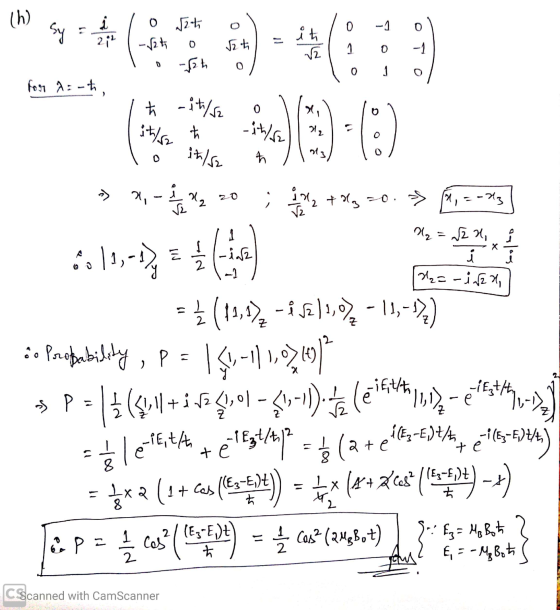
the state IL,tni is an eigenvestor of i and izg with eigeanvalues of +1) and mzh, respectively. Find L>and<I2> n electron is placed in a uniform magnetic field B Bok. At time t O S, was measured and was found to be h/2. (a) (5 points) Write its spin wavefunction at any later time t. (b) (5 points) Calculate < S () (5 pointa) At what time t if you mensure the y component of...
Please solve question 3 ,4,5,6
the state IL,tni is an eigenvestor of i and izg with eigeanvalues of +1) and mzh, respectively. Find L>and<I2> n electron is placed in a uniform magnetic field B Bok. At time t O S, was measured and was found to be h/2. (a) (5 points) Write its spin wavefunction at any later time t. (b) (5 points) Calculate < S () (5 pointa) At what time t if you mensure the y component of...
Intro to Quantum Mechanics Problem: An electron under the influence of a uniform magnetic field By...
 Intro to Quantum Mechanics Problem:
An electron under the influence of a uniform magnetic field By in the y-direction has its spin initially (at 0) pointing in the positive x-direction. That is, it is in an eigenstate of S with eigenvalue +,S h. The Hamiltonian H--μ . B-γ By Sy consists of the interaction of the magnetic dipole moment μ due to spin and the magnetic field B. Show that the probability of finding the electron with its spin pointing...
Intro to Quantum Mechanics Problem:
An electron under the influence of a uniform magnetic field By in the y-direction has its spin initially (at 0) pointing in the positive x-direction. That is, it is in an eigenstate of S with eigenvalue +,S h. The Hamiltonian H--μ . B-γ By Sy consists of the interaction of the magnetic dipole moment μ due to spin and the magnetic field B. Show that the probability of finding the electron with its spin pointing...
Consider the state of a spin-1/2 particle 14) = v1o (31+z) + i] – z)) where...
 Consider the state of a spin-1/2 particle 14) = v1o (31+z) + i] – z)) where | z) are the eigenstates of the operator of the spin z-component $z. 1. Show that [V) is properly normalized, i.e. (W14) = 1. 2. Calculate the probability that a measurement of $x = 6x yields 3. Calculate the expectation value (Šx) for the state 14) and its dispersion ASx = V(@z) – ($()2. 4. Assume that the spin is placed in the magnetic...
1. In this problem, we are going to look at a three-level system. A spin-1 particld is placed in ...
 1. In this problem, we are going to look at a three-level system. A spin-1 particld is placed in a constant magnetic field along the a-direction with strength B,. The spin-1 particle İs initialized in a z-eigenstate with positive eigenvalue h, ie, the i 1,m 1) state. What is the probability to find the negative eigenvalue the spin along the z axis as a function of time? Assume that the spin-1 particle has inagnetic moment 2 × μιι, i.e. that...
The statements in the following list all refer to Quantum Physics. Check the boxes of the...
The statements in the following list all refer to Quantum Physics. Check the boxes of the THREE CORRECT statements. 1. The more massive a particle is, the bigger its de Broglie wavelength. 2. There is a fundamental limit to the precision with which the position and the energy of a particle can be simultaneously known. 3. Classical and quantum mechanics are in complete contradiction. 4. There is a non-zero probability of finding a particle outside a finite square well, even...
please do questions g and h... ONLY G AND H The three spin operators for an...
 please do questions g and h... ONLY G AND H
The three spin operators for an electron (which is a spin-1/2 particle) are $. - 1 (1 :). $=(: ;), $- (-). Suppose the electron is pinned in space but is subject to a magnetic field B = (0,0,B), so that its Hamiltonian H = -1B-S = - BS. Suppose an initial state of the electron is prepared so that (0)) = (?) a. Show that (0)) is a unit...
please do questions g and h... ONLY G AND H
The three spin operators for an electron (which is a spin-1/2 particle) are $. - 1 (1 :). $=(: ;), $- (-). Suppose the electron is pinned in space but is subject to a magnetic field B = (0,0,B), so that its Hamiltonian H = -1B-S = - BS. Suppose an initial state of the electron is prepared so that (0)) = (?) a. Show that (0)) is a unit...
Problem 111.3. A spin 1/2 particle interacts with a nnagnetic field B = Boe through the...
 Problem 111.3. A spin 1/2 particle interacts with a nnagnetic field B = Boe through the Pauli interaction H-μσ. B where μ is the magnetic moment. The Pauli spin matrices are İ-(Oz,@yMwwhere the σί are T0 1 0-il The eigenstates for d, are the spinors 0 (a) (3 pts.) Suppose that at time t-0 the particle is in an eigenstate Xx corresponding to spin pointing along the positive z-axis. Find the eigenstatexz in terms of α and β. (b) (7...
A spin-1 particle interacts with an external magnetic field B = B. The interaction Hamiltonian for the system is H = gB-S, where S-Si + Sỳ + SE is the spin operator. (Ignore all degrees of freedom ot...
 A spin-1 particle interacts with an external magnetic field B = B. The interaction Hamiltonian for the system is H = gB-S, where S-Si + Sỳ + SE is the spin operator. (Ignore all degrees of freedom other than spin.) (a) Find the spin matrices in the basis of the S. S eigenstates, |s, m)) . (Hint: Use the ladder operators, S -S, iS, and S_-S-iS,, and show first that s_ | 1,0-ћ /2 | 1.-1)) . Then use these...
6. Given the spin Hamiltonian of an electron in a magnetic field B-Bok, H--y5.B, find the...
 6. Given the spin Hamiltonian of an electron in a magnetic field B-Bok, H--y5.B, find the time evolution Unitary operator given as U(6) - exp(-()/N). Given that the initial quantum state is le (O) >= 0) find the state after a time t given as (10 points) () >= U(t)|(0) >
QUANTUM MECHANICS Problem 4 Consider a one-dimensional charged harmonic oscillator. Let the coordinate be, charge be...
 QUANTUM MECHANICS
Problem 4 Consider a one-dimensional charged harmonic oscillator. Let the coordinate be, charge be q, mass be m, and the frequency of the oscillator be u. (a) 79 rat t =-oo, the oscillator is in the ground state 10). A uniform electric field E along x axis is applied betweentoo andtoo with the time dependence of E being given by E(t) ー(t/ア Neglect the induced magnetic field. Find the probability that the oscillator goes to the nth excited...
QUANTUM MECHANICS
Problem 4 Consider a one-dimensional charged harmonic oscillator. Let the coordinate be, charge be q, mass be m, and the frequency of the oscillator be u. (a) 79 rat t =-oo, the oscillator is in the ground state 10). A uniform electric field E along x axis is applied betweentoo andtoo with the time dependence of E being given by E(t) ー(t/ア Neglect the induced magnetic field. Find the probability that the oscillator goes to the nth excited...
 Please solve question 3 ,4,5,6
the state IL,tni is an eigenvestor of i and izg with eigeanvalues of +1) and mzh, respectively. Find L>and<I2> n electron is placed in a uniform magnetic field B Bok. At time t O S, was measured and was found to be h/2. (a) (5 points) Write its spin wavefunction at any later time t. (b) (5 points) Calculate < S () (5 pointa) At what time t if you mensure the y component of...
Please solve question 3 ,4,5,6
the state IL,tni is an eigenvestor of i and izg with eigeanvalues of +1) and mzh, respectively. Find L>and<I2> n electron is placed in a uniform magnetic field B Bok. At time t O S, was measured and was found to be h/2. (a) (5 points) Write its spin wavefunction at any later time t. (b) (5 points) Calculate < S () (5 pointa) At what time t if you mensure the y component of...
 Intro to Quantum Mechanics Problem:
An electron under the influence of a uniform magnetic field By in the y-direction has its spin initially (at 0) pointing in the positive x-direction. That is, it is in an eigenstate of S with eigenvalue +,S h. The Hamiltonian H--μ . B-γ By Sy consists of the interaction of the magnetic dipole moment μ due to spin and the magnetic field B. Show that the probability of finding the electron with its spin pointing...
Intro to Quantum Mechanics Problem:
An electron under the influence of a uniform magnetic field By in the y-direction has its spin initially (at 0) pointing in the positive x-direction. That is, it is in an eigenstate of S with eigenvalue +,S h. The Hamiltonian H--μ . B-γ By Sy consists of the interaction of the magnetic dipole moment μ due to spin and the magnetic field B. Show that the probability of finding the electron with its spin pointing...
 Consider the state of a spin-1/2 particle 14) = v1o (31+z) + i] – z)) where | z) are the eigenstates of the operator of the spin z-component $z. 1. Show that [V) is properly normalized, i.e. (W14) = 1. 2. Calculate the probability that a measurement of $x = 6x yields 3. Calculate the expectation value (Šx) for the state 14) and its dispersion ASx = V(@z) – ($()2. 4. Assume that the spin is placed in the magnetic...
 1. In this problem, we are going to look at a three-level system. A spin-1 particld is placed in a constant magnetic field along the a-direction with strength B,. The spin-1 particle İs initialized in a z-eigenstate with positive eigenvalue h, ie, the i 1,m 1) state. What is the probability to find the negative eigenvalue the spin along the z axis as a function of time? Assume that the spin-1 particle has inagnetic moment 2 × μιι, i.e. that...
 please do questions g and h... ONLY G AND H
The three spin operators for an electron (which is a spin-1/2 particle) are $. - 1 (1 :). $=(: ;), $- (-). Suppose the electron is pinned in space but is subject to a magnetic field B = (0,0,B), so that its Hamiltonian H = -1B-S = - BS. Suppose an initial state of the electron is prepared so that (0)) = (?) a. Show that (0)) is a unit...
please do questions g and h... ONLY G AND H
The three spin operators for an electron (which is a spin-1/2 particle) are $. - 1 (1 :). $=(: ;), $- (-). Suppose the electron is pinned in space but is subject to a magnetic field B = (0,0,B), so that its Hamiltonian H = -1B-S = - BS. Suppose an initial state of the electron is prepared so that (0)) = (?) a. Show that (0)) is a unit...
 Problem 111.3. A spin 1/2 particle interacts with a nnagnetic field B = Boe through the Pauli interaction H-μσ. B where μ is the magnetic moment. The Pauli spin matrices are İ-(Oz,@yMwwhere the σί are T0 1 0-il The eigenstates for d, are the spinors 0 (a) (3 pts.) Suppose that at time t-0 the particle is in an eigenstate Xx corresponding to spin pointing along the positive z-axis. Find the eigenstatexz in terms of α and β. (b) (7...
 A spin-1 particle interacts with an external magnetic field B = B. The interaction Hamiltonian for the system is H = gB-S, where S-Si + Sỳ + SE is the spin operator. (Ignore all degrees of freedom other than spin.) (a) Find the spin matrices in the basis of the S. S eigenstates, |s, m)) . (Hint: Use the ladder operators, S -S, iS, and S_-S-iS,, and show first that s_ | 1,0-ћ /2 | 1.-1)) . Then use these...
 6. Given the spin Hamiltonian of an electron in a magnetic field B-Bok, H--y5.B, find the time evolution Unitary operator given as U(6) - exp(-()/N). Given that the initial quantum state is le (O) >= 0) find the state after a time t given as (10 points) () >= U(t)|(0) >
 QUANTUM MECHANICS
Problem 4 Consider a one-dimensional charged harmonic oscillator. Let the coordinate be, charge be q, mass be m, and the frequency of the oscillator be u. (a) 79 rat t =-oo, the oscillator is in the ground state 10). A uniform electric field E along x axis is applied betweentoo andtoo with the time dependence of E being given by E(t) ー(t/ア Neglect the induced magnetic field. Find the probability that the oscillator goes to the nth excited...
QUANTUM MECHANICS
Problem 4 Consider a one-dimensional charged harmonic oscillator. Let the coordinate be, charge be q, mass be m, and the frequency of the oscillator be u. (a) 79 rat t =-oo, the oscillator is in the ground state 10). A uniform electric field E along x axis is applied betweentoo andtoo with the time dependence of E being given by E(t) ー(t/ア Neglect the induced magnetic field. Find the probability that the oscillator goes to the nth excited...
Most questions answered within 3 hours.
-
Where is the error in this code sequence?
String s1 = "Hello";
String s2 = "ello";...
asked 10 months ago -
Financial data for Joel de Paris, Inc., for last year
follow:
Joel de Paris, Inc.
Balance...
asked 10 months ago -
Consider this reaction:
Al2(SO4)3 (aq)+ BaCl3
(aq) Al2Cl6 (aq)- +
3BaSO4(s) . What is the...
asked 10 months ago -
Suppose that Savneet is considering increasing her
recent random sample from 20 car rentals to 40...
asked 10 months ago -
Trucks arrive at an unloading terminal at an average rate of 120
per hour.
Trucks arrive...
asked 10 months ago -
Why are methanol and ethanol completely soluble in water while
octanol is not very little soluble....
asked 10 months ago -
A facilities manager at a university reads in a research report
that the mean amount of...
asked 10 months ago -
When the CuSO4 is rehydrated by adding water to the anhydrous
compound, is this an endothermic...
asked 10 months ago -
A ray of sunlight is passing from diamond into crown glass; the
angle of incidence is...
asked 10 months ago -
A block of mass 0.249 kg is placed on top of a light, vertical
spring of...
asked 10 months ago -
how do the kidneys compensate in the presences of acidosis
a) trigger hyperventilate
b) reserve acid...
asked 10 months ago -
Question 501 pts
The rental rate of capital to the firm increases. Which of the
following...
asked 10 months ago