
Homework Answers
`Hey,
Note: Brother in case of any queries, just comment in box I would be very happy to assist all your queries
#include<stdio.h>
#include<stdlib.h>
#include<math.h>
double fun(double t)
{
return sin(t*t)+0.3*t*t*t;
}
double gfun(double t)
{
return (9.0*t)/5.0+2.0*cos(t*t)-4.0*t*t*sin(t*t);
}
int main()
{
double h=1e-7;
double t;
for(t=0.1;t<5;t=t+0.1)
{
double num=(fun(t+h)-2*fun(t)+fun(t-h))/(h*h);
printf("Second derivative at t=%f, numerically is %f and
analytically is %f\n",t,num,gfun(t));
}
return 0;
}
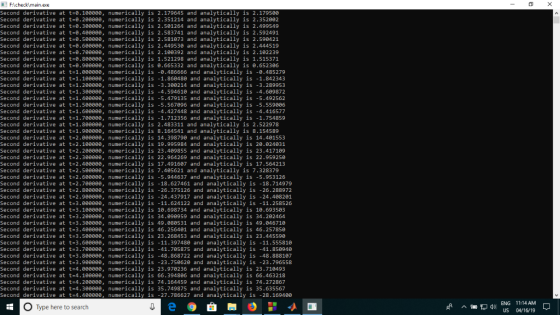
Kindly revert for any queries
Thanks.
Add Answer to:
Write a C program that numerically calculates the second derivative of the function f(t) = sin(H)...
3. (a) Write a MatLab program that calculates for the function F(x, y) = ln(x + Va,2-y2) The prog...
 3. (a) Write a MatLab program that calculates for the function F(x, y) = ln(x + Va,2-y2) The program should use pretty) to display both the original function and the differentiated result, and also use fprintf() to print a label such as "F(x,y) -" and "dF/dxdy - " in front of both the function and the derivative. Then have your program also print out the derivative again after it uses simplify() on the result (b) Find the Taylor expansion of...
My code for calculating the first derivative is the second image Compute second derivative O solutions...
 My code for calculating the
first derivative is the second image
Compute second derivative O solutions submitted (max: 10) You are provided with a set of data for the position of an object over time. The data is sampled at evenly spaced time intervals. Your task is to find a second order accurate approximation for the acceleration at each point in time. Write a Matlab function that takes in a vector of positions x, the time interval between each sampled...
My code for calculating the
first derivative is the second image
Compute second derivative O solutions submitted (max: 10) You are provided with a set of data for the position of an object over time. The data is sampled at evenly spaced time intervals. Your task is to find a second order accurate approximation for the acceleration at each point in time. Write a Matlab function that takes in a vector of positions x, the time interval between each sampled...
4. (a) A function f has first derivative f (r) - and second derivative f"(z) It is also known that the function f h...
 4. (a) A function f has first derivative f (r) - and second derivative f"(z) It is also known that the function f has r-intercept at (-3,0), and a y-intercept at (0,0) (i) Find all critical points, and use them to identify the intervals over which you will examine the behaviour of the first derivative (ii) Use the f'(x), and the First Derivative Test to classify each critical point. (iii) Use the second derivative to examine the concavity around critical...
)and second derivative 4. (a) A function f has first derivative f'(x) f(E) It is also known that the function f has...
 )and second derivative 4. (a) A function f has first derivative f'(x) f(E) It is also known that the function f has r-intercept at (-3,0), and a y-intercept at (0, Q) (i) Find all critical points, and use them to identify the intervals over which you will examine the behaviour of the first derivative [3 marks] (ii) Use the f(x), and the First Derivative Test to classify each critical point.[3 marks] (ii) Use the second derivative to examine the concavity...
4. (a) A function f has first derivative f') and second derivative It is also known that the function f has r-i...
 4. (a) A function f has first derivative f') and second derivative It is also known that the function f has r-intercept at (-3,0) and a y-intercept at (0,0) 0) Find all critical points, and use them to identify the intervals over which you will examine the behaviour of the first derivative. (ii) Use the f'(x), and the First Derivative Test to classify each critical point. (ii) Use the second derivative to examine the concavity around critical points that are...
python the polynomial equation is Ax^3+Bx^2+Cx+D b) Evaluating a polynomial derivative numerically For a function f(x),...
 python
the
polynomial equation is Ax^3+Bx^2+Cx+D
b) Evaluating a polynomial derivative numerically For a function f(x), the derivative of the function at a value x can be found by evaluating f(x+2)-(*) and finding the limit as a gets closer and closer to 0. Using the same polynomial as the user entered in part (a), and for the same value of x as entered in part (a), compute the limit numerically. That is, start with an estimate by evaluating** 72 using...
python
the
polynomial equation is Ax^3+Bx^2+Cx+D
b) Evaluating a polynomial derivative numerically For a function f(x), the derivative of the function at a value x can be found by evaluating f(x+2)-(*) and finding the limit as a gets closer and closer to 0. Using the same polynomial as the user entered in part (a), and for the same value of x as entered in part (a), compute the limit numerically. That is, start with an estimate by evaluating** 72 using...
4. (a) A function f has first derivative f' (x) - and second derivative f"(x) It is also known that the functio...
 4. (a) A function f has first derivative f' (x) - and second derivative f"(x) It is also known that the function f has r-intercept at (-3,0), and a y-intercept at (0,0) (i) Find all critical points, and use them to identify the intervals over which you will examine the behaviour of the first derivative. 3 marks] (ii) Use the f'(x), and the First Derivative Test to classify each critical point. 3 marks (iii) Use the second derivative to examine...
4. (a) A function f has first derivative f'(x) and second derivative 2 f" (x) It is also known that the functio...
 4. (a) A function f has first derivative f'(x) and second derivative 2 f" (x) It is also known that the function f has r-intercept at (-3,0), and a y-intercept at (0,0) (i) Find all critical points, and use them to identify the intervals over which you will examine the behaviour of the first derivative. 3 marks] (ii) Use the f(x), and the First Derivative Test to classify each critical point.[3 marks] (iii) Use the second derivative to examine the...
4. (a) A function f has first derivative f'(r) and second derivative It is also known that the function f has r-int...
 4. (a) A function f has first derivative f'(r) and second derivative It is also known that the function f has r-intercept at (-3,0), and a y-intercept at (0, 0) i) Find all critical points, and use them to identify the intervals over which you will examine the behaviour of the first derivative 3 marks (İİ) Úse the f,(x), and the First Derivative Test to classify each critical point. [3 marks] Iİİ) Úse the second derivative to examine the concavity...
Write a program in C++. You need everything everythihng given You will create a function that...
Write a program in C++. You need everything everythihng given You will create a function that validates input. It should accept only non-negative integers. If the input is incorrect the function should throw an exception. The exception will not be caught in the function. You will create a function that reads in 2 integer values. One is a number that will be raised to the power of the second. So if 5 and 6 are entered the result would be...
 3. (a) Write a MatLab program that calculates for the function F(x, y) = ln(x + Va,2-y2) The program should use pretty) to display both the original function and the differentiated result, and also use fprintf() to print a label such as "F(x,y) -" and "dF/dxdy - " in front of both the function and the derivative. Then have your program also print out the derivative again after it uses simplify() on the result (b) Find the Taylor expansion of...
 My code for calculating the
first derivative is the second image
Compute second derivative O solutions submitted (max: 10) You are provided with a set of data for the position of an object over time. The data is sampled at evenly spaced time intervals. Your task is to find a second order accurate approximation for the acceleration at each point in time. Write a Matlab function that takes in a vector of positions x, the time interval between each sampled...
My code for calculating the
first derivative is the second image
Compute second derivative O solutions submitted (max: 10) You are provided with a set of data for the position of an object over time. The data is sampled at evenly spaced time intervals. Your task is to find a second order accurate approximation for the acceleration at each point in time. Write a Matlab function that takes in a vector of positions x, the time interval between each sampled...
 4. (a) A function f has first derivative f (r) - and second derivative f"(z) It is also known that the function f has r-intercept at (-3,0), and a y-intercept at (0,0) (i) Find all critical points, and use them to identify the intervals over which you will examine the behaviour of the first derivative (ii) Use the f'(x), and the First Derivative Test to classify each critical point. (iii) Use the second derivative to examine the concavity around critical...
 )and second derivative 4. (a) A function f has first derivative f'(x) f(E) It is also known that the function f has r-intercept at (-3,0), and a y-intercept at (0, Q) (i) Find all critical points, and use them to identify the intervals over which you will examine the behaviour of the first derivative [3 marks] (ii) Use the f(x), and the First Derivative Test to classify each critical point.[3 marks] (ii) Use the second derivative to examine the concavity...
 4. (a) A function f has first derivative f') and second derivative It is also known that the function f has r-intercept at (-3,0) and a y-intercept at (0,0) 0) Find all critical points, and use them to identify the intervals over which you will examine the behaviour of the first derivative. (ii) Use the f'(x), and the First Derivative Test to classify each critical point. (ii) Use the second derivative to examine the concavity around critical points that are...
 python
the
polynomial equation is Ax^3+Bx^2+Cx+D
b) Evaluating a polynomial derivative numerically For a function f(x), the derivative of the function at a value x can be found by evaluating f(x+2)-(*) and finding the limit as a gets closer and closer to 0. Using the same polynomial as the user entered in part (a), and for the same value of x as entered in part (a), compute the limit numerically. That is, start with an estimate by evaluating** 72 using...
python
the
polynomial equation is Ax^3+Bx^2+Cx+D
b) Evaluating a polynomial derivative numerically For a function f(x), the derivative of the function at a value x can be found by evaluating f(x+2)-(*) and finding the limit as a gets closer and closer to 0. Using the same polynomial as the user entered in part (a), and for the same value of x as entered in part (a), compute the limit numerically. That is, start with an estimate by evaluating** 72 using...
 4. (a) A function f has first derivative f' (x) - and second derivative f"(x) It is also known that the function f has r-intercept at (-3,0), and a y-intercept at (0,0) (i) Find all critical points, and use them to identify the intervals over which you will examine the behaviour of the first derivative. 3 marks] (ii) Use the f'(x), and the First Derivative Test to classify each critical point. 3 marks (iii) Use the second derivative to examine...
 4. (a) A function f has first derivative f'(x) and second derivative 2 f" (x) It is also known that the function f has r-intercept at (-3,0), and a y-intercept at (0,0) (i) Find all critical points, and use them to identify the intervals over which you will examine the behaviour of the first derivative. 3 marks] (ii) Use the f(x), and the First Derivative Test to classify each critical point.[3 marks] (iii) Use the second derivative to examine the...
 4. (a) A function f has first derivative f'(r) and second derivative It is also known that the function f has r-intercept at (-3,0), and a y-intercept at (0, 0) i) Find all critical points, and use them to identify the intervals over which you will examine the behaviour of the first derivative 3 marks (İİ) Úse the f,(x), and the First Derivative Test to classify each critical point. [3 marks] Iİİ) Úse the second derivative to examine the concavity...
Most questions answered within 3 hours.
-
Where is the error in this code sequence?
String s1 = "Hello";
String s2 = "ello";...
asked 11 months ago -
Financial data for Joel de Paris, Inc., for last year
follow:
Joel de Paris, Inc.
Balance...
asked 11 months ago -
Consider this reaction:
Al2(SO4)3 (aq)+ BaCl3
(aq) Al2Cl6 (aq)- +
3BaSO4(s) . What is the...
asked 11 months ago -
Suppose that Savneet is considering increasing her
recent random sample from 20 car rentals to 40...
asked 11 months ago -
Trucks arrive at an unloading terminal at an average rate of 120
per hour.
Trucks arrive...
asked 11 months ago -
Why are methanol and ethanol completely soluble in water while
octanol is not very little soluble....
asked 11 months ago -
A facilities manager at a university reads in a research report
that the mean amount of...
asked 11 months ago -
When the CuSO4 is rehydrated by adding water to the anhydrous
compound, is this an endothermic...
asked 11 months ago -
A ray of sunlight is passing from diamond into crown glass; the
angle of incidence is...
asked 11 months ago -
A block of mass 0.249 kg is placed on top of a light, vertical
spring of...
asked 11 months ago -
how do the kidneys compensate in the presences of acidosis
a) trigger hyperventilate
b) reserve acid...
asked 11 months ago -
Question 501 pts
The rental rate of capital to the firm increases. Which of the
following...
asked 11 months ago