c + a = -b
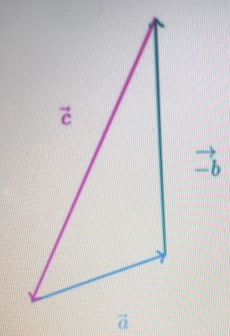
$$ \begin{aligned} &\vec{c}+\vec{a}=-\vec{b} \\ &\vec{c}-\vec{a}=-\vec{b} \\ &\vec{c}+\vec{a}=\vec{b} \\ &\vec{c}-\vec{a}=\vec{b} \end{aligned} $$
Homework Answers

Find the Trace of B
 3. Let \(\quad B=\left[\begin{array}{ll}1 & 2 \\ 2 & 1\end{array}\right]\).(a) Find the Trace of B.(b) Find \(B^{-1}\), the inverse of \(B\).(c) A vector \(\vec{v}\) is an eigenvector of the matrix \(B\) if Matrix-Vector Multiplication \(B \vec{v}\) results in a scaling of the vector \(\vec{v}\). (i.e. \(B \vec{v}=c \vec{v}\), with \(c\) a real number.) Using the definition of Matrix-Vector Multiplication show that the vector \(\vec{v}=\left[\begin{array}{l}1 \\ 1\end{array}\right]\) is an eigenvector of \(B\) with eigenvalue \(c=3\).
Given an LTI system with
Given an LTI system with$$ \begin{aligned} &A=\left(\begin{array}{cc} 1 / 2 & 0 \\ 0 & -1 / 4 \end{array}\right), B=\left(\begin{array}{l} 0 \\ 1 \end{array}\right), C=(1-1), \\ &D=0 \quad X(0)=\left(\begin{array}{l} -1 \\ -1 \end{array}\right), U(n)=(-1)^{n} u[n] \end{aligned} $$Calculate \(y[n], y[4]\) and \(y[\) Steady State \(]\)
C++ int num [ ] = { 1,2,3,3,4,5,6,7,8 } vector <int> vec (num, num + 8)...
C++ int num [ ] = { 1,2,3,3,4,5,6,7,8 } vector <int> vec (num, num + 8) ; vector <int> : : iterator iter ; iter = vec . begin ( ) ; Question 1. What is the result of execute the instruction num [4] ;? a)2 b)7 c) unknown Question 2. How many elements does the vector vec contain? a)0 b)10 c)16
Find the general solution for
Q1) Find the general solution for \(\vec{x}^{\prime}=\left[\begin{array}{cc}2 & 1 \\ -3 & 6\end{array}\right] \vec{x}\).Q2) Find the general solution for \(\vec{x}^{\prime}=\left[\begin{array}{ll}-1 & 1 \\ -4 & 3\end{array}\right] \vec{x}\).
Defining the cross product The cross product of two nonzero vectors
 Defining the cross product The cross product of two nonzero vectors \(\vec{u}\) and \(\vec{v}\) is another vector \(\vec{u} \times \vec{v}\) with magnitude$$ |\vec{u} \times \vec{v}|=|\vec{u}||\vec{v}| \sin (\theta), $$where \(0 \leq \theta \leq \pi\) is the angle between the two vectors. The direction of \(\vec{u} \times \vec{v}\) is given by the right hand rule: when you put the vectors tail to tail and let the fingers of your right hand curl from \(\vec{u}\) to \(\vec{v}\) the direction of \(\vec{u} \times \vec{v}\)...
1. Solve the system: x' =3x+5y, y' =-x-y2. Find the general solution to
Solve the system: \(x^{\prime}=3 x+5 y, y^{\prime}=-x-y\)Find the general solution to$$ \vec{x}^{\prime}=\left(\begin{array}{ll} 2 & 1 \\ 0 & 2 \end{array}\right) \vec{x} $$Find the general solution to$$ \vec{x}^{\prime}=\left(\begin{array}{ccc} 3 & 0 & -2 \\ 0 & 5 & 0 \\ 2 & 0 & 3 \end{array}\right) \vec{x} $$
Referring to the vectors in the figure, express the sum A + B +C in unit vector notation
Referring to the vectors in the figure, express the sum {rm vec A} + {rm vec B} + {rm vec C} in unit vector notation
I have the first method complete, but I can't figure out thesecond method. I have...
 I have the first method complete, but I can't figure out the
second method Could
someone please show how to use the second method?2. Find the unit step response of:$$ \begin{aligned} \dot{\overrightarrow{\mathbf{x}}}(t) &=\left[\begin{array}{cc} 0 & 1 \\ -2 & -2 \end{array}\right] \overrightarrow{\mathbf{x}}(t)+\left[\begin{array}{l} 1 \\ 1 \end{array}\right] u(t) \\ y(t) &=\left[\begin{array}{cc} 2 & 3 \end{array}\right] \overrightarrow{\mathbf{x}}(t) \end{aligned} $$by two methods (1): transfer function and then (2) \(y(t)=\mathbf{C} e^{\mathbf{A} t} \overrightarrow{\mathbf{x}}(0)+\mathbf{C} \int_{0}^{t} e^{\mathbf{A}(t-\tau)} \mathbf{B} u(\tau) d \tau+\mathbf{D} u(t)\). Re-member that the Laplace...
I have the first method complete, but I can't figure out the
second method Could
someone please show how to use the second method?2. Find the unit step response of:$$ \begin{aligned} \dot{\overrightarrow{\mathbf{x}}}(t) &=\left[\begin{array}{cc} 0 & 1 \\ -2 & -2 \end{array}\right] \overrightarrow{\mathbf{x}}(t)+\left[\begin{array}{l} 1 \\ 1 \end{array}\right] u(t) \\ y(t) &=\left[\begin{array}{cc} 2 & 3 \end{array}\right] \overrightarrow{\mathbf{x}}(t) \end{aligned} $$by two methods (1): transfer function and then (2) \(y(t)=\mathbf{C} e^{\mathbf{A} t} \overrightarrow{\mathbf{x}}(0)+\mathbf{C} \int_{0}^{t} e^{\mathbf{A}(t-\tau)} \mathbf{B} u(\tau) d \tau+\mathbf{D} u(t)\). Re-member that the Laplace...
linear algebra
 Problem settingConsider the linear transformation \(\phi(\cdot): \mathbb{R}^{2} \rightarrow \mathbb{R}^{2}\) on the standard vector space of dimension two over the field of real numbers defined as:$$ \phi\left(\left(\begin{array}{l} x_{0} \\ x_{1} \end{array}\right)\right)=\left(\begin{array}{r} 3 x_{0}-x_{1} \\ -7 x_{0}+2 x_{1} \end{array}\right) $$Problem taskFind \(\mathcal{R}_{G \rightarrow E}(\) id \()\) that is the change of basis matrix from basis \(G\) to the standard basis \(E\) where the standard basis vectors are:$$ \begin{array}{l} \vec{e}_{0}=\left(\begin{array}{l} 1 \\ 0 \end{array}\right) \\ \vec{e}_{1}=\left(\begin{array}{l} 0 \\ 1 \end{array}\right) \end{array} $$given that...
1. A triangular pulse (A) moving from left to right passes through a triangular pulse (B)...
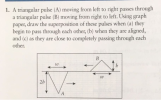 1. A triangular pulse (A) moving from left to right passes through a triangular pulse (B) moving from right to left. Using graph paper, draw the superposition of these pulses when (a) they begin to pass through each other, (b) when they are aligned, and (c) as they are close to completely passing through each other.
 3. Let \(\quad B=\left[\begin{array}{ll}1 & 2 \\ 2 & 1\end{array}\right]\).(a) Find the Trace of B.(b) Find \(B^{-1}\), the inverse of \(B\).(c) A vector \(\vec{v}\) is an eigenvector of the matrix \(B\) if Matrix-Vector Multiplication \(B \vec{v}\) results in a scaling of the vector \(\vec{v}\). (i.e. \(B \vec{v}=c \vec{v}\), with \(c\) a real number.) Using the definition of Matrix-Vector Multiplication show that the vector \(\vec{v}=\left[\begin{array}{l}1 \\ 1\end{array}\right]\) is an eigenvector of \(B\) with eigenvalue \(c=3\).
 Defining the cross product The cross product of two nonzero vectors \(\vec{u}\) and \(\vec{v}\) is another vector \(\vec{u} \times \vec{v}\) with magnitude$$ |\vec{u} \times \vec{v}|=|\vec{u}||\vec{v}| \sin (\theta), $$where \(0 \leq \theta \leq \pi\) is the angle between the two vectors. The direction of \(\vec{u} \times \vec{v}\) is given by the right hand rule: when you put the vectors tail to tail and let the fingers of your right hand curl from \(\vec{u}\) to \(\vec{v}\) the direction of \(\vec{u} \times \vec{v}\)...
 I have the first method complete, but I can't figure out the
second method Could
someone please show how to use the second method?2. Find the unit step response of:$$ \begin{aligned} \dot{\overrightarrow{\mathbf{x}}}(t) &=\left[\begin{array}{cc} 0 & 1 \\ -2 & -2 \end{array}\right] \overrightarrow{\mathbf{x}}(t)+\left[\begin{array}{l} 1 \\ 1 \end{array}\right] u(t) \\ y(t) &=\left[\begin{array}{cc} 2 & 3 \end{array}\right] \overrightarrow{\mathbf{x}}(t) \end{aligned} $$by two methods (1): transfer function and then (2) \(y(t)=\mathbf{C} e^{\mathbf{A} t} \overrightarrow{\mathbf{x}}(0)+\mathbf{C} \int_{0}^{t} e^{\mathbf{A}(t-\tau)} \mathbf{B} u(\tau) d \tau+\mathbf{D} u(t)\). Re-member that the Laplace...
I have the first method complete, but I can't figure out the
second method Could
someone please show how to use the second method?2. Find the unit step response of:$$ \begin{aligned} \dot{\overrightarrow{\mathbf{x}}}(t) &=\left[\begin{array}{cc} 0 & 1 \\ -2 & -2 \end{array}\right] \overrightarrow{\mathbf{x}}(t)+\left[\begin{array}{l} 1 \\ 1 \end{array}\right] u(t) \\ y(t) &=\left[\begin{array}{cc} 2 & 3 \end{array}\right] \overrightarrow{\mathbf{x}}(t) \end{aligned} $$by two methods (1): transfer function and then (2) \(y(t)=\mathbf{C} e^{\mathbf{A} t} \overrightarrow{\mathbf{x}}(0)+\mathbf{C} \int_{0}^{t} e^{\mathbf{A}(t-\tau)} \mathbf{B} u(\tau) d \tau+\mathbf{D} u(t)\). Re-member that the Laplace...
 1. A triangular pulse (A) moving from left to right passes through a triangular pulse (B) moving from right to left. Using graph paper, draw the superposition of these pulses when (a) they begin to pass through each other, (b) when they are aligned, and (c) as they are close to completely passing through each other.
Most questions answered within 3 hours.
-
Where is the error in this code sequence?
String s1 = "Hello";
String s2 = "ello";...
asked 11 months ago -
Financial data for Joel de Paris, Inc., for last year
follow:
Joel de Paris, Inc.
Balance...
asked 11 months ago -
Consider this reaction:
Al2(SO4)3 (aq)+ BaCl3
(aq) Al2Cl6 (aq)- +
3BaSO4(s) . What is the...
asked 11 months ago -
Suppose that Savneet is considering increasing her
recent random sample from 20 car rentals to 40...
asked 11 months ago -
Trucks arrive at an unloading terminal at an average rate of 120
per hour.
Trucks arrive...
asked 11 months ago -
Why are methanol and ethanol completely soluble in water while
octanol is not very little soluble....
asked 11 months ago -
A facilities manager at a university reads in a research report
that the mean amount of...
asked 11 months ago -
When the CuSO4 is rehydrated by adding water to the anhydrous
compound, is this an endothermic...
asked 11 months ago -
A ray of sunlight is passing from diamond into crown glass; the
angle of incidence is...
asked 11 months ago -
A block of mass 0.249 kg is placed on top of a light, vertical
spring of...
asked 11 months ago -
how do the kidneys compensate in the presences of acidosis
a) trigger hyperventilate
b) reserve acid...
asked 11 months ago -
Question 501 pts
The rental rate of capital to the firm increases. Which of the
following...
asked 11 months ago