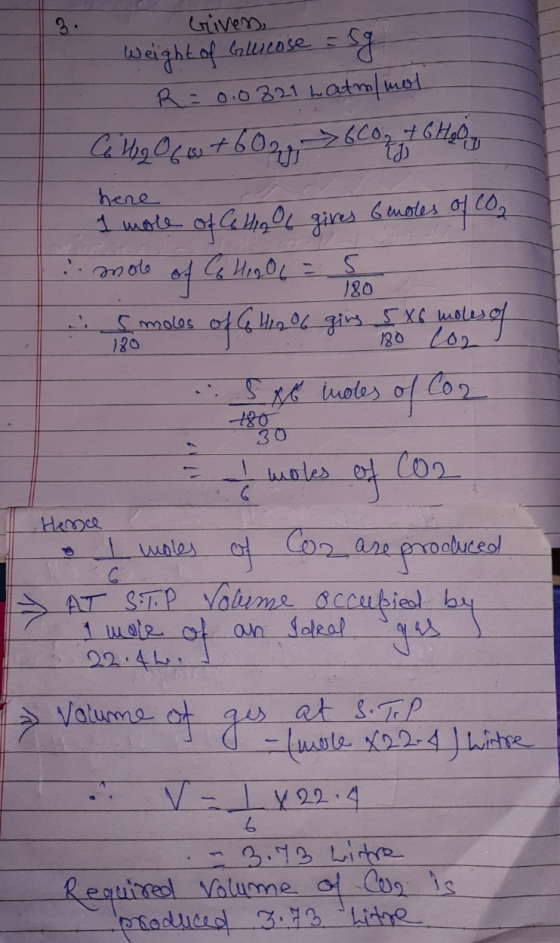
3. What is the volume of CO2 produced from combusting 5 g of glucose at room...
3. What is the volume of CO2 produced from combusting 5 g of glucose at room temperature and pressure? The balanced reaction is shown below. (use R = 0.0821 L•atm/mol•K)
C6H12O6 (s)+ 6 O2 (g) ? 6 CO2 (g) + 6 H2O (g)
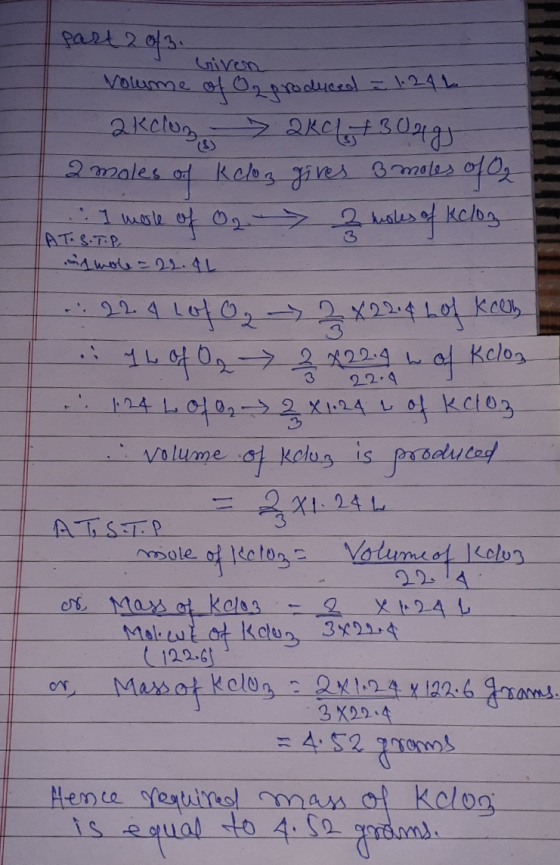
Part 2 of 3. How many grams of KClO3 are required to produce 1.24 L of O2 at room temperature and pressure? The balanced reaction is shown below. (use R = 0.0821 L•atm/mol•K)
2 KClO3 (s) ? 2 KCl (s) + 3 O2 (g)
Homework Answers
Add Answer to:
3. What is the volume of CO2 produced from combusting 5 g of
glucose at room...
Assume that a gummy bear consists 100% of glucose, C6H12O6 (MW = 180 g/mol). A gummy...
Assume that a gummy bear consists 100% of glucose, C6H12O6 (MW = 180 g/mol). A gummy bear weighs 228 mg. What is the heat of reaction for the total combustion of one gummy bear in a reaction with molten potassium chlorate, KClO3? 4 KClO3(s) + C6H12O6(s) = 4 KCl(s) + 6 CO2(g) + 6 H2O(g); ΔH0 r = –2726 kJ/mol a. 3.45 kJ b. 34.5 kJ c. 172.5 kJ d. 2726 kJ
option (c) is 2.17 L (d) 0.355L Question 44(1 point) What volume of O2, measured at...
 option (c) is 2.17 L
(d) 0.355L
Question 44(1 point) What volume of O2, measured at 82 °C and 217 mmHg will be produced by the decomposition of 5.71 gKCIO3? 2 KClO3(s) + 2 KCl(s) + 3 O2(8) R = 0.0821 (L·atm)/(mol · K) 760 mmHg = 1 atm KCIO3 = 122.55 g/mol 5.55 L .O 1.44L
option (c) is 2.17 L
(d) 0.355L
Question 44(1 point) What volume of O2, measured at 82 °C and 217 mmHg will be produced by the decomposition of 5.71 gKCIO3? 2 KClO3(s) + 2 KCl(s) + 3 O2(8) R = 0.0821 (L·atm)/(mol · K) 760 mmHg = 1 atm KCIO3 = 122.55 g/mol 5.55 L .O 1.44L
34) What pressure will 14.0 g of CO exert in a 3.5 L container at 75°C?...
 34) What pressure will 14.0 g of CO exert in a 3.5 L container at 75°C? A) 4.1 atm B) 5.0 atm C) 6.4 atm D) 1.1 atm E) 2.3 atm 35) What pressure would a gas mixture in a 10.0L tank exert if it were composed of 48.5 g He and 94.6 g CO2 at 398 K? A) 39.6 atm B) 7.02 atm C) 32.6 atm D) 46.6 atm E) 58.7 atm 36) Determine the volume of O2 (at STP) formed when 50.0...
1. In the reaction between glucose and oxygen below, how many grams of glucose is required...
1. In the reaction between glucose and oxygen below, how many grams of glucose is required to produce 12.2 L of carbon dioxide if the density of Carbon dioxide is 1.26 g/L, C2H5OH, is 0.789g/mL. C6H12O6(s) + 6 O2(g) = 6 CO2(g) +6 H2O 2. When 10.6 g of boron trichloride is reacted with water, 5.12 g of Hydrochloric acid is produced. Using the following balanced equation, calculate the percent yield for HCl for the reaction? (BCl3 = 117.17 g/mol,...
please show work 2. After taking your chemistry exam and earning a perfect score, you decide...
 please show work
2. After taking your chemistry exam and earning a perfect score, you decide to celebrate and have a well earned glass of champagne. Champagne is made through the following chemical process in which glucose is fermented to ethanol and carbon dioxide. The balanced chemical reaction is shown below: C6H12O6 (aq) → 2 C2H5OH (aq) + 2 CO2 (g) Glucose ethanol carbon dioxide If you start with 1.00 mole of glucose, how much pressure (from the CO2) is...
please show work
2. After taking your chemistry exam and earning a perfect score, you decide to celebrate and have a well earned glass of champagne. Champagne is made through the following chemical process in which glucose is fermented to ethanol and carbon dioxide. The balanced chemical reaction is shown below: C6H12O6 (aq) → 2 C2H5OH (aq) + 2 CO2 (g) Glucose ethanol carbon dioxide If you start with 1.00 mole of glucose, how much pressure (from the CO2) is...
33) A sample of gas initially has a volume of 859 mL at 565 K and...
 33) A sample of gas initially has a volume of 859 mL at 565 K and 2.20 atm. What pressure will the sample have if the volume changes to 268 ml while the temperature is increased to 815 N A) 10.2 atm B) 9.83 atm C) 15.3 atm D) 6.53 atm E) 1.05 atm 34) What pressure will 14.0 g of CO exert in a 3.5 L container at 75°C? A) 4.1 atm B) 5.0 atm C) 6.4 atm D)...
29. Consider the following equilibrium CO2(g)+ H2()Co(g) + H20(g); Ke 1.6 at 1260 K Suppose 0.019...
 29. Consider the following equilibrium CO2(g)+ H2()Co(g) + H20(g); Ke 1.6 at 1260 K Suppose 0.019 mol CO2 and 0.030 mol H2 are placed in a 3.00-L vessel at 1260 K. What is pressure of CO(g)? (R 0.0821 L atm/K mol) a. 4 atm b. 0.35 atm c. 1.6 atm d. 0.66 atm e. 1 atm
Calculate the standard-state entropy for the following reaction: 6 CO2(g) + 6 H2O(l) ⟶ 1 C6H12O6(s) + 6 O2(g) (If app...
Calculate the standard-state entropy for the following reaction: 6 CO2(g) + 6 H2O(l) ⟶ 1 C6H12O6(s) + 6 O2(g) (If applicable, coefficients of one have been included for clarity.) The standard entropy values are given in the table. Formula S∘ J/(K⋅mol) C6H12O6(s) 212 O2(g) 205 CO2(g) 214 H2O(l) 189
Which of the following is a typical chemical equation that represents a hydration reaction? 2 KClO3...
Which of the following is a typical chemical equation that represents a hydration reaction? 2 KClO3 (s) → 2 KCl (s) + 3 O2 (g) K2CO3 (s) ⟶H2O 2K+(aq) + CO3 2-(aq) HCl (aq) + NaOH (aq) → NaCl (aq) + H2O (l) C6H12O6 (s) + 6 O2 (g) → 6 CO2 (g) + 6 H2O (l)
2. Yeast and other organisms can convert glucose (C6H1206) to ethanol (C2H5OH) through a process called...
 2. Yeast and other organisms can convert glucose (C6H1206) to ethanol (C2H5OH) through a process called alcoholic fermentation. The net reaction is C6H12O6(s)—2 C2H5OH(1) + 2 CO2(g). Calculate the mass of glucose required to produce 1.0 L of CO2 at a pressure of 1.0 atm and temperature 300 K. 0 3.654g 0 180.0 g 05.820g 0 45.0 g
 option (c) is 2.17 L
(d) 0.355L
Question 44(1 point) What volume of O2, measured at 82 °C and 217 mmHg will be produced by the decomposition of 5.71 gKCIO3? 2 KClO3(s) + 2 KCl(s) + 3 O2(8) R = 0.0821 (L·atm)/(mol · K) 760 mmHg = 1 atm KCIO3 = 122.55 g/mol 5.55 L .O 1.44L
option (c) is 2.17 L
(d) 0.355L
Question 44(1 point) What volume of O2, measured at 82 °C and 217 mmHg will be produced by the decomposition of 5.71 gKCIO3? 2 KClO3(s) + 2 KCl(s) + 3 O2(8) R = 0.0821 (L·atm)/(mol · K) 760 mmHg = 1 atm KCIO3 = 122.55 g/mol 5.55 L .O 1.44L
 34) What pressure will 14.0 g of CO exert in a 3.5 L container at 75°C? A) 4.1 atm B) 5.0 atm C) 6.4 atm D) 1.1 atm E) 2.3 atm 35) What pressure would a gas mixture in a 10.0L tank exert if it were composed of 48.5 g He and 94.6 g CO2 at 398 K? A) 39.6 atm B) 7.02 atm C) 32.6 atm D) 46.6 atm E) 58.7 atm 36) Determine the volume of O2 (at STP) formed when 50.0...
 please show work
2. After taking your chemistry exam and earning a perfect score, you decide to celebrate and have a well earned glass of champagne. Champagne is made through the following chemical process in which glucose is fermented to ethanol and carbon dioxide. The balanced chemical reaction is shown below: C6H12O6 (aq) → 2 C2H5OH (aq) + 2 CO2 (g) Glucose ethanol carbon dioxide If you start with 1.00 mole of glucose, how much pressure (from the CO2) is...
please show work
2. After taking your chemistry exam and earning a perfect score, you decide to celebrate and have a well earned glass of champagne. Champagne is made through the following chemical process in which glucose is fermented to ethanol and carbon dioxide. The balanced chemical reaction is shown below: C6H12O6 (aq) → 2 C2H5OH (aq) + 2 CO2 (g) Glucose ethanol carbon dioxide If you start with 1.00 mole of glucose, how much pressure (from the CO2) is...
 33) A sample of gas initially has a volume of 859 mL at 565 K and 2.20 atm. What pressure will the sample have if the volume changes to 268 ml while the temperature is increased to 815 N A) 10.2 atm B) 9.83 atm C) 15.3 atm D) 6.53 atm E) 1.05 atm 34) What pressure will 14.0 g of CO exert in a 3.5 L container at 75°C? A) 4.1 atm B) 5.0 atm C) 6.4 atm D)...
 29. Consider the following equilibrium CO2(g)+ H2()Co(g) + H20(g); Ke 1.6 at 1260 K Suppose 0.019 mol CO2 and 0.030 mol H2 are placed in a 3.00-L vessel at 1260 K. What is pressure of CO(g)? (R 0.0821 L atm/K mol) a. 4 atm b. 0.35 atm c. 1.6 atm d. 0.66 atm e. 1 atm
 2. Yeast and other organisms can convert glucose (C6H1206) to ethanol (C2H5OH) through a process called alcoholic fermentation. The net reaction is C6H12O6(s)—2 C2H5OH(1) + 2 CO2(g). Calculate the mass of glucose required to produce 1.0 L of CO2 at a pressure of 1.0 atm and temperature 300 K. 0 3.654g 0 180.0 g 05.820g 0 45.0 g
Most questions answered within 3 hours.
-
Where is the error in this code sequence?
String s1 = "Hello";
String s2 = "ello";...
asked 11 months ago -
Financial data for Joel de Paris, Inc., for last year
follow:
Joel de Paris, Inc.
Balance...
asked 11 months ago -
Consider this reaction:
Al2(SO4)3 (aq)+ BaCl3
(aq) Al2Cl6 (aq)- +
3BaSO4(s) . What is the...
asked 11 months ago -
Suppose that Savneet is considering increasing her
recent random sample from 20 car rentals to 40...
asked 11 months ago -
Trucks arrive at an unloading terminal at an average rate of 120
per hour.
Trucks arrive...
asked 11 months ago -
Why are methanol and ethanol completely soluble in water while
octanol is not very little soluble....
asked 11 months ago -
A facilities manager at a university reads in a research report
that the mean amount of...
asked 11 months ago -
When the CuSO4 is rehydrated by adding water to the anhydrous
compound, is this an endothermic...
asked 11 months ago -
A ray of sunlight is passing from diamond into crown glass; the
angle of incidence is...
asked 11 months ago -
A block of mass 0.249 kg is placed on top of a light, vertical
spring of...
asked 11 months ago -
how do the kidneys compensate in the presences of acidosis
a) trigger hyperventilate
b) reserve acid...
asked 11 months ago -
Question 501 pts
The rental rate of capital to the firm increases. Which of the
following...
asked 11 months ago