in a chemical reaction equation, if the heat change is negative i. e exothermic, on which...
Homework Answers
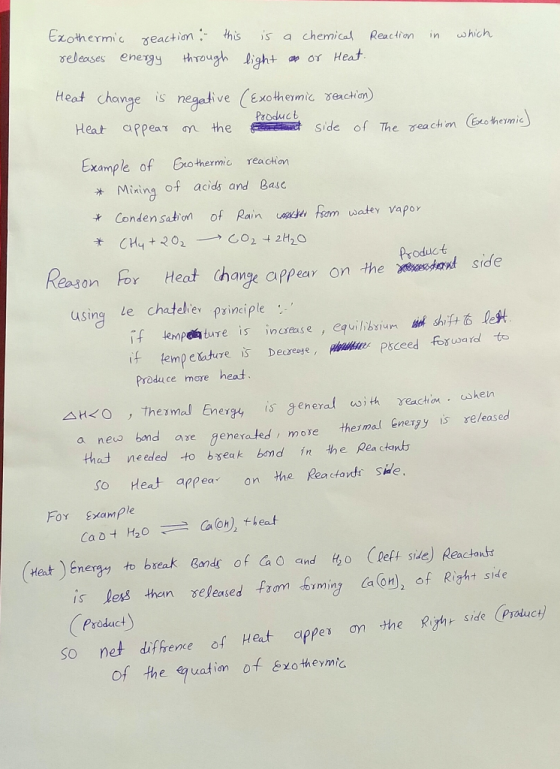
In exothermic reaction, Heat appear on the Products side...
Details answer given in the attachment......
Add Answer to:
in
a chemical reaction equation, if the heat change is negative i. e
exothermic, on which...
Chemical energy stored in the reactants is released as heat when the reaction is exothermic. For...
Chemical energy stored in the reactants is released as heat when the reaction is exothermic. For an exothermic reaction, the enthalpy change for a reaction is negative. Enthalpy, represented as H, is the heat content of a system. As it is a state function, it depends on the state of the system; hence, it is calculated in the form of change in heat content. Heat change, or enthalpy change, is represented as ΔH; ΔH is a measure of the heat...
A negative free energy change indicates that A. the reaction is exothermic. B. the reactant is...
A negative free energy change indicates that A. the reaction is exothermic. B. the reactant is predominant at equilibrium. C. the reaction is at equilibrium. D. the reaction is not possible. E. energy must be added to the reaction before it can proceed.
12. Which statement is always true for an exothermic reaction? A) The enthalpy change is negative....
 12. Which statement is always true for an exothermic reaction? A) The enthalpy change is negative. B) The reaction absorbs heat from the surroundings. C) The enthalpy change is positive. D) The work done on the system is zero
Write a balanced equation for each of the processes in Part A. Remember to include heat...
 Write a balanced equation for each of the processes in Part A.
Remember to include heat on the reactant or product side, as
appropiate.
Reaction Solid + Liquid A NH,Cl(s) + H2O(1) CaCl (s) + H20(1) C NaHCO3(s) + HCl(aq) Reaction A B c Physical or Chemical Change? Chemical Chemical Chemical Exothermic or Endothermic? Endo Thermic Exothermic Endothermic
Write a balanced equation for each of the processes in Part A.
Remember to include heat on the reactant or product side, as
appropiate.
Reaction Solid + Liquid A NH,Cl(s) + H2O(1) CaCl (s) + H20(1) C NaHCO3(s) + HCl(aq) Reaction A B c Physical or Chemical Change? Chemical Chemical Chemical Exothermic or Endothermic? Endo Thermic Exothermic Endothermic
For each reaction write a balanced chemical equation and then below the chemical formula of each...
 For each reaction write a balanced chemical equation and then below the chemical formula of each reactant and product write a brief description of the substance (color and cal state). Also, indicate whether the reaction is exothermic, endothermic, or cannot tell. 3. Single Replacement Reaction Equation: Cu + 2AgNO3 + 2Ag + Cu(NO3)2 Cannot tell Exothermic Endothermic Evidence of Chemical Change: 4. Double Displacement Reaction-Milk from water: Equation: CaCl2 + Na2CO3 → CaCO3 + 2NaCi Endothermic Cannot tell Exothermic Evidence...
19. An exothermic reaction has A. has a negative AH and absorbs heat from the surroundings....
 19. An exothermic reaction has A. has a negative AH and absorbs heat from the surroundings. An exothermic reaction feels warm to the touch. B. has a positive AH and absorbs heat from the surroundings. An exothermic reaction feels warm to the touch. C. has a positive AH and gives off heat to the surroundings. An exothermic reaction feels warm to the touch. D. has a negative AH and gives off heat to the surroundings. An exothermic reaction feels warm...
a student wants a chemical reaction that will produce the most amount of heat to use...
a student wants a chemical reaction that will produce the most amount of heat to use for heating purpose. the student should choose which of the following a. the most exothermic reaction available b. a reaction with the most negative change H c. a reaction with the most positive change H d. a reaction with the most negative delta G
3. Cerium (II) sulfate dissolves in water and releases heat (exothermic reaction). Ce2(SO4)(s)2 Ce (aq) +3...
 3. Cerium (II) sulfate dissolves in water and releases heat (exothermic reaction). Ce2(SO4)(s)2 Ce (aq) +3 SO (aq) a. Write the word "heat" on the appropriate side of the equation above. b. What effect will heating a saturated solution of this salt have? C. What will happen to the equilibrium if more SO ions are added to the solution? d. What will happen if Ba2 ions are added to the solution, causing the SO, to precipitate? 4. Which of the...
14) In an exothermic reaction, heat can be considered a A) reactant B) product C) rate...
 14) In an exothermic reaction, heat can be considered a A) reactant B) product C) rate D) catalyst E) determinant 15) Any reaction that absorbs 150 kcal of energy can be classified as A) endothermic B) exothermic C) activated D) reduction E) oxidation 16) The is the energy difference between reactants and products in a chemical reaction. A) transition energy B) activation energy C) product energy D) overall energy E) heat of reaction 17) For the reaction of carbon with...
in an exothermic reaction, heat is a? A) reactant B)reducing agent C)catalyst D)oxidizing agent E) no...
in an exothermic reaction, heat is a? A) reactant B)reducing agent C)catalyst D)oxidizing agent E) no correct response
 12. Which statement is always true for an exothermic reaction? A) The enthalpy change is negative. B) The reaction absorbs heat from the surroundings. C) The enthalpy change is positive. D) The work done on the system is zero
 Write a balanced equation for each of the processes in Part A.
Remember to include heat on the reactant or product side, as
appropiate.
Reaction Solid + Liquid A NH,Cl(s) + H2O(1) CaCl (s) + H20(1) C NaHCO3(s) + HCl(aq) Reaction A B c Physical or Chemical Change? Chemical Chemical Chemical Exothermic or Endothermic? Endo Thermic Exothermic Endothermic
Write a balanced equation for each of the processes in Part A.
Remember to include heat on the reactant or product side, as
appropiate.
Reaction Solid + Liquid A NH,Cl(s) + H2O(1) CaCl (s) + H20(1) C NaHCO3(s) + HCl(aq) Reaction A B c Physical or Chemical Change? Chemical Chemical Chemical Exothermic or Endothermic? Endo Thermic Exothermic Endothermic
 For each reaction write a balanced chemical equation and then below the chemical formula of each reactant and product write a brief description of the substance (color and cal state). Also, indicate whether the reaction is exothermic, endothermic, or cannot tell. 3. Single Replacement Reaction Equation: Cu + 2AgNO3 + 2Ag + Cu(NO3)2 Cannot tell Exothermic Endothermic Evidence of Chemical Change: 4. Double Displacement Reaction-Milk from water: Equation: CaCl2 + Na2CO3 → CaCO3 + 2NaCi Endothermic Cannot tell Exothermic Evidence...
 19. An exothermic reaction has A. has a negative AH and absorbs heat from the surroundings. An exothermic reaction feels warm to the touch. B. has a positive AH and absorbs heat from the surroundings. An exothermic reaction feels warm to the touch. C. has a positive AH and gives off heat to the surroundings. An exothermic reaction feels warm to the touch. D. has a negative AH and gives off heat to the surroundings. An exothermic reaction feels warm...
 3. Cerium (II) sulfate dissolves in water and releases heat (exothermic reaction). Ce2(SO4)(s)2 Ce (aq) +3 SO (aq) a. Write the word "heat" on the appropriate side of the equation above. b. What effect will heating a saturated solution of this salt have? C. What will happen to the equilibrium if more SO ions are added to the solution? d. What will happen if Ba2 ions are added to the solution, causing the SO, to precipitate? 4. Which of the...
 14) In an exothermic reaction, heat can be considered a A) reactant B) product C) rate D) catalyst E) determinant 15) Any reaction that absorbs 150 kcal of energy can be classified as A) endothermic B) exothermic C) activated D) reduction E) oxidation 16) The is the energy difference between reactants and products in a chemical reaction. A) transition energy B) activation energy C) product energy D) overall energy E) heat of reaction 17) For the reaction of carbon with...
Most questions answered within 3 hours.
-
Where is the error in this code sequence?
String s1 = "Hello";
String s2 = "ello";...
asked 11 months ago -
Financial data for Joel de Paris, Inc., for last year
follow:
Joel de Paris, Inc.
Balance...
asked 11 months ago -
Consider this reaction:
Al2(SO4)3 (aq)+ BaCl3
(aq) Al2Cl6 (aq)- +
3BaSO4(s) . What is the...
asked 11 months ago -
Suppose that Savneet is considering increasing her
recent random sample from 20 car rentals to 40...
asked 11 months ago -
Trucks arrive at an unloading terminal at an average rate of 120
per hour.
Trucks arrive...
asked 11 months ago -
Why are methanol and ethanol completely soluble in water while
octanol is not very little soluble....
asked 11 months ago -
A facilities manager at a university reads in a research report
that the mean amount of...
asked 11 months ago -
When the CuSO4 is rehydrated by adding water to the anhydrous
compound, is this an endothermic...
asked 11 months ago -
A ray of sunlight is passing from diamond into crown glass; the
angle of incidence is...
asked 11 months ago -
A block of mass 0.249 kg is placed on top of a light, vertical
spring of...
asked 11 months ago -
how do the kidneys compensate in the presences of acidosis
a) trigger hyperventilate
b) reserve acid...
asked 11 months ago -
Question 501 pts
The rental rate of capital to the firm increases. Which of the
following...
asked 11 months ago