Calculus BC question
The logistics differential equation dy/dt = ky (1 - y/L) produces y = L / (1 + be^-kt). Find the value of b for the logistics differential equation:
dP/dt = 3P/20 - (P^2) / 1200 given the initial condition (0, 15).
Homework Answers
Request Answer!
We need at least 10 more requests to produce the answer.
0 / 10 have requested this problem solution
The more requests, the faster the answer.
3. (Question 1 Continued) To make mon ey, you have to occasionally sell your bandersnatch. Suppos...
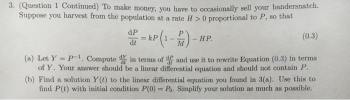 3. (Question 1 Continued) To make mon ey, you have to occasionally sell your bandersnatch. Suppose you harvest from the population at a rate H >0 proportional to P, so that dP dt P -HP (0.3) (a) Let Y - P1. Compute d in terms of d and use it to rewrite Equation (0.3) in terms of Y. Your answer should be a linear differential equation and should not contain P (b) Find a solution Y(t) to the linear differential...
find the solition of the differential equation that satisfies the given initial condition 6. [0/1 Points]...
 find the solition of the differential equation that satisfies the
given initial condition
6. [0/1 Points] DETAILS PREVIOUS ANSWERS SESSCALC2 7.7.012. MY NOTES ASK YOUR TEACHER PRACTICE ANOTHER Find the solution of the differential equation that satisfies the given initial condition. dP = 5 Pt. P(1) = 6 dt 2 51 P= +/6 5 3 3 Need Help? Talk to a Tutor
find the solition of the differential equation that satisfies the
given initial condition
6. [0/1 Points] DETAILS PREVIOUS ANSWERS SESSCALC2 7.7.012. MY NOTES ASK YOUR TEACHER PRACTICE ANOTHER Find the solution of the differential equation that satisfies the given initial condition. dP = 5 Pt. P(1) = 6 dt 2 51 P= +/6 5 3 3 Need Help? Talk to a Tutor
2. Suppose a population P(t) satisfies the logistic differential equation dP dt = 0.1P 1 −...
 2. Suppose a population P(t) satisfies the logistic differential
equation dP dt = 0.1P 1 − P 2000 P(0) = 100 Find the following: a)
P(20) b) When will the population reach 1200?
2. Suppose a population P(t) satisfies the logistic differential equation 2P = 0.1P (1–2000) = 0.1P | P(0) = 100 2000 Find the following: a) P(20) b) When will the population reach 1200?
2. Suppose a population P(t) satisfies the logistic differential
equation dP dt = 0.1P 1 − P 2000 P(0) = 100 Find the following: a)
P(20) b) When will the population reach 1200?
2. Suppose a population P(t) satisfies the logistic differential equation 2P = 0.1P (1–2000) = 0.1P | P(0) = 100 2000 Find the following: a) P(20) b) When will the population reach 1200?
Just letter answer is good, thank you. 1. Given f(x,y) = 10r4y2-1lys, find fry(z, s). Q) 2. The graph of g'(x) is shown in figure. If g(3) 2 then what is the value of g(5)? g'(x) A. 2.0 B. 1.5...
 Just letter answer is good,
thank you.
1. Given f(x,y) = 10r4y2-1lys, find fry(z, s). Q) 2. The graph of g'(x) is shown in figure. If g(3) 2 then what is the value of g(5)? g'(x) A. 2.0 B. 1.5 C. 2.5 6 12 3 D. 3.0 dy-r + si dx sin (2x) er 3. Find the general solution to the differential equation: B. 2x + 2 cos (r)-4e-4x + C D. none of the above llutant spilled on the...
Just letter answer is good,
thank you.
1. Given f(x,y) = 10r4y2-1lys, find fry(z, s). Q) 2. The graph of g'(x) is shown in figure. If g(3) 2 then what is the value of g(5)? g'(x) A. 2.0 B. 1.5 C. 2.5 6 12 3 D. 3.0 dy-r + si dx sin (2x) er 3. Find the general solution to the differential equation: B. 2x + 2 cos (r)-4e-4x + C D. none of the above llutant spilled on the...
II. Find the solution of the differential equation that satisfies the given initial condition du 2t...
 II. Find the solution of the differential equation that satisfies the given initial condition du 2t +sec2 t dt 2uu(0-5 di 1. 2·y' + y tan x = cos2 x, y(0) =-1 dy 6. ( In,() 10
Write a Maple program to solve analytically the ordinary differential equation dy dt = y 2...
Write a Maple program to solve analytically the ordinary differential equation dy dt = y 2 + 1 with initial condition y(0) = 0. What solution is found? Verify (on paper) that the solution found satisfies the differential equation and initial condition.
Problem #3: The Ralston method is a second-order method that can be used to solve an...
 Problem #3: The Ralston method is a second-order method that can be used to solve an initial-value, first-orde ordinary differential equation. The algorithm is given below: Vi#l=>: +($k+ş kz)h Where ky = f(ti,y:) * = f(mehr) You are asked to do the following: 3.1 Following that given in Inclass activity #10a, develop a MATLAB function to implement the algorithm for any given function, the time span, and the initial value. 3.2 Use your code to solve the following first-order ordinary...
Solve the given differential equation by separation of variables.
 Solve the given differential equation by separation of variables. dP/dt= P-P2 Solve the given differential equation by separation of variables. dN/dt + N = Ntet+3 Solve the given differential equation by separation of variables. Find an explicit solution of the given initial-value problem.
In Problems 1 through 10, find a function y = f(x) satisfy. ing the given differential equation and the prescribed initial condition. 1.dy = 2x + 1;y(0) = 3 In Problems 1 through 10, fin...
 In Problems 1 through 10, find a function y = f(x) satisfy. ing the given differential equation and the prescribed initial condition. 1.dy = 2x + 1;y(0) = 3
In Problems 1 through 10, find a function y = f(x) satisfy. ing the given differential equation and the prescribed initial condition. 1.dy = 2x + 1;y(0) = 3
In Problems 1 through 10, find a function y = f(x) satisfy. ing the given differential equation and the prescribed initial condition. 1.dy = 2x + 1;y(0) = 3
Question 2: (5+15=20 points) a) Find the value of the constant k e R for which...
 Question 2: (5+15=20 points) a) Find the value of the constant k e R for which the differential equation (2+ y + xy) dx + (1+2+kx*y) dy=0 is exact. b) Find the solution of the initial value problem using the value of k you found in part (a). (2+ y + r?y?)dr + (1 + x + k.xºy)dy = 0, y(0) = 2
 3. (Question 1 Continued) To make mon ey, you have to occasionally sell your bandersnatch. Suppose you harvest from the population at a rate H >0 proportional to P, so that dP dt P -HP (0.3) (a) Let Y - P1. Compute d in terms of d and use it to rewrite Equation (0.3) in terms of Y. Your answer should be a linear differential equation and should not contain P (b) Find a solution Y(t) to the linear differential...
 find the solition of the differential equation that satisfies the
given initial condition
6. [0/1 Points] DETAILS PREVIOUS ANSWERS SESSCALC2 7.7.012. MY NOTES ASK YOUR TEACHER PRACTICE ANOTHER Find the solution of the differential equation that satisfies the given initial condition. dP = 5 Pt. P(1) = 6 dt 2 51 P= +/6 5 3 3 Need Help? Talk to a Tutor
find the solition of the differential equation that satisfies the
given initial condition
6. [0/1 Points] DETAILS PREVIOUS ANSWERS SESSCALC2 7.7.012. MY NOTES ASK YOUR TEACHER PRACTICE ANOTHER Find the solution of the differential equation that satisfies the given initial condition. dP = 5 Pt. P(1) = 6 dt 2 51 P= +/6 5 3 3 Need Help? Talk to a Tutor
 2. Suppose a population P(t) satisfies the logistic differential
equation dP dt = 0.1P 1 − P 2000 P(0) = 100 Find the following: a)
P(20) b) When will the population reach 1200?
2. Suppose a population P(t) satisfies the logistic differential equation 2P = 0.1P (1–2000) = 0.1P | P(0) = 100 2000 Find the following: a) P(20) b) When will the population reach 1200?
2. Suppose a population P(t) satisfies the logistic differential
equation dP dt = 0.1P 1 − P 2000 P(0) = 100 Find the following: a)
P(20) b) When will the population reach 1200?
2. Suppose a population P(t) satisfies the logistic differential equation 2P = 0.1P (1–2000) = 0.1P | P(0) = 100 2000 Find the following: a) P(20) b) When will the population reach 1200?
 Just letter answer is good,
thank you.
1. Given f(x,y) = 10r4y2-1lys, find fry(z, s). Q) 2. The graph of g'(x) is shown in figure. If g(3) 2 then what is the value of g(5)? g'(x) A. 2.0 B. 1.5 C. 2.5 6 12 3 D. 3.0 dy-r + si dx sin (2x) er 3. Find the general solution to the differential equation: B. 2x + 2 cos (r)-4e-4x + C D. none of the above llutant spilled on the...
Just letter answer is good,
thank you.
1. Given f(x,y) = 10r4y2-1lys, find fry(z, s). Q) 2. The graph of g'(x) is shown in figure. If g(3) 2 then what is the value of g(5)? g'(x) A. 2.0 B. 1.5 C. 2.5 6 12 3 D. 3.0 dy-r + si dx sin (2x) er 3. Find the general solution to the differential equation: B. 2x + 2 cos (r)-4e-4x + C D. none of the above llutant spilled on the...
 II. Find the solution of the differential equation that satisfies the given initial condition du 2t +sec2 t dt 2uu(0-5 di 1. 2·y' + y tan x = cos2 x, y(0) =-1 dy 6. ( In,() 10
 Problem #3: The Ralston method is a second-order method that can be used to solve an initial-value, first-orde ordinary differential equation. The algorithm is given below: Vi#l=>: +($k+ş kz)h Where ky = f(ti,y:) * = f(mehr) You are asked to do the following: 3.1 Following that given in Inclass activity #10a, develop a MATLAB function to implement the algorithm for any given function, the time span, and the initial value. 3.2 Use your code to solve the following first-order ordinary...
 In Problems 1 through 10, find a function y = f(x) satisfy. ing the given differential equation and the prescribed initial condition. 1.dy = 2x + 1;y(0) = 3
In Problems 1 through 10, find a function y = f(x) satisfy. ing the given differential equation and the prescribed initial condition. 1.dy = 2x + 1;y(0) = 3
In Problems 1 through 10, find a function y = f(x) satisfy. ing the given differential equation and the prescribed initial condition. 1.dy = 2x + 1;y(0) = 3
 Question 2: (5+15=20 points) a) Find the value of the constant k e R for which the differential equation (2+ y + xy) dx + (1+2+kx*y) dy=0 is exact. b) Find the solution of the initial value problem using the value of k you found in part (a). (2+ y + r?y?)dr + (1 + x + k.xºy)dy = 0, y(0) = 2
Most questions answered within 3 hours.
-
Where is the error in this code sequence?
String s1 = "Hello";
String s2 = "ello";...
asked 10 months ago -
Financial data for Joel de Paris, Inc., for last year
follow:
Joel de Paris, Inc.
Balance...
asked 10 months ago -
Consider this reaction:
Al2(SO4)3 (aq)+ BaCl3
(aq) Al2Cl6 (aq)- +
3BaSO4(s) . What is the...
asked 10 months ago -
Suppose that Savneet is considering increasing her
recent random sample from 20 car rentals to 40...
asked 10 months ago -
Trucks arrive at an unloading terminal at an average rate of 120
per hour.
Trucks arrive...
asked 10 months ago -
Why are methanol and ethanol completely soluble in water while
octanol is not very little soluble....
asked 10 months ago -
A facilities manager at a university reads in a research report
that the mean amount of...
asked 10 months ago -
When the CuSO4 is rehydrated by adding water to the anhydrous
compound, is this an endothermic...
asked 10 months ago -
A ray of sunlight is passing from diamond into crown glass; the
angle of incidence is...
asked 10 months ago -
A block of mass 0.249 kg is placed on top of a light, vertical
spring of...
asked 10 months ago -
how do the kidneys compensate in the presences of acidosis
a) trigger hyperventilate
b) reserve acid...
asked 10 months ago -
Question 501 pts
The rental rate of capital to the firm increases. Which of the
following...
asked 10 months ago