


Homework Answers
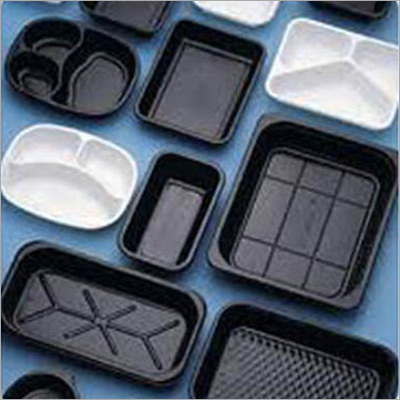
Thermoforming is a process for forming thermoplastic sheets or films over a mold through the application of heat and pressure.In this process, a sheet is clamped and heated to the glass transition temperature,Tg,of the polymer and forced against the mold surfaces through the application of vacuum or air pressure.Because of low strength of materials formed,pressure difference caused by the vacuum is sufficient for forming.However thicker and more complex parts need air pressure, which may range from 100 to 2000 kPa,depending on the type of material and thickness of the sheet.The sheets used in thermoforming are available as a coiled strip or as lengths and widths of various sizes.Molds for Thermoforming are made up of aluminum because high strength is not required and tooling is relatively inexpensive.Typical parts made by thermoforming are packaging,trays for cookies and candy,advertising signs and panels for shower stalls.Usually the production rate is very high for thermoforming process due to the simple manufacturing process.However products with holes or openings cannot be formed because pressure difference cannot be maintained during the forming.Because thermoforming is a combination of drawing and stretching operations materials should exhibit high,uniform elongation.Usual defects encountered in thermoforming include (a) non uniform wall thickness (b) tearing of sheet during forming (c) improper filled molds and (d) lack of surface details.


Add Answer to:
Thermoforming A process of pulling down a heated plastic sheet onto a mold and then forcing...
Select all true statements about plastic machining/ fabrication. A. metal inserts are chemically bonded in plastic...
Select all true statements about plastic machining/ fabrication. A. metal inserts are chemically bonded in plastic parts B. large flat surfaces are generally preferred due to plastic's elastic modulus C. curing time is determined from the thinnest wall section D. raised letters on a plastic part incur less mold expense than depressed letters E. parting lines should be placed along plastic part corners and edges 2. Select benefits of fabricating with plastics, ceramics, and composites. A. one process can take...
1. Select all true statements about plastic machining/ fabrication. A. metal inserts are chemically bonded in...
1. Select all true statements about plastic machining/ fabrication. A. metal inserts are chemically bonded in plastic parts B. large flat surfaces are generally preferred due to plastic's elastic modulus C. curing time is determined from the thinnest wall section D. raised letters on a plastic part incur less mold expense than depressed letters E. parting lines should be placed along plastic part corners and edges 2. Select benefits of fabricating with plastics, ceramics, and composites. A. one process can...
Most questions answered within 3 hours.
-
Where is the error in this code sequence?
String s1 = "Hello";
String s2 = "ello";...
asked 11 months ago -
Financial data for Joel de Paris, Inc., for last year
follow:
Joel de Paris, Inc.
Balance...
asked 11 months ago -
Consider this reaction:
Al2(SO4)3 (aq)+ BaCl3
(aq) Al2Cl6 (aq)- +
3BaSO4(s) . What is the...
asked 11 months ago -
Suppose that Savneet is considering increasing her
recent random sample from 20 car rentals to 40...
asked 11 months ago -
Trucks arrive at an unloading terminal at an average rate of 120
per hour.
Trucks arrive...
asked 11 months ago -
Why are methanol and ethanol completely soluble in water while
octanol is not very little soluble....
asked 11 months ago -
A facilities manager at a university reads in a research report
that the mean amount of...
asked 11 months ago -
When the CuSO4 is rehydrated by adding water to the anhydrous
compound, is this an endothermic...
asked 11 months ago -
A ray of sunlight is passing from diamond into crown glass; the
angle of incidence is...
asked 11 months ago -
A block of mass 0.249 kg is placed on top of a light, vertical
spring of...
asked 11 months ago -
how do the kidneys compensate in the presences of acidosis
a) trigger hyperventilate
b) reserve acid...
asked 11 months ago -
Question 501 pts
The rental rate of capital to the firm increases. Which of the
following...
asked 11 months ago