

Homework Answers
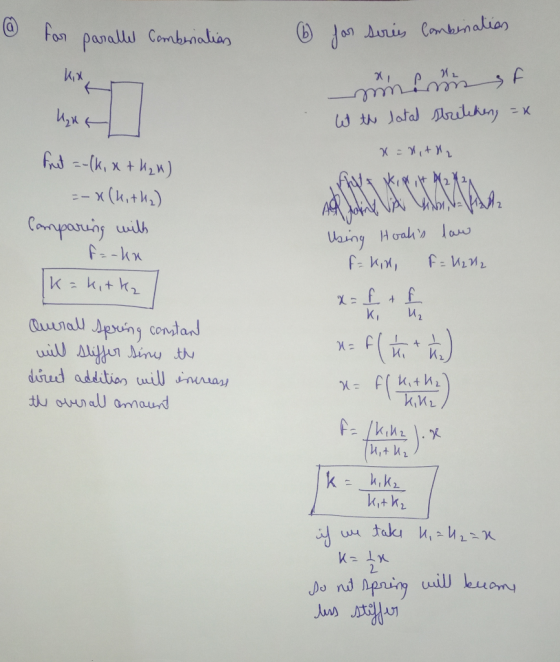
Comment for any further help.
Add Answer to:
The figure (Please see the figure on page 198) shows two different ways of combining a...
The figure - shows two different ways of combining a pair of identical springs, each with...
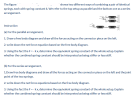 The figure - shows two different ways of combining a pair of identical springs, each with spring constant k. We refer to the top setup as parallel and the bottom one as a series arrangement. Instruction (a) For the parallel arrangement, 1. Draw a free body diagram and draw all the forces acting on the connector piece on the left. 2. write down the net force equation based on the free body diagram. 3. Using the fact the F=-kx, determine...
3. The following figure shows the block diagram of a mechanical translational system k1 U3 m1...
 3. The following figure shows the block diagram of a mechanical translational system k1 U3 m1 (a) Draw free body diagrams for each of the masses. Bearing in mind that the force due to spring is proportional to its length and the force due to friction is proportional to velocity, label each of the forces acting upon each body. (b) Develop the dynamical equations for the system.
Please show work 3. Given a mass-spring-damper system, the 2kg mass is connected to two linear...
 Please show work
3. Given a mass-spring-damper system, the 2kg mass is connected to two linear springs with stiffness coefficients ki- 100 N/m and ki 150 N/m and a viscous damper with b 50 Ns/m. A constant force of SN is applied as shown. The effect of friction is negligible. ki m b 3.1 [2pts] Determine the equivalent stiffness of the springs. 3.2 [3pts] Draw the free-body diagram of the system. Define the generalized coordinate and label your forces and...
Please show work
3. Given a mass-spring-damper system, the 2kg mass is connected to two linear springs with stiffness coefficients ki- 100 N/m and ki 150 N/m and a viscous damper with b 50 Ns/m. A constant force of SN is applied as shown. The effect of friction is negligible. ki m b 3.1 [2pts] Determine the equivalent stiffness of the springs. 3.2 [3pts] Draw the free-body diagram of the system. Define the generalized coordinate and label your forces and...
Figure Qla shows a safety trap for trucks (not to scale) that has been installed on a very steep slope to prevent runaway trucks from crashing. It consists of a rough run- off lane of length 20m...
 Figure Qla shows a safety trap for trucks (not to scale) that has been installed on a very steep slope to prevent runaway trucks from crashing. It consists of a rough run- off lane of length 20m (beginning at point A) and a buffer designed to stop the vehicle. The buffer can be modelled as a spring of spring constant 750 kN/m and natural length 4m, compressed to 1m using cables. The run-off lane provides an effective coefficient of kinetic...
Figure 2 The massless rod in Fig. 2 has two masses on it, one mass mı...
 Figure 2 The massless rod in Fig. 2 has two masses on it, one mass mı is fixed at the end, while the other m2, is constrained to move along the radius by a linear spring k. Derive the equations of motion for the system using D'Alembert's principles. Note there is no friction 1. Draw the free body diagram of each mass. 2. Determine the virtual displacement of each mass in terms of r and θ 3. Determine all applied...
2. The figure shows a 7 kg block being pulled along a frictionless floor by a...
 2. The figure shows a 7 kg block being pulled along a frictionless floor by a cord that applies a force of constant magnitude 16 N but with an angle 0 (t) that varies with time. (a) for an angle e, draw a free-body diagram showing the forces applied to the block, and find expressions for the x & y components of the force on the block. (b) When angle 0 = 27°, find the block's acceleration. When angle 0...
Figure 2 shows a translating mass on a friction-less surface, acted on by an input force...
 Figure 2 shows a translating mass on a friction-less surface,
acted on by an input force fa(t). The mass m is connected to ground
via a linear damper b and spring k, arranged in series. The
coordinate z2 tracks the relative position of the mass-less node
between the damper and mass, shown with a small dark circle. The
relative position of the mass (from rest/equilibrium) is z1. This
lumped-element model could serve, for example, as a basic model of
linear...
Figure 2 shows a translating mass on a friction-less surface,
acted on by an input force fa(t). The mass m is connected to ground
via a linear damper b and spring k, arranged in series. The
coordinate z2 tracks the relative position of the mass-less node
between the damper and mass, shown with a small dark circle. The
relative position of the mass (from rest/equilibrium) is z1. This
lumped-element model could serve, for example, as a basic model of
linear...
The figure above shows a shaft mounted in bearings A and D and having pulleys at B and C.
 The figure above shows a shaft mounted in bearings A and D and having pulleys at B and C. The shaft is 20 mm in diameter and made of AISI 1020 CD steel. The forces shown acting on the pulley surfaces represent the belt tensions. The shaft is concerned with yielding and fatigue failure. [Stress analysis) (1) Draw the free body diagrams and find reaction forces at A and D in the xy and xz planes. (2) Draw the shear force and moment...
Suppose the tractor pulls horizontally on the sled instead of at an angle of 36.9. As...
 Suppose the tractor pulls horizontally on the sled instead of at an angle of 36.9. As a result, the magnitude of the friction force increases to 4400N. What is the total work done on the sled? Answer: 1.20x10 J onedo 72 Work 187 SOLUTION The statement of the problem gives the hright h rather than the distance s measured along the ramp, but we can solve for h by recogsizing from the geometry in Figare 7.13 that s sinB- h....
use UNITS for all final answers no collaboration, no talking to each other is allowed you...
 use UNITS for all final answers no collaboration, no talking to each other is allowed you can use your book and your calculator, but nothing else! (1) 10 points Three identical charges (q- -4.8 pC) lie along a circle of radius 2.0 m at angles of 30°, 150°, and 270°, as shown in the figure. (a) What is the resultant electric field at the center of the circle (magnitude and orientation)? (b) What is the electric potential at the center...
 The figure - shows two different ways of combining a pair of identical springs, each with spring constant k. We refer to the top setup as parallel and the bottom one as a series arrangement. Instruction (a) For the parallel arrangement, 1. Draw a free body diagram and draw all the forces acting on the connector piece on the left. 2. write down the net force equation based on the free body diagram. 3. Using the fact the F=-kx, determine...
 3. The following figure shows the block diagram of a mechanical translational system k1 U3 m1 (a) Draw free body diagrams for each of the masses. Bearing in mind that the force due to spring is proportional to its length and the force due to friction is proportional to velocity, label each of the forces acting upon each body. (b) Develop the dynamical equations for the system.
 Please show work
3. Given a mass-spring-damper system, the 2kg mass is connected to two linear springs with stiffness coefficients ki- 100 N/m and ki 150 N/m and a viscous damper with b 50 Ns/m. A constant force of SN is applied as shown. The effect of friction is negligible. ki m b 3.1 [2pts] Determine the equivalent stiffness of the springs. 3.2 [3pts] Draw the free-body diagram of the system. Define the generalized coordinate and label your forces and...
Please show work
3. Given a mass-spring-damper system, the 2kg mass is connected to two linear springs with stiffness coefficients ki- 100 N/m and ki 150 N/m and a viscous damper with b 50 Ns/m. A constant force of SN is applied as shown. The effect of friction is negligible. ki m b 3.1 [2pts] Determine the equivalent stiffness of the springs. 3.2 [3pts] Draw the free-body diagram of the system. Define the generalized coordinate and label your forces and...
 Figure Qla shows a safety trap for trucks (not to scale) that has been installed on a very steep slope to prevent runaway trucks from crashing. It consists of a rough run- off lane of length 20m (beginning at point A) and a buffer designed to stop the vehicle. The buffer can be modelled as a spring of spring constant 750 kN/m and natural length 4m, compressed to 1m using cables. The run-off lane provides an effective coefficient of kinetic...
 Figure 2 The massless rod in Fig. 2 has two masses on it, one mass mı is fixed at the end, while the other m2, is constrained to move along the radius by a linear spring k. Derive the equations of motion for the system using D'Alembert's principles. Note there is no friction 1. Draw the free body diagram of each mass. 2. Determine the virtual displacement of each mass in terms of r and θ 3. Determine all applied...
 2. The figure shows a 7 kg block being pulled along a frictionless floor by a cord that applies a force of constant magnitude 16 N but with an angle 0 (t) that varies with time. (a) for an angle e, draw a free-body diagram showing the forces applied to the block, and find expressions for the x & y components of the force on the block. (b) When angle 0 = 27°, find the block's acceleration. When angle 0...
 Figure 2 shows a translating mass on a friction-less surface,
acted on by an input force fa(t). The mass m is connected to ground
via a linear damper b and spring k, arranged in series. The
coordinate z2 tracks the relative position of the mass-less node
between the damper and mass, shown with a small dark circle. The
relative position of the mass (from rest/equilibrium) is z1. This
lumped-element model could serve, for example, as a basic model of
linear...
Figure 2 shows a translating mass on a friction-less surface,
acted on by an input force fa(t). The mass m is connected to ground
via a linear damper b and spring k, arranged in series. The
coordinate z2 tracks the relative position of the mass-less node
between the damper and mass, shown with a small dark circle. The
relative position of the mass (from rest/equilibrium) is z1. This
lumped-element model could serve, for example, as a basic model of
linear...
 Suppose the tractor pulls horizontally on the sled instead of at an angle of 36.9. As a result, the magnitude of the friction force increases to 4400N. What is the total work done on the sled? Answer: 1.20x10 J onedo 72 Work 187 SOLUTION The statement of the problem gives the hright h rather than the distance s measured along the ramp, but we can solve for h by recogsizing from the geometry in Figare 7.13 that s sinB- h....
 use UNITS for all final answers no collaboration, no talking to each other is allowed you can use your book and your calculator, but nothing else! (1) 10 points Three identical charges (q- -4.8 pC) lie along a circle of radius 2.0 m at angles of 30°, 150°, and 270°, as shown in the figure. (a) What is the resultant electric field at the center of the circle (magnitude and orientation)? (b) What is the electric potential at the center...
Most questions answered within 3 hours.
-
Where is the error in this code sequence?
String s1 = "Hello";
String s2 = "ello";...
asked 11 months ago -
Financial data for Joel de Paris, Inc., for last year
follow:
Joel de Paris, Inc.
Balance...
asked 11 months ago -
Consider this reaction:
Al2(SO4)3 (aq)+ BaCl3
(aq) Al2Cl6 (aq)- +
3BaSO4(s) . What is the...
asked 11 months ago -
Suppose that Savneet is considering increasing her
recent random sample from 20 car rentals to 40...
asked 11 months ago -
Trucks arrive at an unloading terminal at an average rate of 120
per hour.
Trucks arrive...
asked 11 months ago -
Why are methanol and ethanol completely soluble in water while
octanol is not very little soluble....
asked 11 months ago -
A facilities manager at a university reads in a research report
that the mean amount of...
asked 11 months ago -
When the CuSO4 is rehydrated by adding water to the anhydrous
compound, is this an endothermic...
asked 11 months ago -
A ray of sunlight is passing from diamond into crown glass; the
angle of incidence is...
asked 11 months ago -
A block of mass 0.249 kg is placed on top of a light, vertical
spring of...
asked 11 months ago -
how do the kidneys compensate in the presences of acidosis
a) trigger hyperventilate
b) reserve acid...
asked 11 months ago -
Question 501 pts
The rental rate of capital to the firm increases. Which of the
following...
asked 11 months ago