Using java can someone help me create a program using the following instructions.


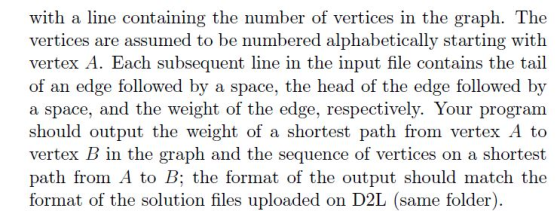
Input file:
10
A J 18
A H 79
A I 81
J G 24
J F 76
G F 2
G H 50
F E 4
E D 2
D H 20
H C 50
I D 6
I C 97
I J 27
C B 22
Solution File:
142
A J G F E D H C B
Homework Answers
CODE TO COPY:
import java.io.File;
import java.io.FileNotFoundException;
import java.io.PrintWriter;
import java.util.ArrayList;
import java.util.Comparator;
import java.util.HashMap;
import java.util.HashSet;
import java.util.Scanner;
import java.util.List;
import java.util.PriorityQueue;
//edge class to hold the edge source, destinationa and the weight of the edge
class GraphEdge{
private char from;
private char to;
private int weight;
public GraphEdge(char from, char to, int weight)
{
this.from=from;
this.to=to;
this.weight=weight;
}
public char getFrom()
{
return from;
}
public char getTo()
{
return to;
}
public int getWeight()
{
return weight;
}
public String toString()
{
return "From: "+from+"\tTo: "+to+"\tWeight: "+weight;
}
}
public class DijkstraAlgorithmTest {
public static void main(String[] args) throws FileNotFoundException {
File file=new File("dijkstraFile.txt");//input file
Scanner obj=new Scanner(file);//scanner object to read data from file
char source='A';//source vertex
char destination='B';//destination vertex
ArrayList<GraphEdge> edges=new ArrayList<GraphEdge>();//list to hold all edges
HashSet<Character> uniqueVertices=new HashSet<Character>();//all unique vertices in map
ArrayList<Character> allVertices=new ArrayList<Character>();//list to hold all vertices
int numberOfVertices=Integer.parseInt(obj.nextLine());
while(obj.hasNextLine())
{//while input file has lines left
String line=obj.nextLine();
String vertex[]=line.split(" ");//split the line into source vertex, destination vertex and the weight
GraphEdge edge=new GraphEdge(vertex[0].charAt(0), vertex[1].charAt(0), Integer.parseInt(vertex[2]));//create a new graphedge object from line data
edges.add(edge);
if(!uniqueVertices.contains(vertex[0].charAt(0)))
{//if vertex not present in unique vertices map, add it in map and arraylist
uniqueVertices.add(vertex[0].charAt(0));
allVertices.add(vertex[0].charAt(0));
}
if(!uniqueVertices.contains(vertex[1].charAt(0)))
{//if vertex not present in unique vertices map, add it in map and arraylist
uniqueVertices.add(vertex[1].charAt(0));
allVertices.add(vertex[1].charAt(0));
}
}
HashMap<Character, Integer> distance=new HashMap<Character, Integer>();
for(Character ch: allVertices)
{
distance.put(ch, Integer.MAX_VALUE);//add all vertices to distance map with initial distance as infinite i.e Integer.MAX_VALUE
}
distance.put(source, 0);//source distance is 0, update in distance map
//comparator to arrange the vertices in the priority queue in min heap fashion
Comparator<Character> cmp=new Comparator<Character>()
{
public int compare(Character a, Character b)
{
if(distance.get(a)<distance.get(b))
return -1;
else if(distance.get(a)==distance.get(b))
return 0;
else
return 1;
}
};
//create a priority queue
PriorityQueue<Character> pq=new PriorityQueue<Character>(cmp);//priority queue / min heap to arrange vertices in min heap fashion
for(Character ch: allVertices)
pq.add(ch);//add all the vertices to pq
String path="";//hold the final path from a to b
while(!pq.isEmpty())
{//while there are elements in the pq
char ch=pq.remove();//get the vertex
path+=ch;//append the vertex to path
if(ch==destination)//if reached destination
break;//loop out
List<GraphEdge> outVertex=getAllOutgoingEdges(edges, ch);
for(GraphEdge edge:outVertex)
{//for each egde in the outVertex list
if(pq.contains(edge.getTo()))
{//if the destination vertex in the edge is present in the pq
if(distance.get(ch)+edge.getWeight()<distance.get(edge.getTo()))
{//if new distance is less than the old distance
distance.put(edge.getTo(), distance.get(ch)+edge.getWeight());//put new distance
}
//the below 2 lines are executed to update the priority queue after change to distance
pq.remove(edge.getTo());//remove destination vertex of edge to pq
pq.add(edge.getTo());//add destination vertex of edge to pq
}
}
}
// solution file
File output=new File("DijkstraSolution.txt");
PrintWriter pw=new PrintWriter(output);
pw.println(distance.get(destination));//print the minuimum distance to destination to file
pw.println(path);//print the path to file
//print a successful message to the console
System.out.println("Successful!");
pw.flush();//flush the output to file
pw.close();//close pw
obj.close();//close obj
}
//get all the outgoing edges in a list from the source vetrtex
public static List<GraphEdge> getAllOutgoingEdges(ArrayList<GraphEdge> list, char source)
{
List<GraphEdge> result=new ArrayList<GraphEdge>();
for(GraphEdge edge: list)
{
if(edge.getFrom()==source)
result.add(edge);
}
return result;
}
}
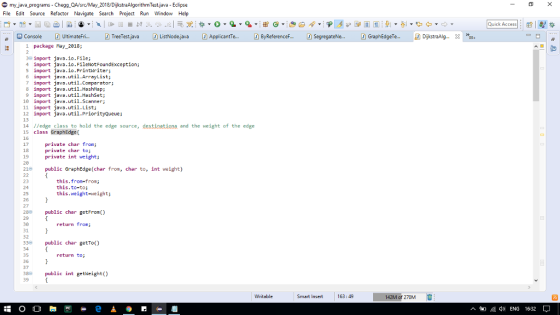
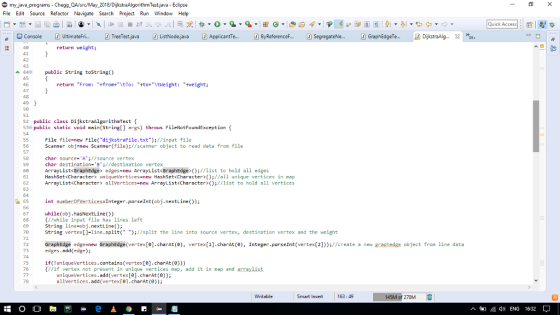
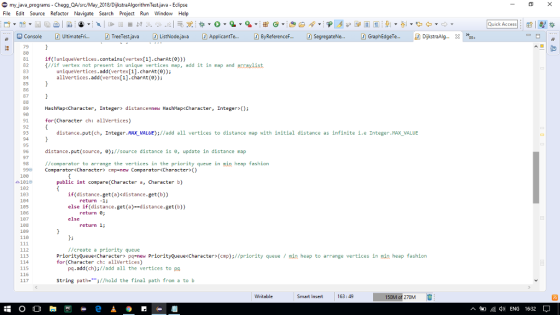
PROGRAM SCREENSHOTS:
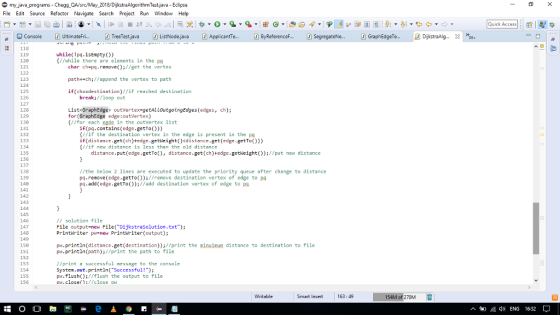
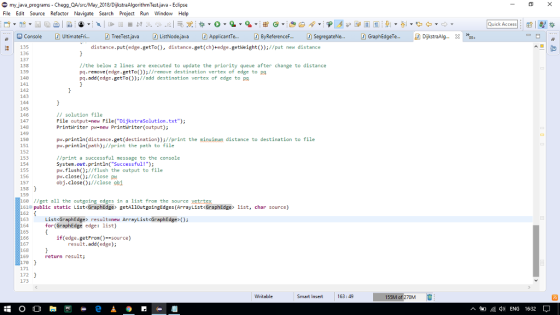
INPUT FILE:
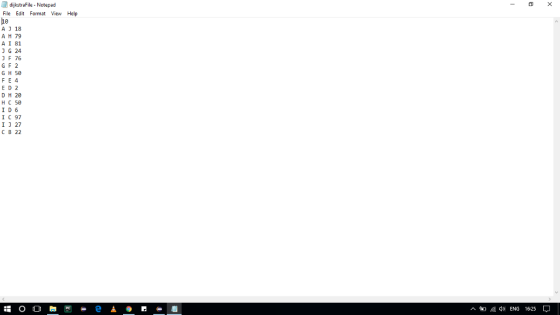
OUTPUT FILE:
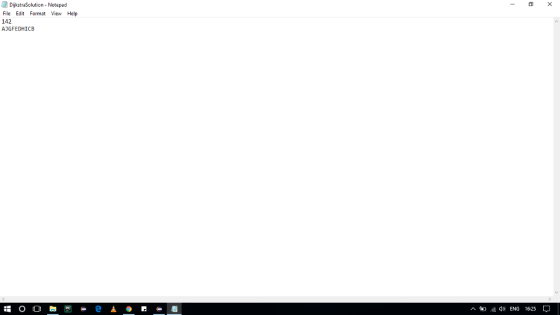
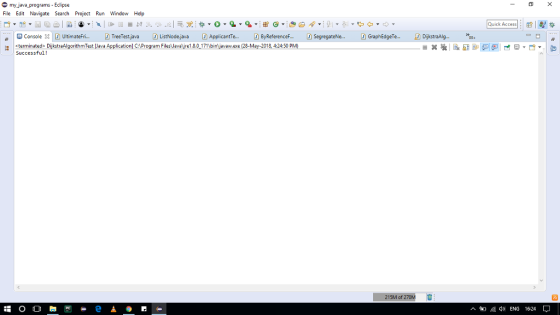
CONSOLE OUTPUT:
Add Answer to:
Using java can someone help me create a program using the
following instructions.
Input file:
10...
Hi I'm stuck with this homework question and hope you can help me. 9. In the...
 Hi I'm stuck with this homework question and hope you can help
me.
9. In the graph below (A) Determine the shortest path from a to ALL other nodes using Dijkstra's Shortest Path Algorithm. The answers must be in the following form: For each node, give the shortest path from a to that node (that is, list the nodes in the path) Also for each path give the length of the path. (B) ON THIS SHEET OF PAPER SHOWING A...
Hi I'm stuck with this homework question and hope you can help
me.
9. In the graph below (A) Determine the shortest path from a to ALL other nodes using Dijkstra's Shortest Path Algorithm. The answers must be in the following form: For each node, give the shortest path from a to that node (that is, list the nodes in the path) Also for each path give the length of the path. (B) ON THIS SHEET OF PAPER SHOWING A...
Please follow all the instructions and do all the parts (a-d)! Create a Java program which implem...
 Please follow all the instructions and do all the parts
(a-d)!
Create a Java program which implements Dijkstra’s shortest path
algorithm according to the psueudocode below. Base the design on
the weighted graph implementation used in Problem3.java (provided
at the bottom). Your program should include the following
features:
a. A new method receives a starting vertex index and a target
vertex index (e.g. 0 and 4). It computes the shortest distances to
all vertexes using Dijkstra’s algorithm. The pseudocode is...
Please follow all the instructions and do all the parts
(a-d)!
Create a Java program which implements Dijkstra’s shortest path
algorithm according to the psueudocode below. Base the design on
the weighted graph implementation used in Problem3.java (provided
at the bottom). Your program should include the following
features:
a. A new method receives a starting vertex index and a target
vertex index (e.g. 0 and 4). It computes the shortest distances to
all vertexes using Dijkstra’s algorithm. The pseudocode is...
Shortest Path (DAG) Students, In this coding assignment, you will be asked to write Java code...
Shortest Path (DAG) Students, In this coding assignment, you will be asked to write Java code to read a text file (input.txt) of a graph represented as an adjacency list. Example: A, 7, B, 9, C B, 1, C C, 8, E, 2, F D, 1, E, 3, G E, 3, G F, 3, D, -3, H H, 6, G K, 3, H, -1, F The graph represented by the adjacency list above looks like this: The graph is a...
Help !! I need help with Depth-First Search using an undirected graph. Write a program, IN JAVA, ...
 Help !! I need help with Depth-First Search using an
undirected graph.
Write a program, IN JAVA, to implement the
depth-first search algorithm using the pseudocode given.
Write a driver program, which reads input file mediumG.txt as an
undirected graph and runs
the depth-first search algorithm to find paths to all the other
vertices considering 0 as the
source. This driver program should display the paths in the
following manner:
0 to ‘v’: list of all the vertices traversed to...
Help !! I need help with Depth-First Search using an
undirected graph.
Write a program, IN JAVA, to implement the
depth-first search algorithm using the pseudocode given.
Write a driver program, which reads input file mediumG.txt as an
undirected graph and runs
the depth-first search algorithm to find paths to all the other
vertices considering 0 as the
source. This driver program should display the paths in the
following manner:
0 to ‘v’: list of all the vertices traversed to...
5. If we apply binary dilation to the same large object twice using the same small...
 5. If we apply binary dilation to the same large object twice using the same small structuring element, the effect, if any, of the second dilation on the object is that the object: (a) is unchanged (b) is completely removed (c) becomes larger (d) becomes smaller (e) does not change 6. Which of the following is/are true? (a) Dijkstra's algorithm can be used to find shortest paths in a network (b) Dijkstra's algorithm is a method to find straight lines...
Run the Dijkstra’s algorithm on the directed graph of the following figure 24.6, using vertex t...
 Run the Dijkstra’s algorithm on the directed graph of the
following figure 24.6, using vertex t as
the source. In the style of Figure 24.6, show the d and
? values and the vertices in set S after each iteration of
the while loop.
1 8 10 I 10 14 4 6 4 6 2 3 2 3 4 6 5 5 2 (a) (c) 1 10 13 4 6 (d) (e) Figure 24.6 The execution of Dijkstra's algorithm. The...
Run the Dijkstra’s algorithm on the directed graph of the
following figure 24.6, using vertex t as
the source. In the style of Figure 24.6, show the d and
? values and the vertices in set S after each iteration of
the while loop.
1 8 10 I 10 14 4 6 4 6 2 3 2 3 4 6 5 5 2 (a) (c) 1 10 13 4 6 (d) (e) Figure 24.6 The execution of Dijkstra's algorithm. The...
Using c 3 File Input & Data Processing Reading data from a file is often done in order to pro...
using c 3 File Input & Data Processing Reading data from a file is often done in order to process and aggregate it to get ad- ditional results. In this activity you will read in data from a file containing win/loss data from the 2011 Major League Baseball season. Specifically, the file data/mlb_nl_2011.txt contains data about each National League team. Each line contains a team name fol- lowed by the number of wins and number of losses during the 2011...
Give 10 cities located within 1,000 miles (left to right) by 1,000 miles (bottom to top)...
Give 10 cities located within 1,000 miles (left to right) by 1,000 miles (bottom to top) region, calculate the shortest traveling path from the traveling salesman problem. The 10 cities are A, B, C, D, E, F, G, H, I, and J. Locations of 10 cities are A (X: 100, Y: 300) B (X: 200, Y: 130) C (X: 300, Y: 500) D (X: 500, Y: 390) E (X: 700, Y: 300) F (X: 900, Y: 600) G (X: 800,...
This is a Python Program Write a program that encrypts letters based on the following key....
This is a Python Program Write a program that encrypts letters based on the following key. Original letter to encrypted letter A M B L C K D J E I F H G G H F I E J D K C L B M A N Z O Y P X Q W R V S U T T U S V R W Q X P Y O Z N Write the output to a file
Given the following test scores on exam #1 for INEN 370 during the summer 2017: Due...
 Given the following test scores on exam #1 for INEN 370 during
the summer 2017:
Due Name Date: Tuesday, January 29, 2019 ISEN 370-Engineering Statistics Assignment # 2 Homework I.(60) Given the following test scores on Exam # 1 for INEN 370 during the Summer 2017 93 77 67 72 528366 84 59 63 75 97 84 73 814261 51 91 87 34 54 7 47 79 706557 90 83 58 69 82 76 716038 81 74 69 68 76...
Given the following test scores on exam #1 for INEN 370 during
the summer 2017:
Due Name Date: Tuesday, January 29, 2019 ISEN 370-Engineering Statistics Assignment # 2 Homework I.(60) Given the following test scores on Exam # 1 for INEN 370 during the Summer 2017 93 77 67 72 528366 84 59 63 75 97 84 73 814261 51 91 87 34 54 7 47 79 706557 90 83 58 69 82 76 716038 81 74 69 68 76...
 Hi I'm stuck with this homework question and hope you can help
me.
9. In the graph below (A) Determine the shortest path from a to ALL other nodes using Dijkstra's Shortest Path Algorithm. The answers must be in the following form: For each node, give the shortest path from a to that node (that is, list the nodes in the path) Also for each path give the length of the path. (B) ON THIS SHEET OF PAPER SHOWING A...
Hi I'm stuck with this homework question and hope you can help
me.
9. In the graph below (A) Determine the shortest path from a to ALL other nodes using Dijkstra's Shortest Path Algorithm. The answers must be in the following form: For each node, give the shortest path from a to that node (that is, list the nodes in the path) Also for each path give the length of the path. (B) ON THIS SHEET OF PAPER SHOWING A...
 Please follow all the instructions and do all the parts
(a-d)!
Create a Java program which implements Dijkstra’s shortest path
algorithm according to the psueudocode below. Base the design on
the weighted graph implementation used in Problem3.java (provided
at the bottom). Your program should include the following
features:
a. A new method receives a starting vertex index and a target
vertex index (e.g. 0 and 4). It computes the shortest distances to
all vertexes using Dijkstra’s algorithm. The pseudocode is...
Please follow all the instructions and do all the parts
(a-d)!
Create a Java program which implements Dijkstra’s shortest path
algorithm according to the psueudocode below. Base the design on
the weighted graph implementation used in Problem3.java (provided
at the bottom). Your program should include the following
features:
a. A new method receives a starting vertex index and a target
vertex index (e.g. 0 and 4). It computes the shortest distances to
all vertexes using Dijkstra’s algorithm. The pseudocode is...
 Help !! I need help with Depth-First Search using an
undirected graph.
Write a program, IN JAVA, to implement the
depth-first search algorithm using the pseudocode given.
Write a driver program, which reads input file mediumG.txt as an
undirected graph and runs
the depth-first search algorithm to find paths to all the other
vertices considering 0 as the
source. This driver program should display the paths in the
following manner:
0 to ‘v’: list of all the vertices traversed to...
Help !! I need help with Depth-First Search using an
undirected graph.
Write a program, IN JAVA, to implement the
depth-first search algorithm using the pseudocode given.
Write a driver program, which reads input file mediumG.txt as an
undirected graph and runs
the depth-first search algorithm to find paths to all the other
vertices considering 0 as the
source. This driver program should display the paths in the
following manner:
0 to ‘v’: list of all the vertices traversed to...
 5. If we apply binary dilation to the same large object twice using the same small structuring element, the effect, if any, of the second dilation on the object is that the object: (a) is unchanged (b) is completely removed (c) becomes larger (d) becomes smaller (e) does not change 6. Which of the following is/are true? (a) Dijkstra's algorithm can be used to find shortest paths in a network (b) Dijkstra's algorithm is a method to find straight lines...
 Run the Dijkstra’s algorithm on the directed graph of the
following figure 24.6, using vertex t as
the source. In the style of Figure 24.6, show the d and
? values and the vertices in set S after each iteration of
the while loop.
1 8 10 I 10 14 4 6 4 6 2 3 2 3 4 6 5 5 2 (a) (c) 1 10 13 4 6 (d) (e) Figure 24.6 The execution of Dijkstra's algorithm. The...
Run the Dijkstra’s algorithm on the directed graph of the
following figure 24.6, using vertex t as
the source. In the style of Figure 24.6, show the d and
? values and the vertices in set S after each iteration of
the while loop.
1 8 10 I 10 14 4 6 4 6 2 3 2 3 4 6 5 5 2 (a) (c) 1 10 13 4 6 (d) (e) Figure 24.6 The execution of Dijkstra's algorithm. The...
 Given the following test scores on exam #1 for INEN 370 during
the summer 2017:
Due Name Date: Tuesday, January 29, 2019 ISEN 370-Engineering Statistics Assignment # 2 Homework I.(60) Given the following test scores on Exam # 1 for INEN 370 during the Summer 2017 93 77 67 72 528366 84 59 63 75 97 84 73 814261 51 91 87 34 54 7 47 79 706557 90 83 58 69 82 76 716038 81 74 69 68 76...
Given the following test scores on exam #1 for INEN 370 during
the summer 2017:
Due Name Date: Tuesday, January 29, 2019 ISEN 370-Engineering Statistics Assignment # 2 Homework I.(60) Given the following test scores on Exam # 1 for INEN 370 during the Summer 2017 93 77 67 72 528366 84 59 63 75 97 84 73 814261 51 91 87 34 54 7 47 79 706557 90 83 58 69 82 76 716038 81 74 69 68 76...
Most questions answered within 3 hours.
-
Where is the error in this code sequence?
String s1 = "Hello";
String s2 = "ello";...
asked 11 months ago -
Financial data for Joel de Paris, Inc., for last year
follow:
Joel de Paris, Inc.
Balance...
asked 11 months ago -
Consider this reaction:
Al2(SO4)3 (aq)+ BaCl3
(aq) Al2Cl6 (aq)- +
3BaSO4(s) . What is the...
asked 11 months ago -
Suppose that Savneet is considering increasing her
recent random sample from 20 car rentals to 40...
asked 11 months ago -
Trucks arrive at an unloading terminal at an average rate of 120
per hour.
Trucks arrive...
asked 11 months ago -
Why are methanol and ethanol completely soluble in water while
octanol is not very little soluble....
asked 11 months ago -
A facilities manager at a university reads in a research report
that the mean amount of...
asked 11 months ago -
When the CuSO4 is rehydrated by adding water to the anhydrous
compound, is this an endothermic...
asked 11 months ago -
A ray of sunlight is passing from diamond into crown glass; the
angle of incidence is...
asked 11 months ago -
A block of mass 0.249 kg is placed on top of a light, vertical
spring of...
asked 11 months ago -
how do the kidneys compensate in the presences of acidosis
a) trigger hyperventilate
b) reserve acid...
asked 11 months ago -
Question 501 pts
The rental rate of capital to the firm increases. Which of the
following...
asked 11 months ago