Consider the sequence: -2/3, 2/9, -2/27, 2/81, -2/243……
Consider the sequence: -2/3, 2/9, -2/27, 2/81, -2/243……
Part 1: A Formula
Find a formula for the nth term of this sequence:
an = _______ ∑
Part 2: Limit of the Sequence
Find the limit of the sequence:
lim(n->∞) an = _______ ∑
Remember: INF, -INF, DNE are also possible answers.
Part 3:
Converge or Diverge?
Does this sequence converge or diverge?
Homework Answers
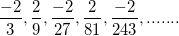



Geometric series test:- If a series of the form

if |r|<1 then series converges and sum is S= a/(1-r)
if |r|>1 then series diverges
Here a=-2/3 ; r=-1/3
|r|=1/3<1
so series converges
Sum

2- 4. Given the Sequence below(-3)***** a) Write the first five terms of the sequence. b)...
 2- 4. Given the Sequence below(-3)***** a) Write the first five terms of the sequence. b) Provide a sketch for the first five terms of the sequence. Does the sequence approach a number? c) Does the sequence Converge or Diverge as no? Explain your answer. d) Find lim,--..(am + b), where a, the general term you found in a) and m2+1 Does the limit converge?
Write a formula for the nth term of the following geometric sequence '3 9' 27 Find...
 Write a formula for the nth term of the following geometric sequence '3 9' 27 Find a formula for the nth term of the geometric sequence. n- 1
Homework 3: Problem 9 Previous Problem Problem List Next Problem (1 point) Use the ratio test...
 Homework 3: Problem 9 Previous Problem Problem List Next Problem (1 point) Use the ratio test to determine whether m2 +2 2" converges or diverges 30 (a) Find the ratio of successive terms. Write your answer as a fully simplified fraction. For n 30, lim =lim 100 а. (b) Evaluate the limit in the previous part. Enter co as infinity and -oo as-infinity. If the limit does not exist, enter DNE an lim (c) By the ratio test, does the...
7. Find the next two terms of each geometric sequence. a.-3.9. - 27. 81.... b. I....
 7. Find the next two terms of each geometric sequence. a.-3.9. - 27. 81.... b. I. -1.1.-1.1. - 1.... 8. Find the first five terms of the geometric sequence for which ,- -2 and 3. 9. Find , for the geometric sequence 60, 30, 15.... 10. Write an equation for the nth term of the geometric sequence 4, 8, 16,... 11. The second term in a geometric sequence is -2 and the third term is-6. Find an equation for the...
(1 point) Write out the first five terms of the sequence determine whether the sequence converges,...
 (1 point) Write out the first five terms of the sequence determine whether the sequence converges, n=1 and if so find its limit. (-1)+1 Enter the following information for an = (n+1)2 lim (-1)^+1 n+ (n + 1)2 (Enter DNE if limit Does Not Exist.) Does the sequence converge (Enter "yes" or "no").
(1 point) Write out the first five terms of the sequence a n = (-1)^ n-1 (n+4)^ 2 Enter the following information for a, a 1 = a 2 = a 3 = a 4 = a 5 = lim n infty (-1)^ n-1 (n+4)^ 2 = Box (Enter DNE if limit Does Not Exist.) Does the sequence converge Big
 (1 point) Write out the first five terms of the sequence a n = (-1)^ n-1 (n+4)^ 2 Enter the following information for a, a 1 = a 2 = a 3 = a 4 = a 5 = lim n infty (-1)^ n-1 (n+4)^ 2 = Box (Enter DNE if limit Does Not Exist.) Does the sequence converge Bigg[ (-1)^ n-1 (n+4)^ 2 Bigg] n=1 ^ infty determine whether the sequence converges, and if so find its limit. (Enter...
Does the sequence {an} converge or diverge? Find the limit if the sequence is convergent. 15n...
 Does the sequence {an} converge or diverge? Find the limit if the sequence is convergent. 15n an = n +4 Select the correct choice below and, if necessary, fill in the answer box to complete the choice. O A. The sequence converges to lim an no (Type an exact answer, using radicals as needed.) OB. The sequence diverges.
(2 points) Use the ratio test to determine whether in+2 "Ta converges or diverges. (a) Find...
 (2 points) Use the ratio test to determine whether in+2 "Ta converges or diverges. (a) Find the ratio of successive terms. Write your answer as a fully simplified fraction. For n > 6. (b) Evaluate the limit in the previous part. Enter o as infinity and - as -infinity. If the limit does not exist, enter DNE. lim 1200 (c) By the ratio test, does the series converge, diverge, or is the test inconclusive? Choose
hw help Use L'Hospital's rule, if applicable to find the limit. x3-27 lim- * +3 e*2-9-1...
 hw help
Use L'Hospital's rule, if applicable to find the limit. x3-27 lim- * +3 e*2-9-1 Select the correct answer. 0 27 ООО DNE or Use L'Hospital's rule, if applicable, to find the limit In(3x2+5) lim X3-7 X00 Select the correct answer. DNE or 00 5 3 -7 Solve the following limit using any valid method. x3 + 9 lim *** in (X? + 6) DNE or o 1 انہتا
hw help
Use L'Hospital's rule, if applicable to find the limit. x3-27 lim- * +3 e*2-9-1 Select the correct answer. 0 27 ООО DNE or Use L'Hospital's rule, if applicable, to find the limit In(3x2+5) lim X3-7 X00 Select the correct answer. DNE or 00 5 3 -7 Solve the following limit using any valid method. x3 + 9 lim *** in (X? + 6) DNE or o 1 انہتا
3. Evaluate using the correct form -dx 0 x-2 4. Consider the sequence 3n n+1 Does...
 3. Evaluate using the correct form -dx 0 x-2 4. Consider the sequence 3n n+1 Does the sequence converge or diverge. If it convergés, to what does it converge?
 2- 4. Given the Sequence below(-3)***** a) Write the first five terms of the sequence. b) Provide a sketch for the first five terms of the sequence. Does the sequence approach a number? c) Does the sequence Converge or Diverge as no? Explain your answer. d) Find lim,--..(am + b), where a, the general term you found in a) and m2+1 Does the limit converge?
 Write a formula for the nth term of the following geometric sequence '3 9' 27 Find a formula for the nth term of the geometric sequence. n- 1
 Homework 3: Problem 9 Previous Problem Problem List Next Problem (1 point) Use the ratio test to determine whether m2 +2 2" converges or diverges 30 (a) Find the ratio of successive terms. Write your answer as a fully simplified fraction. For n 30, lim =lim 100 а. (b) Evaluate the limit in the previous part. Enter co as infinity and -oo as-infinity. If the limit does not exist, enter DNE an lim (c) By the ratio test, does the...
 7. Find the next two terms of each geometric sequence. a.-3.9. - 27. 81.... b. I. -1.1.-1.1. - 1.... 8. Find the first five terms of the geometric sequence for which ,- -2 and 3. 9. Find , for the geometric sequence 60, 30, 15.... 10. Write an equation for the nth term of the geometric sequence 4, 8, 16,... 11. The second term in a geometric sequence is -2 and the third term is-6. Find an equation for the...
 (1 point) Write out the first five terms of the sequence determine whether the sequence converges, n=1 and if so find its limit. (-1)+1 Enter the following information for an = (n+1)2 lim (-1)^+1 n+ (n + 1)2 (Enter DNE if limit Does Not Exist.) Does the sequence converge (Enter "yes" or "no").
 Does the sequence {an} converge or diverge? Find the limit if the sequence is convergent. 15n an = n +4 Select the correct choice below and, if necessary, fill in the answer box to complete the choice. O A. The sequence converges to lim an no (Type an exact answer, using radicals as needed.) OB. The sequence diverges.
 (2 points) Use the ratio test to determine whether in+2 "Ta converges or diverges. (a) Find the ratio of successive terms. Write your answer as a fully simplified fraction. For n > 6. (b) Evaluate the limit in the previous part. Enter o as infinity and - as -infinity. If the limit does not exist, enter DNE. lim 1200 (c) By the ratio test, does the series converge, diverge, or is the test inconclusive? Choose
 hw help
Use L'Hospital's rule, if applicable to find the limit. x3-27 lim- * +3 e*2-9-1 Select the correct answer. 0 27 ООО DNE or Use L'Hospital's rule, if applicable, to find the limit In(3x2+5) lim X3-7 X00 Select the correct answer. DNE or 00 5 3 -7 Solve the following limit using any valid method. x3 + 9 lim *** in (X? + 6) DNE or o 1 انہتا
hw help
Use L'Hospital's rule, if applicable to find the limit. x3-27 lim- * +3 e*2-9-1 Select the correct answer. 0 27 ООО DNE or Use L'Hospital's rule, if applicable, to find the limit In(3x2+5) lim X3-7 X00 Select the correct answer. DNE or 00 5 3 -7 Solve the following limit using any valid method. x3 + 9 lim *** in (X? + 6) DNE or o 1 انہتا
 3. Evaluate using the correct form -dx 0 x-2 4. Consider the sequence 3n n+1 Does the sequence converge or diverge. If it convergés, to what does it converge?
Most questions answered within 3 hours.
-
Where is the error in this code sequence?
String s1 = "Hello";
String s2 = "ello";...
asked 11 months ago -
Financial data for Joel de Paris, Inc., for last year
follow:
Joel de Paris, Inc.
Balance...
asked 11 months ago -
Consider this reaction:
Al2(SO4)3 (aq)+ BaCl3
(aq) Al2Cl6 (aq)- +
3BaSO4(s) . What is the...
asked 11 months ago -
Suppose that Savneet is considering increasing her
recent random sample from 20 car rentals to 40...
asked 11 months ago -
Trucks arrive at an unloading terminal at an average rate of 120
per hour.
Trucks arrive...
asked 11 months ago -
Why are methanol and ethanol completely soluble in water while
octanol is not very little soluble....
asked 11 months ago -
A facilities manager at a university reads in a research report
that the mean amount of...
asked 11 months ago -
When the CuSO4 is rehydrated by adding water to the anhydrous
compound, is this an endothermic...
asked 11 months ago -
A ray of sunlight is passing from diamond into crown glass; the
angle of incidence is...
asked 11 months ago -
A block of mass 0.249 kg is placed on top of a light, vertical
spring of...
asked 11 months ago -
how do the kidneys compensate in the presences of acidosis
a) trigger hyperventilate
b) reserve acid...
asked 11 months ago -
Question 501 pts
The rental rate of capital to the firm increases. Which of the
following...
asked 11 months ago