why is it important for the function of the mitochondrial electron transport chain for the value...
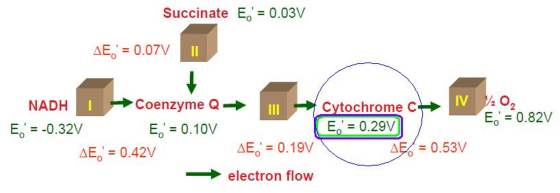
why is it important for the function of the mitochondrial electron transport chain for the value of E of cytochrome c to fall between 0.22 and 0.29V
Homework Answers
A successful catalyst must display a low activation potential for NADH oxidation, high catalytic activity, and high stability. For most catalysts above, activation is controlled by the redox potential of the catalyst, which should ideally be as close to the formal potential of NADH as possible. Stability of quinones, pyrroles, and other materials may be enhanced by electropolymerization of the catalyst onto an electrode surface.For some species, such as azines, electropolymerization results in a positive shift in redox potential, and therefore potential of NADH activation. For example, the redox potential of toluidene blue-o (TBO) increases from −0.11 V/SHE to 0.22V/SHE (0.29–0.62V/RHE, pH 6.7) upon polymerization. Such a shift can enhance the kinetics of NADH oxidation at the expense of higher anode operating potential. Electropolymerization tends not to affect the redox potential of quinones. The enzyme diaphorase (NAD(P)H dehydrogenase, EC, in conjunction with an additional mediator has been shown to provide very high NADH oxidation rates. Diaphorase, a membrane (extrinsic) flavoprotein containing iron–sulfur electron transfer clusters, is a natural electron acceptor from NADH as part of the mitochondrial electron transport chain.
Add Answer to:
why is it important for the function of the mitochondrial
electron transport chain for the value...
The electron transport chain consists of protein complexes embedded in the inner mitochondrial membrane, where it...
 The electron transport chain consists of protein complexes embedded in the inner mitochondrial membrane, where it generat a proton gradient by a series of oxidation-reduction, or redox, reactions. Although all of the stages of cellular respiration (glycolysis, the citric acid cycle, and the electron transport chain) are necessary for life, the electron transport chain is sometimes called the most important stage. First complete the sentence, then answer the question. The electron transport chain uses the transfer of protons between protein...
Which complex in the electron transport chain does not contribute to the proton gradient across the...
Which complex in the electron transport chain does not contribute to the proton gradient across the mitochondrial membrane? A. Complex I B. Complex IV C. Complex II D. Complex III Which statement regarding the mitochondrial electron transport chain and oxidative phosphorylation is true? A. Ubiquinone and the F zero subunit of ATP synthase are peripheral membrane proteins. B. Complexes I, II, III, and IV all are proton pumps. C. The final electron acceptor is water. D. Complex II is considered...
What is the function of cytochrome c in the electron transport chain? Question 3 of 4...
 What is the function of cytochrome c in the electron
transport chain?
Question 3 of 4 To answer this question, you may reference the Metabolic Map. What is the function of cytochrome c in the electron transport chain? o It reduces two molecules of Q to QH2. It oxidizes NADH to NAD+. It oxidizes FADH2 to FAD. It transports two electrons from NADH or FADH to complex III. It transports an electron from complex III to complex IV.
What is the function of cytochrome c in the electron
transport chain?
Question 3 of 4 To answer this question, you may reference the Metabolic Map. What is the function of cytochrome c in the electron transport chain? o It reduces two molecules of Q to QH2. It oxidizes NADH to NAD+. It oxidizes FADH2 to FAD. It transports two electrons from NADH or FADH to complex III. It transports an electron from complex III to complex IV.
Question 5 (0.5 points) Where is the electron transport chain located? In the mitochondrial matrix In...
 Question 5 (0.5 points) Where is the electron transport chain located? In the mitochondrial matrix In the mitochondrial outer membrane In the mitochondrial intermembrane space In the mitochondrial intermembrane Question 6 (0.5 points) What molecules release electrons into the electron transport chain? Acids Glucose and its metabolites NADH and FADH2 ADP
The electron transport chain eases the fall of electrons to the terminal oxygen. Why is this...
The electron transport chain eases the fall of electrons to the terminal oxygen. Why is this important?
The electron transport chain(ETC), or respiratory chain, is linked to proton movement and ATPsynthesis....
The electron transport chain (ETC), or respiratory chain, is linked to proton movement and ATP synthesis. Select the statements that accurately describe the electron transport chain. Choose all that apply.Prosthetic groups, such as iron-sulfur centers, are directly involved with electron transfer. The reactions of the ETC take place in the outer membrane of mitochondria. Electron carriers in the mitochondrial matrix include ubiquinone (coenzyme Q), FMN, and cytochrome c. The outer membrane of mitochondria is readily permeable to small molecules and hydrogen ions. Electrons generated...
1. where is the location of the electron transport chain? a. mitochondrial matrix b. mitochondrial inner...
1. where is the location of the electron transport chain? a. mitochondrial matrix b. mitochondrial inner membrane c cytoplasm 2. photophosphorylation involves the transfer of phosphateto ADP via a. glycolysis b krebs cycle c. sunlight energy d. oxidation-reduction reaction 3. photosynthesis involves absorption of light in the a. microwave region of the electromagnetic spectrum b. infrared region of the electromagnetic spectrum c. visible region of the electromagnetic spectrum d. ultraviolet region of the electromagnetic spectrum e. x-ray region of the...
Loss of mitochondrial function during apoptosis is caused by cytochrome c release from the mitochondria, which...
Loss of mitochondrial function during apoptosis is caused by cytochrome c release from the mitochondria, which disrupts the flow of electrons to oxygen in the electron transport chain. A. True B. False
Which of the following species accept electrons within the mitochondrial electron transport chain? Choose any/all answers...
Which of the following species accept electrons within the mitochondrial electron transport chain? Choose any/all answers that apply. A. NADH B. FMN-containing flavoproteins C. ubiquinone D. iron/sulfur centers E. molecular oxygen
Part A-The role of 02 in electron transport - In mitochondrial electron transport, what is the...
 Part A-The role of 02 in electron transport - In mitochondrial electron transport, what is the direct role of 02? View Avallable Hint(s) 0 to provide the driving force for the synthesis of ATP from ADP and P, O to tunction as the final electron acceptor in the electron transport chain O to oxidize NADH and FADH2 from glycolysis, acelyl CoA formation, and the citric acid cycle O to provide the driving force for the production of a proton gradient
 The electron transport chain consists of protein complexes embedded in the inner mitochondrial membrane, where it generat a proton gradient by a series of oxidation-reduction, or redox, reactions. Although all of the stages of cellular respiration (glycolysis, the citric acid cycle, and the electron transport chain) are necessary for life, the electron transport chain is sometimes called the most important stage. First complete the sentence, then answer the question. The electron transport chain uses the transfer of protons between protein...
 What is the function of cytochrome c in the electron
transport chain?
Question 3 of 4 To answer this question, you may reference the Metabolic Map. What is the function of cytochrome c in the electron transport chain? o It reduces two molecules of Q to QH2. It oxidizes NADH to NAD+. It oxidizes FADH2 to FAD. It transports two electrons from NADH or FADH to complex III. It transports an electron from complex III to complex IV.
What is the function of cytochrome c in the electron
transport chain?
Question 3 of 4 To answer this question, you may reference the Metabolic Map. What is the function of cytochrome c in the electron transport chain? o It reduces two molecules of Q to QH2. It oxidizes NADH to NAD+. It oxidizes FADH2 to FAD. It transports two electrons from NADH or FADH to complex III. It transports an electron from complex III to complex IV.
 Question 5 (0.5 points) Where is the electron transport chain located? In the mitochondrial matrix In the mitochondrial outer membrane In the mitochondrial intermembrane space In the mitochondrial intermembrane Question 6 (0.5 points) What molecules release electrons into the electron transport chain? Acids Glucose and its metabolites NADH and FADH2 ADP
 Part A-The role of 02 in electron transport - In mitochondrial electron transport, what is the direct role of 02? View Avallable Hint(s) 0 to provide the driving force for the synthesis of ATP from ADP and P, O to tunction as the final electron acceptor in the electron transport chain O to oxidize NADH and FADH2 from glycolysis, acelyl CoA formation, and the citric acid cycle O to provide the driving force for the production of a proton gradient
Most questions answered within 3 hours.
-
Where is the error in this code sequence?
String s1 = "Hello";
String s2 = "ello";...
asked 10 months ago -
Financial data for Joel de Paris, Inc., for last year
follow:
Joel de Paris, Inc.
Balance...
asked 10 months ago -
Consider this reaction:
Al2(SO4)3 (aq)+ BaCl3
(aq) Al2Cl6 (aq)- +
3BaSO4(s) . What is the...
asked 10 months ago -
Suppose that Savneet is considering increasing her
recent random sample from 20 car rentals to 40...
asked 10 months ago -
Trucks arrive at an unloading terminal at an average rate of 120
per hour.
Trucks arrive...
asked 10 months ago -
Why are methanol and ethanol completely soluble in water while
octanol is not very little soluble....
asked 10 months ago -
A facilities manager at a university reads in a research report
that the mean amount of...
asked 10 months ago -
When the CuSO4 is rehydrated by adding water to the anhydrous
compound, is this an endothermic...
asked 10 months ago -
A ray of sunlight is passing from diamond into crown glass; the
angle of incidence is...
asked 10 months ago -
A block of mass 0.249 kg is placed on top of a light, vertical
spring of...
asked 10 months ago -
how do the kidneys compensate in the presences of acidosis
a) trigger hyperventilate
b) reserve acid...
asked 10 months ago -
Question 501 pts
The rental rate of capital to the firm increases. Which of the
following...
asked 10 months ago