
Homework Answers
Add Answer to:
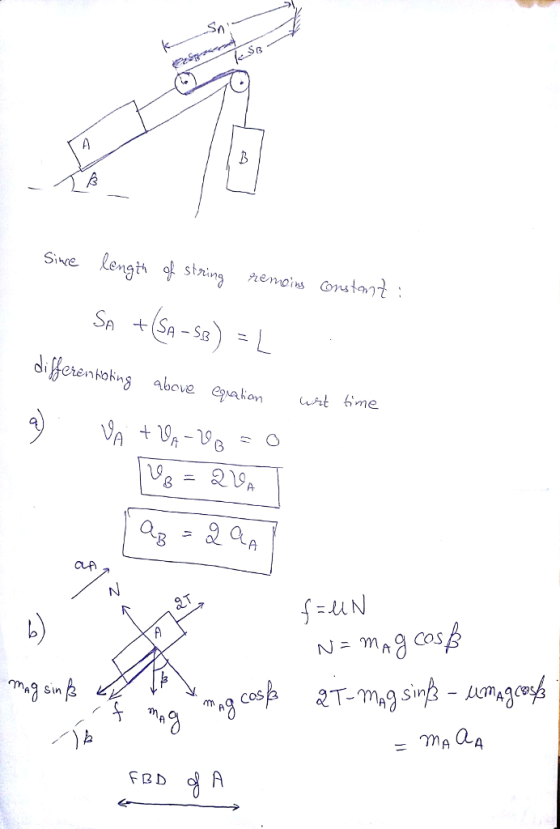
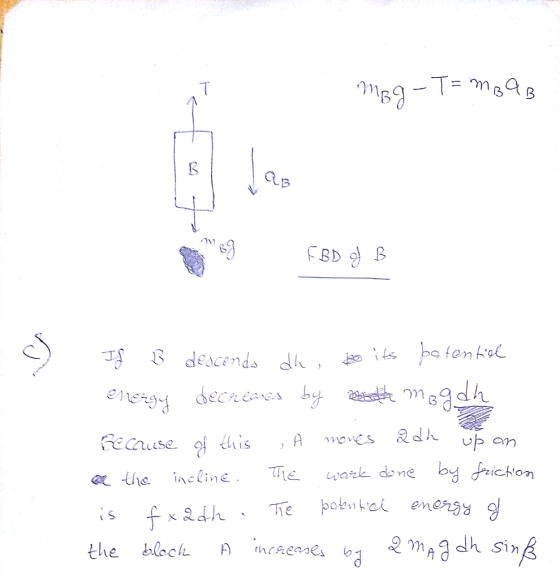
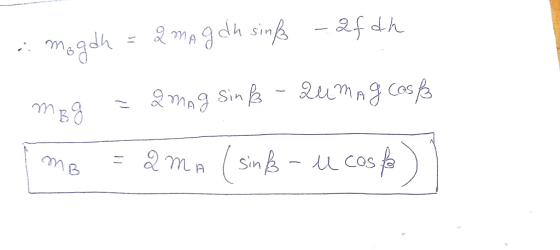
In the figure below, assume motion is in the vertical plane, incline makes an angle β...
A block with mass m1=200 g is on a plane that makes an angle theta =...
 A block with mass m1=200 g is on a plane that makes an
angle theta = 30 degrees above the horizontal. The coefficient of
kinetic friction between m1 and the plane is "mu k"= 0.10. Mass m1
is attached by a string to another mass, m2 = 250g, which hangs
freely as shown in the picture provided. Block m2 accelerates
downward once it is set in motion. Assume pulleys is frictionles
and the weight of the string is negligible.
a)...
A block with mass m1=200 g is on a plane that makes an
angle theta = 30 degrees above the horizontal. The coefficient of
kinetic friction between m1 and the plane is "mu k"= 0.10. Mass m1
is attached by a string to another mass, m2 = 250g, which hangs
freely as shown in the picture provided. Block m2 accelerates
downward once it is set in motion. Assume pulleys is frictionles
and the weight of the string is negligible.
a)...
A block with mass m1=200 g is on a plane that makes an angle theta =...
 A block with mass m1=200 g is on a plane that makes an
angle theta = 30 degrees above the horizontal. The coefficient of
kinetic friction between m1 and the plane is "mu k"= 0.10. Mass m1
is attached by a string to another mass, m2 = 250g, which hangs
freely as shown in the picture provided. Block m2 accelerates
downward once it is set in motion. Assume pulleys is frictionles
and the weight of the string is negligible.
a)...
A block with mass m1=200 g is on a plane that makes an
angle theta = 30 degrees above the horizontal. The coefficient of
kinetic friction between m1 and the plane is "mu k"= 0.10. Mass m1
is attached by a string to another mass, m2 = 250g, which hangs
freely as shown in the picture provided. Block m2 accelerates
downward once it is set in motion. Assume pulleys is frictionles
and the weight of the string is negligible.
a)...
A block with mass m1=200 g is on a plane that makes an angle theta =...
 A block with mass m1=200 g is on a plane that makes an
angle theta = 30 degrees above the horizontal. The coefficient of
kinetic friction between m1 and the plane is "mu k"= 0.10. Mass m1
is attached by a string to another mass, m2 = 250g, which hangs
freely as shown in the picture provided. Block m2 accelerates
downward once it is set in motion. Assume pulleys is frictionles
and the weight of the string is negligible.
a)...
A block with mass m1=200 g is on a plane that makes an
angle theta = 30 degrees above the horizontal. The coefficient of
kinetic friction between m1 and the plane is "mu k"= 0.10. Mass m1
is attached by a string to another mass, m2 = 250g, which hangs
freely as shown in the picture provided. Block m2 accelerates
downward once it is set in motion. Assume pulleys is frictionles
and the weight of the string is negligible.
a)...
A block with mass m1=200 g is on a plane that makes an angle theta =...
 A block with mass m1=200 g is on a plane that makes an
angle theta = 30 degrees above the horizontal. The coefficient of
kinetic friction between m1 and the plane is "mu k"= 0.10. Mass m1
is attached by a string to another mass, m2 = 250g, which hangs
freely as shown in the picture provided. Block m2 accelerates
downward once it is set in motion. Assume pulleys is frictionles
and the weight of the string is negligible.
a)...
A block with mass m1=200 g is on a plane that makes an
angle theta = 30 degrees above the horizontal. The coefficient of
kinetic friction between m1 and the plane is "mu k"= 0.10. Mass m1
is attached by a string to another mass, m2 = 250g, which hangs
freely as shown in the picture provided. Block m2 accelerates
downward once it is set in motion. Assume pulleys is frictionles
and the weight of the string is negligible.
a)...
a 50kg block is pushed 40m up an inclined plane that makes an angle of 35...
a 50kg block is pushed 40m up an inclined plane that makes an angle of 35 degrees with the horizontal by a constant force or 400N acting parallel to the plane. the coefficient of kinetic friction between the block and the inclined plane is .25. a) how much work is done by the 400N force? b) what is the increase of the potential energy of the block? c) what work is friction doing? d) what is the increase in the...
A box (mass 25.8 kg) sits on a rough incline that makes an angle α =...
A box (mass 25.8 kg) sits on a rough incline that makes an angle α = 28.1o with the horizontal. A massless string is tied to the box, runs parallel to the incline, passes over a massless, frictionless pulley, and is tied to mass M hanging on the other end. Assume μs = 0.455 is the coefficient of static friction between the box and the surface of the plane. Find the maximum value of M, in kg, for which this...
A 1 kg block slides down an inclined plane which makes an angle of 30degree to...
 A 1 kg block slides down an inclined plane which makes an angle of 30degree to the horizontal. Starting from rest, it is found to have a speed of 3 m/s after it has moved through a distance of 1.6 m. Find the amount of mechanical energy dissipated due to friction as the block slides down the plane, and hence find the coefficient of friction between the block and the plane, Explain your steps and reasoning. Remember to draw a...
A track consists of a frictionless incline plane, which is a height of 0.5 m, and...
A track consists of a frictionless incline plane, which is a height of 0.5 m, and a rough horizontal section with a coefficient of kinetic friction 0.02. Block A, whose mass is1.5 kg, is released from the top of the incline plane, slides down and collides instantaneously and inelastically with iden tical block B at the lowest point. The two blocks move to the right through the rough section of the track until they stop. Determine the initial potential energy...
A 4.40-kg block is set into motion up an inclined plane with an initial speed of...
 A 4.40-kg block is set into motion up an inclined plane with an initial speed of Vi = 8.20 m/s (see figure below). The block comes to rest after traveling d = 3.00 m along the plane, which is inclined at an angle of 0 = 30.0° to the horizontal. (a) For this motion, determine the change in the block's kinetic energy. (b) For this motion, determine the change in potential energy of the block-Earth system. (c) Determine the friction...
A 4.40-kg block is set into motion up an inclined plane with an initial speed of...
 A 4.40-kg block is set into motion up an inclined plane with an initial speed of v_i = 8.60 m/s (see figure below). The block comes to rest after traveling d = 3.00 m along the plane, which is inclined at an angle of theta = 30.0degree to the horizontal. (a) For this motion, determine the change in the block's kinetic energy. (b) For this motion, determine the change in potential energy of the block-Earth system. (c) Determine the friction...
 A block with mass m1=200 g is on a plane that makes an
angle theta = 30 degrees above the horizontal. The coefficient of
kinetic friction between m1 and the plane is "mu k"= 0.10. Mass m1
is attached by a string to another mass, m2 = 250g, which hangs
freely as shown in the picture provided. Block m2 accelerates
downward once it is set in motion. Assume pulleys is frictionles
and the weight of the string is negligible.
a)...
A block with mass m1=200 g is on a plane that makes an
angle theta = 30 degrees above the horizontal. The coefficient of
kinetic friction between m1 and the plane is "mu k"= 0.10. Mass m1
is attached by a string to another mass, m2 = 250g, which hangs
freely as shown in the picture provided. Block m2 accelerates
downward once it is set in motion. Assume pulleys is frictionles
and the weight of the string is negligible.
a)...
 A block with mass m1=200 g is on a plane that makes an
angle theta = 30 degrees above the horizontal. The coefficient of
kinetic friction between m1 and the plane is "mu k"= 0.10. Mass m1
is attached by a string to another mass, m2 = 250g, which hangs
freely as shown in the picture provided. Block m2 accelerates
downward once it is set in motion. Assume pulleys is frictionles
and the weight of the string is negligible.
a)...
A block with mass m1=200 g is on a plane that makes an
angle theta = 30 degrees above the horizontal. The coefficient of
kinetic friction between m1 and the plane is "mu k"= 0.10. Mass m1
is attached by a string to another mass, m2 = 250g, which hangs
freely as shown in the picture provided. Block m2 accelerates
downward once it is set in motion. Assume pulleys is frictionles
and the weight of the string is negligible.
a)...
 A block with mass m1=200 g is on a plane that makes an
angle theta = 30 degrees above the horizontal. The coefficient of
kinetic friction between m1 and the plane is "mu k"= 0.10. Mass m1
is attached by a string to another mass, m2 = 250g, which hangs
freely as shown in the picture provided. Block m2 accelerates
downward once it is set in motion. Assume pulleys is frictionles
and the weight of the string is negligible.
a)...
A block with mass m1=200 g is on a plane that makes an
angle theta = 30 degrees above the horizontal. The coefficient of
kinetic friction between m1 and the plane is "mu k"= 0.10. Mass m1
is attached by a string to another mass, m2 = 250g, which hangs
freely as shown in the picture provided. Block m2 accelerates
downward once it is set in motion. Assume pulleys is frictionles
and the weight of the string is negligible.
a)...
 A block with mass m1=200 g is on a plane that makes an
angle theta = 30 degrees above the horizontal. The coefficient of
kinetic friction between m1 and the plane is "mu k"= 0.10. Mass m1
is attached by a string to another mass, m2 = 250g, which hangs
freely as shown in the picture provided. Block m2 accelerates
downward once it is set in motion. Assume pulleys is frictionles
and the weight of the string is negligible.
a)...
A block with mass m1=200 g is on a plane that makes an
angle theta = 30 degrees above the horizontal. The coefficient of
kinetic friction between m1 and the plane is "mu k"= 0.10. Mass m1
is attached by a string to another mass, m2 = 250g, which hangs
freely as shown in the picture provided. Block m2 accelerates
downward once it is set in motion. Assume pulleys is frictionles
and the weight of the string is negligible.
a)...
 A 1 kg block slides down an inclined plane which makes an angle of 30degree to the horizontal. Starting from rest, it is found to have a speed of 3 m/s after it has moved through a distance of 1.6 m. Find the amount of mechanical energy dissipated due to friction as the block slides down the plane, and hence find the coefficient of friction between the block and the plane, Explain your steps and reasoning. Remember to draw a...
 A 4.40-kg block is set into motion up an inclined plane with an initial speed of Vi = 8.20 m/s (see figure below). The block comes to rest after traveling d = 3.00 m along the plane, which is inclined at an angle of 0 = 30.0° to the horizontal. (a) For this motion, determine the change in the block's kinetic energy. (b) For this motion, determine the change in potential energy of the block-Earth system. (c) Determine the friction...
 A 4.40-kg block is set into motion up an inclined plane with an initial speed of v_i = 8.60 m/s (see figure below). The block comes to rest after traveling d = 3.00 m along the plane, which is inclined at an angle of theta = 30.0degree to the horizontal. (a) For this motion, determine the change in the block's kinetic energy. (b) For this motion, determine the change in potential energy of the block-Earth system. (c) Determine the friction...
Most questions answered within 3 hours.
-
Where is the error in this code sequence?
String s1 = "Hello";
String s2 = "ello";...
asked 10 months ago -
Financial data for Joel de Paris, Inc., for last year
follow:
Joel de Paris, Inc.
Balance...
asked 10 months ago -
Consider this reaction:
Al2(SO4)3 (aq)+ BaCl3
(aq) Al2Cl6 (aq)- +
3BaSO4(s) . What is the...
asked 10 months ago -
Suppose that Savneet is considering increasing her
recent random sample from 20 car rentals to 40...
asked 10 months ago -
Trucks arrive at an unloading terminal at an average rate of 120
per hour.
Trucks arrive...
asked 10 months ago -
Why are methanol and ethanol completely soluble in water while
octanol is not very little soluble....
asked 10 months ago -
A facilities manager at a university reads in a research report
that the mean amount of...
asked 10 months ago -
When the CuSO4 is rehydrated by adding water to the anhydrous
compound, is this an endothermic...
asked 10 months ago -
A ray of sunlight is passing from diamond into crown glass; the
angle of incidence is...
asked 10 months ago -
A block of mass 0.249 kg is placed on top of a light, vertical
spring of...
asked 10 months ago -
how do the kidneys compensate in the presences of acidosis
a) trigger hyperventilate
b) reserve acid...
asked 10 months ago -
Question 501 pts
The rental rate of capital to the firm increases. Which of the
following...
asked 10 months ago