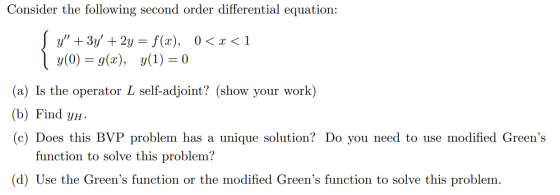
Consider the following second order differential equation:
Consider the following second-order differential equation:
(a) Is the operator L self-adjoint? (show your work)
(b) Find yH.
(c) Does this BVP problem have a unique solution? Do you need to use modified Green’s function to solve this problem?
(d) Use the Green’s function or the modified Green’s function to solve this problem.
Homework Answers
Request Answer!
We need at least 10 more requests to produce the answer.
0 / 10 have requested this problem solution
The more requests, the faster the answer.
Consider the following second order linear operator: 82 with Notice, that if instead of 3 we had 2 there, we would get a Legendre operator (whose eigenfunctions are Legendre polynomials). But no...
 Consider the following second order linear operator: 82 with Notice, that if instead of 3 we had 2 there, we would get a Legendre operator (whose eigenfunctions are Legendre polynomials). But nothing can be further from it than the operator above. The eigenvalue/eigenfunction problem, emerged in the analysis of vibrations of a particular quant urn liquid. An eigenvalue λ corresponds to an excitation mode of frequency Ω = V The eigenfunction ψ(r) would give a spatial profile of the deviation...
Consider the nonlinear second-order differential equation where k > 0 is a constant. Answer to the following questio...
 Consider the nonlinear second-order differential equation where k > 0 is a constant. Answer to the following questions (a) Derive a plane autonomous system from the given equation and find all the critical points (b) Classify(discriminate/categorize) all the critical points into one of the three cat- egories: {stable / saddle / unstable(not saddle)) (c) Show that there is no periodic solution in a simply connected region (Hint: Use the corollary to Theorem 11.5.1)
Consider the nonlinear second-order differential equation where...
Consider the nonlinear second-order differential equation where k > 0 is a constant. Answer to the following questions (a) Derive a plane autonomous system from the given equation and find all the critical points (b) Classify(discriminate/categorize) all the critical points into one of the three cat- egories: {stable / saddle / unstable(not saddle)) (c) Show that there is no periodic solution in a simply connected region (Hint: Use the corollary to Theorem 11.5.1)
Consider the nonlinear second-order differential equation where...
Problem 5. Consider the following second order linear differential equation f"(t)-f'(t) +f(t) kt ...
 Problem 5. Consider the following second order linear differential equation f"(t)-f'(t) +f(t) kt which models a forced oscillation in a damping material. For example, imagine moving your hand back and forth underwater. Write this equation as a set of coupled first order equations by doing the following: ·Define a new function g = f'(t). This gives you one of the two coupled equations. . Use the given ODE, g, and its derivatives to write the second first order equation. Both...
A linear equation. Differentiate the first-order equation 1 (2- a2) (3.123) a2 linear, second-order differential equati...
 A linear equation. Differentiate the first-order equation 1 (2- a2) (3.123) a2 linear, second-order differential equation with respect to c to derive Solve for the general solution to this ODE and show that it contains three arbitrary constants a Use equation (3.123) to eliminate one constant and rederive the catenary of equation y(x) a cosh
A linear equation. Differentiate the first-order equation 1 (2- a2) (3.123) a2 linear, second-order differential equation with respect to c to derive Solve for the...
A linear equation. Differentiate the first-order equation 1 (2- a2) (3.123) a2 linear, second-order differential equation with respect to c to derive Solve for the general solution to this ODE and show that it contains three arbitrary constants a Use equation (3.123) to eliminate one constant and rederive the catenary of equation y(x) a cosh
A linear equation. Differentiate the first-order equation 1 (2- a2) (3.123) a2 linear, second-order differential equation with respect to c to derive Solve for the...
Find the general solution of the given second-order differential equation. 27"-3y + 4y = 0 Upload...
 Find the general solution of the given second-order differential equation. 27"-3y + 4y = 0 Upload a completed solution of your work as a PDF, JPEG or DOCX file. Upload Choose a File Question 5 Find the general solution for the given second order differential equation. - 64+25 y = 0 Please show all work and upload a file (PDF, JPG, DOCX) of the work and circle your final answer. Upload Choose a File
Consider the following initial value problem to be solved by undetermined coefficients. Y" – 16y =...
 Consider the following initial value problem to be solved by undetermined coefficients. Y" – 16y = 8, 7(0) = 1, y'(O) = 0 Write the given differential equation in the form L(y) = g(x) where L is a linear operator with constant coefficients. If possible, factor L. (Use D for the differential operator.) y = 8 Find a linear differential operator that annihilates the function g(x) = 8. (Use D for the differential operator.) Solve the given initial-value problem. Y(X)...
3. Consider the following second order differential equation: If we let u y andv-y then express the second order differ...
 3. Consider the following second order differential equation: If we let u y andv-y then express the second order differential equation as an AUTONOMOUS first order system.
3. Consider the following second order differential equation: If we let u y andv-y then express the second order differential equation as an AUTONOMOUS first order system.
3. Consider the following second order differential equation: If we let u y andv-y then express the second order differential equation as an AUTONOMOUS first order system.
Consider the differential equation 4x2y′′ − 8x2y′ + (4x2 + 1)y = 0 (a) Verify that x0 = 0 is a regular singular point of...
Consider the differential equation 4x2y′′ − 8x2y′ + (4x2 + 1)y = 0 (a) Verify that x0 = 0 is a regular singular point of the differential equation and then find one solution as a Frobenius series centered at x0 = 0. The indicial equation has a single root with multiplicity two. Therefore the differential equation has only one Frobenius series solution. Write your solution in terms of familiar elementary functions. (b) Use Reduction of Order to find a second...
2. a) (7 pnts) Solve the second order homogeneous linear differential equation y" - y =...
 2. a) (7 pnts) Solve the second order homogeneous linear differential equation y" - y = 0. b) (6 pnts) Without any solving, explain how would you change the above differential equation so that the general solution to the homogeneous equation will become c cos x + C sinx. c) (7 pnts) Solve the second order linear differential equation y" - y = 3e2x by using Variation of Parameters. 5. a) (7 pnts) Determine the general solution to the system...
Find the general solution of the given second-order differential equation. y'' + 10y' + 25y =...
Find the general solution of the given second-order differential equation. y'' + 10y' + 25y = 0 Solve the given differential equation by undetermined coefficients. y'' + 4y = 2 sin 2x Solve the given differential equation by undetermined coefficients. y'' − y' = −10
 Consider the following second order linear operator: 82 with Notice, that if instead of 3 we had 2 there, we would get a Legendre operator (whose eigenfunctions are Legendre polynomials). But nothing can be further from it than the operator above. The eigenvalue/eigenfunction problem, emerged in the analysis of vibrations of a particular quant urn liquid. An eigenvalue λ corresponds to an excitation mode of frequency Ω = V The eigenfunction ψ(r) would give a spatial profile of the deviation...
 Consider the nonlinear second-order differential equation where k > 0 is a constant. Answer to the following questions (a) Derive a plane autonomous system from the given equation and find all the critical points (b) Classify(discriminate/categorize) all the critical points into one of the three cat- egories: {stable / saddle / unstable(not saddle)) (c) Show that there is no periodic solution in a simply connected region (Hint: Use the corollary to Theorem 11.5.1)
Consider the nonlinear second-order differential equation where...
Consider the nonlinear second-order differential equation where k > 0 is a constant. Answer to the following questions (a) Derive a plane autonomous system from the given equation and find all the critical points (b) Classify(discriminate/categorize) all the critical points into one of the three cat- egories: {stable / saddle / unstable(not saddle)) (c) Show that there is no periodic solution in a simply connected region (Hint: Use the corollary to Theorem 11.5.1)
Consider the nonlinear second-order differential equation where...
 Problem 5. Consider the following second order linear differential equation f"(t)-f'(t) +f(t) kt which models a forced oscillation in a damping material. For example, imagine moving your hand back and forth underwater. Write this equation as a set of coupled first order equations by doing the following: ·Define a new function g = f'(t). This gives you one of the two coupled equations. . Use the given ODE, g, and its derivatives to write the second first order equation. Both...
 A linear equation. Differentiate the first-order equation 1 (2- a2) (3.123) a2 linear, second-order differential equation with respect to c to derive Solve for the general solution to this ODE and show that it contains three arbitrary constants a Use equation (3.123) to eliminate one constant and rederive the catenary of equation y(x) a cosh
A linear equation. Differentiate the first-order equation 1 (2- a2) (3.123) a2 linear, second-order differential equation with respect to c to derive Solve for the...
A linear equation. Differentiate the first-order equation 1 (2- a2) (3.123) a2 linear, second-order differential equation with respect to c to derive Solve for the general solution to this ODE and show that it contains three arbitrary constants a Use equation (3.123) to eliminate one constant and rederive the catenary of equation y(x) a cosh
A linear equation. Differentiate the first-order equation 1 (2- a2) (3.123) a2 linear, second-order differential equation with respect to c to derive Solve for the...
 Find the general solution of the given second-order differential equation. 27"-3y + 4y = 0 Upload a completed solution of your work as a PDF, JPEG or DOCX file. Upload Choose a File Question 5 Find the general solution for the given second order differential equation. - 64+25 y = 0 Please show all work and upload a file (PDF, JPG, DOCX) of the work and circle your final answer. Upload Choose a File
 Consider the following initial value problem to be solved by undetermined coefficients. Y" – 16y = 8, 7(0) = 1, y'(O) = 0 Write the given differential equation in the form L(y) = g(x) where L is a linear operator with constant coefficients. If possible, factor L. (Use D for the differential operator.) y = 8 Find a linear differential operator that annihilates the function g(x) = 8. (Use D for the differential operator.) Solve the given initial-value problem. Y(X)...
 3. Consider the following second order differential equation: If we let u y andv-y then express the second order differential equation as an AUTONOMOUS first order system.
3. Consider the following second order differential equation: If we let u y andv-y then express the second order differential equation as an AUTONOMOUS first order system.
3. Consider the following second order differential equation: If we let u y andv-y then express the second order differential equation as an AUTONOMOUS first order system.
 2. a) (7 pnts) Solve the second order homogeneous linear differential equation y" - y = 0. b) (6 pnts) Without any solving, explain how would you change the above differential equation so that the general solution to the homogeneous equation will become c cos x + C sinx. c) (7 pnts) Solve the second order linear differential equation y" - y = 3e2x by using Variation of Parameters. 5. a) (7 pnts) Determine the general solution to the system...
Most questions answered within 3 hours.
-
Where is the error in this code sequence?
String s1 = "Hello";
String s2 = "ello";...
asked 10 months ago -
Financial data for Joel de Paris, Inc., for last year
follow:
Joel de Paris, Inc.
Balance...
asked 10 months ago -
Consider this reaction:
Al2(SO4)3 (aq)+ BaCl3
(aq) Al2Cl6 (aq)- +
3BaSO4(s) . What is the...
asked 10 months ago -
Suppose that Savneet is considering increasing her
recent random sample from 20 car rentals to 40...
asked 10 months ago -
Trucks arrive at an unloading terminal at an average rate of 120
per hour.
Trucks arrive...
asked 10 months ago -
Why are methanol and ethanol completely soluble in water while
octanol is not very little soluble....
asked 10 months ago -
A facilities manager at a university reads in a research report
that the mean amount of...
asked 10 months ago -
When the CuSO4 is rehydrated by adding water to the anhydrous
compound, is this an endothermic...
asked 10 months ago -
A ray of sunlight is passing from diamond into crown glass; the
angle of incidence is...
asked 10 months ago -
A block of mass 0.249 kg is placed on top of a light, vertical
spring of...
asked 10 months ago -
how do the kidneys compensate in the presences of acidosis
a) trigger hyperventilate
b) reserve acid...
asked 10 months ago -
Question 501 pts
The rental rate of capital to the firm increases. Which of the
following...
asked 10 months ago