For a first order reactiomA-----> B, rate constant k for the reaction follows the equation: ln...
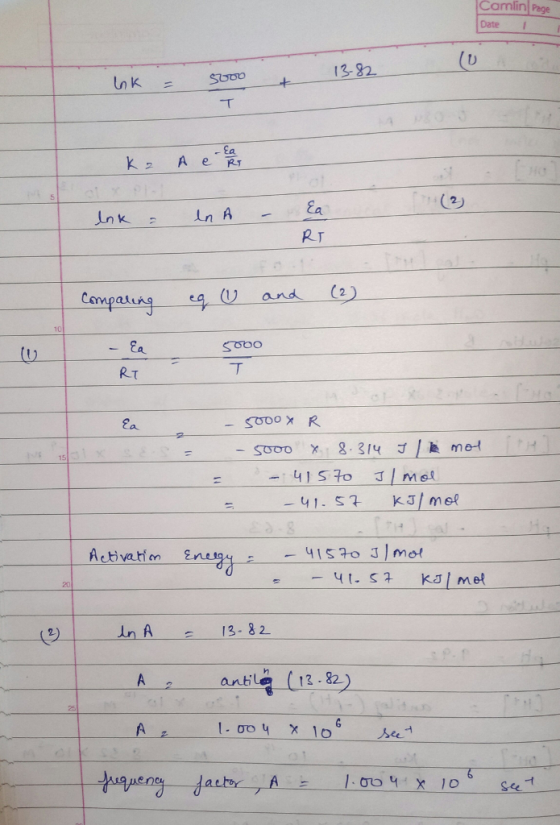
For a first order reactiomA-----> B, rate constant k for the reaction follows the equation:
ln k= (5000/T) + 13.82
find the frequency factor A and the activation energy Ea
Homework Answers
Add Answer to:
For a first order reactiomA-----> B, rate constant k for the
reaction follows the equation:
ln...
The Arrhenius equation shows how the rate constant (k) for a reaction is related to various...
The Arrhenius equation shows how the rate constant (k) for a reaction is related to various factors, as follows. k = Ae−(Ea/RT) In this equation, k is the rate constant, A is the frequency factor, Ea is the activation energy, R is the gas constant, and T is the temperature in kelvin. (The frequency factor is associated with the frequency and orientation of molecular collisions.) Calculate the activation energy for a reaction that has a rate constant of 0.265 s−1...
Match the following A) rate constant B) frequency factor C) activation energy D) reaction order E)...
 Match the following A) rate constant B) frequency factor C) activation energy D) reaction order E) half-life 1) k 2) n, in Rate = k[A]" 3) ti/2 4) Ea 5) A
The Arrhenius equation shows the relationship between the rate constant k and the temperature T in...
The Arrhenius equation shows the relationship between the rate constant k and the temperature T in kelvins and is typically written as k=Ae−Ea/RT where R is the gas constant (8.314 J/mol⋅K), A is a constant called the frequency factor, and Ea is the activation energy for the reaction. However, a more practical form of this equation is lnk2k1=EaR(1T1−1T2) which is mathmatically equivalent to lnk1k2=EaR(1T2−1T1) where k1 and k2 are the rate constants for a single reaction at two different absolute...
The Arrhenius equation shows the relationship between the rate constant k and the temperature T in...
The Arrhenius equation shows the relationship between the rate constant k and the temperature T in kelvins and is typically written as k=Ae−Ea/RT where R is the gas constant (8.314 J/mol⋅K), A is a constant called the frequency factor, and Ea is the activation energy for the reaction. However, a more practical form of this equation is lnk2k1=EaR(1T1−1T2) which is mathmatically equivalent to lnk1k2=EaR(1T2−1T1) where k1 and k2 are the rate constants for a single reaction at two different absolute...
The Arrhenius equation shows the relationship between the rate constant k and the temperature T in...
The Arrhenius equation shows the relationship between the rate constant k and the temperature T in kelvins and is typically written as k=Ae−Ea/RT where R is the gas constant (8.314 J/mol⋅K), A is a constant called the frequency factor, and Ea is the activation energy for the reaction. However, a more practical form of this equation is lnk2k1=EaR(1T1−1T2) which is mathmatically equivalent to lnk1k2=EaR(1T2−1T1) where k1 and k2 are the rate constants for a single reaction at two different absolute...
The Arrhenius equation shows the relationship between the rate constant k and the temperature T in...
The Arrhenius equation shows the relationship between the rate constant k and the temperature T in kelvins and is typically written as k=A e − E a /RT where R is the gas constant ( 8.314 J/mol⋅K ), A is a constant called the frequency factor, and E a is the activation energy for the reaction. However, a more practical form of this equation is ln k 2 k 1 = E a R ( 1 T 1 − 1...
There are several factors that affect the rate of a reaction. These factors include temperature, activation...
There are several factors that affect the rate of a reaction. These factors include temperature, activation energy, steric factors (orientation), and also collision frequency, which changes with concentration and phase. All the factors that affect reaction rate can be summarized in an equation called the Arrhenius equation: k=Ae−Ea/RT, where k is the rate constant, A is the frequency factor, Ea is the activation energy, R=8.314 J mol−1 K−1 is the gas constant, and T is the absolute temperature. A certain...
There are several factors that affect the rate of a reaction. These factors include temperature, activation...
There are several factors that affect the rate of a reaction. These factors include temperature, activation energy, steric factors (orientation), and also collision frequency, which changes with concentration and phase. All the factors that affect reaction rate can be summarized in an equation called the Arrhenius equation: k=Ae−Ea/RT, where k is the rate constant, A is the frequency factor, Ea is the activation energy, R=8.314 J mol−1 K−1 is the gas constant, and T is the absolute temperature. A certain...
The Arrhenius equation for the dependence of the rate constant, k, on temperature is given by...
 The Arrhenius equation for the dependence of the rate constant, k, on temperature is given by In k = + In A, where A is the frequency factor, R is the ideal gas constant, and EA is the activation energy. The rate of conversion of cyclo-propane to propene in gas phase was measured over the temperature range 750-900 K, and the rate constants that were found are reported below. Hint: think about what the following equation means In = (1,...
For the first-order reaction X ⟶ products, which of the following graphs is best for determining...
For the first-order reaction X ⟶ products, which of the following graphs is best for determining the activation energy, Ea ? Note: The best choice is the one that yields a straight line graph with the slope directly proportional to Ea . In the options below, T is the kelvin temperature and t is time. (a) k versus 1/T (b) 1 / [X] versus t (c) ln k versus T (d) ln [X] versus t (e) [X] versus t (f)...
 Match the following A) rate constant B) frequency factor C) activation energy D) reaction order E) half-life 1) k 2) n, in Rate = k[A]" 3) ti/2 4) Ea 5) A
 The Arrhenius equation for the dependence of the rate constant, k, on temperature is given by In k = + In A, where A is the frequency factor, R is the ideal gas constant, and EA is the activation energy. The rate of conversion of cyclo-propane to propene in gas phase was measured over the temperature range 750-900 K, and the rate constants that were found are reported below. Hint: think about what the following equation means In = (1,...
Most questions answered within 3 hours.
-
Where is the error in this code sequence?
String s1 = "Hello";
String s2 = "ello";...
asked 10 months ago -
Financial data for Joel de Paris, Inc., for last year
follow:
Joel de Paris, Inc.
Balance...
asked 10 months ago -
Consider this reaction:
Al2(SO4)3 (aq)+ BaCl3
(aq) Al2Cl6 (aq)- +
3BaSO4(s) . What is the...
asked 10 months ago -
Suppose that Savneet is considering increasing her
recent random sample from 20 car rentals to 40...
asked 10 months ago -
Trucks arrive at an unloading terminal at an average rate of 120
per hour.
Trucks arrive...
asked 10 months ago -
Why are methanol and ethanol completely soluble in water while
octanol is not very little soluble....
asked 10 months ago -
A facilities manager at a university reads in a research report
that the mean amount of...
asked 10 months ago -
When the CuSO4 is rehydrated by adding water to the anhydrous
compound, is this an endothermic...
asked 10 months ago -
A ray of sunlight is passing from diamond into crown glass; the
angle of incidence is...
asked 10 months ago -
A block of mass 0.249 kg is placed on top of a light, vertical
spring of...
asked 10 months ago -
how do the kidneys compensate in the presences of acidosis
a) trigger hyperventilate
b) reserve acid...
asked 10 months ago -
Question 501 pts
The rental rate of capital to the firm increases. Which of the
following...
asked 10 months ago