
Homework Answers
The stoicheometric reaction of lead Nitrate with Potassium iodide is as follows.

As per the above reaction, one mole of lead nitrate reacts with 2 moles of potassium iodide to precipitate completely and gives one mole of lead iodide..
Calculating number of moles present in given molar solution is as follows
M=(N/V) * 1000
Where M= Molarity, N = number of moles, V= Volume of solution in mL.
Rearranging the above equation as N=(M * V)/1000, we can calculate number of moles.
A) 1.0mL of 0.10M lead nitrate reacts with 5mL of 0.10M of KI.
Using the above equations,
1) number of moles present in 1.0mL of 0.10M of lead nitrate is 0.1 millimoles.
2) number of moles present in 5mL of 0.10M KI is 0.5 millimoles.
3) 0.1millimoles of lead nitrate reacts with 0.2millimoles of KI to give 0.1millimoles of PbI.Remaining 0.3 millimoles of KI remains unconsumed.
B) 2.0 mL of 0.10 M lead nitrate reacts with 4 mL of 0.10 M of KI.
Using the above equations,
1) number of moles present in 2.0 mL of 0.10M of lead nitrate is 0.2 millimoles.
2) number of moles present in 4mL of 0.10M KI is 0.4 millimoles.
3) 0.2 millimoles of lead nitrate reacts with 0.4 millimoles of KI to give 0.2 millimoles of PbI. KI is consumed.
C) 3.0 mL of 0.10 M lead nitrate reacts with 3 mL of 0.10 M of KI.
Using the above equations,
1) number of moles present in 3.0 mL of 0.10M of lead nitrate is 0.3 millimoles.
2) number of moles present in 3 mL of 0.10M KI is 0.3 millimoles.
3) As per the stoicheometry of reaction 0.15 millimoles of lead nitrate reacts with 0.3 millimoles of KI to give 0.15 millimoles of PbI. 0.15 millimoles of leadnitrate remains unreacted.
D) 4.0 mL of 0.10 M lead nitrate reacts with 2 mL of 0.10 M of KI.
Using the above equations,
1) number of moles present in 4.0 mL of 0.10M of lead nitrate is 0.4 millimoles.
2) number of moles present in 2 mL of 0.10M KI is 0.2 millimoles.
3) 0.1 millimoles of lead nitrate reacts with 0.2 millimoles of KI to give 0.1 millimles of PbI. 0.3 millimoles of lead nitrate remains unreacted.
E) 5.0 mL of 0.10 M lead nitrate reacts with 1 mL of 0.10 M of KI.
Using the above equations,
1) number of moles present in 5.0 mL of 0.10M of lead nitrate is 0.5 millimoles.
2) number of moles present in 1 mL of 0.10M KI is 0.1 millimoles.
3) 0.05 millimoles of lead nitrate reacts with 0.1 millimoles of KI to give 0.05 millimoles of PbI. 0.45 millimoles of lead nitrate remains unreacted.
Add Answer to:
PLEASE DO ALL
3. Calculate the number of moles of precipitate that would be produced when...
Preparation of Solutions: Pre-laboratory Assignment Instructor Name Section Date 2. Prepare a written plan for making...
 Preparation of Solutions: Pre-laboratory Assignment Instructor Name Section Date 2. Prepare a written plan for making up 100.0 ml of a solution that is 0.100M in Ca2 ion using 2.00 M CaCl2H2O solution. 1. Prepare a written plan for making up 100.0 ml of 0.100 M KI solution. (Note the list of reagents and equipment provided in the background information). Include in your plan the exact amount of KI that you will need and the actual steps that you will...
How do I calculate the Initial Fe(NO3)3 for each tria. Please help and show all work...
How do I calculate the Initial Fe(NO3)3 for each tria. Please help and show all work Please!!!! 1 2 3 4 5 mL Fe(NO3)3 1.0 2.0 3.0 4.0 5.0 0.0003 M mL KSCN 1.0 M 5 5 5 5 5 mL HNO3 0.1 M 4 3 2 1 0 Total mL 10 10 10 10 10 Initial [Fe(NO3)3] 3.0x10^-5 Absorbance .284 1.085 1.325 1.820 2.121 Transmittance 52.01 8.22 4.73 1.51 0.76
Calculate the Qen or Knt as indicated, and determine whether a precipitate will form when each...
 Calculate the Qen or Knt as indicated, and determine whether a precipitate will form when each of the following mixtures is prepared. (You may assume temperature is held constant, volumes are additive, and that the initial solutions, prior to mixing, are unsaturated.) (a) 25.27 mL 1.54 x 10⁴ M CaCI, is mixed with 25.16 mL 3.02x 10⁻³ M NaF. (K 3.5x 10⁻¹¹) for CaF, Qsp A precipitate will form. A precipitate will not form. (b) 14.92 mL 3.56x 10⁻³ M...
Calculate the mass of precipitate formed when 340. mL of 2.53 M solution of K3PO4 is...
 Calculate the mass of precipitate formed when 340. mL of 2.53 M solution of K3PO4 is mixed with 360. mL of 2.75 M solution of Pb(NO3)2. 2 K3PO4 (aq) + 3 Pb(NO3)2(aq) - Pb3(PO4)2 (s) + 6NaNO3 (aq)
1. Calculate the molarity of the following solutions: a. 318 g Mg Br, in 859 ml...
 1. Calculate the molarity of the following solutions: a. 318 g Mg Br, in 859 ml solution b. 8.28 g Ca(C,H,O,), in 414 ml solution c. 31,1 g Al,(80.), in 766 ml solution d. 59.8 g CaCl, in 100 ml solution e. 313.5 g LICIO, in 250 ml solution | 849 Calculate the moles of solute needed to prepare each of the following: 2. LOL of a 3.0 M NaCl solution b. 0.40 L of a 1.0 M KBr solution...
Please indicate for every reactions where equal amounts of chemicals (all in aqueous solutions) are mixed...
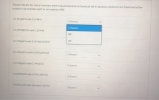 Please indicate for every reactions where equal amounts of chemicals (all in aqueous solutions) are mixed and either produce a precipitate (ppt) or no reaction (NR) 0.1 M AgNO3 with 0.10 M KI [Choose [Choose) 0.1 M Pb(NO3)2 with 0.10 MKI NR 0.1 MMgSO4 with 0.1 M NaC2H302 ppt 0.1 M Na3PO4 with 0.1 M Ca(NO3)2 [Choose 0.1 MMgSO4 with 0.1 M BaCl2 [Choose 0.10 M NH4Cl with 0.1 M Ca(NO3)2 Choose 0.10 M CoCl2 with saturated CaOH)2 Choose
16/ For PbCl2 (K.p = 2.4 x 10), will a precipitate of PbCl2 form when 0.10...
 16/ For PbCl2 (K.p = 2.4 x 10), will a precipitate of PbCl2 form when 0.10 L of 3.0 x 10²M Pb(NO3)2 is added to 400 mL of 9.0 x 10⁻² M NaCl? Pb (NO3)₂ + Nach a Yes, because > Ksp. b. No, because Q = Kp. 100 c. No, because Q<Kip. d. Yes, because Q<K poll, + NaNO3 2. u* 10 = Pb (1 ke Q 17. Over what range of pH is a HOCI - NaOCI buffer...
Calculate the Qsp or Ksp, as indicated, and determine whether a precipitate will form when each...
Calculate the Qsp or Ksp, as indicated, and determine whether a precipitate will form when each of the following mixtures is prepared. (a) 25.12 mL 1.57 ✕ 10−4 M CaCl2 is mixed with 25.13 mL 3.26 ✕ 10−3 M NaF. (Ksp for CaF2 = 3.5 ✕ 10−11) (b) 14.77 mL 3.68 ✕ 10−3M Pb(NO3)2 is mixed with 35.01 mL 1.63 ✕ 10−4M Na2SO4. (Ksp for PbSO4 = 2.5 ✕ 10−8) (c) 50.33 mL 2.62 ✕ 10−2M Pb(NO3)2 is mixed with...
From the data in the table, calculate the final [FeSCN2+]: Beaker 0.200 M Fe(NO3)3 (mL) 0.0020...
From the data in the table, calculate the final [FeSCN2+]: Beaker 0.200 M Fe(NO3)3 (mL) 0.0020 M SCN– (mL) H2O (mL) [FeSCN2+] 1 5.0 4.0 41.0 2 5.0 3.0 42.0 3 5.0 2.0 43.0 4 5.0 1.0 44.0
Question 3 1.2 pts When 0.385 M RbOH solution is mixed with an aqueous solution of...
 Question 3 1.2 pts When 0.385 M RbOH solution is mixed with an aqueous solution of Pb(NO3)2, 15.656 g of precipitate is formed (precipitate should be identified first - see question #1). The number of moles of precipitate formed is The number of moles of RbOH that has reacted is and the volume of the 0.385 M ROOH solution mixed is (MM (g/mole) RbOH = 102.478; Pb(OH)2 = 241.216; Pb(NO3)2=331.21; RbNO3=147.47) (Express your answer with 4 decimal figures or 4...
 Preparation of Solutions: Pre-laboratory Assignment Instructor Name Section Date 2. Prepare a written plan for making up 100.0 ml of a solution that is 0.100M in Ca2 ion using 2.00 M CaCl2H2O solution. 1. Prepare a written plan for making up 100.0 ml of 0.100 M KI solution. (Note the list of reagents and equipment provided in the background information). Include in your plan the exact amount of KI that you will need and the actual steps that you will...
 Calculate the Qen or Knt as indicated, and determine whether a precipitate will form when each of the following mixtures is prepared. (You may assume temperature is held constant, volumes are additive, and that the initial solutions, prior to mixing, are unsaturated.) (a) 25.27 mL 1.54 x 10⁴ M CaCI, is mixed with 25.16 mL 3.02x 10⁻³ M NaF. (K 3.5x 10⁻¹¹) for CaF, Qsp A precipitate will form. A precipitate will not form. (b) 14.92 mL 3.56x 10⁻³ M...
 Calculate the mass of precipitate formed when 340. mL of 2.53 M solution of K3PO4 is mixed with 360. mL of 2.75 M solution of Pb(NO3)2. 2 K3PO4 (aq) + 3 Pb(NO3)2(aq) - Pb3(PO4)2 (s) + 6NaNO3 (aq)
 1. Calculate the molarity of the following solutions: a. 318 g Mg Br, in 859 ml solution b. 8.28 g Ca(C,H,O,), in 414 ml solution c. 31,1 g Al,(80.), in 766 ml solution d. 59.8 g CaCl, in 100 ml solution e. 313.5 g LICIO, in 250 ml solution | 849 Calculate the moles of solute needed to prepare each of the following: 2. LOL of a 3.0 M NaCl solution b. 0.40 L of a 1.0 M KBr solution...
 Please indicate for every reactions where equal amounts of chemicals (all in aqueous solutions) are mixed and either produce a precipitate (ppt) or no reaction (NR) 0.1 M AgNO3 with 0.10 M KI [Choose [Choose) 0.1 M Pb(NO3)2 with 0.10 MKI NR 0.1 MMgSO4 with 0.1 M NaC2H302 ppt 0.1 M Na3PO4 with 0.1 M Ca(NO3)2 [Choose 0.1 MMgSO4 with 0.1 M BaCl2 [Choose 0.10 M NH4Cl with 0.1 M Ca(NO3)2 Choose 0.10 M CoCl2 with saturated CaOH)2 Choose
 16/ For PbCl2 (K.p = 2.4 x 10), will a precipitate of PbCl2 form when 0.10 L of 3.0 x 10²M Pb(NO3)2 is added to 400 mL of 9.0 x 10⁻² M NaCl? Pb (NO3)₂ + Nach a Yes, because > Ksp. b. No, because Q = Kp. 100 c. No, because Q<Kip. d. Yes, because Q<K poll, + NaNO3 2. u* 10 = Pb (1 ke Q 17. Over what range of pH is a HOCI - NaOCI buffer...
 Question 3 1.2 pts When 0.385 M RbOH solution is mixed with an aqueous solution of Pb(NO3)2, 15.656 g of precipitate is formed (precipitate should be identified first - see question #1). The number of moles of precipitate formed is The number of moles of RbOH that has reacted is and the volume of the 0.385 M ROOH solution mixed is (MM (g/mole) RbOH = 102.478; Pb(OH)2 = 241.216; Pb(NO3)2=331.21; RbNO3=147.47) (Express your answer with 4 decimal figures or 4...
Most questions answered within 3 hours.
-
Where is the error in this code sequence?
String s1 = "Hello";
String s2 = "ello";...
asked 11 months ago -
Financial data for Joel de Paris, Inc., for last year
follow:
Joel de Paris, Inc.
Balance...
asked 11 months ago -
Consider this reaction:
Al2(SO4)3 (aq)+ BaCl3
(aq) Al2Cl6 (aq)- +
3BaSO4(s) . What is the...
asked 11 months ago -
Suppose that Savneet is considering increasing her
recent random sample from 20 car rentals to 40...
asked 11 months ago -
Trucks arrive at an unloading terminal at an average rate of 120
per hour.
Trucks arrive...
asked 11 months ago -
Why are methanol and ethanol completely soluble in water while
octanol is not very little soluble....
asked 11 months ago -
A facilities manager at a university reads in a research report
that the mean amount of...
asked 11 months ago -
When the CuSO4 is rehydrated by adding water to the anhydrous
compound, is this an endothermic...
asked 11 months ago -
A ray of sunlight is passing from diamond into crown glass; the
angle of incidence is...
asked 11 months ago -
A block of mass 0.249 kg is placed on top of a light, vertical
spring of...
asked 11 months ago -
how do the kidneys compensate in the presences of acidosis
a) trigger hyperventilate
b) reserve acid...
asked 11 months ago -
Question 501 pts
The rental rate of capital to the firm increases. Which of the
following...
asked 11 months ago