surf the internet for information about the Department of Homeland security. Examine the available information, and...
Homework Answers
The United States Department of Homeland Security (DHS) is a cabinet department of the U.S. federal government with responsibilities in public security, roughly comparable to the interior or home ministries of other countries. Its stated missions involve anti-terrorism, border security, immigration and customs, cyber security, and disaster prevention and management. It was created in November 2002 in response to 9/11 and began operations the following year. It is the youngest U.S. cabinet department.
| Agency overview | |
|---|---|
| Formed | November 25, 2002 |
| Jurisdiction | United States |
| Headquarters | St. Elizabeths West Campus, Washington, D.C., U.S. 38.854715°N 76.999952°W |
| Employees | 240,000 (2018) |
| Annual budget | $51.672 billion (FY 2020) |
| Agency executives |
|
| Child agencies |
|
| Website |
www.dhs.gov |
In fiscal year 2018, it was allocated a net discretionary budget of $47.716 billion. With more than 240,000 employees, DHS is the third largest Cabinet department, after the Departments of Defense and Veterans Affairs. Homeland security policy is coordinated at the White House by the Homeland Security Council. Other agencies with significant homeland security responsibilities include the Departments of Health and Human Services, Justice, and Energy.
Secretary Kirstjen Nielsen resigned on April 7, 2019, effective April 10. By law (6 U.S.C. §113(g)), Undersecretary for Management Claire Grady was to become the acting Secretary of Homeland Security. On April 7, President Donald J. Trump designated the current U.S. Customs and Border Protection Commissioner Kevin McAleenan as acting Secretary; that had lingering questions of legality resolved after Trump forced Grady to resign on April 9. McAleenan then named David Pekoske, who currently also serves as the TSA Administrator, as the acting Deputy Secretary. On November 13, 2019, Chad Wolf became the Acting Secretary and named Ken Cuccinelli as the Acting Deputy Secretary
Role of IT in the dept. :-
The following sections outline SSA, SCC, GCC, and shared
responsibilities.
6.3.1 Sector-Specific Agency
NCSD has responsibility for working with public and private IT
Sector security partners to promote not only the physical,
human, and cyber elements of the infrastructure but also the cyber
security of all infrastructure sectors as consumers of IT.
NCSD responsibilities are as follows:
• Coordinate development and drive implementation of the IT
SSP:
– Coordinate efforts to compose and maintain the IT SSP;
– Support implementation of the collaboratively developed risk
assessment approach for the IT Sector;
– Coordinate efforts to determine protective measures for the IT
Sector;
– Identify R&D requirements and conduct R&D in concert with
other government entities, the private sector, and other
security partners;
– Ensure public and private sector security partners are engaged,
as early as possible, in the development and revision of the
SSP and in planning other CI/KR protection initiatives;
– Encourage and promote participation in the IT GCC, IT SCC, and
IT-ISAC; and
– Support the IT-ISAC as the operational information-sharing
mechanism for the private sector.
• Engage with IT Sector security partners:
– Identify relevant public and private sector security partners
that have a role in securing the IT Sector;
– Develop a plan for regular engagement between NCSD and the public
and private IT Sector security partners;–
— Promote security awareness within the IT Sector;
– Communicate timely, analytical, and useable information,
including threat and warning information, specific to the
infra-
structure and public and private IT Sector security partners;
– Identify incentives for the private sector to undertake voluntary
efforts to improve security (physical, cyber, and human)
and implement the SSP;
– Encourage the use of risk transfer mechanisms, such as
contractual arrangements that expand the use of
state-of-the-art
security practices through market mechanisms; and
– Develop a business case for continuing investment in securing the
IT Sector.
• Engage with other government entities:
– Work with the intelligence and law enforcement communities to
enhance the collection, assessment, and distribution of
cyber-related intelligence to IT Sector security partners;
– Solicit input from government entities on IT Sector CI/KR
protection-related efforts;
– Work with US-CERT to provide cyber alerts, response assistance,
and information on remediation measures to public and
private sector security partners; and
– Interact with other SSAs and sectors to identify unique
dependencies, interdependencies, relationships, and
partnerships
across sectors.
6.3.2 IT Sector Coordinating Council36
The IT SCC’s responsibilities are as follows:
• Develop and drive implementation of the IT SSP:
– Participate in the development, review, and enhancement of the IT
SSP;
– Support the identification and risk assessment of critical IT
Sector functions;
– Collaborate with NCSD and other public IT Sector security
partners to identify current and future protective program
needs;
– Encourage and share advances in security resulting from R&D;
and
– Use the IT-ISAC as the focal point for operational information
sharing with the private sector.
• Engage with IT public sector security partners to promote CI/KR
protection:
– Identify relevant public sector security partners that have a
role in securing the IT Sector; and
– Promote security awareness within the IT Sector.
6.3.3 IT Government Coordinating Council37
The IT GCC has responsibility for coordination of strategies,
activities, policy, and communications across government
entities
with a role in securing the IT Sector. The IT GCC’s
responsibilities are as follows:
• Develop and facilitate implementation of the IT SSP:
– Lead efforts to develop, review, enhance, and maintain the IT
SSP;
– Support the identification and risk assessment of critical IT
Sector functions;
– Collaborate with private IT Sector security partners to identify
current and future IT Sector protective program needs; and
– Encourage and share advances in security resulting from
R&D.
• Engage with IT private sector security partners to promote CI/KR
protection:
– Identify relevant private sector security partners that have a
role in the security of the IT Sector;
– Participate in the sector partnership model to coordinate with IT
Sector security partners;
– Use available communication tools (e.g., HSIN-CS, Web site, and
telephone hotline) to exchange information with the
private sector in relation to the IT Sector; and
– Promote security awareness within the IT Sector.
6.3.4 Shared Cross-Sector Cyber Security Responsibilities
Various critical IT Sector functions are consumed by other critical
infrastructure sectors and by Federal, State, and local
govern-
ments. The IT Sector provides the ability to secure IT products and
services; however, each sector is individually responsible
for the day-to-day operational security of its cyber systems. The
IT Sector has an understanding of not only how its products
and services are used by consumers, but also an understanding of
the security challenges that other sectors face as they use
their cyber infrastructure. Public and private IT Sector security
partners leverage this expertise to assist other CI/KR sectors
and
governments in addressing cyber security.
*all these information was taken from Internet
Thank you
Happy day
Add Answer to:
surf the internet for information about the Department of Homeland
security. Examine the available information, and...
The Department of Homeland Security has asked the Internal Revenue Service for the tax retums of...
 The Department of Homeland Security has asked the Internal Revenue Service for the tax retums of U.S. citizens who have been identified as having ties to terrorist organizations. The IRS has declined to turn over the tax retums. Which of the following rights relating to the individuals and the authority of the two agencies is correct? O a. The IRS must festseek permission from the individuals. O b. The Department of Homeland Security cannot obtain this information, as they may...
Which of the following is NOT true about emergency preparedness and response? The Department of Homeland...
Which of the following is NOT true about emergency preparedness and response? The Department of Homeland Security has extensive authority and powers related to domestic terrorism and security, including several public health functions. To gain full benefit from the emergency response assets of the federal government, states must develop incident management systems that are interoperable with the National Incident Management System. Emergency preparedness and response are handled by one single federal agency. The Department of Health and Human services and...
The Department of Homeland Security particularly the office of the United State Coast Guard has published...
The Department of Homeland Security particularly the office of the United State Coast Guard has published a notice seeking sources to provide fitness center services. They are looking for either a small or large business to provide gym memberships and fitness services for a specified base period with a longer 4 year option that can be opted into. The request is for these services to be available beginning September 18, 2018. Discuss the analysis of what will need to include...
In 2002, the new Department of Homeland Security was tasked with which of the following areas...
In 2002, the new Department of Homeland Security was tasked with which of the following areas of responsibility? a. securing the borders b. enforcing immigration laws c. guarding against terrorism d. all of these
The Department of Homeland Security (DHS) consists of U.S. Customs and Border Protection, Federal Emergency Management...
The Department of Homeland Security (DHS) consists of U.S. Customs and Border Protection, Federal Emergency Management Agency, U.S. Immigration and Customs Enforcement, Transportation Security Administration, United States Coast Guard and the United States Secret Service. The DHS strategic plan states: “The Department of Homeland Security’s overriding and urgent mission is to lead the unified national effort to secure the country and preserve our freedoms. While the Department was created to secure our country against those who seek to disrupt the...
9. Creation of the Department of Homeland Security in 2003 was intended to: A. consolidate the...
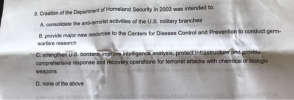 9. Creation of the Department of Homeland Security in 2003 was intended to: A. consolidate the anti-terrorist activities of the U.S. military branches B. provide major new resources to the Centers for Disease Control and Prevention to warfare research conduct germ- C strengthen Uls, borders mprove inteligence analysis, protectinfrastructure and provide comprehensive response and recovery operations for terrorist attacks with chemical or biologic weapons D. none of the above
Now apply the trade-offs concepts at the Port of entry. The Department of Homeland Security (DHS)...
 Now apply the trade-offs concepts at the Port of entry. The Department of Homeland Security (DHS) is tasked with keeping the homeland safe and secure, while allowing goods to come across the border. The number one objective of DHS is security. Taxpayers must pay for the services from the government, but expect to have accountability, and thus keep the cost as low as possible. Companies that move goods across the border have time a Just-in-Time incentive of moving their goods...
Let’s look at a real-world scenario and how the Department of Homeland Security (DHS) plays into...
Let’s look at a real-world scenario and how the Department of Homeland Security (DHS) plays into it. In the scenario, the United States will be hit by a large-scale, coordinated cyber attack organized by China. These attacks debilitate the functioning of government agencies, parts of the critical infrastructure, and commercial ventures. The IT infrastructure of several agencies are paralyzed, the electric grid in most of the country is shut down, telephone traffic is seriously limited and satellite communications are down...
d. Department of Homeland Security Answer 9. This organization provides guidelines for the minimum criteria for...
 d. Department of Homeland Security Answer 9. This organization provides guidelines for the minimum criteria for the evaluation of candidates for state and local judicial offices a. Corporate Bar b. Association of Federal Defense Attormeys American Bar Association. d National Bar Association Answer .Which three Justice Department offices directly affect the prosecutorial aspect of the criminal justice process? a. Office of the Solicitor General b. Criminal Division c. U.S. Attorneys d. all of the above Answer: 12. This federal officer...
As a health information professional, it is important to be informed about data breaches, health information...
As a health information professional, it is important to be informed about data breaches, health information security, threats, and vulnerability in healthcare. Elaborate on how you would address a potential threat to health information security that started in your department or, potentially, the larger organization. Examine the following websites to determine the potential types of threats to health information security and basic policy requirements: HIMSS.org, HealthIT.gov, healthcareinfosecurity.com, or other websites related to health information security.
 The Department of Homeland Security has asked the Internal Revenue Service for the tax retums of U.S. citizens who have been identified as having ties to terrorist organizations. The IRS has declined to turn over the tax retums. Which of the following rights relating to the individuals and the authority of the two agencies is correct? O a. The IRS must festseek permission from the individuals. O b. The Department of Homeland Security cannot obtain this information, as they may...
 9. Creation of the Department of Homeland Security in 2003 was intended to: A. consolidate the anti-terrorist activities of the U.S. military branches B. provide major new resources to the Centers for Disease Control and Prevention to warfare research conduct germ- C strengthen Uls, borders mprove inteligence analysis, protectinfrastructure and provide comprehensive response and recovery operations for terrorist attacks with chemical or biologic weapons D. none of the above
 Now apply the trade-offs concepts at the Port of entry. The Department of Homeland Security (DHS) is tasked with keeping the homeland safe and secure, while allowing goods to come across the border. The number one objective of DHS is security. Taxpayers must pay for the services from the government, but expect to have accountability, and thus keep the cost as low as possible. Companies that move goods across the border have time a Just-in-Time incentive of moving their goods...
 d. Department of Homeland Security Answer 9. This organization provides guidelines for the minimum criteria for the evaluation of candidates for state and local judicial offices a. Corporate Bar b. Association of Federal Defense Attormeys American Bar Association. d National Bar Association Answer .Which three Justice Department offices directly affect the prosecutorial aspect of the criminal justice process? a. Office of the Solicitor General b. Criminal Division c. U.S. Attorneys d. all of the above Answer: 12. This federal officer...
Most questions answered within 3 hours.
-
Where is the error in this code sequence?
String s1 = "Hello";
String s2 = "ello";...
asked 10 months ago -
Financial data for Joel de Paris, Inc., for last year
follow:
Joel de Paris, Inc.
Balance...
asked 10 months ago -
Consider this reaction:
Al2(SO4)3 (aq)+ BaCl3
(aq) Al2Cl6 (aq)- +
3BaSO4(s) . What is the...
asked 10 months ago -
Suppose that Savneet is considering increasing her
recent random sample from 20 car rentals to 40...
asked 10 months ago -
Trucks arrive at an unloading terminal at an average rate of 120
per hour.
Trucks arrive...
asked 10 months ago -
Why are methanol and ethanol completely soluble in water while
octanol is not very little soluble....
asked 10 months ago -
A facilities manager at a university reads in a research report
that the mean amount of...
asked 10 months ago -
When the CuSO4 is rehydrated by adding water to the anhydrous
compound, is this an endothermic...
asked 10 months ago -
A ray of sunlight is passing from diamond into crown glass; the
angle of incidence is...
asked 10 months ago -
A block of mass 0.249 kg is placed on top of a light, vertical
spring of...
asked 10 months ago -
how do the kidneys compensate in the presences of acidosis
a) trigger hyperventilate
b) reserve acid...
asked 10 months ago -
Question 501 pts
The rental rate of capital to the firm increases. Which of the
following...
asked 10 months ago