
Homework Answers

Add Answer to:
show how to calculate the stator curren the output torque when the motor is operating over...
Problem 2. (25 points) For a 120-V, 1/3 hp, four pole, 1-phase induction motor, the parameters of the equivalent circuit, are R,-1.8(2, R,-2.5Ω, X,-X,-2.462, and Xm-60 Ω. At a slip of 500, the motor&...
 Problem 2. (25 points) For a 120-V, 1/3 hp, four pole, 1-phase induction motor, the parameters of the equivalent circuit, are R,-1.8(2, R,-2.5Ω, X,-X,-2.462, and Xm-60 Ω. At a slip of 500, the motor's rotational losses are 51W. The rotational losses maybe assumed constant over the normal operating range of the motor. If the slip is 0.05, calculate a. Input Power b. Air Gap Power, c. Induced Torque Tin d. Output power e. Load torque. f. Overall Motor efficiency g....
3. (25 points) Induction Motor Torque Production. An induction motor has the torque vs. speed curve shown below. By changing the machine's inputs or its parameters, we can influence it...
 3. (25 points) Induction Motor Torque Production. An induction motor has the torque vs. speed curve shown below. By changing the machine's inputs or its parameters, we can influence its behavior. For example, cutting its terminal voltage by half yields the changes illustrated below Peak Torque at same speed t(slip) % of the Peak Torque Floalslip) Slightly reduced operating speed, but double the operating slip 2001000 100 200 slip) % of the Starting Torque We can influence its torque production...
I want to solve this problem step by step. Thanks 3. (25 points) Induction Motor Torque Production. An induction motor has the torque vs. speed curve shown below. By changing the machine's i...
 I want to solve this problem step by step. Thanks
3. (25 points) Induction Motor Torque Production. An induction motor has the torque vs. speed curve shown below. By changing the machine's inputs or its parameters, we can influence its behavior. For example, cutting its terminal voltage by half yields the changes illustrated below Peak Torque at same speed t (slip) fslip) load slip) of the Peak Torque Slightly reduced operating speed, but double the operating slip 200 -200 100...
I want to solve this problem step by step. Thanks
3. (25 points) Induction Motor Torque Production. An induction motor has the torque vs. speed curve shown below. By changing the machine's inputs or its parameters, we can influence its behavior. For example, cutting its terminal voltage by half yields the changes illustrated below Peak Torque at same speed t (slip) fslip) load slip) of the Peak Torque Slightly reduced operating speed, but double the operating slip 200 -200 100...
A hydraulic motor, operating at 1500 rpm, develops 3.5 brake horse power. Calculate the output torque...
A hydraulic motor, operating at 1500 rpm, develops 3.5 brake horse power. Calculate the output torque of the motor.
The starting torque of a three-phase synchronous motor is increased when SE O ou h atic...
 The starting torque of a three-phase synchronous motor is increased when SE O ou h atic tio co e rotor electromagnet is turned on. a. b. the rotor electromagnet is turned off. c, the power factor of the ac power network is unity. d. dc power is applied to one of the stator windings. 2. When a synchronous motor without load is connected to a three-phase ac power network, the resulting power factor depends on a. the speed of the...
4. A three-phase induction motor has the following data: Nominal power, P 7.5 kW Nominal voltage, = 400 V Connection: Y Nominal frequency, f-50 Hz Nominal speed, nn 960 rpm Stator resistance, r,...
 4. A three-phase induction motor has the following data: Nominal power, P 7.5 kW Nominal voltage, = 400 V Connection: Y Nominal frequency, f-50 Hz Nominal speed, nn 960 rpm Stator resistance, r, 0.55 Ω Rotor resistance referred to a stator winding phase: r:-0.51 Ω Stator leakage inductance, L,-4.4 mH Rotor leakage inductance referred to a stator winding phase,1'-4.4 mH Magnetising inductance L-65 mH How many pole pairs has the motor? 12] a. Calculate the nominal power factor of the...
The output torque of a motor is 69.2 lb-ft when it operates at 950 rpm. Calculate...
The output torque of a motor is 69.2 lb-ft when it operates at 950 rpm. Calculate the losses in the machine and its efficiency if, under this condition, the power input is 10900 watts. Topic: DC MOTOR: Efficiency and Power Losses
6. A 3-phase 2.2 kV 25 Hz squirrel cage induction motor draws a line current of...
 6. A 3-phase 2.2 kV 25 Hz squirrel cage induction motor draws a line current of 224 A and a total power of 777 kW when operating at full load. The full-load speed is 245 rpm. The stator is wye connected and has an effective resistance per phase of 0.125 Ω. The stator iron (core) loss is 8.88 kW; friction and windage losses are 4.54 kW. Calculate at full-load conditions: b. power supplied to the rotor, a. the power factor;...
2. Calculate how much output torque a motor will produce if it has a displacement of...
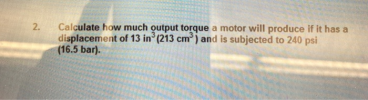 2. Calculate how much output torque a motor will produce if it has a displacement of 13 in (213 cm”) and is subjected to 240 psi (16.5 bar).
A 220-V, 1.5-hp, 50-Hz, six-pole, capacitor-start induction motor has the following main-winding impedances: R1= 1.30 Ω...
A 220-V, 1.5-hp, 50-Hz, six-pole, capacitor-start induction motor has the following main-winding impedances: R1= 1.30 Ω R2 = 1.73 Ω Xl = 2.01 Ω X2 = 2.01 Ω Xm = 105 Ω At a slip of 0.05, the motor's rotational losses are 291 W. The rotational losses may be assumed constant over the nominal operating range of the motor. Find the following quantities for this motor at 5 percent slip: (a) Stator current (b) Stator power factor (e) Input power...
 Problem 2. (25 points) For a 120-V, 1/3 hp, four pole, 1-phase induction motor, the parameters of the equivalent circuit, are R,-1.8(2, R,-2.5Ω, X,-X,-2.462, and Xm-60 Ω. At a slip of 500, the motor's rotational losses are 51W. The rotational losses maybe assumed constant over the normal operating range of the motor. If the slip is 0.05, calculate a. Input Power b. Air Gap Power, c. Induced Torque Tin d. Output power e. Load torque. f. Overall Motor efficiency g....
 3. (25 points) Induction Motor Torque Production. An induction motor has the torque vs. speed curve shown below. By changing the machine's inputs or its parameters, we can influence its behavior. For example, cutting its terminal voltage by half yields the changes illustrated below Peak Torque at same speed t(slip) % of the Peak Torque Floalslip) Slightly reduced operating speed, but double the operating slip 2001000 100 200 slip) % of the Starting Torque We can influence its torque production...
 I want to solve this problem step by step. Thanks
3. (25 points) Induction Motor Torque Production. An induction motor has the torque vs. speed curve shown below. By changing the machine's inputs or its parameters, we can influence its behavior. For example, cutting its terminal voltage by half yields the changes illustrated below Peak Torque at same speed t (slip) fslip) load slip) of the Peak Torque Slightly reduced operating speed, but double the operating slip 200 -200 100...
I want to solve this problem step by step. Thanks
3. (25 points) Induction Motor Torque Production. An induction motor has the torque vs. speed curve shown below. By changing the machine's inputs or its parameters, we can influence its behavior. For example, cutting its terminal voltage by half yields the changes illustrated below Peak Torque at same speed t (slip) fslip) load slip) of the Peak Torque Slightly reduced operating speed, but double the operating slip 200 -200 100...
 The starting torque of a three-phase synchronous motor is increased when SE O ou h atic tio co e rotor electromagnet is turned on. a. b. the rotor electromagnet is turned off. c, the power factor of the ac power network is unity. d. dc power is applied to one of the stator windings. 2. When a synchronous motor without load is connected to a three-phase ac power network, the resulting power factor depends on a. the speed of the...
 4. A three-phase induction motor has the following data: Nominal power, P 7.5 kW Nominal voltage, = 400 V Connection: Y Nominal frequency, f-50 Hz Nominal speed, nn 960 rpm Stator resistance, r, 0.55 Ω Rotor resistance referred to a stator winding phase: r:-0.51 Ω Stator leakage inductance, L,-4.4 mH Rotor leakage inductance referred to a stator winding phase,1'-4.4 mH Magnetising inductance L-65 mH How many pole pairs has the motor? 12] a. Calculate the nominal power factor of the...
 6. A 3-phase 2.2 kV 25 Hz squirrel cage induction motor draws a line current of 224 A and a total power of 777 kW when operating at full load. The full-load speed is 245 rpm. The stator is wye connected and has an effective resistance per phase of 0.125 Ω. The stator iron (core) loss is 8.88 kW; friction and windage losses are 4.54 kW. Calculate at full-load conditions: b. power supplied to the rotor, a. the power factor;...
 2. Calculate how much output torque a motor will produce if it has a displacement of 13 in (213 cm”) and is subjected to 240 psi (16.5 bar).
Most questions answered within 3 hours.
-
Where is the error in this code sequence?
String s1 = "Hello";
String s2 = "ello";...
asked 11 months ago -
Financial data for Joel de Paris, Inc., for last year
follow:
Joel de Paris, Inc.
Balance...
asked 11 months ago -
Consider this reaction:
Al2(SO4)3 (aq)+ BaCl3
(aq) Al2Cl6 (aq)- +
3BaSO4(s) . What is the...
asked 11 months ago -
Suppose that Savneet is considering increasing her
recent random sample from 20 car rentals to 40...
asked 11 months ago -
Trucks arrive at an unloading terminal at an average rate of 120
per hour.
Trucks arrive...
asked 11 months ago -
Why are methanol and ethanol completely soluble in water while
octanol is not very little soluble....
asked 11 months ago -
A facilities manager at a university reads in a research report
that the mean amount of...
asked 11 months ago -
When the CuSO4 is rehydrated by adding water to the anhydrous
compound, is this an endothermic...
asked 11 months ago -
A ray of sunlight is passing from diamond into crown glass; the
angle of incidence is...
asked 11 months ago -
A block of mass 0.249 kg is placed on top of a light, vertical
spring of...
asked 11 months ago -
how do the kidneys compensate in the presences of acidosis
a) trigger hyperventilate
b) reserve acid...
asked 11 months ago -
Question 501 pts
The rental rate of capital to the firm increases. Which of the
following...
asked 11 months ago