Suppose that 8.59g of a nuclide of mass number 105 decays at a rate of 6.19
Suppose that 8.59g of a nuclide of mass number 105 decays at a rate of 6.19
Homework Answers


Add Answer to:
Suppose that 8.59g of a nuclide of mass number 105 decays at a
rate of 6.19
Suppose a carbon-14 nuclide decays into a nitrogen-14 nuclide by emitting an electron. Complete the nuclear...
 Suppose a carbon-14 nuclide decays into a nitrogen-14 nuclide by emitting an electron. Complete the nuclear chemical equation below so that it describes this nuclear reaction. Y Х 5 ?
The nuclide 59Fe decays by beta emission with a half-life of 44.5 days. The mass of...
The nuclide 59Fe decays by beta emission with a half-life of 44.5 days. The mass of a 59Fe atom is 58.935 u. (a) How many grams of 59Fe are in a sample that has a decay rate from that nuclide of 463 s-1? ____ g (b) After 200 days, how many grams of 59Fe remain? _____ g
When the nuclide strontium-80 decays by electron capture: The name of the product nuclide is[ The...
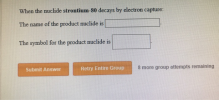 When the nuclide strontium-80 decays by electron capture: The name of the product nuclide is[ The symbol for the product nuclide is Submit Answer Retry Entire Group 8 more group attempts remaining
The nuclide 96Nb decays by a first-order process with a rate constant of 2.96 × 10⁻²...
The nuclide 96Nb decays by a first-order process with a rate constant of 2.96 × 10⁻² h–1. How long will it take for 86.0% of the initial amount of 96Nb to be consumed?
35. A certain radio-nuclide decays by emitting an alpha-particle. What is the difference between the atomic...
35. A certain radio-nuclide decays by emitting an alpha-particle. What is the difference between the atomic numbers of the parent and the daughter nuclides? 36. What is the difference in mass number between the parent and daughter nuclides after a beta-decay process?
A radioactive nuclide X having a mass of 65.0 grams is sealed in a container having...
 A
radioactive nuclide X having a mass of 65.0 grams is sealed in a
container having a mass of. 5.00 grams. The nuclide X decays into
the nuclide Y. The nuclide X has a half life of 6.00 hours.
19. What will the mass of nuclide Y be after 24 hours have
elapsed?
20. What will the mass of nuclide Y be after 24 hours have
elapsed?
21. What will the mass of the sealed container be after 24
hours...
A
radioactive nuclide X having a mass of 65.0 grams is sealed in a
container having a mass of. 5.00 grams. The nuclide X decays into
the nuclide Y. The nuclide X has a half life of 6.00 hours.
19. What will the mass of nuclide Y be after 24 hours have
elapsed?
20. What will the mass of nuclide Y be after 24 hours have
elapsed?
21. What will the mass of the sealed container be after 24
hours...
Polonium-216 decays by alpha particle emission. The chemical symbol of the daughter nuclide is and its mass , its atomic number is number is DI Question 8 10 pts Potassium-40 decays to produc...
 Polonium-216 decays by alpha particle emission. The chemical symbol of the daughter nuclide is and its mass , its atomic number is number is DI Question 8 10 pts Potassium-40 decays to produce argon-40. Which of the following modes of radioactive decay are possible? That is, which modes would result in the conversion of potassium-40 to argon-40? If more than one mode could achieve this effect, check all that apply. Alpha praticle emission Beta particle emission Electron capture Positron emission...
19. What will the mass of nuclide X be after 24 hours have elapsed? 20. What...
 19.
What will the mass of nuclide X be after 24 hours have elapsed?
20. What will the mass of nuclide Y be after 24 hours have
elapsed?
21. What will the mass of the sealed container be after 24
hours have elapsed?
A radioactive nuclide X having a mass of 65.0 grams is sealed in a container having a mass of 5.00 grams. The nuclide X decays into the nuclide Y. The nuclide X has a half life of...
19.
What will the mass of nuclide X be after 24 hours have elapsed?
20. What will the mass of nuclide Y be after 24 hours have
elapsed?
21. What will the mass of the sealed container be after 24
hours have elapsed?
A radioactive nuclide X having a mass of 65.0 grams is sealed in a container having a mass of 5.00 grams. The nuclide X decays into the nuclide Y. The nuclide X has a half life of...
The hydride of an unstable nuclide of a Group IIA metal, MH2(s), decays by alpha emission....
The hydride of an unstable nuclide of a Group IIA metal, MH2(s), decays by alpha emission. A 0.025-mol sample of the hydride is placed in an evacuated 1.7-L container at 298 K. After 91 minutes, the pressure in the container is 0.44 atm. Find the half-life of the nuclide.
The hydride of an unstable nuclide of a Group IIA metal, MH2(s), decays by a-emission. A...
The hydride of an unstable nuclide of a Group IIA metal, MH2(s), decays by a-emission. A 0.025-mol sample of the hydride is placed in an evacuated 1.1 −L container at 298 K. After 64 minutes, the pressure in the container is 0.49 atm. Find the half-life of the nuclide. Express your answer to two significant figures and include the appropriate units.
 Suppose a carbon-14 nuclide decays into a nitrogen-14 nuclide by emitting an electron. Complete the nuclear chemical equation below so that it describes this nuclear reaction. Y Х 5 ?
 When the nuclide strontium-80 decays by electron capture: The name of the product nuclide is[ The symbol for the product nuclide is Submit Answer Retry Entire Group 8 more group attempts remaining
 A
radioactive nuclide X having a mass of 65.0 grams is sealed in a
container having a mass of. 5.00 grams. The nuclide X decays into
the nuclide Y. The nuclide X has a half life of 6.00 hours.
19. What will the mass of nuclide Y be after 24 hours have
elapsed?
20. What will the mass of nuclide Y be after 24 hours have
elapsed?
21. What will the mass of the sealed container be after 24
hours...
A
radioactive nuclide X having a mass of 65.0 grams is sealed in a
container having a mass of. 5.00 grams. The nuclide X decays into
the nuclide Y. The nuclide X has a half life of 6.00 hours.
19. What will the mass of nuclide Y be after 24 hours have
elapsed?
20. What will the mass of nuclide Y be after 24 hours have
elapsed?
21. What will the mass of the sealed container be after 24
hours...
 Polonium-216 decays by alpha particle emission. The chemical symbol of the daughter nuclide is and its mass , its atomic number is number is DI Question 8 10 pts Potassium-40 decays to produce argon-40. Which of the following modes of radioactive decay are possible? That is, which modes would result in the conversion of potassium-40 to argon-40? If more than one mode could achieve this effect, check all that apply. Alpha praticle emission Beta particle emission Electron capture Positron emission...
 19.
What will the mass of nuclide X be after 24 hours have elapsed?
20. What will the mass of nuclide Y be after 24 hours have
elapsed?
21. What will the mass of the sealed container be after 24
hours have elapsed?
A radioactive nuclide X having a mass of 65.0 grams is sealed in a container having a mass of 5.00 grams. The nuclide X decays into the nuclide Y. The nuclide X has a half life of...
19.
What will the mass of nuclide X be after 24 hours have elapsed?
20. What will the mass of nuclide Y be after 24 hours have
elapsed?
21. What will the mass of the sealed container be after 24
hours have elapsed?
A radioactive nuclide X having a mass of 65.0 grams is sealed in a container having a mass of 5.00 grams. The nuclide X decays into the nuclide Y. The nuclide X has a half life of...
Most questions answered within 3 hours.
-
Where is the error in this code sequence?
String s1 = "Hello";
String s2 = "ello";...
asked 11 months ago -
Financial data for Joel de Paris, Inc., for last year
follow:
Joel de Paris, Inc.
Balance...
asked 11 months ago -
Consider this reaction:
Al2(SO4)3 (aq)+ BaCl3
(aq) Al2Cl6 (aq)- +
3BaSO4(s) . What is the...
asked 11 months ago -
Suppose that Savneet is considering increasing her
recent random sample from 20 car rentals to 40...
asked 11 months ago -
Trucks arrive at an unloading terminal at an average rate of 120
per hour.
Trucks arrive...
asked 11 months ago -
Why are methanol and ethanol completely soluble in water while
octanol is not very little soluble....
asked 11 months ago -
A facilities manager at a university reads in a research report
that the mean amount of...
asked 11 months ago -
When the CuSO4 is rehydrated by adding water to the anhydrous
compound, is this an endothermic...
asked 11 months ago -
A ray of sunlight is passing from diamond into crown glass; the
angle of incidence is...
asked 11 months ago -
A block of mass 0.249 kg is placed on top of a light, vertical
spring of...
asked 11 months ago -
how do the kidneys compensate in the presences of acidosis
a) trigger hyperventilate
b) reserve acid...
asked 11 months ago -
Question 501 pts
The rental rate of capital to the firm increases. Which of the
following...
asked 11 months ago