
Homework Answers
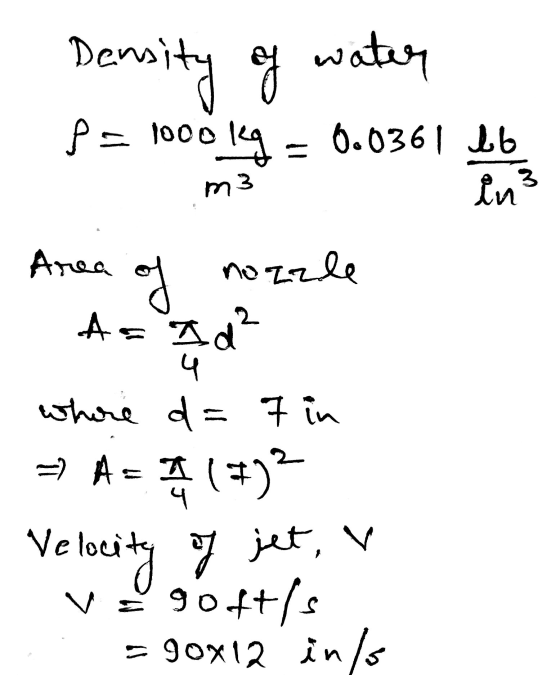
![Free body diagram ca | | F - Applying newtons and low in the direction of F force motion Jisoo jet.is . E=m [v -o] { from ne](http://img.homeworklib.com/questions/8fd3b460-5be9-11ec-9549-67edd6cbb6c5.png?x-oss-process=image/resize,w_560)
Add Answer to:
A vehicle is to be propelled by a jet of water striking a vane as shown....
Force from a Jet of Water A jet of fluid striking a vane exerts a force on the vane it is equal a...
 Force from a Jet of Water A jet of fluid striking a vane exerts a force on the vane it is equal and opposite to the vane. It is the equal and opposite force of the fluid momentum change that accompanies such a flow. For different weights, the water flow rate is adjusted so the platform stays at the zero reading. These values are given below Q, ftA3/s 0045 0069 0011 0107 0116 0041 0076 0113 0146 Weight Angle, deg...
Objective To determine the force generated by a jet of water striking on a surface Description...
 Objective To determine the force generated by a jet of water striking on a surface Description of apparatus The supply is led to a vertical pipe terminating in a tapered nozzle. This produces a jet of water which impinges on the vane in the form of a Flat Plate, Hemispherical Cup, Conical Plate or 30° Angled Plate. The nozzle and vane are contained within a transparent cylinder; at the base of the cylinder there is an outlet by which the...
a 50-mm-diameter jet of water impacts a vane at a velocity of 20 m/s as shown...
 a 50-mm-diameter jet of water impacts a vane at a
velocity of 20 m/s as shown in Figure 4.78. The vane has a mass of
90 kg, and it deflects the jet through a 55° angle. The vane is
constrained to move in the direction of the incoming jet, and there
is no force opposing the motion of the vane. Determine the
acceleration of the vane when it was first released. Assume water
at 20°C
Mecánica de fluidos Problemas A...
a 50-mm-diameter jet of water impacts a vane at a
velocity of 20 m/s as shown in Figure 4.78. The vane has a mass of
90 kg, and it deflects the jet through a 55° angle. The vane is
constrained to move in the direction of the incoming jet, and there
is no force opposing the motion of the vane. Determine the
acceleration of the vane when it was first released. Assume water
at 20°C
Mecánica de fluidos Problemas A...
Mechanical Engineering - Fluid Mechanics (Do Not convert to S.I. units) A jet of water issuing...
 Mechanical Engineering - Fluid Mechanics
(Do Not convert to S.I. units)
A jet of water issuing from a stationary nozzle with a speed of 20 ft/s strikes a turning vane mounted on a cart as shown. The vane turns the jet through an angle of 115 degrees. Determine the mass, m, required to hold the cart stationary. The jet diameter is 1.0 inch.
Mechanical Engineering - Fluid Mechanics
(Do Not convert to S.I. units)
A jet of water issuing from a stationary nozzle with a speed of 20 ft/s strikes a turning vane mounted on a cart as shown. The vane turns the jet through an angle of 115 degrees. Determine the mass, m, required to hold the cart stationary. The jet diameter is 1.0 inch.
12. A water jet (p = 1000kg /m?) is deflected by a vane as shown in...
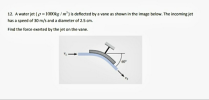 12. A water jet (p = 1000kg /m?) is deflected by a vane as shown in the image below. The incoming jet has a speed of 30 m/s and a diameter of 2.5 cm. Find the force exerted by the jet on the vane. 60°
A water jet strikes a vane and exerts a force on it. This force is balanced...
 A water jet strikes a vane and exerts a force on it. This force
is balanced by the weight W. The purpose of this experiment is to
compare the theoretical force on the vane with the experimentally
measured force. The experiment is as follows:
We measure the outlet diameter, d, of the nozzle. Then, we
fasten θ=90o ? vane to its support and adjust the balance spring to
give a zero reading when there is no weight, W, on the...
A water jet strikes a vane and exerts a force on it. This force
is balanced by the weight W. The purpose of this experiment is to
compare the theoretical force on the vane with the experimentally
measured force. The experiment is as follows:
We measure the outlet diameter, d, of the nozzle. Then, we
fasten θ=90o ? vane to its support and adjust the balance spring to
give a zero reading when there is no weight, W, on the...
Question 8 A water jet issues vertically from a nozzle, as shown. The water velocity as...
 Question 8 A water jet issues vertically from a nozzle, as shown. The water velocity as it exits the nozzle is 18 ft/s. Calculate how high h the jet will rise. (Hint: Apply the Bernoulli equation along the centerline.) 1 h = ft Click here to access the appendices. the tolerance is +/-2%
A horizontal water jet impinges against the vertical back surface of a stationary cart. After striking...
A horizontal water jet impinges against the vertical back surface of a stationary cart. After striking the surface the water stream splatters off in all directions along the surface of the plate. The diameter of the nozzle exit is 6 cm and the water jet leaves the nozzle at 20 m/sec. If the mass of the cart is 400 kg and if there is no friction between its wheels and the ground calculate the acceleration of the cart when the...
A vane on wheels moves with constant velocity 0.58 m/s when a stream of water having...
 A vane on wheels moves with constant velocity 0.58 m/s when a stream of water having .( a nozzle exit velocity 1.83 m/s and 5 cm diameter is turned at 8 = 45° by the vane as indicated in the figure below. Neglect friction so that the speed of the water jet relative to the vane is unchanged result of the Bernoulli equation if elevation of the water jet is .neglected (Determine the reaction force (N) in the x-direction (RX...
a) What do we mean by friction and pressure drag? b) A jet of water issuing...
 a) What do we mean by friction and pressure drag? b) A jet of water issuing from a stationary nozzle at 10 m/s (A -0.1 m) 2 strikes a turning vane mounted on a cart as shown. The vane turns the jet through angle 40°. Determine the value of M required to hold the cart stationary.
 Force from a Jet of Water A jet of fluid striking a vane exerts a force on the vane it is equal and opposite to the vane. It is the equal and opposite force of the fluid momentum change that accompanies such a flow. For different weights, the water flow rate is adjusted so the platform stays at the zero reading. These values are given below Q, ftA3/s 0045 0069 0011 0107 0116 0041 0076 0113 0146 Weight Angle, deg...
 Objective To determine the force generated by a jet of water striking on a surface Description of apparatus The supply is led to a vertical pipe terminating in a tapered nozzle. This produces a jet of water which impinges on the vane in the form of a Flat Plate, Hemispherical Cup, Conical Plate or 30° Angled Plate. The nozzle and vane are contained within a transparent cylinder; at the base of the cylinder there is an outlet by which the...
 a 50-mm-diameter jet of water impacts a vane at a
velocity of 20 m/s as shown in Figure 4.78. The vane has a mass of
90 kg, and it deflects the jet through a 55° angle. The vane is
constrained to move in the direction of the incoming jet, and there
is no force opposing the motion of the vane. Determine the
acceleration of the vane when it was first released. Assume water
at 20°C
Mecánica de fluidos Problemas A...
a 50-mm-diameter jet of water impacts a vane at a
velocity of 20 m/s as shown in Figure 4.78. The vane has a mass of
90 kg, and it deflects the jet through a 55° angle. The vane is
constrained to move in the direction of the incoming jet, and there
is no force opposing the motion of the vane. Determine the
acceleration of the vane when it was first released. Assume water
at 20°C
Mecánica de fluidos Problemas A...
 Mechanical Engineering - Fluid Mechanics
(Do Not convert to S.I. units)
A jet of water issuing from a stationary nozzle with a speed of 20 ft/s strikes a turning vane mounted on a cart as shown. The vane turns the jet through an angle of 115 degrees. Determine the mass, m, required to hold the cart stationary. The jet diameter is 1.0 inch.
Mechanical Engineering - Fluid Mechanics
(Do Not convert to S.I. units)
A jet of water issuing from a stationary nozzle with a speed of 20 ft/s strikes a turning vane mounted on a cart as shown. The vane turns the jet through an angle of 115 degrees. Determine the mass, m, required to hold the cart stationary. The jet diameter is 1.0 inch.
 12. A water jet (p = 1000kg /m?) is deflected by a vane as shown in the image below. The incoming jet has a speed of 30 m/s and a diameter of 2.5 cm. Find the force exerted by the jet on the vane. 60°
 A water jet strikes a vane and exerts a force on it. This force
is balanced by the weight W. The purpose of this experiment is to
compare the theoretical force on the vane with the experimentally
measured force. The experiment is as follows:
We measure the outlet diameter, d, of the nozzle. Then, we
fasten θ=90o ? vane to its support and adjust the balance spring to
give a zero reading when there is no weight, W, on the...
A water jet strikes a vane and exerts a force on it. This force
is balanced by the weight W. The purpose of this experiment is to
compare the theoretical force on the vane with the experimentally
measured force. The experiment is as follows:
We measure the outlet diameter, d, of the nozzle. Then, we
fasten θ=90o ? vane to its support and adjust the balance spring to
give a zero reading when there is no weight, W, on the...
 Question 8 A water jet issues vertically from a nozzle, as shown. The water velocity as it exits the nozzle is 18 ft/s. Calculate how high h the jet will rise. (Hint: Apply the Bernoulli equation along the centerline.) 1 h = ft Click here to access the appendices. the tolerance is +/-2%
 A vane on wheels moves with constant velocity 0.58 m/s when a stream of water having .( a nozzle exit velocity 1.83 m/s and 5 cm diameter is turned at 8 = 45° by the vane as indicated in the figure below. Neglect friction so that the speed of the water jet relative to the vane is unchanged result of the Bernoulli equation if elevation of the water jet is .neglected (Determine the reaction force (N) in the x-direction (RX...
 a) What do we mean by friction and pressure drag? b) A jet of water issuing from a stationary nozzle at 10 m/s (A -0.1 m) 2 strikes a turning vane mounted on a cart as shown. The vane turns the jet through angle 40°. Determine the value of M required to hold the cart stationary.
Most questions answered within 3 hours.
-
Where is the error in this code sequence?
String s1 = "Hello";
String s2 = "ello";...
asked 11 months ago -
Financial data for Joel de Paris, Inc., for last year
follow:
Joel de Paris, Inc.
Balance...
asked 11 months ago -
Consider this reaction:
Al2(SO4)3 (aq)+ BaCl3
(aq) Al2Cl6 (aq)- +
3BaSO4(s) . What is the...
asked 11 months ago -
Suppose that Savneet is considering increasing her
recent random sample from 20 car rentals to 40...
asked 11 months ago -
Trucks arrive at an unloading terminal at an average rate of 120
per hour.
Trucks arrive...
asked 11 months ago -
Why are methanol and ethanol completely soluble in water while
octanol is not very little soluble....
asked 11 months ago -
A facilities manager at a university reads in a research report
that the mean amount of...
asked 11 months ago -
When the CuSO4 is rehydrated by adding water to the anhydrous
compound, is this an endothermic...
asked 11 months ago -
A ray of sunlight is passing from diamond into crown glass; the
angle of incidence is...
asked 11 months ago -
A block of mass 0.249 kg is placed on top of a light, vertical
spring of...
asked 11 months ago -
how do the kidneys compensate in the presences of acidosis
a) trigger hyperventilate
b) reserve acid...
asked 11 months ago -
Question 501 pts
The rental rate of capital to the firm increases. Which of the
following...
asked 11 months ago