
Homework Answers
Add Answer to:
Please explain
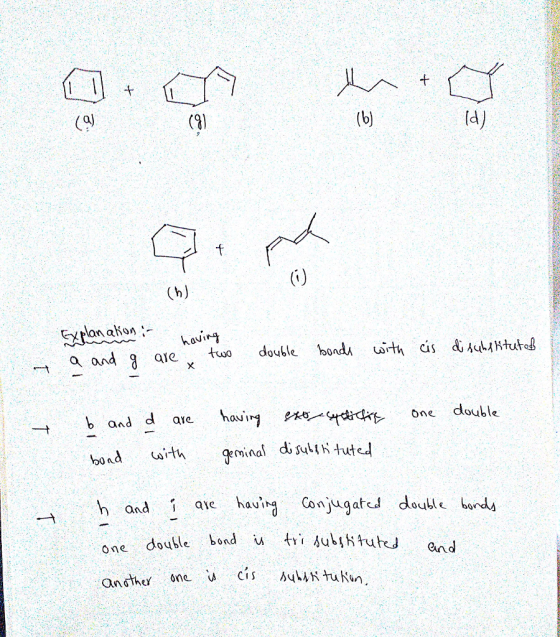
3. The conversion of an alkene into an alkane via catalytic hydrogenation (with H2...
Passage 11 (Questions 1-9) Dienes, a special group of alkenes, can be classified as conjugated or...
 Passage 11 (Questions 1-9) Dienes, a special group of alkenes, can be classified as conjugated or isolated. Conjugated dienes are alkenes with alternating double and single bonds. Isolated dienes have double bonds separated by more than one single bond. One explanation for this observation is the hybridization theory. According to the hybridization theory, the stability of conjugated dienes comes from the hybridization of the orbitals forming the carbon-carbon single bonds. For example, in 1,4-pentadiene, the C-C single bonds result from...
(C) Protonation of alkene to form a carbocation followed by addition of bromide ion (D) Addition...
 (C) Protonation of alkene to form a carbocation followed by addition of bromide ion (D) Addition of the proton to one face of the alkene with simultaneous delivery of a bromide ion from a different molecule of H-Br. 11. Which compound is the strongest nmucleophile for reaction of methane methanesulfonate (CHOS0.CH) in methanol at room temperature? (You may assume that everything is soluble in methanol) (A) potassium bromide (B) cesium iodide (C) sodiam chloride (D) lithium flaoride 12. Which proton...
 Passage 11 (Questions 1-9) Dienes, a special group of alkenes, can be classified as conjugated or isolated. Conjugated dienes are alkenes with alternating double and single bonds. Isolated dienes have double bonds separated by more than one single bond. One explanation for this observation is the hybridization theory. According to the hybridization theory, the stability of conjugated dienes comes from the hybridization of the orbitals forming the carbon-carbon single bonds. For example, in 1,4-pentadiene, the C-C single bonds result from...
 (C) Protonation of alkene to form a carbocation followed by addition of bromide ion (D) Addition of the proton to one face of the alkene with simultaneous delivery of a bromide ion from a different molecule of H-Br. 11. Which compound is the strongest nmucleophile for reaction of methane methanesulfonate (CHOS0.CH) in methanol at room temperature? (You may assume that everything is soluble in methanol) (A) potassium bromide (B) cesium iodide (C) sodiam chloride (D) lithium flaoride 12. Which proton...
Most questions answered within 3 hours.
-
Where is the error in this code sequence?
String s1 = "Hello";
String s2 = "ello";...
asked 10 months ago -
Financial data for Joel de Paris, Inc., for last year
follow:
Joel de Paris, Inc.
Balance...
asked 10 months ago -
Consider this reaction:
Al2(SO4)3 (aq)+ BaCl3
(aq) Al2Cl6 (aq)- +
3BaSO4(s) . What is the...
asked 10 months ago -
Suppose that Savneet is considering increasing her
recent random sample from 20 car rentals to 40...
asked 10 months ago -
Trucks arrive at an unloading terminal at an average rate of 120
per hour.
Trucks arrive...
asked 10 months ago -
Why are methanol and ethanol completely soluble in water while
octanol is not very little soluble....
asked 10 months ago -
A facilities manager at a university reads in a research report
that the mean amount of...
asked 10 months ago -
When the CuSO4 is rehydrated by adding water to the anhydrous
compound, is this an endothermic...
asked 10 months ago -
A ray of sunlight is passing from diamond into crown glass; the
angle of incidence is...
asked 10 months ago -
A block of mass 0.249 kg is placed on top of a light, vertical
spring of...
asked 10 months ago -
how do the kidneys compensate in the presences of acidosis
a) trigger hyperventilate
b) reserve acid...
asked 10 months ago -
Question 501 pts
The rental rate of capital to the firm increases. Which of the
following...
asked 10 months ago