
Homework Answers
given X1,X2,...,Xn (zeta replaced by x for convenience) follow Bernoulli distribution with p = 7/8 with

therefore Sn follows binomial distribution(n,p=7/8).
E(Sn/n) = np/n = p =7/8
Var(Sn) = pq/n =(7/8*1/8)/n
![p[ \left | \frac{S_{n}}{n} -p \right | < k ] \geqslant 1-\frac{Var(S_{n}/n)}{k^{2}}](http://img.homeworklib.com/questions/2e8cbe10-5ec5-11ec-98ef-39924e2539a1.gif?x-oss-process=image/resize,w_560)
choosing k =0.1,
we have
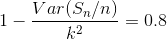
1-(pq/n)/(0.1*0.1) =0.8
n =7/0.128
n = 54.6875
hence n = 55
so he has to play at least n = 55 games to get gain = np = 55*(7/8) =48.125.
Add Answer to:
chebyshev’s inequality
Problem 2 Chebyshev's Inequality Suppose that the random variable ? has a Poisson distribution...
2. Suppose that is an exponential random variable with pdf f(y)= e), y>0. a. Use Chebyshev's Inequality to get an up...
 2. Suppose that is an exponential random variable with pdf f(y)= e), y>0. a. Use Chebyshev's Inequality to get an upper bound for the probability that takes on a value more than two standard deviations away from the mean. b. Use the given pdf to compute the exact probability that takes on a value more than two standard deviations away from the mean.
Problem 2, using Chebyshev's inequality, estimate the probability that a random variable X ~ Г (4...
 Problem 2, using Chebyshev's inequality, estimate the probability that a random variable X ~ Г (4, 10) satisfies |X - 0.42 0.2 Problem 3. For i.id. X1 , . . . , Xn ~ Exp(2), n = 200estimate from above
Problem 2, using Chebyshev's inequality, estimate the probability that a random variable X ~ Г (4, 10) satisfies |X - 0.42 0.2 Problem 3. For i.id. X1 , . . . , Xn ~ Exp(2), n = 200estimate from above
Problem 2, using Chebyshev's inequality, estimate the probability that a random variable X ~ Г (4, 10) satisfies |X - 0.42 0.2 Problem 3. For i.id. X1 , . . . , Xn ~ Exp(2), n = 200estimate from above
Problem 8 (4x4 pts) Suppose Xi, X2-, ..,. Xn are each independent Poisson random variables with...
 Problem 8 (4x4 pts) Suppose Xi, X2-, ..,. Xn are each independent Poisson random variables with mean 1. Let 100 k=1 (a) Rccall, Markov's incquality is P(Y > a) for a> 0 Using Markov's inequality, estimate the probability that P(Y > 120). (b) Rccal, Chebyshev's incquality is Using Chebyshev's inequality, estimate P( Y-?> 20) (c), (d) Using the Central Limit Theorem, estimate P(Y > 120) and Ply-? > 20).
The probability distribution of random variable X is given below. What is E[X]? X 4 2...
The probability distribution of random variable X is given below. What is E[X]? X 4 2 6 P(x) 0.6 0.2 0.2 The probability distribution of random variable X is given below. What is σ2x? X 4 2 6 P(x) 0.6 0.2 0.2 The probability distribution of random variable X is given below. Let Y = 4X − 5 be a new random variable. What is σ2y? X 4 2 6 P(x) 0.6 0.2 0.2 The probability distribution of random variable...
Suppose that 1/2 where Z is any random variable with E22c, say, with c> 0 and...
 Suppose that 1/2 where Z is any random variable with E22c, say, with c> 0 and a E R fixed, and X is any other random variable. (a) Let e > 0. Use Chebyshev's inequality to show that (b) For what values of does the argument in part (a) prove that Xn converges in probability to X? (c) For the values of α identified in part (b), what other mode of convergence of Xn to X is assured (without any...
Suppose that 1/2 where Z is any random variable with E22c, say, with c> 0 and...
 Suppose that 1/2 where Z is any random variable with E22c, say, with c> 0 and a E R fixed, and X is any other random variable. (a) Let e > 0. Use Chebyshev's inequality to show that (b) For what values of does the argument in part (a) prove that Xn converges in probability to X? (c) For the values of α identified in part (b), what other mode of convergence of Xn to X is assured (without any...
Part c please Suppose that Zn n/2 where Zn is any random variable with Eena, say,...
 Part c please
Suppose that Zn n/2 where Zn is any random variable with Eena, say, with c0 and a E R fixed, and X is any other random variable. (a) Let > 0. Use Chebyshev's inequality to show that (b) For what values of o does the argument in part (a) prove that X converges in probability to X? (c) For the values of α identified in part (b), what other mode of convergence of X, to X is...
Part c please
Suppose that Zn n/2 where Zn is any random variable with Eena, say, with c0 and a E R fixed, and X is any other random variable. (a) Let > 0. Use Chebyshev's inequality to show that (b) For what values of o does the argument in part (a) prove that X converges in probability to X? (c) For the values of α identified in part (b), what other mode of convergence of X, to X is...
2 5. Suppose X is a discrete random variable that has a geometric distribution with p=...
 2 5. Suppose X is a discrete random variable that has a geometric distribution with p= a. Compute P(X > 6). [5] b. Use Markov's Inequality to estimate P(X > 6). [5] c. Use Chebyshev's Inequality to estimate P(X > 6). [5]
5. Suppose X is a discrete random variable that has a geometric distribution with p= 1....
 5. Suppose X is a discrete random variable that has a geometric distribution with p= 1. a. Compute P(X > 6). [5] b. Use Markov's Inequality to estimate P(X> 6). [5] c. Use Chebyshev's Inequality to estimate P(X>6). [5] t> 0 6. Let be the probability density function of the continuous 0 t< 0 random variable X. a. Verify that g(t) is indeed a probability density function. [8] b. Find the median of X, i.e. the number m such that...
A) Let X be a discrete random variable that follows a binomial distribution with n =...
A) Let X be a discrete random variable that follows a binomial distribution with n = 20 and probability of success p = 0.16. What is P(X≤2)? Round your response to at least 3 decimal places. B)A baseball player has a 60% chance of hitting the ball each time at bat, with succesive times at bat being independent. Calculate the probability that he gets at least 2 hits in 11 times at bat. Answer to 3 decimals please. C) A...
 2. Suppose that is an exponential random variable with pdf f(y)= e), y>0. a. Use Chebyshev's Inequality to get an upper bound for the probability that takes on a value more than two standard deviations away from the mean. b. Use the given pdf to compute the exact probability that takes on a value more than two standard deviations away from the mean.
 Problem 2, using Chebyshev's inequality, estimate the probability that a random variable X ~ Г (4, 10) satisfies |X - 0.42 0.2 Problem 3. For i.id. X1 , . . . , Xn ~ Exp(2), n = 200estimate from above
Problem 2, using Chebyshev's inequality, estimate the probability that a random variable X ~ Г (4, 10) satisfies |X - 0.42 0.2 Problem 3. For i.id. X1 , . . . , Xn ~ Exp(2), n = 200estimate from above
Problem 2, using Chebyshev's inequality, estimate the probability that a random variable X ~ Г (4, 10) satisfies |X - 0.42 0.2 Problem 3. For i.id. X1 , . . . , Xn ~ Exp(2), n = 200estimate from above
 Problem 8 (4x4 pts) Suppose Xi, X2-, ..,. Xn are each independent Poisson random variables with mean 1. Let 100 k=1 (a) Rccall, Markov's incquality is P(Y > a) for a> 0 Using Markov's inequality, estimate the probability that P(Y > 120). (b) Rccal, Chebyshev's incquality is Using Chebyshev's inequality, estimate P( Y-?> 20) (c), (d) Using the Central Limit Theorem, estimate P(Y > 120) and Ply-? > 20).
 Suppose that 1/2 where Z is any random variable with E22c, say, with c> 0 and a E R fixed, and X is any other random variable. (a) Let e > 0. Use Chebyshev's inequality to show that (b) For what values of does the argument in part (a) prove that Xn converges in probability to X? (c) For the values of α identified in part (b), what other mode of convergence of Xn to X is assured (without any...
 Suppose that 1/2 where Z is any random variable with E22c, say, with c> 0 and a E R fixed, and X is any other random variable. (a) Let e > 0. Use Chebyshev's inequality to show that (b) For what values of does the argument in part (a) prove that Xn converges in probability to X? (c) For the values of α identified in part (b), what other mode of convergence of Xn to X is assured (without any...
 Part c please
Suppose that Zn n/2 where Zn is any random variable with Eena, say, with c0 and a E R fixed, and X is any other random variable. (a) Let > 0. Use Chebyshev's inequality to show that (b) For what values of o does the argument in part (a) prove that X converges in probability to X? (c) For the values of α identified in part (b), what other mode of convergence of X, to X is...
Part c please
Suppose that Zn n/2 where Zn is any random variable with Eena, say, with c0 and a E R fixed, and X is any other random variable. (a) Let > 0. Use Chebyshev's inequality to show that (b) For what values of o does the argument in part (a) prove that X converges in probability to X? (c) For the values of α identified in part (b), what other mode of convergence of X, to X is...
 2 5. Suppose X is a discrete random variable that has a geometric distribution with p= a. Compute P(X > 6). [5] b. Use Markov's Inequality to estimate P(X > 6). [5] c. Use Chebyshev's Inequality to estimate P(X > 6). [5]
 5. Suppose X is a discrete random variable that has a geometric distribution with p= 1. a. Compute P(X > 6). [5] b. Use Markov's Inequality to estimate P(X> 6). [5] c. Use Chebyshev's Inequality to estimate P(X>6). [5] t> 0 6. Let be the probability density function of the continuous 0 t< 0 random variable X. a. Verify that g(t) is indeed a probability density function. [8] b. Find the median of X, i.e. the number m such that...
Most questions answered within 3 hours.
-
Where is the error in this code sequence?
String s1 = "Hello";
String s2 = "ello";...
asked 11 months ago -
Financial data for Joel de Paris, Inc., for last year
follow:
Joel de Paris, Inc.
Balance...
asked 11 months ago -
Consider this reaction:
Al2(SO4)3 (aq)+ BaCl3
(aq) Al2Cl6 (aq)- +
3BaSO4(s) . What is the...
asked 11 months ago -
Suppose that Savneet is considering increasing her
recent random sample from 20 car rentals to 40...
asked 11 months ago -
Trucks arrive at an unloading terminal at an average rate of 120
per hour.
Trucks arrive...
asked 11 months ago -
Why are methanol and ethanol completely soluble in water while
octanol is not very little soluble....
asked 11 months ago -
A facilities manager at a university reads in a research report
that the mean amount of...
asked 11 months ago -
When the CuSO4 is rehydrated by adding water to the anhydrous
compound, is this an endothermic...
asked 11 months ago -
A ray of sunlight is passing from diamond into crown glass; the
angle of incidence is...
asked 11 months ago -
A block of mass 0.249 kg is placed on top of a light, vertical
spring of...
asked 11 months ago -
how do the kidneys compensate in the presences of acidosis
a) trigger hyperventilate
b) reserve acid...
asked 11 months ago -
Question 501 pts
The rental rate of capital to the firm increases. Which of the
following...
asked 11 months ago