
Homework Answers
Add Answer to:
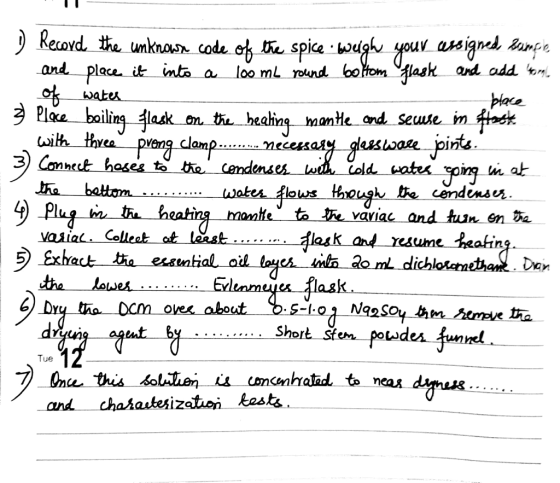
List the procedural steps, from start to finish, that are required to perform a steam distillation....
Assemble the glassware for fractional distillation according to the diagram and discussion above. Make certain that...
Assemble the glassware for fractional distillation according to the diagram and discussion above. Make certain that all joints are secure and that the apparatus is appropriately supported. Remember to allow for space below the distillation flask for the heating mantle and below the receiving flask for an ice bath. Pay extra attention to the positioning of the bulb of the thermometer as mentioned in the introduction. It is critical that the thermometer be positioned correctly for accurate temperature measurement. Using...
rewrite text in past tense Procedure-Simple Distillation 1. Take 60 ml of a 50:50 mixture of...
rewrite text in past tense Procedure-Simple Distillation 1. Take 60 ml of a 50:50 mixture of cyclohexane and toluene and place in a round bottom flask. Make sure you add a few boiling chips. 2. Assemble the distillation apparatus (See Figure 2.) and start the water flowing through the condenser. Place a graduated cylinder under the bent adapter so that you can measure the volume of distillate you collect. 3. Begin heating the sample with a heating mantle until it...
rewrite text in past tense Procedure-Simple Distillation 1. Take 60 ml of a 50:50 mixture of...
rewrite text in past tense Procedure-Simple Distillation 1. Take 60 ml of a 50:50 mixture of cyclohexane and toluene and place in a round bottom flask. Make sure you add a few boiling chips. 2. Assemble the distillation apparatus (See Figure 2.) and start the water flowing through the condenser. Place a graduated cylinder under the bent adapter so that you can measure the volume of distillate you collect. 3. Begin heating the sample with a heating mantle until it...
Remember in experiment 2 you used boiling chips; can the boiling sticks be replaced by boiling...
Remember in experiment 2 you used boiling chips; can the boiling sticks be replaced by boiling chips in this experiment? Explain your answer. Experiment2: Determination of Alcohol content of Wine by Fractional Distillation Introduction If a mixture of ethanol and water are warmed you might expect the more volatile (lower boiling) ethanol to boil first and then the water. This is not exactly true. As the mixture is warmed all the molecules within the flask will gain energy. In fact...
You don’t have to tell me purpose. just where in procedure for each technique. Section/Instructor SN2...
 You
don’t have to tell me purpose. just where in procedure for each
technique.
Section/Instructor SN2 Pre-lab (20 points) Answer on a separate piece of paper 1. (6 pts.) What is the purpose of the following experimental techniques and where in the procedure is each used? a. Heating under reflux b. Simple distillation c. Water wash d. Addition of COLD NAOH e. Saturated NaCl solution f. Addition of anhydrous sodium sulfate SN2 Reaction Procedure Set-Up: 100 mL RBF: 11.1 g...
You
don’t have to tell me purpose. just where in procedure for each
technique.
Section/Instructor SN2 Pre-lab (20 points) Answer on a separate piece of paper 1. (6 pts.) What is the purpose of the following experimental techniques and where in the procedure is each used? a. Heating under reflux b. Simple distillation c. Water wash d. Addition of COLD NAOH e. Saturated NaCl solution f. Addition of anhydrous sodium sulfate SN2 Reaction Procedure Set-Up: 100 mL RBF: 11.1 g...
The alcohol could easily be converted to a tosylate, a good leaving group, and a conventional sub...
 The alcohol could easily be converted to a tosylate, a good
leaving group, and a conventional substitution reaction could have
been performed instead of the nucleophilic aromatic substitution
(NAS) reaction. Why was the NAS reaction the preferred method?
(Hint : Look up the nucleophiles of both reactions on chemical
manufacturing site.)
Part A: Synthesis of (t)-N,N-dimethyl-3-phenyl-3-(4- trifluoromethylphenoxy)propanamine 1. To the 250-mL round-bottom flask (RBF) containing (t)-3-(dimethylamino)-1-phenylpropanol (product from Lab 6) and a magnetic stir bar, add 4 mL of 4-...
The alcohol could easily be converted to a tosylate, a good
leaving group, and a conventional substitution reaction could have
been performed instead of the nucleophilic aromatic substitution
(NAS) reaction. Why was the NAS reaction the preferred method?
(Hint : Look up the nucleophiles of both reactions on chemical
manufacturing site.)
Part A: Synthesis of (t)-N,N-dimethyl-3-phenyl-3-(4- trifluoromethylphenoxy)propanamine 1. To the 250-mL round-bottom flask (RBF) containing (t)-3-(dimethylamino)-1-phenylpropanol (product from Lab 6) and a magnetic stir bar, add 4 mL of 4-...
I was wondering if anyone could help with finding the theoretical yield? i need to get...
 I was wondering if anyone could help with finding the
theoretical yield? i need to get the Limiting Reagent to find the
theoretical yield. it would be appreciated thanks!
cyclohexanol MW: 110.16
cyclohexene MW: 82.14
Walol. 2. Cyclohexanol and especially cyclohexene are flammable liquids. Do not heating source in this experiment som stalo tento omos nopo of videos bos bosohoo Physical constants Cyclohexanol Cyclohexene bp (°C) 161 density (g/mL) 0.960 0.810 83 Experimental Procedure (macroscale) Add 20 mL of cyclohexanol...
I was wondering if anyone could help with finding the
theoretical yield? i need to get the Limiting Reagent to find the
theoretical yield. it would be appreciated thanks!
cyclohexanol MW: 110.16
cyclohexene MW: 82.14
Walol. 2. Cyclohexanol and especially cyclohexene are flammable liquids. Do not heating source in this experiment som stalo tento omos nopo of videos bos bosohoo Physical constants Cyclohexanol Cyclohexene bp (°C) 161 density (g/mL) 0.960 0.810 83 Experimental Procedure (macroscale) Add 20 mL of cyclohexanol...
The alcohol could easily be converted to a tosylate, a good leaving group, and a conventional...
 The alcohol could easily be converted to a tosylate, a good
leaving group, and a conventional substitution reaction could have
been performed instead of the nucleophilic aromatic substitution
(NAS) reaction. Why was the NAS reaction the preferred method?
(Hint : Look up the nucleophiles of both reactions on chemical
manufacturing site.)
Part A: Synthesis of (t)-N,N-dimethyl-3-phenyl-3-(4- trifluoromethylphenoxy)propanamine 1. To the 250-mL round-bottom flask (RBF) containing (t)-3-(dimethylamino)-1-phenylpropanol (product from Lab 6) and a magnetic stir bar, add 4 mL of 4-...
The alcohol could easily be converted to a tosylate, a good
leaving group, and a conventional substitution reaction could have
been performed instead of the nucleophilic aromatic substitution
(NAS) reaction. Why was the NAS reaction the preferred method?
(Hint : Look up the nucleophiles of both reactions on chemical
manufacturing site.)
Part A: Synthesis of (t)-N,N-dimethyl-3-phenyl-3-(4- trifluoromethylphenoxy)propanamine 1. To the 250-mL round-bottom flask (RBF) containing (t)-3-(dimethylamino)-1-phenylpropanol (product from Lab 6) and a magnetic stir bar, add 4 mL of 4-...
35. In a distillation set up a) Cold water flows into the condenser from the elevated...
 35. In a distillation set up a) Cold water flows into the condenser from the elevated end of the condenser and flows out of the lower end b) Plastic joint clips should not be used to hold the glass joints of the equipment together, equipment clamps are sufficient c) In a properly set up distillation experiment azeotropes will never occur. d) A and C alone e) None of the above 34. If a distillation is carried out under reduced pressure...
Please help with calculating the yield on this first page...the other two are data for your...
 Please help with calculating the yield on this first page...the
other two are data for your calculations. I believe the limiting
agent is 2-methoxyphenol, but I don't know how to calculate the
percent yield, or how to set that up...thank you
We were unable to transcribe this imageCHEM 246 Fundamentals of Organic Chemistry Laboratory Experimental Procedure Day 1 1. Bring a 50 mL round bottom flask, a yellow cap, and a cork ring to the reagent hood, measure 1 mL...
Please help with calculating the yield on this first page...the
other two are data for your calculations. I believe the limiting
agent is 2-methoxyphenol, but I don't know how to calculate the
percent yield, or how to set that up...thank you
We were unable to transcribe this imageCHEM 246 Fundamentals of Organic Chemistry Laboratory Experimental Procedure Day 1 1. Bring a 50 mL round bottom flask, a yellow cap, and a cork ring to the reagent hood, measure 1 mL...
 You
don’t have to tell me purpose. just where in procedure for each
technique.
Section/Instructor SN2 Pre-lab (20 points) Answer on a separate piece of paper 1. (6 pts.) What is the purpose of the following experimental techniques and where in the procedure is each used? a. Heating under reflux b. Simple distillation c. Water wash d. Addition of COLD NAOH e. Saturated NaCl solution f. Addition of anhydrous sodium sulfate SN2 Reaction Procedure Set-Up: 100 mL RBF: 11.1 g...
You
don’t have to tell me purpose. just where in procedure for each
technique.
Section/Instructor SN2 Pre-lab (20 points) Answer on a separate piece of paper 1. (6 pts.) What is the purpose of the following experimental techniques and where in the procedure is each used? a. Heating under reflux b. Simple distillation c. Water wash d. Addition of COLD NAOH e. Saturated NaCl solution f. Addition of anhydrous sodium sulfate SN2 Reaction Procedure Set-Up: 100 mL RBF: 11.1 g...
 The alcohol could easily be converted to a tosylate, a good
leaving group, and a conventional substitution reaction could have
been performed instead of the nucleophilic aromatic substitution
(NAS) reaction. Why was the NAS reaction the preferred method?
(Hint : Look up the nucleophiles of both reactions on chemical
manufacturing site.)
Part A: Synthesis of (t)-N,N-dimethyl-3-phenyl-3-(4- trifluoromethylphenoxy)propanamine 1. To the 250-mL round-bottom flask (RBF) containing (t)-3-(dimethylamino)-1-phenylpropanol (product from Lab 6) and a magnetic stir bar, add 4 mL of 4-...
The alcohol could easily be converted to a tosylate, a good
leaving group, and a conventional substitution reaction could have
been performed instead of the nucleophilic aromatic substitution
(NAS) reaction. Why was the NAS reaction the preferred method?
(Hint : Look up the nucleophiles of both reactions on chemical
manufacturing site.)
Part A: Synthesis of (t)-N,N-dimethyl-3-phenyl-3-(4- trifluoromethylphenoxy)propanamine 1. To the 250-mL round-bottom flask (RBF) containing (t)-3-(dimethylamino)-1-phenylpropanol (product from Lab 6) and a magnetic stir bar, add 4 mL of 4-...
 I was wondering if anyone could help with finding the
theoretical yield? i need to get the Limiting Reagent to find the
theoretical yield. it would be appreciated thanks!
cyclohexanol MW: 110.16
cyclohexene MW: 82.14
Walol. 2. Cyclohexanol and especially cyclohexene are flammable liquids. Do not heating source in this experiment som stalo tento omos nopo of videos bos bosohoo Physical constants Cyclohexanol Cyclohexene bp (°C) 161 density (g/mL) 0.960 0.810 83 Experimental Procedure (macroscale) Add 20 mL of cyclohexanol...
I was wondering if anyone could help with finding the
theoretical yield? i need to get the Limiting Reagent to find the
theoretical yield. it would be appreciated thanks!
cyclohexanol MW: 110.16
cyclohexene MW: 82.14
Walol. 2. Cyclohexanol and especially cyclohexene are flammable liquids. Do not heating source in this experiment som stalo tento omos nopo of videos bos bosohoo Physical constants Cyclohexanol Cyclohexene bp (°C) 161 density (g/mL) 0.960 0.810 83 Experimental Procedure (macroscale) Add 20 mL of cyclohexanol...
 The alcohol could easily be converted to a tosylate, a good
leaving group, and a conventional substitution reaction could have
been performed instead of the nucleophilic aromatic substitution
(NAS) reaction. Why was the NAS reaction the preferred method?
(Hint : Look up the nucleophiles of both reactions on chemical
manufacturing site.)
Part A: Synthesis of (t)-N,N-dimethyl-3-phenyl-3-(4- trifluoromethylphenoxy)propanamine 1. To the 250-mL round-bottom flask (RBF) containing (t)-3-(dimethylamino)-1-phenylpropanol (product from Lab 6) and a magnetic stir bar, add 4 mL of 4-...
The alcohol could easily be converted to a tosylate, a good
leaving group, and a conventional substitution reaction could have
been performed instead of the nucleophilic aromatic substitution
(NAS) reaction. Why was the NAS reaction the preferred method?
(Hint : Look up the nucleophiles of both reactions on chemical
manufacturing site.)
Part A: Synthesis of (t)-N,N-dimethyl-3-phenyl-3-(4- trifluoromethylphenoxy)propanamine 1. To the 250-mL round-bottom flask (RBF) containing (t)-3-(dimethylamino)-1-phenylpropanol (product from Lab 6) and a magnetic stir bar, add 4 mL of 4-...
 35. In a distillation set up a) Cold water flows into the condenser from the elevated end of the condenser and flows out of the lower end b) Plastic joint clips should not be used to hold the glass joints of the equipment together, equipment clamps are sufficient c) In a properly set up distillation experiment azeotropes will never occur. d) A and C alone e) None of the above 34. If a distillation is carried out under reduced pressure...
 Please help with calculating the yield on this first page...the
other two are data for your calculations. I believe the limiting
agent is 2-methoxyphenol, but I don't know how to calculate the
percent yield, or how to set that up...thank you
We were unable to transcribe this imageCHEM 246 Fundamentals of Organic Chemistry Laboratory Experimental Procedure Day 1 1. Bring a 50 mL round bottom flask, a yellow cap, and a cork ring to the reagent hood, measure 1 mL...
Please help with calculating the yield on this first page...the
other two are data for your calculations. I believe the limiting
agent is 2-methoxyphenol, but I don't know how to calculate the
percent yield, or how to set that up...thank you
We were unable to transcribe this imageCHEM 246 Fundamentals of Organic Chemistry Laboratory Experimental Procedure Day 1 1. Bring a 50 mL round bottom flask, a yellow cap, and a cork ring to the reagent hood, measure 1 mL...
Most questions answered within 3 hours.
-
Where is the error in this code sequence?
String s1 = "Hello";
String s2 = "ello";...
asked 10 months ago -
Financial data for Joel de Paris, Inc., for last year
follow:
Joel de Paris, Inc.
Balance...
asked 10 months ago -
Consider this reaction:
Al2(SO4)3 (aq)+ BaCl3
(aq) Al2Cl6 (aq)- +
3BaSO4(s) . What is the...
asked 10 months ago -
Suppose that Savneet is considering increasing her
recent random sample from 20 car rentals to 40...
asked 10 months ago -
Trucks arrive at an unloading terminal at an average rate of 120
per hour.
Trucks arrive...
asked 10 months ago -
Why are methanol and ethanol completely soluble in water while
octanol is not very little soluble....
asked 10 months ago -
A facilities manager at a university reads in a research report
that the mean amount of...
asked 10 months ago -
When the CuSO4 is rehydrated by adding water to the anhydrous
compound, is this an endothermic...
asked 10 months ago -
A ray of sunlight is passing from diamond into crown glass; the
angle of incidence is...
asked 10 months ago -
A block of mass 0.249 kg is placed on top of a light, vertical
spring of...
asked 10 months ago -
how do the kidneys compensate in the presences of acidosis
a) trigger hyperventilate
b) reserve acid...
asked 10 months ago -
Question 501 pts
The rental rate of capital to the firm increases. Which of the
following...
asked 10 months ago