
Question #2
In this part you are going to use the concepts in the first part to analyze the following scenario which has 6 parts (A through F).
Suppose our agent's income is $240. Only two goods exist for our agent, good X and good Y. Good X costs $10 per unit and Good Y costs $12 per unit. Assume this agent has indifference curves that look like those typically drawn in class.
Of the following bundles below, circle which bundle could possibly be an optimal consumption bundle (OCB) for this agent.
(11 units X, 12 units Y) (12 units X, 10 units Y) (13 units X, 8 units Y)
Explain how you got your answer in part (A). Why could the bundle you selected be an OCB, why couldn't the other bundles be an OCB?
Given this price change, and given the OCB you selected above, circle which of the following bundles could be Point B (where the change between the OCB and Point B represents the substitution effect):
(10 units X, 12 units Y) (12 units X, 15 units Y) (10 units X, 10 units Y)
Explain how you got your answer in part (C).
Homework Answers
Request Answer!
We need at least 10 more requests to produce the answer.
0 / 10 have requested this problem solution
The more requests, the faster the answer.
Add Answer to:
Question #2
In this part you are
going to use the concepts in the first part...
Suppose our agent's income is $240. Only two goods exist for our agent, good X and...
Suppose our agent's income is $240. Only two goods exist for our agent, good X and good Y. Good X costs $10 per unit and Good Y costs $12 per unit. Assume this agent has indifference curves that look like those typically drawn in class. Now suppose the price of Good Y decreases to $8 per unit. The price of Good X is still $10 per unit. A.Given this price change, and given the OCB you selected above, circle which...
1 Discrete goods Consider a setting withn 2 goods, here each good must be purchased in...
 1 Discrete goods Consider a setting withn 2 goods, here each good must be purchased in discrete one-unit increments. However, they need not be consumed that way each good is infinitely divisible once purchased and the agent may throw away portions if she so desires. Prices are linear, with P1 = 2 and P2-1. The agent's wealth is w = 8. 1. Draw the agent's budget set. 2. Suppose the agent has utility U(x) = r r . Find the...
4. Charlie likes both apples and bananas. He consumes nothing else. Charlie consumes x bushels of apples per year...
 4. Charlie likes both apples and bananas. He consumes nothing else. Charlie consumes x bushels of apples per year and x bushels of bananas per year. Suppose that Charlie's preference is represented in the following utility function: u(x,,Xy)-x,Xy . Suppose that the price of apples is S1, the price of bananas is S2, and Charlie's income is $40. (14 points) a. Draw Charlie's budget line. Plot a few points on the indifference curve that gives Charlie a utility of 150...
1. Charlie’s utility function for weekly consumption of bananas (B) and Apples (A) is given by...
1. Charlie’s utility function for weekly consumption of bananas (B) and Apples (A) is given by U = BA . a. Suppose Charlie consumes 20 bananas and 10 apples in a week. Sketch his indifference curve through that bundle on a diagram. (While it doesn’t really matter which good is on the horizontal axis, for consistency with our classwork, assume bananas are on the horizontal axis.) b. Use calculus (partial derivatives) to derive formulas for the marginal utilities (MU) of...
Question 2. Consider the following 8 bundles of goods x and y: A = (8,4) B...
Question 2. Consider the following 8 bundles of goods x and y: A = (8,4) B = (5,6) C = (5,9) D = (10,3) E =(1,4) F =(6,5) G=(2,8) H =(7,8) (a) Come up with an example of a utility function that will produce the following order of preference for the bundles, where H is most preferred, A and G are equally preferred, and E is least preferred. H , C , B , F , A = G ,...
Hello Tutor, Could you solve part d of this question for me ASAP. I need to...
 Hello Tutor,
Could you solve part d of this question for me ASAP. I need to
see how the diagrams will look like.
Thank you.
Person 1 and 2 are the only two individuals in an exchange economy. Each person drives utility from the consumption of two goods, x and y. Their utility functions are: 1. Person 1: U1 = xfyl-u Person 2: U2-x'' y," where (Xi,y) is consumption bundles of individual i E (1,2). The initial endowment bundles are:...
Hello Tutor,
Could you solve part d of this question for me ASAP. I need to
see how the diagrams will look like.
Thank you.
Person 1 and 2 are the only two individuals in an exchange economy. Each person drives utility from the consumption of two goods, x and y. Their utility functions are: 1. Person 1: U1 = xfyl-u Person 2: U2-x'' y," where (Xi,y) is consumption bundles of individual i E (1,2). The initial endowment bundles are:...
Hello tutor, could you help me solve this question as soon as possible? Thank you Person...
 Hello tutor, could you help me solve this question as soon as
possible?
Thank you
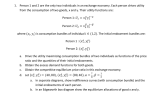
Person 1 and 2 are the only two individuals in an exchange economy. Each person drives utility from the consumption of two goods, x and y. Their utility functions are: 1. Person 1: U1 = xfyl-u Person 2: U2-x'' y," where (Xi,y) is consumption bundles of individual i E (1,2). The initial endowment bundles are: Person 1: (xgf.yt) Person 2: (x2,y2) Drive the utility maximizing...
Hello tutor, could you help me solve this question as soon as
possible?
Thank you
Person 1 and 2 are the only two individuals in an exchange economy. Each person drives utility from the consumption of two goods, x and y. Their utility functions are: 1. Person 1: U1 = xfyl-u Person 2: U2-x'' y," where (Xi,y) is consumption bundles of individual i E (1,2). The initial endowment bundles are: Person 1: (xgf.yt) Person 2: (x2,y2) Drive the utility maximizing...
Suppose that there two goods, X and Y , available in arbitrary nonnegative quantities (so the the...
Suppose that there two goods, X and Y , available in arbitrary nonnegative quantities (so the the consumption set is R 2 +). The consumer has preferences over consumption bundles that are monotone, strictly convex, and represented by the following (differentiable) utility function: u(x, y) = α √ x + (1 − α) √ y, where x is the quantity of good X, y is the quantity of good Y , and α ≥ 0 is a utility parameter. The...
(Use this information to answer a, b, c below) Suppose Mary’s utility function for two goods...
(Use this information to answer a, b, c below) Suppose Mary’s utility function for two goods X and Y is given by: U(X,Y) = 3X1/2Y1/2 . Suppose consumption bundle A consists of 10 units of X and 30 units of Y, and consumption bundle B consists of 40 units of X and 20 units of Y. a. Consumption bundle A lies on a higher/lower/same indifference curve than consumption bundle B. Show computations. b. Compute Mary’s MRSxy at consumption bundle A....
Please help me with this question, thank you so much! 1.a) Consider an agent who will...
 Please help me with this question, thank
you so much!
1.a) Consider an agent who will live for two periods with utility function U(x1, x2) = x1 * x * . The agent receives incomes 11 and 12 in periods 1 and 2 respectively. If the market interest rate is r = 10% and 14 = $10 and 12 = $10, solve for the agent's optimal consumption in each period. Graph the budget constraint and some indifference curves.
Please help me with this question, thank
you so much!
1.a) Consider an agent who will live for two periods with utility function U(x1, x2) = x1 * x * . The agent receives incomes 11 and 12 in periods 1 and 2 respectively. If the market interest rate is r = 10% and 14 = $10 and 12 = $10, solve for the agent's optimal consumption in each period. Graph the budget constraint and some indifference curves.
 1 Discrete goods Consider a setting withn 2 goods, here each good must be purchased in discrete one-unit increments. However, they need not be consumed that way each good is infinitely divisible once purchased and the agent may throw away portions if she so desires. Prices are linear, with P1 = 2 and P2-1. The agent's wealth is w = 8. 1. Draw the agent's budget set. 2. Suppose the agent has utility U(x) = r r . Find the...
 4. Charlie likes both apples and bananas. He consumes nothing else. Charlie consumes x bushels of apples per year and x bushels of bananas per year. Suppose that Charlie's preference is represented in the following utility function: u(x,,Xy)-x,Xy . Suppose that the price of apples is S1, the price of bananas is S2, and Charlie's income is $40. (14 points) a. Draw Charlie's budget line. Plot a few points on the indifference curve that gives Charlie a utility of 150...
 Hello Tutor,
Could you solve part d of this question for me ASAP. I need to
see how the diagrams will look like.
Thank you.
Person 1 and 2 are the only two individuals in an exchange economy. Each person drives utility from the consumption of two goods, x and y. Their utility functions are: 1. Person 1: U1 = xfyl-u Person 2: U2-x'' y," where (Xi,y) is consumption bundles of individual i E (1,2). The initial endowment bundles are:...
Hello Tutor,
Could you solve part d of this question for me ASAP. I need to
see how the diagrams will look like.
Thank you.
Person 1 and 2 are the only two individuals in an exchange economy. Each person drives utility from the consumption of two goods, x and y. Their utility functions are: 1. Person 1: U1 = xfyl-u Person 2: U2-x'' y," where (Xi,y) is consumption bundles of individual i E (1,2). The initial endowment bundles are:...
 Hello tutor, could you help me solve this question as soon as
possible?
Thank you
Person 1 and 2 are the only two individuals in an exchange economy. Each person drives utility from the consumption of two goods, x and y. Their utility functions are: 1. Person 1: U1 = xfyl-u Person 2: U2-x'' y," where (Xi,y) is consumption bundles of individual i E (1,2). The initial endowment bundles are: Person 1: (xgf.yt) Person 2: (x2,y2) Drive the utility maximizing...
Hello tutor, could you help me solve this question as soon as
possible?
Thank you
Person 1 and 2 are the only two individuals in an exchange economy. Each person drives utility from the consumption of two goods, x and y. Their utility functions are: 1. Person 1: U1 = xfyl-u Person 2: U2-x'' y," where (Xi,y) is consumption bundles of individual i E (1,2). The initial endowment bundles are: Person 1: (xgf.yt) Person 2: (x2,y2) Drive the utility maximizing...
 Please help me with this question, thank
you so much!
1.a) Consider an agent who will live for two periods with utility function U(x1, x2) = x1 * x * . The agent receives incomes 11 and 12 in periods 1 and 2 respectively. If the market interest rate is r = 10% and 14 = $10 and 12 = $10, solve for the agent's optimal consumption in each period. Graph the budget constraint and some indifference curves.
Please help me with this question, thank
you so much!
1.a) Consider an agent who will live for two periods with utility function U(x1, x2) = x1 * x * . The agent receives incomes 11 and 12 in periods 1 and 2 respectively. If the market interest rate is r = 10% and 14 = $10 and 12 = $10, solve for the agent's optimal consumption in each period. Graph the budget constraint and some indifference curves.
Most questions answered within 3 hours.
-
Where is the error in this code sequence?
String s1 = "Hello";
String s2 = "ello";...
asked 10 months ago -
Financial data for Joel de Paris, Inc., for last year
follow:
Joel de Paris, Inc.
Balance...
asked 10 months ago -
Consider this reaction:
Al2(SO4)3 (aq)+ BaCl3
(aq) Al2Cl6 (aq)- +
3BaSO4(s) . What is the...
asked 10 months ago -
Suppose that Savneet is considering increasing her
recent random sample from 20 car rentals to 40...
asked 10 months ago -
Trucks arrive at an unloading terminal at an average rate of 120
per hour.
Trucks arrive...
asked 10 months ago -
Why are methanol and ethanol completely soluble in water while
octanol is not very little soluble....
asked 10 months ago -
A facilities manager at a university reads in a research report
that the mean amount of...
asked 10 months ago -
When the CuSO4 is rehydrated by adding water to the anhydrous
compound, is this an endothermic...
asked 10 months ago -
A ray of sunlight is passing from diamond into crown glass; the
angle of incidence is...
asked 10 months ago -
A block of mass 0.249 kg is placed on top of a light, vertical
spring of...
asked 10 months ago -
how do the kidneys compensate in the presences of acidosis
a) trigger hyperventilate
b) reserve acid...
asked 10 months ago -
Question 501 pts
The rental rate of capital to the firm increases. Which of the
following...
asked 10 months ago