
Homework Answers
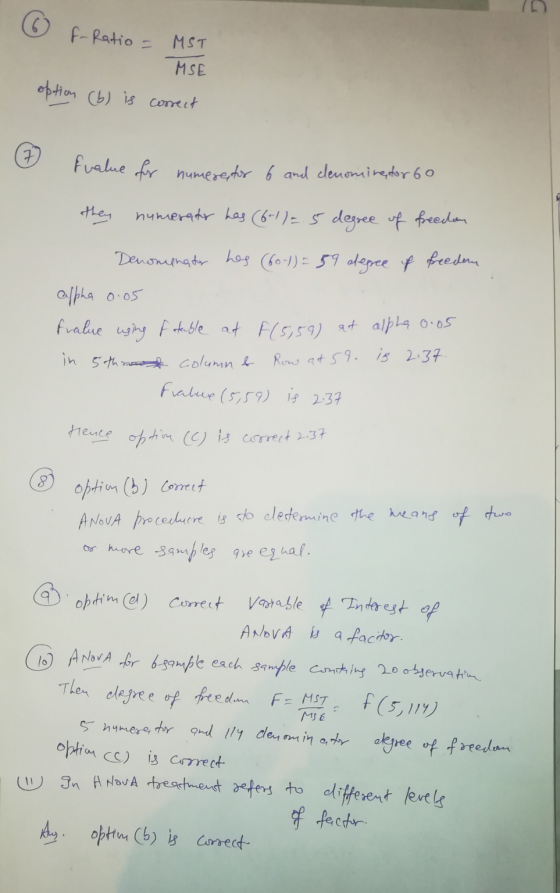
6) option (B) is correct
7) option (C) is correct F value 2.37
8) option (B) is correct
9) option (D) is correct
10) option (C) is correct
11) Option (B) is correct
Solution file is attached go through it
Thanks
Add Answer to:
The F ratio in a completely randomized ANOVA is the ratio of a. MSTR MSE b....
An ANOVA procedure is applied to data obtained from 7 samples where each sample contains 20...
 An ANOVA procedure is applied to data obtained from 7 samples where each sample contains 20 observations. The degrees of freedom for the critical value of Fare a. 7 numerator and 20 denominator degrees of freedom O b. 5 numerator and 114 denominator degrees of freedom O c. 6 numerator and 133 denominator degrees of freedom d. 6 numerator and 20 denominator degrees of freedom
In a completely randomized design, ten subjects were assigned to each of three treatments of a...
In a completely randomized design, ten subjects were assigned to each of three treatments of a factor. The partially completed ANOVA table is shown below. Complete parts a through d. Source DF Sum of Squares Mean Square F-Ratio P-Value Treatment (Between) 831.84 Error (Within) Total 1103.41 ?a) What are the degrees of freedom for? treatment, error, and? total? The degrees of freedom for treatment are nothing. ?(Simplify your? answer.) The degrees of freedom for error are nothing. ?(Simplify your? answer.)...
In a completely randomized design for ANOVA, the number of degrees of freedom for the numerator...
In a completely randomized design for ANOVA, the number of degrees of freedom for the numerator and denominator are 3 and 16, respectively. The total number of observations must equal: a. 24 b. 20 c. 19 d. 32 e. 48
Analysis of variance compares the means of a response variable for several groups. ANOVA compares the...
 Analysis of variance compares the means of a response variable for several groups. ANOVA compares the variation within each group to the variation of the mean of each group. The ratio of these two is the F statistic from an F distribution with (number of groups - 1) as the numerator degrees of freedom and (number of observations - number of groups) as the denominator degrees of freedom. You intend to conduct an ANOVA with 4 groups in which each...
Analysis of variance compares the means of a response variable for several groups. ANOVA compares the...
 Analysis of variance compares the means of a response variable for several groups. ANOVA compares the variation within each group to the variation of the mean of each group. The ratio of these two is the F statistic from an F distribution with (number of groups - 1) as the numerator degrees of freedom and (number of observations - number of groups) as the denominator degrees of freedom. You intend to conduct an ANOVA with 4 groups in which each...
Analysis of variance compares the means of a response variable for several groups. ANOVA compares the...
 Analysis of variance compares the means of a response variable for several groups. ANOVA compares the variation within each group to the variation of the mean of each group. The ratio of these two is the F statistic from an F distribution with (number of groups - 1) as the numerator degrees of freedom and (number of observations - number of groups) as the denominator degrees of freedom. You intend to conduct an ANOVA with 4 groups in which each...
Question 6 1 points Save An ANOVA procedure is applied to data obtained from 5 samples...
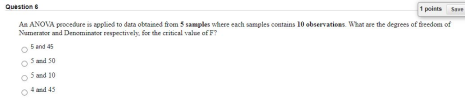 Question 6 1 points Save An ANOVA procedure is applied to data obtained from 5 samples where each samples contains 10 observations. What are the degrees of freedom of Numerator and Denominator respectively, for the critical value of F? 5 and 45 5 and 50 0 5 and 10 4 and 45
You intend to conduct an ANOVA with 7 groups in which each group will have the...
You intend to conduct an ANOVA with 7 groups in which each group will have the same number of subjects: n=6n=6. (This is referred to as a "balanced" single-factor ANOVA.) What are the degrees of freedom for the numerator? d.f.(treatment) = What are the degrees of freedom for the denominator? d.f.(error) =
Please help with the following multiple choice 1. In the one-way ANOVA where there are k...
Please help with the following multiple choice 1. In the one-way ANOVA where there are k treatments and n observations, the degrees of freedom for the F-statistic are equal to, respectively: a. n and k. b. k and n. c. n − k and k − 1. d. k − 1 and n − k. 2. In ANOVA, the F-test is the ratio of two sample variances. In the one-way ANOVA (completely randomized design), the variance used as a numerator...
Which of the following statements is not correct for an F-distribution? A. Exact shape of the...
Which of the following statements is not correct for an F-distribution? A. Exact shape of the distribution is determined by two numbers of degrees of freedom B. Variables that are F-distributed range from 0 to 100 C. Degrees of freedom for the numerator can be larger, smaller, or equal to the degrees of freedom for the denominator. D. Degrees of freedom for the denominator are always smaller than the degrees of freedom for the numerator In testing the difference between...
 An ANOVA procedure is applied to data obtained from 7 samples where each sample contains 20 observations. The degrees of freedom for the critical value of Fare a. 7 numerator and 20 denominator degrees of freedom O b. 5 numerator and 114 denominator degrees of freedom O c. 6 numerator and 133 denominator degrees of freedom d. 6 numerator and 20 denominator degrees of freedom
 Analysis of variance compares the means of a response variable for several groups. ANOVA compares the variation within each group to the variation of the mean of each group. The ratio of these two is the F statistic from an F distribution with (number of groups - 1) as the numerator degrees of freedom and (number of observations - number of groups) as the denominator degrees of freedom. You intend to conduct an ANOVA with 4 groups in which each...
 Analysis of variance compares the means of a response variable for several groups. ANOVA compares the variation within each group to the variation of the mean of each group. The ratio of these two is the F statistic from an F distribution with (number of groups - 1) as the numerator degrees of freedom and (number of observations - number of groups) as the denominator degrees of freedom. You intend to conduct an ANOVA with 4 groups in which each...
 Analysis of variance compares the means of a response variable for several groups. ANOVA compares the variation within each group to the variation of the mean of each group. The ratio of these two is the F statistic from an F distribution with (number of groups - 1) as the numerator degrees of freedom and (number of observations - number of groups) as the denominator degrees of freedom. You intend to conduct an ANOVA with 4 groups in which each...
 Question 6 1 points Save An ANOVA procedure is applied to data obtained from 5 samples where each samples contains 10 observations. What are the degrees of freedom of Numerator and Denominator respectively, for the critical value of F? 5 and 45 5 and 50 0 5 and 10 4 and 45
Most questions answered within 3 hours.
-
Where is the error in this code sequence?
String s1 = "Hello";
String s2 = "ello";...
asked 10 months ago -
Financial data for Joel de Paris, Inc., for last year
follow:
Joel de Paris, Inc.
Balance...
asked 10 months ago -
Consider this reaction:
Al2(SO4)3 (aq)+ BaCl3
(aq) Al2Cl6 (aq)- +
3BaSO4(s) . What is the...
asked 10 months ago -
Suppose that Savneet is considering increasing her
recent random sample from 20 car rentals to 40...
asked 10 months ago -
Trucks arrive at an unloading terminal at an average rate of 120
per hour.
Trucks arrive...
asked 10 months ago -
Why are methanol and ethanol completely soluble in water while
octanol is not very little soluble....
asked 10 months ago -
A facilities manager at a university reads in a research report
that the mean amount of...
asked 10 months ago -
When the CuSO4 is rehydrated by adding water to the anhydrous
compound, is this an endothermic...
asked 10 months ago -
A ray of sunlight is passing from diamond into crown glass; the
angle of incidence is...
asked 10 months ago -
A block of mass 0.249 kg is placed on top of a light, vertical
spring of...
asked 10 months ago -
how do the kidneys compensate in the presences of acidosis
a) trigger hyperventilate
b) reserve acid...
asked 10 months ago -
Question 501 pts
The rental rate of capital to the firm increases. Which of the
following...
asked 10 months ago