
Homework Answers
The drag force at velocity 20 m/s is

Let F be the traction force on the car. Applying Newton's Second Law along the longitudinal direction


Therefore, the power required by the car at this instant is

It is given that the engine efficiency is 0.75. Therefore, the power that the engine needs to generate is

Add Answer to:
0. A car has a mass of 2,000 kg. It is known that the velocity is...
Problem 4 A car of mass m is traveling at a slow velocity vo If it...
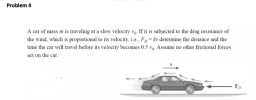 Problem 4 A car of mass m is traveling at a slow velocity vo If it is subjected to the drag resistance of the wind, which is proportional to its velocity, i.e., FD- kv determine the distance and the time the car will travel before its velocity becomes 0.5 Vo. Assume no other frictional forces act on the car
The car shown has a mass of 2,000 kg and a center of mass at G....
 The car shown has a mass of 2,000 kg and a center of mass at G.
Determine the car’s acceleration if the “driving” wheels in the
back are always slipping, whereas the front wheels freely rotate.
The coefficient of kinetic friction between the wheels and the road
is 0.25.
0.3 m " 1.25 m 0.75 m
The car shown has a mass of 2,000 kg and a center of mass at G.
Determine the car’s acceleration if the “driving” wheels in the
back are always slipping, whereas the front wheels freely rotate.
The coefficient of kinetic friction between the wheels and the road
is 0.25.
0.3 m " 1.25 m 0.75 m
A car travels at a constant velocity of 90 km/h along an expressway under-ambient temperature and...
 A car travels at a constant velocity of 90 km/h along an
expressway under-ambient temperature and pressure conditions. The
width of the car is 1.5 m while its height is 1.2 m. The wheelbase
(length between the front and rear wheels) is 2.5 m. The drag
coefficient is 0.22.
[Use
air, ambient density of the air = 1.12 kg/m3 and,
fuel, density of the fuel = 930 kg/m3. You may neglect
any energy contained in the exhaust gases and any...
A car travels at a constant velocity of 90 km/h along an
expressway under-ambient temperature and pressure conditions. The
width of the car is 1.5 m while its height is 1.2 m. The wheelbase
(length between the front and rear wheels) is 2.5 m. The drag
coefficient is 0.22.
[Use
air, ambient density of the air = 1.12 kg/m3 and,
fuel, density of the fuel = 930 kg/m3. You may neglect
any energy contained in the exhaust gases and any...
A car of mass 1100 kg starts from rest at sea level and climbs a hill...
A car of mass 1100 kg starts from rest at sea level and climbs a hill of height 50.0 m. At the top of the hill, the car has a speed of 25.0 m/s, and at this instant, the driver shuts off the engine of the car. The car then coasts down the other side of the hill to height of 15.0 m above sea level. Assume that friction and air resistance are negligibly small. a) (6 pts) How much...
Consider a Porsche 911 sports car with a mass of 1900 kg. The air drag force...
 Consider a Porsche 911 sports car with a mass of 1900 kg. The air drag force at highway speeds can be approximately calculated as: F_drag = 1/2 C p Av^2 where p = 1.2 kg/m^3 is the density of air, A is the front area of the car, C is the drag coefficient and v is the velocity. For the Porsche 911, we can take A - 2.3 m^2 and C = 0.28. What is the power necessary to overcome...
A 10 kg bar shown is currently moving with a center of mass velocity of 1...
 A 10 kg bar shown is currently moving with a center of mass
velocity of 1 m/s to the right. What is the angular velocity of the
bar at this instant in rad/s?
QUESTION 1 A 10 kg bar shown is currently moving with a center of mass velocity of 1 m/s to the right. What is the angular velocity of the bar at this instant in rad's? (gravity is acting in the vertical plane) 0.75 m V = 1...
A 10 kg bar shown is currently moving with a center of mass
velocity of 1 m/s to the right. What is the angular velocity of the
bar at this instant in rad/s?
QUESTION 1 A 10 kg bar shown is currently moving with a center of mass velocity of 1 m/s to the right. What is the angular velocity of the bar at this instant in rad's? (gravity is acting in the vertical plane) 0.75 m V = 1...
13) There are several types of drag on a car other than air resistance. Effects having...
13) There are several types of drag on a car other than air resistance. Effects having to do with the squeezing of the tires (rolling resistance) and frictional forces in the drivetrain (the system that transfers energy from the engine to the rotation of the wheels) also must be taken into account. Engineers use the following equation to model the total force due to these different effects Fdrag=A+Bv+Cv2Fdrag=A+Bv+Cv2 For a Camry, these coefficients are estimated to be A=117.130A=117.130 N, B=1.800...
P2.4-4) A car initially traveling at 60 mph coasts for 5 seconds. Due to friction and...
 P2.4-4) A car initially traveling at 60 mph coasts for 5 seconds. Due to friction and wind resistance, the car decelerates while coasting at a rate of 1 ft/s2. After the 5 seconds of coasting, the driver applies the brakes and decelerates at a constant rate eventually bringing the car to a stop. If the total time that the car travels is 8 seconds, determine the car's braking acceleration. Given: Find: Solution: Draw the acceleration and velocity curves. v (ft/s)...
The 1800-kg car descends a hill of angle 0 3°. The drag force due to air...
 The 1800-kg car descends a hill of angle 0 3°. The drag force due to air resistance is k 0.45 kg/m D kv2 for Use the sketch to complete a free-body diagram. From an initial velocity of 29 m/s (65 mph), the car coasts 1600 m along the slope. Determine the velocity at that point Hint: After finding the acceleration, choose a dr vs dvs to integrate the kinematics; the resulting integral simplifies with the substitution, u = denominator, which...
1) A railroad car of mass 2,000 kg traveling at a velocity v = 10 m/s...
 1) A railroad car of mass 2,000 kg traveling at a velocity v = 10 m/s is stopped at the end of the tracks by a spring-damper system, as shown below. If the stiffness of the spring is k= 40 N/mm and the damping constant c 20 N-s/mm, determine (a) the maximum displacement of the car after engaging the springs and damper, (b) the time taken to reach maximum displacement k2 P 0000 k/2
1) A railroad car of mass...
1) A railroad car of mass 2,000 kg traveling at a velocity v = 10 m/s is stopped at the end of the tracks by a spring-damper system, as shown below. If the stiffness of the spring is k= 40 N/mm and the damping constant c 20 N-s/mm, determine (a) the maximum displacement of the car after engaging the springs and damper, (b) the time taken to reach maximum displacement k2 P 0000 k/2
1) A railroad car of mass...
 Problem 4 A car of mass m is traveling at a slow velocity vo If it is subjected to the drag resistance of the wind, which is proportional to its velocity, i.e., FD- kv determine the distance and the time the car will travel before its velocity becomes 0.5 Vo. Assume no other frictional forces act on the car
 The car shown has a mass of 2,000 kg and a center of mass at G.
Determine the car’s acceleration if the “driving” wheels in the
back are always slipping, whereas the front wheels freely rotate.
The coefficient of kinetic friction between the wheels and the road
is 0.25.
0.3 m " 1.25 m 0.75 m
The car shown has a mass of 2,000 kg and a center of mass at G.
Determine the car’s acceleration if the “driving” wheels in the
back are always slipping, whereas the front wheels freely rotate.
The coefficient of kinetic friction between the wheels and the road
is 0.25.
0.3 m " 1.25 m 0.75 m
 A car travels at a constant velocity of 90 km/h along an
expressway under-ambient temperature and pressure conditions. The
width of the car is 1.5 m while its height is 1.2 m. The wheelbase
(length between the front and rear wheels) is 2.5 m. The drag
coefficient is 0.22.
[Use
air, ambient density of the air = 1.12 kg/m3 and,
fuel, density of the fuel = 930 kg/m3. You may neglect
any energy contained in the exhaust gases and any...
A car travels at a constant velocity of 90 km/h along an
expressway under-ambient temperature and pressure conditions. The
width of the car is 1.5 m while its height is 1.2 m. The wheelbase
(length between the front and rear wheels) is 2.5 m. The drag
coefficient is 0.22.
[Use
air, ambient density of the air = 1.12 kg/m3 and,
fuel, density of the fuel = 930 kg/m3. You may neglect
any energy contained in the exhaust gases and any...
 Consider a Porsche 911 sports car with a mass of 1900 kg. The air drag force at highway speeds can be approximately calculated as: F_drag = 1/2 C p Av^2 where p = 1.2 kg/m^3 is the density of air, A is the front area of the car, C is the drag coefficient and v is the velocity. For the Porsche 911, we can take A - 2.3 m^2 and C = 0.28. What is the power necessary to overcome...
 A 10 kg bar shown is currently moving with a center of mass
velocity of 1 m/s to the right. What is the angular velocity of the
bar at this instant in rad/s?
QUESTION 1 A 10 kg bar shown is currently moving with a center of mass velocity of 1 m/s to the right. What is the angular velocity of the bar at this instant in rad's? (gravity is acting in the vertical plane) 0.75 m V = 1...
A 10 kg bar shown is currently moving with a center of mass
velocity of 1 m/s to the right. What is the angular velocity of the
bar at this instant in rad/s?
QUESTION 1 A 10 kg bar shown is currently moving with a center of mass velocity of 1 m/s to the right. What is the angular velocity of the bar at this instant in rad's? (gravity is acting in the vertical plane) 0.75 m V = 1...
 P2.4-4) A car initially traveling at 60 mph coasts for 5 seconds. Due to friction and wind resistance, the car decelerates while coasting at a rate of 1 ft/s2. After the 5 seconds of coasting, the driver applies the brakes and decelerates at a constant rate eventually bringing the car to a stop. If the total time that the car travels is 8 seconds, determine the car's braking acceleration. Given: Find: Solution: Draw the acceleration and velocity curves. v (ft/s)...
 The 1800-kg car descends a hill of angle 0 3°. The drag force due to air resistance is k 0.45 kg/m D kv2 for Use the sketch to complete a free-body diagram. From an initial velocity of 29 m/s (65 mph), the car coasts 1600 m along the slope. Determine the velocity at that point Hint: After finding the acceleration, choose a dr vs dvs to integrate the kinematics; the resulting integral simplifies with the substitution, u = denominator, which...
 1) A railroad car of mass 2,000 kg traveling at a velocity v = 10 m/s is stopped at the end of the tracks by a spring-damper system, as shown below. If the stiffness of the spring is k= 40 N/mm and the damping constant c 20 N-s/mm, determine (a) the maximum displacement of the car after engaging the springs and damper, (b) the time taken to reach maximum displacement k2 P 0000 k/2
1) A railroad car of mass...
1) A railroad car of mass 2,000 kg traveling at a velocity v = 10 m/s is stopped at the end of the tracks by a spring-damper system, as shown below. If the stiffness of the spring is k= 40 N/mm and the damping constant c 20 N-s/mm, determine (a) the maximum displacement of the car after engaging the springs and damper, (b) the time taken to reach maximum displacement k2 P 0000 k/2
1) A railroad car of mass...
Most questions answered within 3 hours.
-
Where is the error in this code sequence?
String s1 = "Hello";
String s2 = "ello";...
asked 11 months ago -
Financial data for Joel de Paris, Inc., for last year
follow:
Joel de Paris, Inc.
Balance...
asked 11 months ago -
Consider this reaction:
Al2(SO4)3 (aq)+ BaCl3
(aq) Al2Cl6 (aq)- +
3BaSO4(s) . What is the...
asked 11 months ago -
Suppose that Savneet is considering increasing her
recent random sample from 20 car rentals to 40...
asked 11 months ago -
Trucks arrive at an unloading terminal at an average rate of 120
per hour.
Trucks arrive...
asked 11 months ago -
Why are methanol and ethanol completely soluble in water while
octanol is not very little soluble....
asked 11 months ago -
A facilities manager at a university reads in a research report
that the mean amount of...
asked 11 months ago -
When the CuSO4 is rehydrated by adding water to the anhydrous
compound, is this an endothermic...
asked 11 months ago -
A ray of sunlight is passing from diamond into crown glass; the
angle of incidence is...
asked 11 months ago -
A block of mass 0.249 kg is placed on top of a light, vertical
spring of...
asked 11 months ago -
how do the kidneys compensate in the presences of acidosis
a) trigger hyperventilate
b) reserve acid...
asked 11 months ago -
Question 501 pts
The rental rate of capital to the firm increases. Which of the
following...
asked 11 months ago