
Homework Answers
Add Answer to:
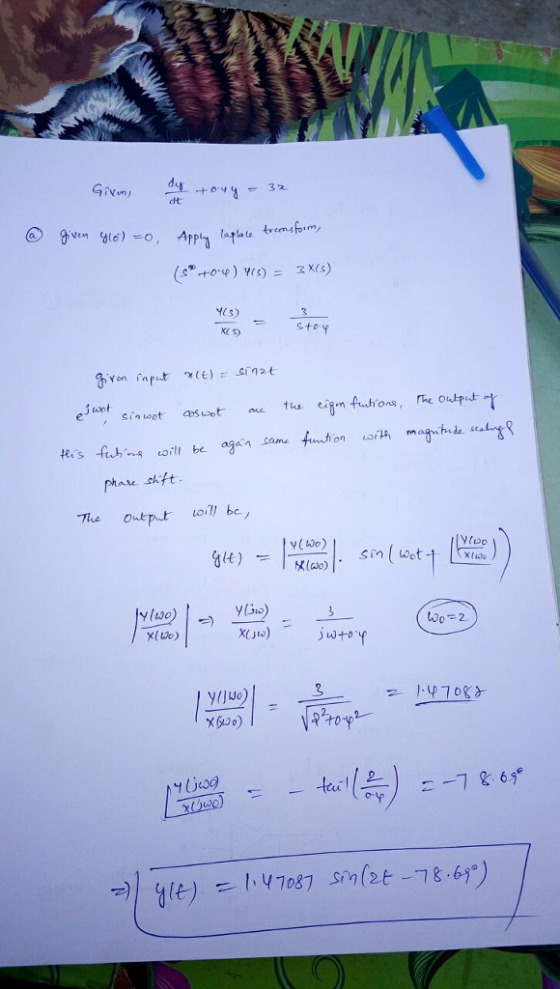
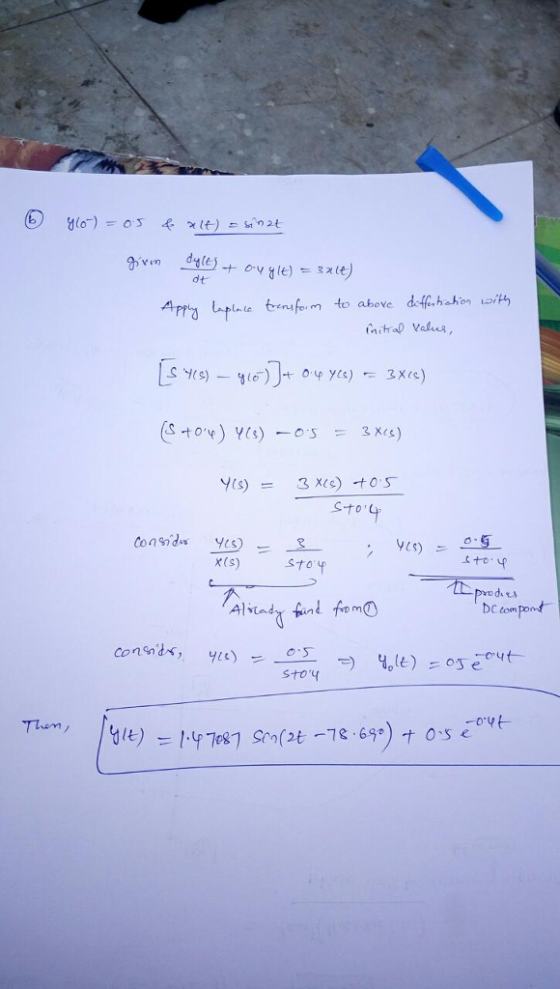
Given the following first-order system: dy(t) dt where x(t) represents input, and y(t) represents the output....
1. Consider a continuous system whose input x(t) and output y(t) are related by dy(t) +...
 1. Consider a continuous system whose input x(t) and output y(t) are related by dy(t) + ay(t) = x(t) dt where a is a constant. (a) Find y(t) with the condition y(0) = yo and x(t) = Ke-bu(t) (b) Express y(t) in terms of the zero-input and zero-state responses. 2. Consider the system in Problem 1. (a) Show that the system is not linear if y(0) = yo 70. (b) Show that the system is linear if y(0) = 0....
Let a linear system with input x(t) and output y(t) be described by the differential equation...
 Let a linear system with input x(t) and output y(t) be described
by the differential equation .
(a) Compute the simplest math function form of the impulse
response h(t) for this system. HINT: Remember that with zero
initial conditions, the following Laplace transform pairs hold:
Let the time-domain function p(t) be given by p(t) = g(3 − 0.5
t). (a) Compute the simplest piecewise math form for p(t).
(b) Plot p(t) over the range 0 ≤ t ≤ 10 ....
Let a linear system with input x(t) and output y(t) be described
by the differential equation .
(a) Compute the simplest math function form of the impulse
response h(t) for this system. HINT: Remember that with zero
initial conditions, the following Laplace transform pairs hold:
Let the time-domain function p(t) be given by p(t) = g(3 − 0.5
t). (a) Compute the simplest piecewise math form for p(t).
(b) Plot p(t) over the range 0 ≤ t ≤ 10 ....
Find the time constant t of the following differential equation: a(dy/dt)+by+cx=e(dx/dt)+f(dy/dt)...
 Find the time constant t of the following differential
equation: a(dy/dt)+by+cx=e(dx/dt)+f(dy/dt)+g, of the given that x
is the inout, y is the output, and a through g are constants.
13, Find the time constant τ from the following differential equation, dt dt given that x is the input, y is the output and, a through g are constants. It is known that for a first-order instrument with differential equation a time constant r- alao dy the
13, Find the time...
Find the time constant t of the following differential
equation: a(dy/dt)+by+cx=e(dx/dt)+f(dy/dt)+g, of the given that x
is the inout, y is the output, and a through g are constants.
13, Find the time constant τ from the following differential equation, dt dt given that x is the input, y is the output and, a through g are constants. It is known that for a first-order instrument with differential equation a time constant r- alao dy the
13, Find the time...
Consider a first-order system with input x(t) and output y(t). Let the time constant be the...
 Consider a first-order system with input x(t) and output y(t). Let the time constant be the part of your birth date in the format of day, month (ddmm) in microseconds. Complete the following steps: 1. Write the differential equation representing the system. 2. Derive the transfer function H(s). A Note: Label all graphs appropriately. ddmm 3. Use H(s) with MATLAB to complete the following actions: • Find the poles are zeros. • Find the step response. • Find the impulse...
Using the Runge-Kutta fourth-order method, obtain a solution to dx/dt=f(t,x,y)=xy^3+t^2; dy/dt=g(t,x,y)=ty+x^3 for t= 0 to t= 1 second. The initial conditions are given as x(0)=0, y(0) =1. Use a time...
Using the Runge-Kutta fourth-order method, obtain a solution to dx/dt=f(t,x,y)=xy^3+t^2; dy/dt=g(t,x,y)=ty+x^3 for t= 0 to t= 1 second. The initial conditions are given as x(0)=0, y(0) =1. Use a time increment of 0.2 seconds. Do hand calculations for t = 0.2 sec only.
1.7-3 For a certain LTI system with the input f(t), the output y(t) and the two initial conditions (0) and 2(0), follow...
 1.7-3 For a certain LTI system with the input f(t), the output y(t) and the two initial conditions (0) and 2(0), following observations were made 1(0) z2(0) eu(t) e(3+2)u(t) 2u(t) 0 0 (t) Determine v(t) when both the initial conditions are zero and the input f(t) is as shown in Fig. P1.7-3. Hint: There are three causes: the input and each of the two initial conditions. Because of linearity property, if a cause is increased by a factor k, the...
An LTI system is described by the following differential equation. Find the output when x(t)- u(t)...
 An LTI system is described by the following differential equation. Find the output when x(t)- u(t) and has the following initial conditions: y(0)= 1, (0) = 2 , and x(0)--I dy x dx +at + 4 y(t) = dt + x(t) Solution
Problem 4. Given the input/output system represented by t-1 y(t) = 2 ( x(y - 3)...
 Problem 4. Given the input/output system represented by t-1 y(t) = 2 ( x(y - 3) dy where x(t) is the input and y(t) is the output, a) Determine whether the system is linear or non-linear. b) Determine the impulse response h(t, to) of the system by setting x(t)= 8(t–to). c) Determine whether the system is time invariant or time variant. d) Determine whether the system is causal or non-causal.
aliasing? A continuous-time system is given by the input/output differential equation 4. H(s) v(t) dy(t) dt dx(t) + 2 (+ x(t 2) dt (a) Determine its transfer function H(s)? (b) Determine its impulse...
 aliasing? A continuous-time system is given by the input/output differential equation 4. H(s) v(t) dy(t) dt dx(t) + 2 (+ x(t 2) dt (a) Determine its transfer function H(s)? (b) Determine its impulse response. (c) Determine its step response. (d) Is the stable? (a) Give two reasons why digital filters are favored over analog filters 5. (b) What is the main difference between IIR and FIR digital filters? (c) Give an example of a second order IIR filter and FIR...
(6). The quantities x(t) and y(t) satisfy the simultaneous equations dt dt dx dt where x(0)-y(0)-...
 (6). The quantities x(t) and y(t) satisfy the simultaneous equations dt dt dx dt where x(0)-y(0)-ay (0)-0, and ax (0)-λ. Here n, μ, and λ are all positive real numbers. This problem involves Laplace transforms, has three parts, and is continued on the next page. You must use Laplace transforms where instructed to receive credit for your solution (a). Define the Laplace Transforms X(s) -|e"x(t)dt and Y(s) -e-"y(t)dt Laplace Transform the differential equations for x(t) and y(t) above, and incorporate...
 1. Consider a continuous system whose input x(t) and output y(t) are related by dy(t) + ay(t) = x(t) dt where a is a constant. (a) Find y(t) with the condition y(0) = yo and x(t) = Ke-bu(t) (b) Express y(t) in terms of the zero-input and zero-state responses. 2. Consider the system in Problem 1. (a) Show that the system is not linear if y(0) = yo 70. (b) Show that the system is linear if y(0) = 0....
 Let a linear system with input x(t) and output y(t) be described
by the differential equation .
(a) Compute the simplest math function form of the impulse
response h(t) for this system. HINT: Remember that with zero
initial conditions, the following Laplace transform pairs hold:
Let the time-domain function p(t) be given by p(t) = g(3 − 0.5
t). (a) Compute the simplest piecewise math form for p(t).
(b) Plot p(t) over the range 0 ≤ t ≤ 10 ....
Let a linear system with input x(t) and output y(t) be described
by the differential equation .
(a) Compute the simplest math function form of the impulse
response h(t) for this system. HINT: Remember that with zero
initial conditions, the following Laplace transform pairs hold:
Let the time-domain function p(t) be given by p(t) = g(3 − 0.5
t). (a) Compute the simplest piecewise math form for p(t).
(b) Plot p(t) over the range 0 ≤ t ≤ 10 ....
 Find the time constant t of the following differential
equation: a(dy/dt)+by+cx=e(dx/dt)+f(dy/dt)+g, of the given that x
is the inout, y is the output, and a through g are constants.
13, Find the time constant τ from the following differential equation, dt dt given that x is the input, y is the output and, a through g are constants. It is known that for a first-order instrument with differential equation a time constant r- alao dy the
13, Find the time...
Find the time constant t of the following differential
equation: a(dy/dt)+by+cx=e(dx/dt)+f(dy/dt)+g, of the given that x
is the inout, y is the output, and a through g are constants.
13, Find the time constant τ from the following differential equation, dt dt given that x is the input, y is the output and, a through g are constants. It is known that for a first-order instrument with differential equation a time constant r- alao dy the
13, Find the time...
 Consider a first-order system with input x(t) and output y(t). Let the time constant be the part of your birth date in the format of day, month (ddmm) in microseconds. Complete the following steps: 1. Write the differential equation representing the system. 2. Derive the transfer function H(s). A Note: Label all graphs appropriately. ddmm 3. Use H(s) with MATLAB to complete the following actions: • Find the poles are zeros. • Find the step response. • Find the impulse...
 1.7-3 For a certain LTI system with the input f(t), the output y(t) and the two initial conditions (0) and 2(0), following observations were made 1(0) z2(0) eu(t) e(3+2)u(t) 2u(t) 0 0 (t) Determine v(t) when both the initial conditions are zero and the input f(t) is as shown in Fig. P1.7-3. Hint: There are three causes: the input and each of the two initial conditions. Because of linearity property, if a cause is increased by a factor k, the...
 An LTI system is described by the following differential equation. Find the output when x(t)- u(t) and has the following initial conditions: y(0)= 1, (0) = 2 , and x(0)--I dy x dx +at + 4 y(t) = dt + x(t) Solution
 Problem 4. Given the input/output system represented by t-1 y(t) = 2 ( x(y - 3) dy where x(t) is the input and y(t) is the output, a) Determine whether the system is linear or non-linear. b) Determine the impulse response h(t, to) of the system by setting x(t)= 8(t–to). c) Determine whether the system is time invariant or time variant. d) Determine whether the system is causal or non-causal.
 aliasing? A continuous-time system is given by the input/output differential equation 4. H(s) v(t) dy(t) dt dx(t) + 2 (+ x(t 2) dt (a) Determine its transfer function H(s)? (b) Determine its impulse response. (c) Determine its step response. (d) Is the stable? (a) Give two reasons why digital filters are favored over analog filters 5. (b) What is the main difference between IIR and FIR digital filters? (c) Give an example of a second order IIR filter and FIR...
 (6). The quantities x(t) and y(t) satisfy the simultaneous equations dt dt dx dt where x(0)-y(0)-ay (0)-0, and ax (0)-λ. Here n, μ, and λ are all positive real numbers. This problem involves Laplace transforms, has three parts, and is continued on the next page. You must use Laplace transforms where instructed to receive credit for your solution (a). Define the Laplace Transforms X(s) -|e"x(t)dt and Y(s) -e-"y(t)dt Laplace Transform the differential equations for x(t) and y(t) above, and incorporate...
Most questions answered within 3 hours.
-
Where is the error in this code sequence?
String s1 = "Hello";
String s2 = "ello";...
asked 10 months ago -
Financial data for Joel de Paris, Inc., for last year
follow:
Joel de Paris, Inc.
Balance...
asked 10 months ago -
Consider this reaction:
Al2(SO4)3 (aq)+ BaCl3
(aq) Al2Cl6 (aq)- +
3BaSO4(s) . What is the...
asked 10 months ago -
Suppose that Savneet is considering increasing her
recent random sample from 20 car rentals to 40...
asked 10 months ago -
Trucks arrive at an unloading terminal at an average rate of 120
per hour.
Trucks arrive...
asked 10 months ago -
Why are methanol and ethanol completely soluble in water while
octanol is not very little soluble....
asked 10 months ago -
A facilities manager at a university reads in a research report
that the mean amount of...
asked 10 months ago -
When the CuSO4 is rehydrated by adding water to the anhydrous
compound, is this an endothermic...
asked 10 months ago -
A ray of sunlight is passing from diamond into crown glass; the
angle of incidence is...
asked 10 months ago -
A block of mass 0.249 kg is placed on top of a light, vertical
spring of...
asked 10 months ago -
how do the kidneys compensate in the presences of acidosis
a) trigger hyperventilate
b) reserve acid...
asked 10 months ago -
Question 501 pts
The rental rate of capital to the firm increases. Which of the
following...
asked 10 months ago