Can conductivity be used to decide between two salts with metal ions of the same charge?
Homework Answers

Add Answer to:
Can
conductivity be used to decide between two salts with metal ions of
the same charge?
It is of interest to decide if an analytical separation of the metal ions can be...
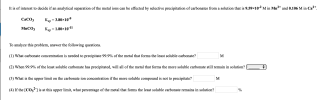 It is of interest to decide if an analytical separation of the metal ions can be effected by selective precipitation of carbonates from a solution that is 9.59x10² M in Mn2+ and 0.106 M in Ca24 СаСОз Ksp 3.80x10⁻⁹ MnCO3 = 1.80x10⁻¹¹ Kşp To analyze this problem, answer the following questions (1) What carbonate concentration is needed to precipitate 99.9% of the metal that forms the least soluble carbonate? M (2) When 99.9% of the least soluble carbonate has precipitated,...
It is of interest to decide if an analytical separation of the metal ions can be...
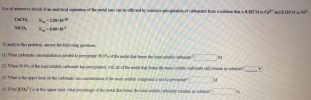 It is of interest to decide if an analytical separation of the metal ions can be effected by selective precipitation of carbonates ftrom a solution that is 0.102 M im Cu? and 0.110 M in NP Kp-2.50 10-10 NiCOs Kup-6.60 10 To analyze this problem, answer the following questions (1) What carbonate concentration is needed to precipitate 99 9% of the metal that forms the least soluble carbonate? When 990% of the least sol ble cat nate has precipt ated,...
It is of interest to decide if an analytical separation of the metal ions can be...
 It is of interest to decide if an analytical separation of the metal ions can be effected by selective precipitation of carbonates from a solution that is 0.102 M in Cu²+ and 0.110 Min Ni2+ NiCO3 CuCO3 Ksp = 6.60X10⁻⁹ K = 2.50X10⁻¹⁰ To analyze this problem, answer the following questions. (1) What carbonate concentration is needed to precipitate 99.9% of the metal that forms the least soluble carbonate? C M (2) When 99.9% of the least soluble carbonate has...
It is of interest to decide if an analytical separation of the metal ions can be...
It is of interest to decide if an analytical separation of the metal ions can be effected by selective precipitation of carbonates from a solution that is 9.11×10⁻² M in Cu2+ and 0.100 M in Ca2+. CaCO3 Ksp = 3.80×10⁻⁹ CuCO3 Ksp = 2.50×10⁻¹⁰ To analyze this problem, answer the following questions. (1) What carbonate concentration is needed to precipitate 99.9% of the metal that forms the least soluble carbonate? __M (2) When 99.9% of the least soluble carbonate has...
conclusions: 1. If two salts release a different number of ions into solution when they dissolve,...
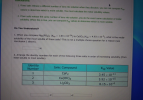 conclusions: 1. If two salts release a different number of ions into solution when they dissolve, you can not compare ko values to determine which is more soluble. You must calculate the molar solubility values 2. If two salts release the same number of ions into solution, you do the exact same calculation of molar solubility. When this is true, you can compare Ksp values to determine which is more soluble. Do You Understand? 1. When you compare Mg3(PO4)2 (Ksp...
If the metal in the ionic compound is a transition element (with variable charge metal ions),...
If the metal in the ionic compound is a transition element (with variable charge metal ions), the ionic charge is written as a Roman numeral following the element name of the cation. Name the compound CuF2. Spell out the full name of the ionic compound.
Question 1 (1 point) The reaction of metal ions with dilute NaOH (Itd.OH") produces the same...
 Question 1 (1 point) The reaction of metal ions with dilute NaOH (Itd.OH") produces the same result as the reaction with dilute aqueous NH3 because they are both Arrhenius bases. True False Question 2 (1 point) Since dilute NaOH (Itd.OH") and dilute aqueous NH3 produce similar results, why do the results differ between excess NaOH (xs. OH") and concentrated aqueous NH3? The results differ because the ammonia (when added in excess amounts) can form an anionic complex with the metal...
The aqueous solutions of the transition metal salts are acidic as a result of hydrolysis of...
 The aqueous solutions of the transition metal salts are acidic as a result of hydrolysis of their hydrated cations. The H2O in these hydrated cations can form different colors in the solution of colmplex ions by entering ligand exchange reaction with different ligands like CI, NH3 SO Cu2+ Fe2+ Cr3+ Ni2+ Co2+ Mn2+ Al3+ V3+ Sc3+ salts are separately a)Write down water-solubility / hydration reactions. b)Write down the hydrolysis reactions and explain the reason for the acidity according to the...
For questions 5-8, write names for the binary salts of representative elements. These are ionic compounds...
 For questions 5-8, write names for the binary salts of representative elements. These are ionic compounds in which the metal ion has only one observed charge. Therefore, it is not necessary to designate the charge of the metal ion. The expected charges of the ions, and the need to have the formula in lowest terms, means that no Greek prefixes are necessary to indicate the number of ions in the formula. 5. CaF2 6. MgaN2 7. Nal 8. AIP For...
In many chemical reactions of two or more compounds, ions are present in the solution that...
In many chemical reactions of two or more compounds, ions are present in the solution that do not participate in the reaction. These ions, known as spectator ions, can be removed from the chemical equation describing the reaction. A chemical equation that has the spectator ions removed is known as a net ionic equation. Reactions between ionic compounds often result in the precipitation of an insoluble compound. Spectator ions and precipitation products of a chemical reaction can be predicted by...
 It is of interest to decide if an analytical separation of the metal ions can be effected by selective precipitation of carbonates from a solution that is 9.59x10² M in Mn2+ and 0.106 M in Ca24 СаСОз Ksp 3.80x10⁻⁹ MnCO3 = 1.80x10⁻¹¹ Kşp To analyze this problem, answer the following questions (1) What carbonate concentration is needed to precipitate 99.9% of the metal that forms the least soluble carbonate? M (2) When 99.9% of the least soluble carbonate has precipitated,...
 It is of interest to decide if an analytical separation of the metal ions can be effected by selective precipitation of carbonates ftrom a solution that is 0.102 M im Cu? and 0.110 M in NP Kp-2.50 10-10 NiCOs Kup-6.60 10 To analyze this problem, answer the following questions (1) What carbonate concentration is needed to precipitate 99 9% of the metal that forms the least soluble carbonate? When 990% of the least sol ble cat nate has precipt ated,...
 It is of interest to decide if an analytical separation of the metal ions can be effected by selective precipitation of carbonates from a solution that is 0.102 M in Cu²+ and 0.110 Min Ni2+ NiCO3 CuCO3 Ksp = 6.60X10⁻⁹ K = 2.50X10⁻¹⁰ To analyze this problem, answer the following questions. (1) What carbonate concentration is needed to precipitate 99.9% of the metal that forms the least soluble carbonate? C M (2) When 99.9% of the least soluble carbonate has...
 conclusions: 1. If two salts release a different number of ions into solution when they dissolve, you can not compare ko values to determine which is more soluble. You must calculate the molar solubility values 2. If two salts release the same number of ions into solution, you do the exact same calculation of molar solubility. When this is true, you can compare Ksp values to determine which is more soluble. Do You Understand? 1. When you compare Mg3(PO4)2 (Ksp...
 Question 1 (1 point) The reaction of metal ions with dilute NaOH (Itd.OH") produces the same result as the reaction with dilute aqueous NH3 because they are both Arrhenius bases. True False Question 2 (1 point) Since dilute NaOH (Itd.OH") and dilute aqueous NH3 produce similar results, why do the results differ between excess NaOH (xs. OH") and concentrated aqueous NH3? The results differ because the ammonia (when added in excess amounts) can form an anionic complex with the metal...
 The aqueous solutions of the transition metal salts are acidic as a result of hydrolysis of their hydrated cations. The H2O in these hydrated cations can form different colors in the solution of colmplex ions by entering ligand exchange reaction with different ligands like CI, NH3 SO Cu2+ Fe2+ Cr3+ Ni2+ Co2+ Mn2+ Al3+ V3+ Sc3+ salts are separately a)Write down water-solubility / hydration reactions. b)Write down the hydrolysis reactions and explain the reason for the acidity according to the...
 For questions 5-8, write names for the binary salts of representative elements. These are ionic compounds in which the metal ion has only one observed charge. Therefore, it is not necessary to designate the charge of the metal ion. The expected charges of the ions, and the need to have the formula in lowest terms, means that no Greek prefixes are necessary to indicate the number of ions in the formula. 5. CaF2 6. MgaN2 7. Nal 8. AIP For...
Most questions answered within 3 hours.
-
Where is the error in this code sequence?
String s1 = "Hello";
String s2 = "ello";...
asked 10 months ago -
Financial data for Joel de Paris, Inc., for last year
follow:
Joel de Paris, Inc.
Balance...
asked 10 months ago -
Consider this reaction:
Al2(SO4)3 (aq)+ BaCl3
(aq) Al2Cl6 (aq)- +
3BaSO4(s) . What is the...
asked 10 months ago -
Suppose that Savneet is considering increasing her
recent random sample from 20 car rentals to 40...
asked 10 months ago -
Trucks arrive at an unloading terminal at an average rate of 120
per hour.
Trucks arrive...
asked 10 months ago -
Why are methanol and ethanol completely soluble in water while
octanol is not very little soluble....
asked 10 months ago -
A facilities manager at a university reads in a research report
that the mean amount of...
asked 10 months ago -
When the CuSO4 is rehydrated by adding water to the anhydrous
compound, is this an endothermic...
asked 10 months ago -
A ray of sunlight is passing from diamond into crown glass; the
angle of incidence is...
asked 10 months ago -
A block of mass 0.249 kg is placed on top of a light, vertical
spring of...
asked 10 months ago -
how do the kidneys compensate in the presences of acidosis
a) trigger hyperventilate
b) reserve acid...
asked 10 months ago -
Question 501 pts
The rental rate of capital to the firm increases. Which of the
following...
asked 10 months ago