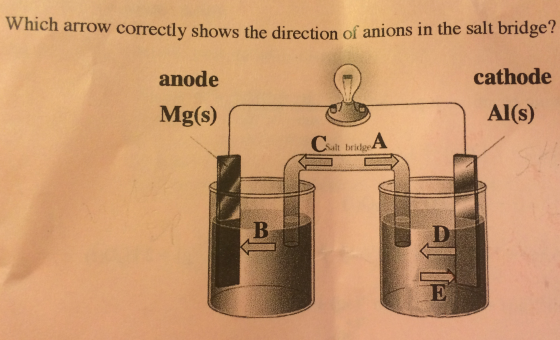
Which arrow correctly shows the direction of anions in the salt bridge? Please explain the correct...
Which arrow correctly shows the direction of anions in the salt bridge?
Please explain the correct answer and why the others are incorrect please.
Homework Answers
anions are negatively charged, they will go to the cathode, and lose electrons
then
expect
the "A" direction in the salt bridge
they go from solution in "B" to the cathode in E
Add Answer to:
Which arrow correctly shows the direction of anions in the salt
bridge?
Please explain the correct...
The salt bridge was soaked with a saturated solution of KNO3. In which direction do the...
The salt bridge was soaked with a saturated solution of KNO3. In which direction do the K+ ions move when this salt bridge is used to complete the electric circuit in the electrochemical cell in Part I? Toward the zinc metal or toward the copper metal? In which direction do the NO 3- ions move?
206. Please label the cathode, anode, salt bridge, and the direction of the electron flow Zn...
 206. Please label the cathode, anode, salt bridge, and the direction of the electron flow Zn Cu CuSO4 ZnSO4 207. For the voltaic cell in previous question, please write down the 2 half reactions Cutey
1- what is hydrated salt? 2what is the common anions are present in tap water? 3-explain...
1- what is hydrated salt? 2what is the common anions are present in tap water? 3-explain endpoint during titration. Please Answer these problems in an easy way
Which statement correctly describes chemical activity, as it relates to this diagram? Wire Zn) Salt bridge...
 Which statement correctly describes chemical activity, as it relates to this diagram? Wire Zn) Salt bridge Cu2 SO Zn2 so Zn(s) → Zn2+ + 2 e Cu 2m Cu(s) D Zinc and copper are equally chemically active D Zinc is less chemically active than copper D Zinc is more active than copper O None of the above
Choose the sketch which correctly shows the direction of the magnetic field (in red) and the...
 Choose the sketch which correctly shows the direction of the
magnetic field (in red) and the direction of the particle's
circular motion (in green).
Choose the sketch which correctly shows the direction of the magnetic field (in red) and the direction of the particle's circular motion (in green). Х X X X X х x x x x x Х Х Х Х Х
Choose the sketch which correctly shows the direction of the
magnetic field (in red) and the direction of the particle's
circular motion (in green).
Choose the sketch which correctly shows the direction of the magnetic field (in red) and the direction of the particle's circular motion (in green). Х X X X X х x x x x x Х Х Х Х Х
salt bridge Zn(s) electrode Culs) electrode 1.0M Zn (a 1.0 M Cu (aq A voltaic cell...
 salt bridge Zn(s) electrode Culs) electrode 1.0M Zn (a 1.0 M Cu (aq A voltaic cell similar to that shown in the figure above is constructed. The electronic device shown at the top of the figure is a volt meter. One electrode compartment consists of a zinc strip placed in a 1.0 M ZnCl2 solution, and the other has a copper strip placed in a 1.0 M CuSOA solution. The overall cell reaction is: Zn(s)Cu2+(aq)= zn2+ (aq ) Cu (s)...
salt bridge ME Cr(s) electrode Cu(s) electrode 1.0 M Cr3+ (aq) 1.0 M Cu2+ (aq) A...
 salt bridge ME Cr(s) electrode Cu(s) electrode 1.0 M Cr3+ (aq) 1.0 M Cu2+ (aq) A electrolytic cell similar to that shown in the figure above is constructed. The electronic device shown at the top of the figure is a power supply. One electrode compartment consists of a chromium strip placed in a 1.0 M CrCl3 solution, and the other has a copper strip placed in a 1.0 M CuSO4 solution. The overall cell reaction is: 2 Cr3+ (aq) +...
A standard galvanic cell is constructed with Cr3+|Cr2+ and Cd2+|Cd half cell compartments connected by a salt bridge. Which of the following statements are correct? Hint: Refer to a table of standard...
A standard galvanic cell is constructed with Cr3+|Cr2+ and Cd2+|Cd half cell compartments connected by a salt bridge. Which of the following statements are correct? Hint: Refer to a table of standard reduction potentials. (Choose all that apply.) In the external circuit, electrons flow from the Cd2+|Cd compartment to the Cr3+|Cr2+ compartment. The cathode compartment is the Cd2+|Cd compartment. Cd is oxidized at the anode. The cathode compartment is the Cr3+|Cr2+ compartment. As the cell runs, anions will migrate from...
Which arrow best shows the direction of the force on Q2 due to the other charges?
 Three charges are positioned as shown in the diagram. Q1=-30 C Q2= +10 C Q3= -90 CWhich arrow best shows the direction of the force on Q2 due to the other charges?
Switch Voitmeter Salt bridge Cu(s) Pb(s) 1.0 M Pb."(aq) 1.0 M Cu(aq) [ Pb(s)+Cu(aq) Pb(aq)+Culs) a) When the switch is closed, which electrode will become heavier? Check the correct answerls)...
 Switch Voitmeter Salt bridge Cu(s) Pb(s) 1.0 M Pb."(aq) 1.0 M Cu(aq) [ Pb(s)+Cu(aq) Pb(aq)+Culs) a) When the switch is closed, which electrode will become heavier? Check the correct answerls) Neither Pb nor Cu Both Pb and Cu Cu Pb b) Which direction will the electrons flow? From Pb through the voltmeter to Cu From Cu through the voltmeter to Pb From Pb through the salt bridge to Cu From Cu through the salt bridge to Pb c) Which metal...
 206. Please label the cathode, anode, salt bridge, and the direction of the electron flow Zn Cu CuSO4 ZnSO4 207. For the voltaic cell in previous question, please write down the 2 half reactions Cutey
 Which statement correctly describes chemical activity, as it relates to this diagram? Wire Zn) Salt bridge Cu2 SO Zn2 so Zn(s) → Zn2+ + 2 e Cu 2m Cu(s) D Zinc and copper are equally chemically active D Zinc is less chemically active than copper D Zinc is more active than copper O None of the above
 Choose the sketch which correctly shows the direction of the
magnetic field (in red) and the direction of the particle's
circular motion (in green).
Choose the sketch which correctly shows the direction of the magnetic field (in red) and the direction of the particle's circular motion (in green). Х X X X X х x x x x x Х Х Х Х Х
Choose the sketch which correctly shows the direction of the
magnetic field (in red) and the direction of the particle's
circular motion (in green).
Choose the sketch which correctly shows the direction of the magnetic field (in red) and the direction of the particle's circular motion (in green). Х X X X X х x x x x x Х Х Х Х Х
 salt bridge Zn(s) electrode Culs) electrode 1.0M Zn (a 1.0 M Cu (aq A voltaic cell similar to that shown in the figure above is constructed. The electronic device shown at the top of the figure is a volt meter. One electrode compartment consists of a zinc strip placed in a 1.0 M ZnCl2 solution, and the other has a copper strip placed in a 1.0 M CuSOA solution. The overall cell reaction is: Zn(s)Cu2+(aq)= zn2+ (aq ) Cu (s)...
 salt bridge ME Cr(s) electrode Cu(s) electrode 1.0 M Cr3+ (aq) 1.0 M Cu2+ (aq) A electrolytic cell similar to that shown in the figure above is constructed. The electronic device shown at the top of the figure is a power supply. One electrode compartment consists of a chromium strip placed in a 1.0 M CrCl3 solution, and the other has a copper strip placed in a 1.0 M CuSO4 solution. The overall cell reaction is: 2 Cr3+ (aq) +...
 Switch Voitmeter Salt bridge Cu(s) Pb(s) 1.0 M Pb."(aq) 1.0 M Cu(aq) [ Pb(s)+Cu(aq) Pb(aq)+Culs) a) When the switch is closed, which electrode will become heavier? Check the correct answerls) Neither Pb nor Cu Both Pb and Cu Cu Pb b) Which direction will the electrons flow? From Pb through the voltmeter to Cu From Cu through the voltmeter to Pb From Pb through the salt bridge to Cu From Cu through the salt bridge to Pb c) Which metal...
Most questions answered within 3 hours.
-
Where is the error in this code sequence?
String s1 = "Hello";
String s2 = "ello";...
asked 10 months ago -
Financial data for Joel de Paris, Inc., for last year
follow:
Joel de Paris, Inc.
Balance...
asked 10 months ago -
Consider this reaction:
Al2(SO4)3 (aq)+ BaCl3
(aq) Al2Cl6 (aq)- +
3BaSO4(s) . What is the...
asked 10 months ago -
Suppose that Savneet is considering increasing her
recent random sample from 20 car rentals to 40...
asked 10 months ago -
Trucks arrive at an unloading terminal at an average rate of 120
per hour.
Trucks arrive...
asked 10 months ago -
Why are methanol and ethanol completely soluble in water while
octanol is not very little soluble....
asked 10 months ago -
A facilities manager at a university reads in a research report
that the mean amount of...
asked 10 months ago -
When the CuSO4 is rehydrated by adding water to the anhydrous
compound, is this an endothermic...
asked 10 months ago -
A ray of sunlight is passing from diamond into crown glass; the
angle of incidence is...
asked 10 months ago -
A block of mass 0.249 kg is placed on top of a light, vertical
spring of...
asked 10 months ago -
how do the kidneys compensate in the presences of acidosis
a) trigger hyperventilate
b) reserve acid...
asked 10 months ago -
Question 501 pts
The rental rate of capital to the firm increases. Which of the
following...
asked 10 months ago